
ΔEVE指标

Search documents
国泰海通 · 晨报260116|固收:考虑政府债久期拉长与存款置换:大行EVE指标空间再测算的四个要点
国泰海通证券研究· 2026-01-15 12:07
Core Viewpoint - The article discusses the recalibration of the EVE (Economic Value of Equity) indicators for major banks in light of extended government bond durations and deposit replacements, emphasizing the limited impact on active bond purchases despite regulatory adjustments [2][4]. Group 1: EVE Indicator Dynamics - The recalibration of the ΔEVE indicator should consider not only the regulatory adjustments but also the dynamic increase in the duration of government and local bonds held by major banks, which raises the sensitivity of the EVE indicator [2]. - As of H1 2025, the total assets of major banks in the AC+OCI accounts for bonds with maturities over five years reached 24.91 trillion yuan, accounting for 43.24% of the total, with a growth rate of 22.98% in the OCI accounts [2]. Group 2: Impact of Deposit Repricing - The impact of maturing deposits on the ΔEVE indicator is twofold: if the interest rates decline without significantly changing the maturity profile, it negatively affects the ΔEVE; conversely, if depositors prefer shorter-term deposits, it further compresses the duration of bank liabilities, also negatively impacting the ΔEVE [3]. - By 2026, the amount of time deposits with a maturity of over one year is estimated to be between 40 trillion to 47 trillion yuan, which will influence the ΔEVE indicator depending on depositor behavior [3]. Group 3: Capital Supplementation - Supplementing Tier 1 capital is crucial for alleviating pressure on the ΔEVE indicator, with expected growth of approximately 8.48% in Tier 1 capital net worth for major banks by 2026, providing support from the denominator side of the EVE calculation [4]. - The estimated net remaining space for the ΔEVE indicator for major banks is over 200 billion yuan, corresponding to the potential allocation of over 1.1 trillion yuan in 10-year bonds or around 500 billion yuan in 30-year bonds [4]. Group 4: Market Behavior and Bond Purchases - The reduction in the ΔEVE regulatory threshold primarily serves as a compliance buffer for major banks in a long-duration government bond supply environment, rather than a strong incentive for active secondary market purchases [4]. - Historical data indicates that major banks are not typically significant buyers in the secondary market, which influences their prioritization towards ensuring compliance in primary market responsibilities [4].


债市小幅回暖,银行一项指标成后续机构关注焦点
Xin Lang Cai Jing· 2025-12-10 13:43
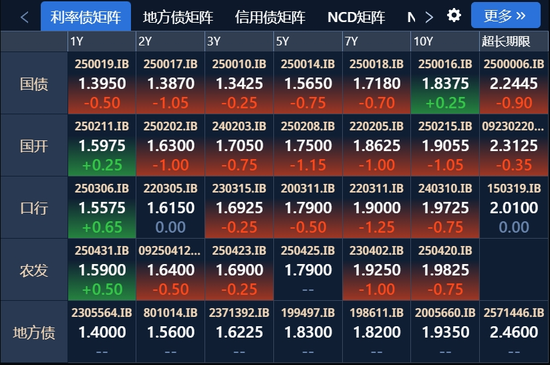
Core Viewpoint - The bond market has shown signs of recovery after a period of decline, with most bond yields experiencing slight decreases, indicating a potential stabilization in market sentiment [1][3][9]. Group 1: Market Performance - As of December 10, most bond varieties have shown an upward trend after several days of decline, with yields on government bonds from one year to ultra-long term decreasing by less than 1 basis point [1][9]. - The 30-year government bond yield had previously increased by 4 basis points on December 4, and the price of the 30-year government bond futures hit a yearly low of 111.69 yuan on December 8 [1][9]. - The 10-year government bond yield fluctuated around 1.84% after rising from 1.82% on December 1 to a peak of 1.86% on December 4 [1][9]. Group 2: Institutional Behavior - Market participants noted that the fluctuations in the 30-year government bond were primarily driven by differing behaviors among institutions and trading sentiment rather than fundamental changes [2][10]. - Traditional buyers such as banks and insurance companies have shown reduced buying power recently, contributing to the market's cooling [2][10]. - The anticipated implementation of new regulations for public funds has created uncertainty, affecting institutional behavior and leading to a decrease in demand for short-term bonds [2][10]. Group 3: Regulatory Impact - The new public fund sales regulations are expected to increase short-term redemption fees, which may negatively impact the liquidity management of institutions that typically use short-term bond funds [2][10]. - Concerns about the timing of the new regulations and their impact on market dynamics remain a significant focus for investors [11]. Group 4: ΔEVE Indicator - The ΔEVE indicator, which measures the economic value fluctuations of banks due to interest rate changes, is approaching regulatory limits for major banks, prompting them to adjust their bond holdings [12][13]. - As of the end of 2024, major state-owned banks have ΔEVE ratios exceeding 14%, nearing the 15% regulatory threshold [13]. - The ongoing issuance of long-term local government bonds is expected to maintain pressure on banks' ΔEVE ratios, influencing their investment strategies [12][13].
大行ΔEVE指标测算及承接债券能力评估
KAIYUAN SECURITIES· 2025-12-08 05:46
Investment Rating - The industry investment rating is optimistic (maintained) [1] Core Insights - The report indicates that the ΔEVE (Economic Value of Equity) indicator for major banks has decreased compared to 2024, with some banks potentially exceeding the regulatory requirement of -15% [4][15] - The report highlights that for every 20 trillion yuan of local government bonds undertaken by banks, the ΔEVE/ Tier 1 capital ratio deteriorates by 0.65% to 1.73% [24][25] - The current regulatory buffer allows major banks to undertake approximately 666.8 billion yuan of 30-year local government bonds [33][34] - The report suggests a potential relaxation of regulatory requirements for interest rate risk indicators, which could facilitate banks' ability to manage long-term local government bonds [7] Summary by Sections ΔEVE Indicator Assessment - As of H1 2025, the ΔEVE/ Tier 1 capital ratio for major banks is as follows: ICBC at -16.66%, CCB at -17.26%, ABC at -14.89%, BOC at -12.28%, PSBC at -9.02%, and BC at -12.46% [15][16] - The report notes a decline in the ΔEVE indicator for these banks compared to 2024, with specific changes of -1.95pct for ICBC and -2.52pct for CCB [4][15] Local Government Bond Undertaking - The report estimates that major banks added 3.25 trillion yuan in local government bonds in H1 2025, with state-owned banks accounting for 1.86 trillion yuan, representing 57.2% of the total [5][32] - The duration of local government bonds is assumed to be distributed across various terms, with 30% of bonds being 10 years and 23% being 30 years [25][29] Debt Capacity Assessment - The current regulatory buffer allows major banks to support the undertaking of 30-year local government bonds up to 666.8 billion yuan, with potential increases if regulatory requirements are relaxed [33][34] - For every 1% relaxation in the ΔEVE/ Tier 1 capital ratio, banks could undertake an additional 593.4 billion yuan of 30-year local government bonds [34][35] Investment Recommendations - The report recommends a bottom-line allocation to large state-owned banks, with specific beneficiaries being ABC and ICBC [39] - Core allocations should focus on leading comprehensive banks, with recommended stocks including CMB and CCB [39] - For flexible allocations, regional banks with unique characteristics, such as JSB and CQB, are highlighted as potential beneficiaries [39][40]





