
江阴银行

Search documents
银行业绩分化实录:“大象”转身慢,“小船”浪中驰
Xin Lang Cai Jing· 2025-09-15 22:41
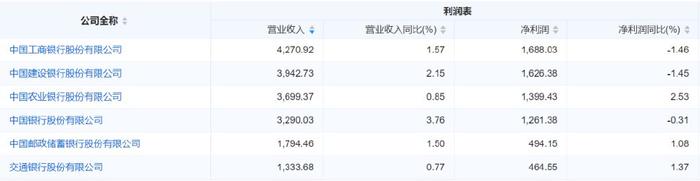
股份行分化较为明显。 营收方面,除了 浦发银行 、 民生银行 外,其余7家银行皆出现不同程度的下滑。同比降幅最高的是 平 安银行 ,达10.04%;其次为 华夏银行 ,同比降幅为5.86%。净利润方面,也有四家银行出现同比下 滑。如平安银行同比降幅为3.9%;民生银行同比降幅为5.43%,华夏银行同比降幅为7.64%。其中,民 生银行为"增收不增利", 招商银行 、 兴业银行 、 中信银行 等则为营收有所下滑,但利润保持增长。 | 公司全称 : | | 利润表 | | | | --- | --- | --- | --- | --- | | | 富亚收入 # | 营业收入园比(%) = | 净利润 > | 净利润可比(%) = | | 招商银行股份有限公司 | 1,699,69 | -1.72 | 754.05 | 0.03 | | 兴业银行股份有限公司 | 1,104,58 | -2.29 | 433.61 | 0.77 | | 中信银行股份有限公司 | 1,057,62 | -2.99 | 370.74 | 3.35 | | 上海浦东发展银行毅份有限公司 | 905.59 | 2.62 | 298.94 | ...

农商行板块9月15日跌1.26%,渝农商行领跌,主力资金净流入7545.27万元
Zheng Xing Xing Ye Ri Bao· 2025-09-15 08:43
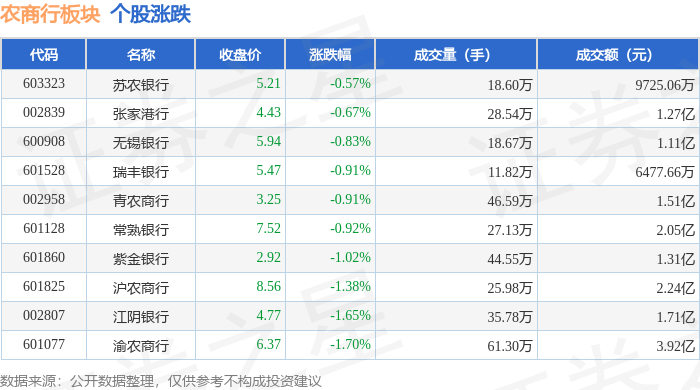
Core Viewpoint - The rural commercial bank sector experienced a decline of 1.26% on September 15, with Yunnan Rural Commercial Bank leading the drop. The Shanghai Composite Index closed at 3860.5, down 0.26%, while the Shenzhen Component Index rose by 0.63% to 13005.77 [1]. Group 1: Market Performance - The closing prices and changes for various rural commercial banks showed negative trends, with Yunnan Rural Commercial Bank down 1.70% to 6.37, and Jiangyin Bank down 1.65% to 4.77 [1]. - The trading volume for the rural commercial bank sector was significant, with total transaction amounts reaching hundreds of millions, such as Zhangjiagang Bank at 1.27 billion and Jiangyin Bank at 1.71 billion [1]. Group 2: Capital Flow - The rural commercial bank sector saw a net inflow of 75.45 million from main funds, while retail investors experienced a net outflow of 71.17 million [1]. - Specific banks like Yunnan Rural Commercial Bank had a main fund net inflow of 57.00 million, but retail investors withdrew 16.05 million [2].





江阴银行9项议案全部通过审议 6项议案遭到近10%投票反对
Xi Niu Cai Jing· 2025-09-13 14:05
Group 1 - Jiangyin Bank held its first extraordinary shareholders' meeting of 2025, where 9 proposals were reviewed, with 6 proposals facing over 9.6% opposition votes, a rare occurrence [2][3] - The meeting was chaired by Chairman Song Ping, attended by 6 directors, 2 supervisors, and 5 senior management personnel [3] - All 9 proposals were ultimately approved, but the proposals that faced significant opposition included revisions to various governance rules and management measures [3] Group 2 - As of June 30, 2025, the top ten shareholders of Jiangyin Bank and their respective shareholding percentages are as follows: Jiangsu Jiangnan Water Co., Ltd. (5.76%), Hong Kong Central Clearing Limited (4.17%), Jiangyin Xinjinnan Investment Development Co., Ltd. (3.69%), Jiangyin Development Zone Shengan Park Investment Co., Ltd. (3.61%), Jiangyin New Guolian Power Development Co., Ltd. (3.01%), Jiangyin Changjiang Investment Group Co., Ltd. (2.57%), Jiangyin Aiyisi Tuanrong Wool Spinning Co., Ltd. (2.51%), Huatai-PB Index Reducing Volatility ETF (2.22%), Jiangyin Meilun Yarn Industry Co., Ltd. (1.75%), and Jiangyin New Guolian Group Co., Ltd. (1.61%) [4] - The bank has a dispersed shareholding structure, lacking a controlling shareholder or actual controller, with the top ten shareholders primarily consisting of local enterprises from Jiangsu [3]


农商行板块9月12日跌1.2%,渝农商行领跌,主力资金净流出1.18亿元
Zheng Xing Xing Ye Ri Bao· 2025-09-12 08:38
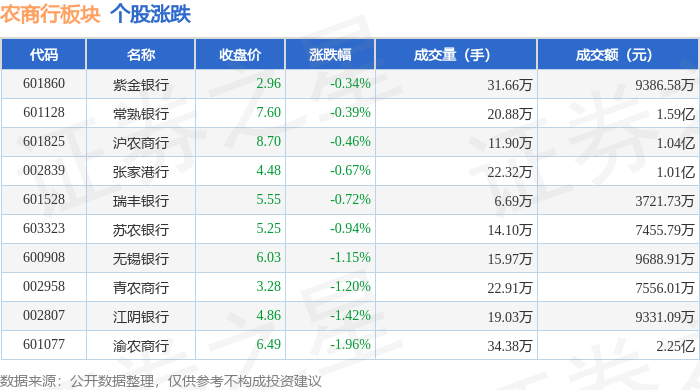
Core Points - The rural commercial bank sector experienced a decline of 1.2% on September 12, with Yunnan Rural Commercial Bank leading the drop [1] - The Shanghai Composite Index closed at 3883.69, up 0.22%, while the Shenzhen Component Index closed at 12996.38, up 0.13% [1] Stock Performance - The closing prices and changes for key rural commercial banks are as follows: - Zijin Bank: 2.96, -0.34% - Changshu Bank: 7.60, -0.39% - Shanghai Rural Commercial Bank: 8.70, -0.46% - Zhangjiagang Bank: 4.48, -0.67% - Ruifeng Bank: 5.55, -0.72% - Sunong Bank: 5.25, -0.94% - Wuxi Bank: 6.03, -1.15% - Qingnong Bank: 3.28, -1.20% - Jiangyin Bank: 4.86, -1.42% - Yunnan Rural Commercial Bank: 6.49, -1.96% [1] Capital Flow - The rural commercial bank sector saw a net outflow of 118 million yuan from main funds, while retail investors contributed a net inflow of 108 million yuan [1] - Detailed capital flow for individual banks shows: - Ruifeng Bank: Main funds -189.46 thousand, Retail funds +66.01 thousand - Shanghai Rural Commercial Bank: Main funds -543.89 thousand, Retail funds +117.60 thousand - Zijin Bank: Main funds -740.49 thousand, Retail funds +762.08 thousand - Wuxi Bank: Main funds -831.59 thousand, Retail funds +881.56 thousand - Zhangjiagang Bank: Main funds -1087.07 thousand, Retail funds +1526.36 thousand - Qingnong Bank: Main funds -1198.02 thousand, Retail funds +899.30 thousand - Sunong Bank: Main funds -1200.33 thousand, Retail funds +764.96 thousand - Jiangyin Bank: Main funds -1627.70 thousand, Retail funds +850.10 thousand - Changshu Bank: Main funds -1722.64 thousand, Retail funds +2455.71 thousand - Yunnan Rural Commercial Bank: Main funds -2678.88 thousand, Retail funds +2524.52 thousand [2]


普惠金融“期中考“交卷:农行四项指标居首 中小行份额继续下降
2 1 Shi Ji Jing Ji Bao Dao· 2025-09-11 13:01
Core Insights - The share of inclusive finance business by large commercial banks continues to increase, while the market share of rural financial institutions is declining [1][2] - The transition of inclusive finance development in China is moving from "incremental expansion" to "high-quality development" [2][3] Summary by Sections Inclusive Finance Market Share - As of the end of Q2 2024, large commercial banks' inclusive micro-enterprise loans accounted for 45.11% of the total, while rural financial institutions' share dropped to 25.86% from 27.38% in Q1 2023 [1] - The average growth rate of inclusive micro-enterprise loans has been slowing down, with growth rates of 30.9%, 24.9%, 23.6%, 23.3%, and 14.7% from 2020 to 2024 respectively [1] Regulatory Changes - Recent regulatory documents emphasize the shift towards high-quality development, moving away from rigid quantity targets [2][3] - The 2023 and 2024 notifications from the financial regulatory authority focus on maintaining volume, stabilizing prices, and improving structure, with an added emphasis on quality in 2025 [2] Performance of Major Banks - Agricultural Bank of China leads in inclusive micro-enterprise loans with a balance of 3.82 trillion yuan, followed closely by China Construction Bank at 3.74 trillion yuan [4] - Agricultural Bank's loan balance growth rate is the highest among major banks at 18.50%, with other banks like Industrial and Commercial Bank of China and China Bank also showing strong growth [4][5] Client Base and Service Innovations - Agricultural Bank has the largest number of clients for inclusive micro-enterprise loans at 5.2084 million, reflecting a significant increase [5] - The bank is innovating its service offerings by leveraging AI technology and enhancing its online service platforms [6] Focus on Asset Quality - Many banks are prioritizing the improvement of asset quality for inclusive micro-loans, with specific strategies tailored to their client bases [8][9] - Agricultural Bank reported that its non-performing loan rates for inclusive loans are among the best in the industry, indicating effective risk management practices [11]

息差下滑趋势出现分化 零售不良走高再引关注
Jin Rong Shi Bao· 2025-09-11 03:21
Core Viewpoint - The performance of A-share listed rural commercial banks in the first half of 2025 shows overall profit growth despite a declining net interest margin, with asset quality improving amidst increasing uncertainties [1][9]. Group 1: Financial Performance - All 10 A-share listed rural commercial banks reported year-on-year growth in net profit for the first half of 2025, despite a general decline in net interest margins [1]. - Jiangyin Rural Commercial Bank led the growth with a revenue of 2.401 billion yuan and a net profit of 846 million yuan, representing increases of 10.45% and 16.63% respectively [2]. - Changshu Rural Commercial Bank achieved revenue and net profit growth rates of 10.1% and 13.51%, maintaining a relatively high net interest margin of 2.58% [2]. Group 2: Net Interest Margin Trends - The net interest margin for several banks has shown a slowing decline, with some banks like Ruifeng Rural Commercial Bank experiencing a minimal drop of only 0.08 percentage points [4]. - Chongqing Rural Commercial Bank had the smallest decline in net interest margin, reducing by just 0.03 percentage points, while still achieving a 5.98% increase in interest income [4]. - However, banks like Zhangjiagang and Suzhou Rural Commercial Banks faced larger declines in net interest margins, with drops of 0.19 and 0.16 percentage points respectively [5]. Group 3: Asset Quality Improvement - The non-performing loan (NPL) ratio for rural commercial banks improved overall, with the average NPL ratio at 2.77%, a decrease of 0.03 percentage points from the end of 2024 [9]. - Qingdao Rural Commercial Bank showed the most significant improvement, with its NPL ratio decreasing by 0.04 percentage points to 1.75% [10]. - Despite improvements, challenges remain in retail loan quality, with some banks experiencing rising NPL ratios in specific sectors [11]. Group 4: Strategic Adjustments - Banks are adjusting their business structures and pricing strategies to mitigate the impact of declining net interest margins, with Chongqing Rural Commercial Bank effectively managing interest costs [6][7]. - The focus on enhancing non-interest income has been a key strategy, with banks like Changshu Rural Commercial Bank integrating financial and non-financial services to strengthen their competitive edge [7]. - Digital tools and data analytics are being utilized by banks to enhance customer targeting and service delivery, particularly in small and micro-business financing [12][13].


量化点评报告:行业ETF轮动模型2025年超额9.3%
GOLDEN SUN SECURITIES· 2025-09-10 11:07
Quantitative Models and Construction Methods 1. Model Name: Industry Mainline Model (Relative Strength Index, RSI) - **Model Construction Idea**: The model identifies leading industries by calculating their relative strength (RS) and uses a threshold (RS > 90%) to signal potential outperforming sectors for the year [13] - **Model Construction Process**: 1. Use 29 first-level industry indices as the configuration targets [13] 2. Calculate the price change rates over the past 20, 40, and 60 trading days for each industry, and rank them cross-sectionally [13] 3. Normalize the rankings to obtain RS_20, RS_40, and RS_60 [13] 4. Compute the average of the three normalized rankings to derive the final RS index: $ RS = (RS_{20} + RS_{40} + RS_{60}) / 3 $ where RS_20, RS_40, and RS_60 represent the normalized rankings for 20, 40, and 60-day returns, respectively [13] 5. Industries with RS > 90% before the end of April are considered likely to lead the market for the year [13] - **Model Evaluation**: The model successfully identified key themes such as high dividends, resource products, overseas markets, and AI in 2024, which aligned with market trends during the year [13] 2. Model Name: Industry Rotation Model (Prosperity-Trend-Crowdedness Framework) - **Model Construction Idea**: This framework combines three dimensions—industry prosperity, trend strength, and crowdedness—to optimize sector allocation [2][6] - **Model Construction Process**: 1. **Prosperity Model**: Focuses on high prosperity and strong trends while avoiding highly crowded sectors [17] 2. **Trend Model**: Prioritizes strong trends and low crowdedness while avoiding low-prosperity sectors [17] 3. Combine the two models to form a comprehensive allocation strategy [17] - **Model Evaluation**: The combined framework adapts well to different market conditions, with strong historical performance metrics [17] 3. Model Name: Left-Side Inventory Reversal Model - **Model Construction Idea**: This model identifies industries in a turnaround phase by analyzing sectors with low inventory pressure and high analyst optimism, aiming to capture rebound opportunities during restocking cycles [26] - **Model Construction Process**: 1. Identify sectors currently or historically in distress but showing signs of recovery [26] 2. Focus on industries with low inventory pressure and favorable restocking conditions [26] 3. Incorporate analyst views to select sectors with long-term growth potential [26] - **Model Evaluation**: The model complements right-side models by targeting contrarian opportunities, achieving strong absolute and relative returns in recent years [26] --- Model Backtesting Results 1. Industry Mainline Model (RSI) - **Annualized Excess Return**: Not explicitly provided, but the model identified leading sectors with significant subsequent outperformance (e.g., banking: +32.1% absolute return after signal) [14][16] - **Information Ratio (IR)**: Not explicitly provided [13][14] - **Maximum Drawdown**: Not explicitly provided [13][14] - **Monthly Win Rate**: Not explicitly provided [13][14] 2. Industry Rotation Model (Prosperity-Trend-Crowdedness Framework) - **Annualized Excess Return**: +14.0% relative to Wind All-A Index [17] - **Information Ratio (IR)**: 1.52 [17] - **Maximum Drawdown**: -8.0% [17] - **Monthly Win Rate**: 68% [17] 3. Left-Side Inventory Reversal Model - **Annualized Excess Return**: +14.8% relative to equal-weighted industry benchmark in 2024; +5.8% in 2025 YTD [26] - **Information Ratio (IR)**: Not explicitly provided [26] - **Maximum Drawdown**: Not explicitly provided [26] - **Monthly Win Rate**: Not explicitly provided [26] --- Quantitative Factors and Construction Methods 1. Factor Name: Prosperity Factor - **Factor Construction Idea**: Measures industry prosperity based on macro and micro indicators to identify high-growth sectors [17] - **Factor Construction Process**: 1. Aggregate macroeconomic and industry-specific indicators to assess prosperity levels [17] 2. Rank industries based on prosperity scores and select top-performing sectors [17] - **Factor Evaluation**: The factor effectively captures growth opportunities, contributing to the overall model's success [17] 2. Factor Name: Trend Factor - **Factor Construction Idea**: Captures momentum by identifying industries with strong upward trends [17] - **Factor Construction Process**: 1. Analyze price trends and volume data to assess momentum strength [17] 2. Rank industries based on trend scores and prioritize those with strong momentum [17] - **Factor Evaluation**: The factor enhances the model's ability to align with prevailing market trends [17] 3. Factor Name: Crowdedness Factor - **Factor Construction Idea**: Measures the level of investor positioning in industries to avoid overcrowded trades [17] - **Factor Construction Process**: 1. Use metrics such as fund flows and trading volumes to assess crowdedness [17] 2. Avoid industries with high crowdedness scores to mitigate risk [17] - **Factor Evaluation**: The factor provides a risk-control mechanism, improving the model's robustness [17] --- Factor Backtesting Results 1. Prosperity Factor - **Annualized Excess Return**: Not explicitly provided [17] - **Information Ratio (IR)**: Not explicitly provided [17] - **Maximum Drawdown**: Not explicitly provided [17] - **Monthly Win Rate**: Not explicitly provided [17] 2. Trend Factor - **Annualized Excess Return**: Not explicitly provided [17] - **Information Ratio (IR)**: Not explicitly provided [17] - **Maximum Drawdown**: Not explicitly provided [17] - **Monthly Win Rate**: Not explicitly provided [17] 3. Crowdedness Factor - **Annualized Excess Return**: Not explicitly provided [17] - **Information Ratio (IR)**: Not explicitly provided [17] - **Maximum Drawdown**: Not explicitly provided [17] - **Monthly Win Rate**: Not explicitly provided [17]
农商行板块9月10日涨0.58%,渝农商行领涨,主力资金净流出3471.47万元
Zheng Xing Xing Ye Ri Bao· 2025-09-10 08:37
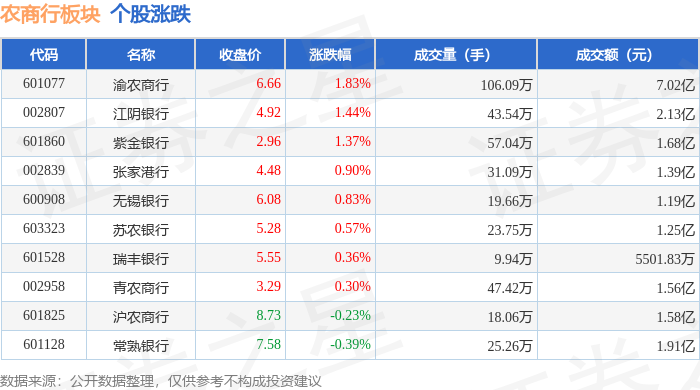
Core Insights - The agricultural commercial bank sector experienced a rise of 0.58% on September 10, with Yunnan Agricultural Commercial Bank leading the gains [1] - The Shanghai Composite Index closed at 3812.22, up 0.13%, while the Shenzhen Component Index closed at 12557.68, up 0.38% [1] Stock Performance - Yunnan Agricultural Commercial Bank (601077) closed at 6.66, with an increase of 1.83% and a trading volume of 1.061 million shares, amounting to 702 million yuan [1] - Jiangyin Bank (002807) closed at 4.92, up 1.44%, with a trading volume of 435,400 shares and a turnover of 213 million yuan [1] - Zijin Bank (601860) closed at 2.96, up 1.37%, with a trading volume of 570,400 shares and a turnover of 168 million yuan [1] - Other notable performances include Zhangjiagang Bank (002839) at 4.48 (+0.90%), and Wuxi Bank (600908) at 6.08 (+0.83%) [1] Capital Flow - The agricultural commercial bank sector saw a net outflow of 34.71 million yuan from institutional investors, while retail investors contributed a net inflow of 51.18 million yuan [1] - The detailed capital flow for individual stocks indicates that Changshu Bank (601128) had a net inflow of 20.62 million yuan from institutional investors, while it faced a net outflow of 15.01 million yuan from retail investors [2] - Yunnan Agricultural Commercial Bank (601077) experienced a significant net outflow of 42.29 million yuan from institutional investors, despite a retail net inflow of 36.90 million yuan [2]
江阴银行股东大会现“插曲”:6项与股东利益相关议案遭超9.6%反对票
Sou Hu Cai Jing· 2025-09-08 14:07
分析人士指出,6项议案反对票比例接近,可能表明反对意见来自同一群体股东。这种集中表达反对意见的情况,在上市银行股东大会中较为罕见。相比之 下,前三项议案虽然也涉及股东利益,但未出现大比例反对票,进一步凸显了后6项议案的特殊性。 江阴银行股权结构呈现分散特征,第一大股东江苏江南水务股份有限公司持股比例仅为5.76%,前十大股东中持股比例最低者仅为1.61%。这种股权分布特 点导致股东参与公司治理的积极性不高。数据显示,本次股东大会共有288名股东及授权代表出席,代表有表决权股份679,042,290股,占股权登记日股份总 数的27.5877%。 上市银行股东大会上出现大比例反对票的情况并不多见,但江阴银行近期召开的临时股东大会却打破了这一惯例。在审议的9项议案中,前3项以超过99%的 同意票顺利通过,而后6项涉及公司治理规则修订的议案却遭遇了超过9.6%的反对票,这一现象引发了市场关注。 9月5日,江阴银行2025年第一次临时股东大会如期举行。会议审议的议案涵盖中期分红安排、监事会调整、公司章程修订等多个方面。其中,《关于2025年 中期分红安排的议案》《关于不再设立监事会相关事项的议案》《关于修订〈公司章程〉 ...
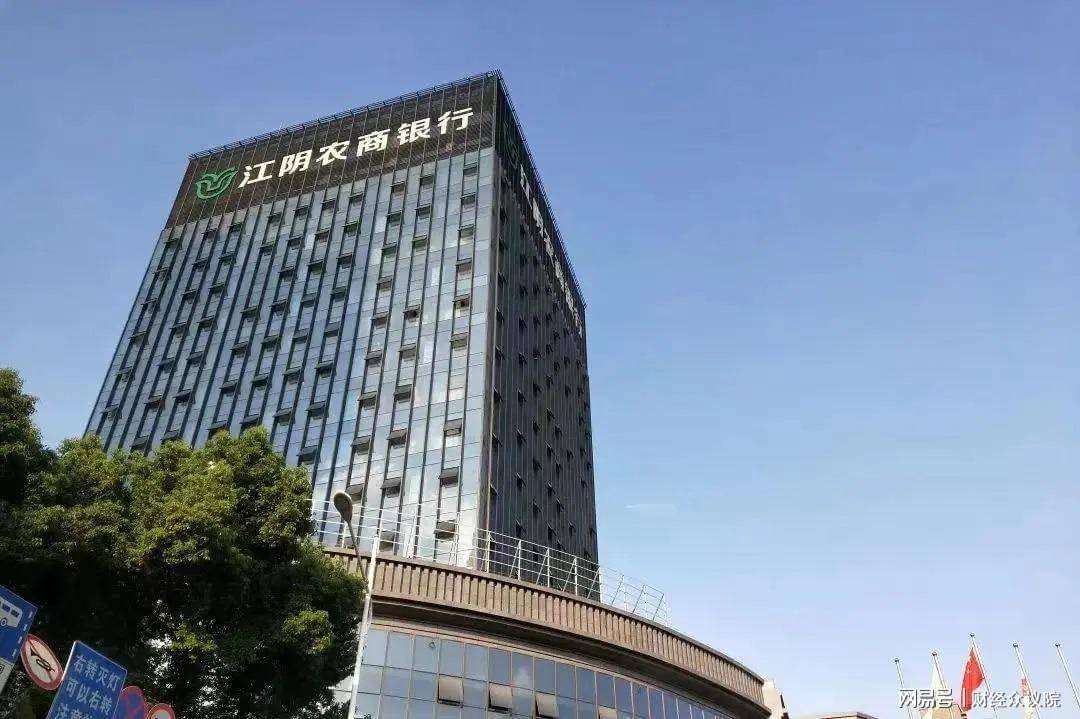
江阴银行股东大会现争议,6项议案均遭遇近一成股东反对
Xin Lang Cai Jing· 2025-09-08 13:35
江阴银行的一场股东大会引起市场关注。近日,江阴银行2025年第一次临时股东大会上审议了9项议 案,值得注意的是,其中有6项议案遭到了近10%股东反对。 本次会议由江阴银行董事长宋萍主持,共计6名董事,2名监事,以及5名高级管理人员出席和列席会 议。 8月16日,江阴银行披露2025年半年度报告。2025年上半年,公司实现营业总收入24.01亿元,同比增长 10.45%;归母净利润8.46亿元,同比增长16.63%;扣非净利润8.27亿元,同比增长21.26%;经营活动产 生的现金流量净额为-58.5亿元,上年同期为-8.11亿元;报告期内,江阴银行基本每股收益为0.3437元, 加权平均净资产收益率为4.49%。 半年报显示,江阴银行总资产2075.77亿元,而金融投资资产650.33亿元,占比高达31.32%。其中,交 易性金融资产、债权投资、其他债权投资等三大科目均包括了政府债券、金融债券、企业债、同业存单 等品种的投资。 责任编辑:曹睿潼 虽然9项议案全部通过,但第四项至第九项议案这6项议案,均遭遇了超过9.6%以上的反对票。其中包 括了《关于修订〈股东会议事规则〉的议案》、《关于修订〈董事会议事规则〉 ...