ByteDance

Search documents
Oracle (NYSE:ORCL) 2025 Conference Transcript
2025-10-15 17:17
Summary of Oracle's 2025 Conference Call Company Overview - **Company**: Oracle Corporation (NYSE: ORCL) - **Event**: 2025 Conference held on October 15, 2025 Key Points Discussed Oracle Cloud Infrastructure (OCI) - OCI aims to be the highest performance, lowest cost, and most secure cloud infrastructure possible, focusing on absolute excellence rather than just outperforming competitors [5][6][25] - The design of OCI emphasizes bare metal servers for enhanced security and extensibility, allowing customers complete control over their machines [11][12][14] - OCI's architecture is built to be resilient and extensible, anticipating future improvements across hardware and software layers [9][10] Infrastructure and Performance - Oracle has made significant investments in network architecture, including dedicated network fabrics and disintermediation to reduce latency and improve performance [61][66] - The introduction of Acceleron, a project aimed at enhancing performance, efficiency, and security, was announced, which includes new capabilities for input/output acceleration [58][59][78] - OCI provides a simple pricing model with consistent costs across regions, eliminating complex pricing structures that confuse customers [18][19] Customer Partnerships - **TikTok**: - TikTok has over 1 billion users globally, with significant infrastructure demands translating to millions of servers and zettabyte-scale storage [32][33] - The partnership with Oracle has allowed TikTok to scale its infrastructure rapidly, achieving a 60% increase in monthly active users since 2021 [39][43] - TikTok's unique shopping experiences, such as live streams, have driven infrastructure needs, requiring smart load balancing and proactive capacity planning [44][46] - **OpenAI**: - OpenAI's infrastructure needs have grown significantly, with a focus on industrializing compute to maximize efficiency and capacity [80][85] - The collaboration with Oracle has enabled OpenAI to scale its operations rapidly, addressing compute constraints effectively [88][96] - OpenAI's growth has been supported by Oracle's ability to provide flexible and secure infrastructure solutions across various global markets [99][100] Future Directions - Oracle is committed to continuous improvement of OCI, focusing on enhancing user experience, stability, and operational efficiency [50][51][54] - The company is exploring new technologies and partnerships to further expand its capabilities in AI and cloud services, ensuring it remains competitive in the evolving market [92][98] Additional Insights - The emphasis on user experience metrics at TikTok highlights the importance of infrastructure stability and performance in maintaining user engagement [49][50] - Oracle's approach to security, including Zero Trust Packet Routing and multi-planar networks, reflects a commitment to safeguarding customer data while enhancing performance [71][75] This summary encapsulates the core discussions and strategic directions presented during Oracle's 2025 Conference, highlighting the company's focus on cloud infrastructure, customer partnerships, and future growth initiatives.

Global Economic Snapshot: Trade Tensions, Inflation Outlook, and Strategic Resource Shifts
Stock Market News· 2025-10-15 17:09
Group 1: Stellantis and Canadian Backlash - Stellantis N.V. is facing significant opposition from Canada due to its decision to shift Jeep Compass production from Brampton, Ontario, to Illinois, threatening approximately 3,000 jobs [2][6] - Canadian Prime Minister Mark Carney stated that the production move is a "direct consequence" of existing U.S. tariffs, impacting the auto sector until a new North American trade agreement is reached [2][6] - Ontario Premier Doug Ford expressed disappointment and confirmed that no provincial funding would be allocated to Stellantis until assurances regarding the Brampton plant's future operations are provided [2] Group 2: Federal Reserve Insights - Federal Reserve Governor Stephen Miran projects a "material decline" in services inflation in the coming quarters, primarily driven by easing housing costs [3][6] - Miran believes that two more interest rate cuts this year are "realistic" and emphasized the urgency of reaching a neutral interest rate quickly, estimating it at approximately 0.5% [3][6] - Miran dissented at the recent FOMC meeting, advocating for a larger 50 basis point rate cut instead of the adopted 25 basis point reduction [3] Group 3: Oracle and TikTok - A ByteDance executive acknowledged Oracle's "vital role" in TikTok's expansion, with Oracle leading a proposed deal to control approximately 80% of TikTok's U.S. business [4][6] - The arrangement aims to address U.S. national security concerns regarding potential Chinese government access to user data [4][6] - Under the proposed deal, Oracle would manage and safeguard U.S. user data under its existing "Project Texas" initiative [4] Group 4: Prologis Market Activity - Prologis Inc. CEO Hamid R. Moghadam announced discussions for nearly 30 million square feet of new deals, following a strong third quarter with record lease signings totaling 62 million square feet [5][6] - The company reported a period-end occupancy rate of 95.3% and is expanding its strategic focus into data centers [5] Group 5: Turkey's Rare Earth Element Development - Turkey is in advanced talks with the United States to jointly develop its substantial rare earth reserves in Beylikova, Eskişehir province, which are considered the world's second-largest after China's [8] - This strategic pivot towards the U.S. follows stalled negotiations with China and Russia over technology transfer demands [8] - Ankara is prioritizing local refining capacity and technology transfer in any new agreement [8] Group 6: Ukraine's Energy Needs - Ukraine is seeking U.S. gas supplies via Greece, with discussions between Ukrainian President Volodymyr Zelensky and Greek Prime Minister Kyriakos Mitsotakis [9] - Ukraine's state-owned Naftogaz reported recent Russian attacks on its gas production infrastructure, necessitating a need for at least 13.2 billion cubic meters in gas storage for the upcoming winter [9] - Greece aims to replace Russian gas imports with American LNG and facilitate its onward transmission to Ukraine through the North-South corridor [9]




Broadcom Stock Investors Just Got Good News From OpenAI -- Is Nvidia Losing Its Edge in AI Chips?
The Motley Fool· 2025-10-15 08:15
Core Insights - Broadcom has entered a multiyear partnership with OpenAI to develop custom AI accelerators, enhancing its position in the AI market [1][4] - Broadcom is the second-largest supplier of AI accelerators, with a significant market share in Ethernet switching and high-end ASICs [1][6] - The partnership with OpenAI is expected to contribute to Broadcom's revenue growth, with projections of $60 billion to $90 billion by fiscal 2027 [2][7] Company Developments - Broadcom is currently building custom AI chips for three hyperscale companies, with an estimated annual revenue of $60 billion to $90 billion by fiscal 2027 [2] - A fourth significant customer has placed orders totaling $10 billion, speculated to be OpenAI [3] - The partnership will involve co-developing 10 gigawatts of custom AI accelerators, with deployment expected from the second half of 2026 through 2029 [4] Market Position and Projections - Broadcom's share of the AI accelerator market is projected to increase from 6% today to 14% by 2030, while Nvidia's share is expected to decrease from over 80% to 67% [6] - Broadcom is on track to earn $13 billion in custom AI accelerator revenue in fiscal 2025, with potential growth of 115% to 163% over the next two years [7] Valuation Concerns - Despite the growth potential, Broadcom's stock is trading at 91 times earnings, indicating a high valuation compared to its forecasted 30% annual earnings growth [8] - The price-to-earnings-to-growth (PEG) ratio exceeds 3, suggesting the stock may be overvalued [8] Competitive Landscape - Nvidia remains the dominant player in the AI accelerator market, with a lower total cost of ownership for its systems [10] - Broadcom collaborates with major companies like Google and Meta Platforms, but Nvidia's established ecosystem and R&D investment present significant competitive barriers [11][12]


OpenAI partners with Broadcom to build custom AI chips, adding to Nvidia and AMD deals
CNBC· 2025-10-13 13:04
Core Insights - OpenAI and Broadcom have officially announced a partnership to develop and deploy 10 gigawatts of custom AI accelerators, enhancing AI infrastructure across the industry [2][3] - Following the announcement, Broadcom's shares increased by over 10% in premarket trading [2] - OpenAI has been collaborating with Broadcom for 18 months, with plans to start deploying OpenAI-designed chips by late next year [3] Group 1: Partnership Details - The partnership aims to create a comprehensive system that includes networking, memory, and compute, all tailored for OpenAI's workloads [5] - OpenAI's strategy to design its own chips is expected to reduce compute costs and optimize infrastructure spending [5] - The estimated cost for a 1-gigawatt data center is around $50 billion, with $35 billion typically allocated for chips based on current Nvidia pricing [5] Group 2: Market Impact - Broadcom has significantly benefited from the generative AI boom, with its custom AI chips, referred to as XPUs, being in high demand from major tech companies [8] - Broadcom's stock has risen 40% this year, following a more than doubling in 2024, with its market capitalization exceeding $1.5 trillion [8] Group 3: Future Projections - OpenAI President Greg Brockman highlighted the use of AI models to enhance chip design efficiency, achieving significant area reductions [9] - Broadcom's CEO emphasized the necessity of advanced compute capacity for developing better frontier models and superintelligence [10] - OpenAI currently operates on just over 2 gigawatts of compute capacity, which has been sufficient for scaling ChatGPT and launching new services, but demand is rapidly increasing [11]

ByteDance's higher valuation reflects resilience amid upcoming US divestment of TikTok
Yahoo Finance· 2025-10-13 09:30
Core Insights - ByteDance has initiated a new round of employee share buy-backs, which is expected to enhance the company's valuation amid ongoing geopolitical uncertainties regarding TikTok's US operations [1][5]. Employee Share Buy-Back Program - The latest repurchase program priced vested restricted stock units (RSUs) at US$200.41 per share, reflecting a 5.5% increase from US$189.90 in the previous round held in April [2]. - For former employees, the repurchase price was set at US$180.37 per share, nearly 12% higher than the last round's US$161.42, narrowing the gap between current and former employees [3]. Valuation Insights - The new repurchase price indicates that ByteDance's management does not perceive the potential divestment of TikTok's US operations as significantly detrimental to the company's valuation, which is estimated at approximately US$330 billion [5]. - The share repurchase price may serve as a reference point for company valuation, although a comprehensive assessment is necessary to consider market conditions, profitability, and growth prospects [6]. Market Resilience - The modest increase in share price and valuation highlights ByteDance's resilience in the face of geopolitical tensions and market uncertainties, with the company's valuation peaking at around US$400 billion in 2021 before plans for an IPO were affected by deteriorating US-China relations [6][7].
2025年度最全面的AI报告:谁在赚钱,谁爱花钱,谁是草台班子
Hu Xiu· 2025-10-13 08:49
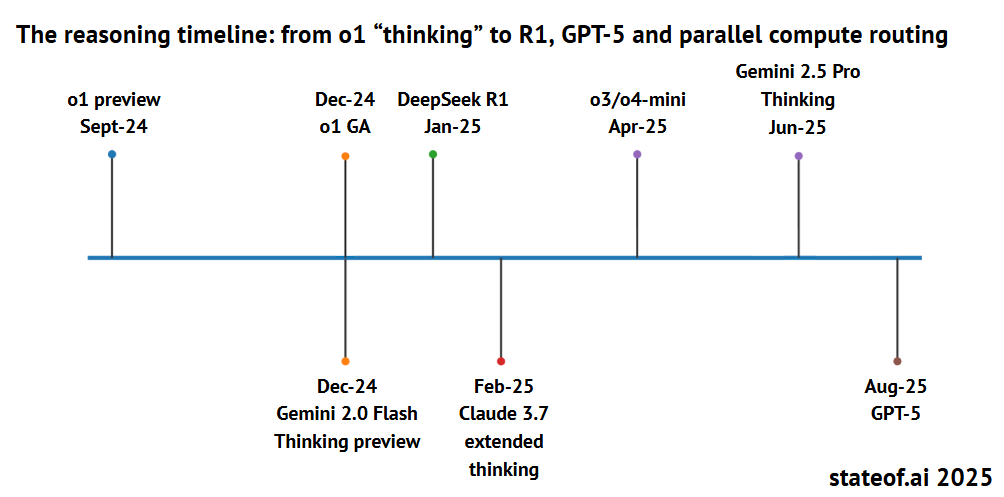
Core Insights - The AI industry is transitioning from hype to real business applications, marking a significant shift in its economic impact by 2025 [1][2] - AI is becoming a crucial driver of economic growth, with 16 leading AI-first companies achieving an annualized total revenue of $18.5 billion by August 2025 [2] - The 2025 "State of AI Report" by Nathan Benaich connects various developments in research, industry, politics, and security, illustrating AI's evolution into a transformative production system [3][5] Group 1: Industry Developments - 2025 is defined as the "Year of Reasoning," highlighting advancements in reasoning models like OpenAI's o1-preview and DeepSeek's R1-lite-preview [8][9] - Major companies are releasing reasoning-capable models, with OpenAI and DeepMind leading the rankings, although competition is intensifying [13][20] - The report indicates that traditional benchmark tests are becoming less reliable, with practical utility emerging as the new standard for measuring AI capabilities [25][28] Group 2: Financial Performance - AI-first companies are experiencing rapid revenue growth, with median annual recurring revenue (ARR) exceeding $2 million for enterprise applications and $4 million for consumer applications [57][60] - The growth rate of top AI companies from inception to achieving $5 million ARR is 1.5 times faster than traditional SaaS companies, with newer AI firms growing at an astonishing rate of 4.5 times [60][61] - The demand for paid AI solutions is surging, with adoption rates among U.S. enterprises rising from 5% in early 2023 to 43.8% by September 2025 [65] Group 3: Competitive Landscape - OpenAI remains a benchmark in the industry, but its competitive edge is narrowing as other models like DeepSeek and Qwen close the gap in reasoning and coding capabilities [20][30] - The report notes that the open-source ecosystem is shifting, with Chinese models like Qwen gaining significant traction over Meta's offerings [29][31] - The AI agent framework is diversifying, with numerous competing frameworks emerging, each carving out niches in various applications [36][37] Group 4: Future Predictions - The report forecasts that a real-time generated video game will become the most-watched game on Twitch, and AI agents will significantly impact online sales and advertising expenditures [97][99] - It predicts that a major AI lab will resume open-sourcing its cutting-edge models to gain governmental support, and a Chinese AI lab will surpass U.S. labs in a key ranking [99]
Z Event|ICCV 2025夏威夷AI之夜,黄昏晚宴报名中,顶级AI研究者们齐聚
Z Potentials· 2025-10-13 04:55
Core Insights - The event organized by Z Potentials aims to create a unique networking opportunity for AI researchers and entrepreneurs during ICCV, featuring discussions on cutting-edge large models and AI advancements [1][4][5]. Group 1: Event Details - The gathering will take place on October 20, from 17:30 to 20:00, in Honolulu, just a two-minute walk from the main ICCV venue [8]. - Participants include researchers from leading organizations such as OpenAI, DeepMind, Meta, NVIDIA, and ByteDance, as well as professors and PhD students from top universities [1][8]. - The event will feature Hawaiian cuisine, cocktails, and a relaxed atmosphere for academic discussions, encouraging attendees to bring their posters and papers for further dialogue [8]. Group 2: Target Audience - The event is tailored for researchers working on video, image, multimodal AI, and large language models who wish to engage with top-tier researchers [5]. - It provides a platform for discussions on training data, evaluation, and the practical application of vision models, as well as opportunities to connect with entrepreneurs and investors [5]. Group 3: Organizers and Support - Z Potentials is supported by Hat-Trick Capital, which focuses on early investments in AI and frontier technologies, and Abaka AI and 2077AI, which provide high-quality datasets and evaluation services for AI teams [4].


China's lesson for the US: it takes more than chips to win the AI race
Yahoo Finance· 2025-10-11 09:30
Core Insights - The AI competition between China and the US is increasingly characterized by "hyperscalers," the largest tech companies with extensive capabilities across the AI stack, with estimates suggesting over US$400 billion in collective spending on AI infrastructure this year [1][5][11] - The focus of the AI race has shifted from merely developing foundational models to encompassing hardware, algorithms, and applications, indicating a more comprehensive approach to AI development [3][19] - Alibaba aims to become the "world's leading full-stack AI service provider," with significant investments in AI infrastructure and a clear roadmap towards artificial superintelligence (ASI) [6][7][32] Investment and Market Dynamics - US and Chinese tech giants are making substantial investments in AI, with the US leading in foundational model development and China focusing on practical applications and integration with existing industries [8][19][27] - The spending disparity between US and Chinese firms is notable, with Alibaba's three-year spending pledge being less than what any of the top three US hyperscalers spend annually [14][24] - OpenAI's valuation has reached US$500 billion, while leading Chinese AI start-ups have significantly lower valuations, indicating a gap in perceived market value [15] Technological Advancements - China leads in industrial robot installations, with over 2 million active robots, and is rapidly advancing in the humanoid robot market [20][21] - The Chinese government is promoting "embodied intelligence" as a key future industry, with substantial funding directed towards robotics and AI integration in various sectors [21][22] - Chinese AI models are performing competitively on global leaderboards, particularly in image and video generation, often at lower training costs compared to US counterparts [26][28] Strategic Collaborations and Ecosystem Development - A self-sufficient AI ecosystem is emerging in China, with collaborations among local tech firms to reduce reliance on US technologies [29][30] - The US government is considering broader chip export controls to limit China's access to advanced technologies, which is seen as crucial for maintaining a competitive edge in AI [31] - Both countries are recognizing the importance of AI applications in hard technology, with US firms ramping up efforts in robotics and AI applications [22][30]

Nvidia Has A Problem In China. Meet The Chipmakers Vying To Replace The AI Titan In A Key Market.
Investors· 2025-10-10 12:01
Core Insights - Nvidia's CEO Jensen Huang expressed concerns about the competitive threat from China in the AI chip market, noting that Chinese companies are rapidly advancing and could challenge Nvidia's dominance [1][2] - The shift towards domestic alternatives in China is gaining momentum, as companies like iFlytek are training large language models on Huawei's chips, indicating a significant move away from reliance on Nvidia [2] - Nvidia's stock has experienced volatility due to various challenges, including export restrictions and competition from Chinese firms, despite being the first company to surpass a $4 trillion market value [3][5] Nvidia's Market Position - Nvidia is currently the world's most valuable company and leads in AI training GPUs, but faces increasing competition from Chinese companies pivoting to homegrown hardware [3] - The company reported zero sales from its H2O chip in China for the fiscal second quarter, and management did not include H20 sales in its third-quarter revenue outlook of $54 billion [4] Regulatory and Competitive Landscape - U.S. export restrictions have impacted Nvidia's ability to sell advanced chips in China, and Chinese regulators have cautioned local firms against purchasing Nvidia's products [8][10] - Chinese regulators are actively assessing local chipmakers' capabilities, with reports suggesting that domestic AI chips are now performing at levels comparable to Nvidia's offerings [13] Key Competitors in China - Huawei is identified as a major competitor, producing its own Ascend AI chips, but faces challenges in scaling production due to restrictions on advanced chipmaking tools [15][16] - Alibaba is developing new chips compatible with Nvidia's platform and is significantly increasing its AI infrastructure budget, indicating a strong push to compete in the AI space [19][20] - Other notable competitors include MetaX, which is preparing to mass-produce a chip to replace Nvidia's H20, and Cambricon, which has seen a surge in revenue due to demand for its AI processors [23][27] Future Outlook - Analysts suggest that while China's chipmakers may eventually close the gap with Nvidia, it is not expected to happen in the near term, as the country aims for AI sovereignty and increased domestic production [33][34]
China Tightens Checks On Chip Imports
Seeking Alpha· 2025-10-10 11:20
Economic Indicators - The U.S. Bureau of Labor Statistics is expected to release September's CPI data despite the government shutdown, as staff have been recalled to ensure the report is published [4] Electric Vehicle Industry - Ford has delayed its plans to purchase lithium from Liontown and has reversed its strategy regarding the now-expired EV tax credit [5] Semiconductor Industry - China is intensifying enforcement of import controls on semiconductors, particularly targeting Nvidia's AI chips, to reduce reliance on U.S. technology [6][7] - Customs inspections have expanded to include all advanced semiconductor products, with reports indicating that at least $1 billion worth of Nvidia's top AI chips were smuggled into China in the last three months [8] - In the U.S., bipartisan legislation has been passed requiring advanced AI chipmakers like Nvidia and AMD to prioritize American customers over Chinese buyers, although the future of this measure remains uncertain [9] Market Trends - Microsoft forecasts that data center demand is outpacing capacity [10] - Cannabis stocks have seen an increase following strong earnings from Tilray Brands [11] - Civitas Resources is considering a merger with SM Energy [11] Financial Markets - In Asia, markets showed mixed results with Japan down 1%, Hong Kong down 1.7%, and India up 0.4% [12] - In Europe, midday trading showed slight gains in London and Paris, while Frankfurt was down 0.2% [12] - Futures indicate a slight increase for the Dow and flat performance for S&P and Nasdaq [12]