沪农商行

Search documents
银基合作、生态共建,沪农商行投融资生态联盟启航
Zhong Guo Jin Rong Xin Xi Wang· 2025-11-25 08:05
Core Insights - Shanghai Rural Commercial Bank has launched the first Private Equity Fund Forum and established the "Investment and Financing Ecological Alliance" to enhance financial services for technology enterprises [1] - The "Investment and Financing Ecological Alliance" aims to create an open and integrated financial service ecosystem, breaking traditional banking service boundaries [1] - The bank has introduced the "Xinhuitou" comprehensive financial service plan for private equity institutions, covering the entire lifecycle of fundraising, investment, management, and exit [1] Group 1 - The "Investment and Financing Ecological Alliance" will leverage various resources to support the high-quality development of technology enterprises through comprehensive services such as policy interpretation and one-stop professional guidance [1] - The alliance will also create a rich rights system, including industry salons, investment roadshows, corporate visits, and exclusive training [1] - Shanghai Rural Commercial Bank has established deep cooperation with over 300 private equity funds and has conducted hundreds of matching activities to support technology enterprises [2] Group 2 - The bank successfully assisted AP Company in securing several million yuan in pre-A round financing by leveraging its private equity resources and professional services [2] - Looking ahead, Shanghai Rural Commercial Bank aims to deepen collaboration with private equity funds and continuously innovate comprehensive financial service plans for technology enterprises [2] - The bank's service philosophy focuses on enhancing technology innovation and integration with capital and industry to drive regional technological advancement and industrial upgrading [2]
曹中铭:银行股掀增持潮 估值空间还有多大?
Xin Lang Cai Jing· 2025-11-25 07:19
Core Viewpoint - The recent surge in bank stock purchases by major shareholders indicates strong confidence in the potential and long-term investment value of bank stocks, particularly among city commercial banks in China [1][2]. Group 1: Bank Stock Performance - Bank stocks have shown impressive performance, with a significant index increase from 2535.75 points on October 31, 2022, to a peak of 4632.44 points on July 11, 2023, marking a maximum increase of 82.69% [2]. - Agricultural Bank of China has been a standout performer, with its stock price rising from 2.07 yuan on October 31, 2022, to a high of 8.68 yuan by November 14, 2023, representing a growth of over 300% [2]. Group 2: Reasons for Shareholder Purchases - Major shareholders are increasing their stakes in bank stocks due to their attractive dividend yields, which are often higher than one-year deposit rates, making bank stocks a preferred investment over traditional savings [2]. - The strong dividend-paying capability of bank stocks, often referred to as "cash cows," is appealing to investors seeking cash returns, with many banks implementing annual and even mid-year dividends [3]. Group 3: Profitability and Valuation - The profitability of bank stocks is robust, as demonstrated by Agricultural Bank's non-GAAP net profit growth from 216.5 billion yuan in 2020 to an expected 281.6 billion yuan in 2024, indicating a consistent upward trend [3]. - The valuation of bank stocks is closely tied to their profitability; despite previous neglect by large funds, a re-evaluation of bank stocks is underway, transforming them from "market orphans" to desirable investments [4]. Group 4: Market Trends - The valuation of individual bank stocks is influenced not only by their earnings but also by overall market trends; in a bullish market, bank stock valuations tend to rise, while they may decline in a bearish market [4].

深耕缝隙市场场景金融激发银行普惠新动能
Zhong Guo Zheng Quan Bao· 2025-11-24 20:13
Core Insights - The latest data from the Financial Regulatory Bureau indicates that by the end of Q3, the balance of inclusive loans to small and micro enterprises reached 36.5 trillion yuan, a year-on-year increase of 12.1% [1] - Inclusive agricultural loans amounted to 14.1 trillion yuan, with an increase of 1.2 trillion yuan since the beginning of the year [1] - Institutions like Wuhan Zhongbang Bank and Beijing Rural Commercial Bank are leveraging digital empowerment and collaborative banking to effectively meet the financing needs of small and micro enterprises and agricultural entities [1] Group 1: Financial Inclusion and Digital Solutions - The challenge of reaching gap markets is addressed through digital means, with Wuhan Zhongbang Bank utilizing financial technology to create a credit system that converts tax and transaction data into lending power, thus solving information asymmetry [2] - The bank has achieved an agricultural loan balance of 6.359 billion yuan, with a growth rate exceeding the overall loan growth by 24.71 percentage points [2] - Shanghai Rural Commercial Bank has issued nearly 17 billion yuan in loans to support over 2,000 enterprises in parks and associations, focusing on providing warmer services to key customer groups [2] Group 2: Innovative Financing Models - Wuhan Zhongbang Bank has embedded financial services deeply into various stages of the industrial chain, issuing over 150 billion yuan in chain finance loans and serving nearly 500,000 small and micro clients [3] - A textile company in Hubei benefited from a warehouse receipt pledge loan, securing 7 million yuan in financing through a digital inventory system that enhances traceability [3] - The bank's innovative services are tailored to meet the specific needs of industries, providing efficient and reliable financing support [3] Group 3: Risk Management and Sustainable Development - The sustainable development of inclusive finance relies on a robust risk control system, with the banking sector's non-performing loan ratio at 1.52% and a provision coverage ratio of 207.15% as of Q3 [3] - Local banks are developing differentiated risk control models, with Beijing Rural Commercial Bank using a combination of regional recommendations and online verification to assess business authenticity [4] - Wuhan Zhongbang Bank has established a digital-native risk control system that integrates real-time data from core enterprises, logistics, contracts, and invoices for comprehensive online monitoring [4] Group 4: Localized Financial Services - Local banks are well-positioned to understand the economic and credit conditions of their communities, effectively reducing risks associated with information asymmetry [4] - The Financial Regulatory Bureau emphasizes the need for a multi-layered, widely covered, and sustainable inclusive financial institution system, urging local banks to focus on supporting agriculture and small enterprises [5] - There is a call for banks to adapt to changes in rural financial market demands and enhance support for key areas of rural revitalization and small micro-enterprises [5]
“顺风期”来了!11月6家银行被增持,机构看好配置时机
2 1 Shi Ji Jing Ji Bao Dao· 2025-11-24 13:11
Core Viewpoint - A new wave of shareholder buybacks has emerged among A-share listed banks since November 2025, indicating strong confidence in the banking sector's value and performance [1][3]. Group 1: Shareholder Actions - From November 1 to 24, six listed banks disclosed shareholder or executive buyback activities, with significant purchases from major shareholders in banks like Nanjing Bank and Chengdu Bank [3]. - Notably, Nanjing Bank's largest shareholder, BNP Paribas, increased its stake from 17.02% to 18.06% by acquiring approximately 128.23 million shares, marking its second large-scale buyback this year [6][7]. - Local state-owned enterprises are also actively investing in regional banks, as seen with Chengdu Bank's major shareholders increasing their holdings by 34.24 million shares at a cost of 611 million yuan [7]. Group 2: Market Performance - The banking sector has shown strong performance, with major banks like Bank of China and Industrial and Commercial Bank of China reaching historical highs in stock prices [3]. - Agricultural Bank of China has seen a year-to-date increase of nearly 60%, while several regional banks have also reported gains exceeding 20% [10]. - In November alone, the banking sector's cumulative increase was 2.78%, outperforming other industries, with some banks experiencing significant stock price increases [11]. Group 3: Financial Performance - The overall performance of listed banks has been resilient, with 35 out of 42 banks reporting year-on-year profit growth in the first three quarters of 2025 [9]. - The net interest margin for commercial banks stabilized at 1.42% in Q3 2025, with improvements noted particularly among joint-stock banks and city commercial banks [9]. - The financial stability and positive market actions have created a favorable environment for bank stocks, leading to a revaluation trend [9]. Group 4: Future Outlook - Multiple institutions believe that the banking sector is entering a favorable configuration window, with optimistic expectations for stock performance based on resilient fundamentals and valuation advantages [12]. - The demand for bank stocks is expected to rise due to their defensive attributes, attracting long-term capital from insurance funds and asset management companies [12][13]. - Analysts suggest that the investment logic for 2026 will focus on high dividend yields and defensive characteristics, while also considering the growth potential and long-term value of banks [13].

24家A股银行将现金分红超2600亿元
2 1 Shi Ji Jing Ji Bao Dao· 2025-11-24 12:56
Core Viewpoint - The recent surge in stock prices of major Chinese banks is driven by their mid-term dividend announcements, with a total cash dividend amounting to 2637.90 billion yuan for 2025, indicating significant investment potential in the banking sector [2][4]. Dividend Announcements - As of November 24, 2025, 24 A-share listed banks have disclosed their mid-term dividend plans, with a total cash dividend of 2638 billion yuan [4]. - Notably, seven banks, including Industrial Bank, Changsha Bank, and Ningbo Bank, are implementing mid-term dividends for the first time since their listings [2]. - The six major state-owned banks are expected to distribute over 2046 billion yuan in dividends [5]. Dividend Yield - The average dividend yield for listed banks as of November 24 is 4.48%, with 12 banks yielding over 5% and 26 banks exceeding 4% [6]. - Specific banks like Bank of Communications and China Construction Bank have dividend yields of 4.18% and 3.93%, respectively [6]. Shareholder and Executive Buybacks - There has been a notable increase in share buybacks by major shareholders and executives of listed banks, signaling positive market sentiment [8]. - For instance, Chengdu Bank's major shareholders have collectively bought approximately 34.25 million shares, investing 6.11 billion yuan from August 27 to November 21 [8]. - Nanjing Bank reported that foreign shareholder BNP Paribas increased its stake by over 128 million shares, raising its ownership to 18.06% [9]. Overall Market Sentiment - The banking sector has seen a net increase in holdings exceeding 9 billion yuan, with significant buybacks from shareholders and executives across multiple banks [10]. - The proactive buyback activities reflect confidence in the banks' future strategies and growth prospects, with the banking sector ranking second in shareholder buybacks this year, only behind the transportation sector [10].





太平人寿,一次落袋65亿
36氪· 2025-11-24 10:14
Core Viewpoint - China Taiping's subsidiary, Taiping Life, has sold equity stakes in four companies for 6.5 billion yuan, reflecting a strategic asset rotation amid a growing equity market for insurance capital [3][6][9]. Group 1: Asset Sale and Financial Impact - Taiping Life's sale of equity stakes will result in an influx of 6.5 billion yuan in cash, enhancing its liquidity for future investments [6][9]. - The investment in the four companies, made in December 2019, yielded a total return of approximately 2.35 billion yuan over nearly six years, indicating a successful exit strategy [9][10]. - The proceeds from the sale are intended for general operational funding, allowing for greater flexibility in future investments [11][12]. Group 2: Investment Performance and Strategy - In the first three quarters of 2025, Taiping Life reported a significant increase in investment income, totaling 16.71 billion yuan, up from 6.89 billion yuan in the same period the previous year, marking a 142.5% increase [13][14]. - The company has diversified its investments, appearing as a major shareholder in multiple stocks, with a focus on both traditional sectors and emerging technologies [14][15]. - The investment strategy has shifted from infrastructure-heavy allocations to a more balanced approach that includes equities, reflecting a response to changing market conditions and regulatory frameworks [28][29]. Group 3: Market Trends and Regulatory Environment - The insurance industry is experiencing a systemic trend towards increased equity market participation, driven by low interest rates and regulatory adjustments that allow for higher equity allocations [29][30]. - As of mid-2025, Taiping Life's equity investment weight was 13.6%, which is below the regulatory cap, indicating potential for further investment growth in equities [30][31]. - The shift in investment focus is seen as a rational response to market dynamics, aiming to enhance returns while managing risks effectively [28][29].



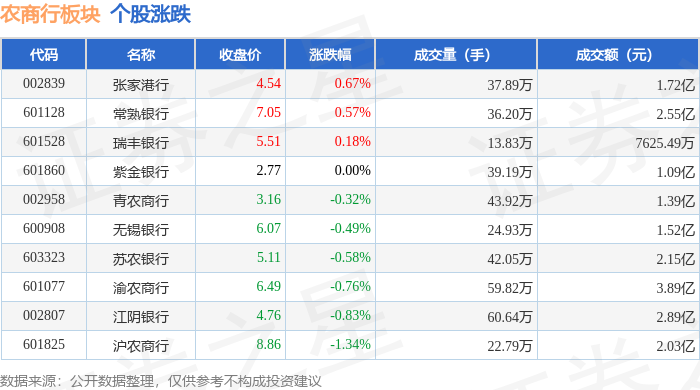
农商行板块11月24日跌0.65%,沪农商行领跌,主力资金净流入6415.83万元
Zheng Xing Xing Ye Ri Bao· 2025-11-24 09:12
Core Insights - The rural commercial bank sector experienced a decline of 0.65% on November 24, with Hu Nong Commercial Bank leading the drop [1] - The Shanghai Composite Index closed at 3836.77, up 0.05%, while the Shenzhen Component Index closed at 12585.08, up 0.37% [1] Stock Performance - Zhangjiagang Bank (002839) closed at 4.54, up 0.67% with a trading volume of 378,900 shares and a transaction value of 172 million [1] - Changshu Bank (601128) closed at 7.05, up 0.57% with a trading volume of 362,000 shares and a transaction value of 255 million [1] - Ruifeng Bank (601528) closed at 5.51, up 0.18% with a trading volume of 138,300 shares and a transaction value of 76.25 million [1] - Zijin Bank (601860) closed at 2.77, unchanged with a trading volume of 391,900 shares and a transaction value of 109 million [1] - Qingnong Commercial Bank (002958) closed at 3.16, down 0.32% with a trading volume of 439,200 shares and a transaction value of 139 million [1] - Wuxi Bank (600908) closed at 6.07, down 0.49% with a trading volume of 249,300 shares and a transaction value of 152 million [1] - Sunong Bank (603323) closed at 5.11, down 0.58% with a trading volume of 420,500 shares and a transaction value of 215 million [1] - Yunnan Rural Commercial Bank (601077) closed at 6.49, down 0.76% with a trading volume of 598,200 shares and a transaction value of 389 million [1] - Jiangyin Bank (002807) closed at 4.76, down 0.83% with a trading volume of 606,400 shares and a transaction value of 289 million [1] - Hu Nong Commercial Bank (601825) closed at 8.86, down 1.34% with a trading volume of 227,900 shares and a transaction value of 203 million [1] Capital Flow - The rural commercial bank sector saw a net inflow of 64.16 million from institutional investors, while retail investors experienced a net outflow of 32.24 million [1] - The capital flow for individual stocks shows that Changshu Bank had a net outflow of 43.91 million from institutional investors [2] - Su Nong Bank had a net inflow of 26.33 million from institutional investors, indicating a positive sentiment [2] - Wuxi Bank recorded a net inflow of 12.99 million from institutional investors, while retail investors had a significant outflow of 22.25 million [2] - Hu Nong Commercial Bank experienced a net outflow of 13.33 million from institutional investors, but a net inflow of 19.17 million from retail investors [2]



国有大行之后,城商行机会如何
2025-11-24 01:46
Summary of Conference Call Records Industry Overview - The banking sector is experiencing a rise in stock prices supported by multiple factors, including market fluctuations, ongoing capital allocation, stabilization of industry interest margins, and a decrease in non-performing loan rates, which provides a basis for industry value reassessment [1][4] Key Points and Arguments - **Valuation Perspective**: Domestic quality city commercial banks have significantly lower price-to-earnings (P/E) ratios compared to overseas quality regional banks and are undervalued compared to large domestic banks. There is a higher likelihood of outperforming large state-owned banks in the next three to five years [1][5] - **Risk Resilience**: Quality small banks in core cities exhibit stronger risk resilience than large commercial banks, with more stable profit growth during economic fluctuations and lower peak bad debt rates [1][6] - **Investment Trends**: Large insurance companies prefer investing in large-cap stocks like Agricultural Bank, while smaller insurance companies opt for small-cap stocks that match their capital size, such as quality city commercial banks [1][8] - **Mortgage Loan Subsidy Policy**: Market rumors about mortgage loan subsidies indicate that the government believes bank interest margins are near their bottom, which is significant for stabilizing market expectations. However, the actual impact depends on the policy's strength [1][9] - **Public Fund Strategies**: Public fund managers are expected to increase allocations to bank stocks, prioritizing quality city commercial banks, followed by joint-stock banks, and lastly large state-owned banks, indicating a shift in investment strategy [1][10] Additional Important Insights - **Market Performance**: Despite recent market volatility, bank stocks have performed relatively well, with state-owned banks showing strong performance over the past quarter [2] - **Investment Selection**: When selecting specific sub-industries for investment, considerations should include reasonable valuations and marginal changes. Quality city commercial banks are significantly undervalued compared to international standards [5] - **Economic Recovery Impact**: Historically, bank stocks perform well during economic recovery, but different types of banks show varying performance. Quality city commercial banks tend to outperform large state-owned banks in the long run [7] - **ETF Fund Flows**: Recent ETF fund flows indicate a clear sign of state support, with significant net inflows into major ETFs, while financial and real estate sectors are experiencing net outflows [14][15] Conclusion - The outlook for the banking sector remains optimistic, with expectations of substantial growth for quality city commercial banks over the next five years, despite short-term market fluctuations [13]
中信证券:年底步入长线资金配置时段 银行防御价值显著
Xin Lang Cai Jing· 2025-11-24 00:52
Core Viewpoint - The banking sector demonstrates significant defensive value amid market volatility, with low valuation large banks showing notable performance, suggesting a favorable environment for long-term institutional investment [1][4]. Market Performance - The A-share market experienced increased volatility, with major indices recording substantial declines, while the CITIC Bank Index only saw a minor drop of 0.9%, highlighting the defensive nature of the banking sector [1]. - The top-performing bank stocks included China Bank (+8.1%), Everbright Bank (+2.6%), and Construction Bank (+2.4%), indicating that low valuation large banks are performing particularly well [1]. Shareholder and Executive Activity - Nanjing Bank reported that its major shareholder, BNP Paribas, increased its stake by 1.04%, raising its total holding to 18.06%, a record high [2]. - Senior executives from Changshu Bank and Shanghai Rural Commercial Bank have also announced plans to purchase shares, indicating confidence in the bank's future performance [2]. Interest Rate and Loan Market - The People's Bank of China announced that the November Loan Prime Rate (LPR) remains unchanged at 3.0% for one year and 3.5% for five years, reflecting a stable interest rate environment [3]. - The average interest rates for various loans have shown minimal changes, suggesting a stabilization in the banking sector's interest margins [3]. Investment Outlook - The banking sector's defensive characteristics are expected to attract long-term capital allocation as the year-end approaches, providing opportunities for certain returns [4].

真金白银出手!上市银行,增持潮起
Zheng Quan Shi Bao· 2025-11-24 00:13
Core Viewpoint - Recent trends show a significant increase in share buybacks by major shareholders and executives in A-share listed banks, particularly among city commercial banks and rural commercial banks, indicating confidence in long-term growth prospects despite market volatility [1][2][4]. Group 1: Shareholder and Executive Buybacks - Multiple listed banks, including Nanjing Bank and Chengdu Bank, have reported substantial share buybacks by major shareholders, with Chengdu Bank's two major shareholders investing approximately 611 million yuan to acquire nearly 34.247 million shares [2][3]. - Nanjing Bank's largest shareholder, BNP Paribas, increased its stake by approximately 12.8 million shares, raising its total holding from 17.02% to 18.06%, marking a new high for the bank [3]. - Executives from banks like Changshu Bank and Shanghai Rural Commercial Bank have also engaged in share buybacks, demonstrating their confidence in the banks' future [4]. Group 2: Market Performance and Analyst Insights - The banking sector has shown resilience, with major banks like Bank of China and Industrial and Commercial Bank of China reaching historical highs, and Bank of China experiencing a 13.74% increase over the past month [1][6]. - Analysts suggest that the recent buybacks reflect a shift from defensive strategies to proactive market management, as banks are now buying back shares not just at low prices but also during periods of price recovery, driven by expectations of economic recovery and stable interest margins [5][7]. - Despite the recent gains, the overall valuation of bank stocks remains low, with most A-share listed banks trading below their net asset value, indicating potential for further investment opportunities [6]. Group 3: Future Investment Opportunities - Analysts from various firms have reiterated the investment potential in the banking sector, highlighting the attributes of high dividends and low valuations as key factors for future interest [7]. - There is an expectation that medium-sized insurance companies will increasingly seek long-term equity investments in smaller banks, particularly those with strong regional advantages and stable dividends [7]. - The shift in investment logic from "pro-cyclical" to "weak-cyclical" suggests that bank stocks may become more attractive during periods of economic stagnation due to their high dividend yields [7].