
国投电力

Search documents
国投电力(600886):雅砻江来水影响电量,火电成本下降改善利润
Shenwan Hongyuan Securities· 2025-10-31 07:12
Investment Rating - The report maintains a "Buy" rating for Guotou Electric Power (600886) [2] Core Views - The company reported a revenue of 40.572 billion yuan for the first three quarters of 2025, a year-on-year decrease of 8.61%, while the net profit attributable to shareholders was 6.517 billion yuan, down 0.92% year-on-year [7] - The hydropower generation from the Yalong River decreased year-on-year, but a low base is expected to help recover Q4 performance [7] - The company's thermal power generation faced pressure, but cost improvements have enhanced profitability [7] - Financial expenses have decreased due to a reduction in interest rates, positively impacting overall performance [7] - The company has a commitment to maintain a cash dividend ratio of no less than 55% of the annual net profit attributable to shareholders from 2025 to 2027 [7] Financial Data and Profit Forecast - Total revenue for 2025 is estimated at 55.182 billion yuan, with a year-on-year decline of 4.6% [6] - The net profit attributable to shareholders for 2025 is projected to be 7.201 billion yuan, reflecting an 8.4% year-on-year increase [6] - Earnings per share for 2025 is expected to be 0.90 yuan, with a projected PE ratio of 16 [6][8] - The company anticipates a gradual increase in installed capacity across water, thermal, wind, and solar energy during the 14th Five-Year Plan period [7]

长江电力的前世今生:营收657.41亿居行业榜首,净利润285.55亿远超同行,高分红凸显投资价值
Xin Lang Cai Jing· 2025-10-30 15:12
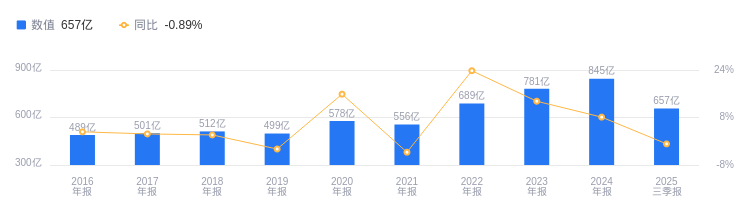
Core Viewpoint - Yangtze Power is the largest publicly listed hydropower company globally, with significant operational advantages and strong financial performance in the hydropower sector [1][2]. Group 1: Financial Performance - In Q3 2025, Yangtze Power achieved a revenue of 65.741 billion, ranking first among 11 companies in the industry, significantly exceeding the industry average of 13.524 billion and the median of 3.644 billion [2]. - The net profit for the same period was 28.555 billion, also leading the industry, with the average net profit at 5.366 billion and the median at 2.227 billion [2]. Group 2: Profitability and Debt Ratios - As of Q3 2025, Yangtze Power's asset-liability ratio was 59.04%, down from 61.04% year-on-year but still above the industry average of 46.38% [3]. - The gross profit margin for Q3 2025 was 62.48%, an increase from 61.19% year-on-year, and higher than the industry average of 47.16% [3]. Group 3: Management and Shareholder Information - The chairman, Liu Weiping, is also the chairman of the Three Gorges Group, while the general manager, Liu Haibo, received a salary of 1.149 million in 2024, an increase from 997,700 in 2023 [4]. - As of September 30, 2025, the number of A-share shareholders decreased by 1.95% to 601,600, while the average number of circulating A-shares held per account increased by 1.99% to 39,900 [5]. Group 4: Market Outlook and Ratings - Yangtze Power's electricity generation was impacted by water supply but remains optimistic for the full-year performance due to the onset of autumn floods [5]. - The company continues to emphasize high dividend commitments, reflecting its focus on shareholder returns, with projected EPS for 2025-2027 at 1.38, 1.45, and 1.47, corresponding to PE ratios of 20.06, 19.07, and 18.92 [5].

华能水电的前世今生:2025年三季度营收206.41亿行业第三,净利润81.58亿超行业均值
Xin Lang Cai Jing· 2025-10-30 14:15
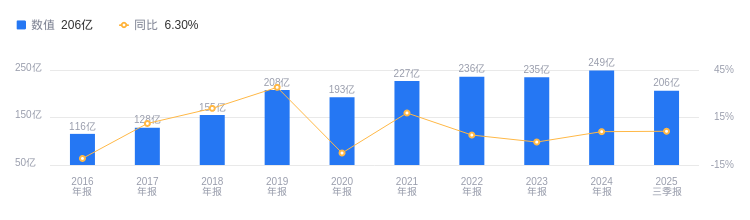
Core Viewpoint - Huaneng Hydropower is a leading clean power operator in the Lancang-Mekong subregion, focusing on hydropower generation with strong and sustainable profitability [1] Group 1: Business Performance - In Q3 2025, Huaneng Hydropower achieved a revenue of 20.641 billion yuan, ranking third among 11 companies in the industry [2] - The company's net profit for the same period was 8.158 billion yuan, also ranking third in the industry [2] - The main business composition includes hydropower generation at 11.912 billion yuan (91.92%), solar power at 0.847 billion yuan (6.53%), and wind power at 0.127 billion yuan (0.98%) [2] Group 2: Financial Ratios - As of Q3 2025, Huaneng Hydropower's debt-to-asset ratio was 61.28%, higher than the industry average of 46.38% [3] - The gross profit margin for the same period was 60.68%, exceeding the industry average of 47.16% [3] Group 3: Shareholder Information - As of September 30, 2025, the number of A-share shareholders increased by 2.87% to 98,600 [5] - The average number of circulating A-shares held per shareholder decreased by 2.79% to 182,600 [5] Group 4: Growth Prospects - Huaneng Hydropower's electricity generation increased by 11.90% year-on-year in the first three quarters, with a positive outlook for quarterly performance [5] - The company plans to expand its hydropower capacity through a joint venture with Huaneng International and has received approval for a targeted issuance [5] - Expected earnings per share (EPS) for 2025-2027 are projected to be 0.49 yuan, 0.53 yuan, and 0.55 yuan respectively [5] Group 5: Market Position - Huaneng Hydropower ranks third in the industry for both revenue and net profit, with the top two competitors being Yangtze Power and Guotou Power [2]

桂冠电力的前世今生:2025年三季度营收73.35亿元行业排第四,净利润27.66亿元位居第五
Xin Lang Cai Jing· 2025-10-30 13:25
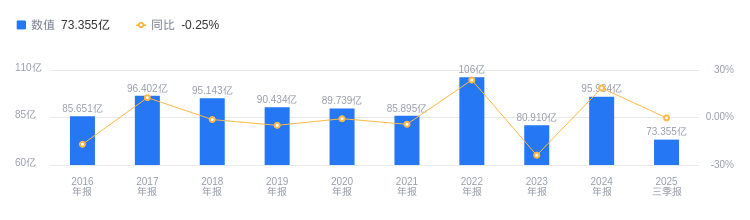
Core Viewpoint - Guiguan Electric Power, a major hydropower listed company in China, has shown strong revenue and profit performance but faces challenges in terms of debt levels and market conditions affecting its various energy segments [1][2][3]. Group 1: Company Overview - Guiguan Electric Power was established on September 4, 1992, and listed on the Shanghai Stock Exchange on March 23, 2000, with its headquarters in Guangxi [1]. - The company operates a complete power generation industry chain, focusing on hydropower, thermal power, wind power, and electricity sales [1]. Group 2: Financial Performance - For Q3 2025, Guiguan Electric Power reported revenue of 7.335 billion yuan, ranking 4th in the industry, with a net profit of 2.766 billion yuan, ranking 5th [2]. - The revenue breakdown shows hydropower contributing 3.018 billion yuan (72.65%), wind power 484 million yuan (11.65%), thermal power 392 million yuan (9.43%), solar power 196 million yuan (4.71%), and other segments 41.68 million yuan (1.00%) [2]. Group 3: Financial Ratios - As of Q3 2025, the company's debt-to-asset ratio was 55.24%, higher than the industry average of 46.38%, indicating increased debt pressure [3]. - The gross profit margin for Q3 2025 was 55.61%, surpassing the industry average of 47.16%, reflecting strong profitability [3]. Group 4: Shareholder Information - As of September 30, 2025, the number of A-share shareholders increased by 9.49% to 48,000, while the average number of shares held per shareholder decreased by 8.67% to 164,300 [5]. - Major shareholders include Hong Kong Central Clearing Limited and Dongfanghong Zhongzheng Dongfanghong Dividend Low Volatility Index A [5]. Group 5: Market Outlook - Analysts noted that the company experienced a decline in revenue and net profit in the first half of 2025 due to late water inflow affecting hydropower generation, but improvements are expected in Q3 2025 [6]. - The company has also added 276,400 kW of new energy capacity in the first half of 2025, although pricing pressures on wind and solar energy remain a concern [6].

国投电力2025年第三季度营收、净利双降
Zheng Quan Ri Bao Wang· 2025-10-30 12:47
Core Points - The company reported a decline in revenue and net profit for the first three quarters of 2025, with total revenue of 40.57 billion yuan, down 8.61% year-on-year, and net profit attributable to shareholders of 6.517 billion yuan, down 0.92% year-on-year [1] - In the third quarter alone, the company achieved revenue of 14.876 billion yuan, a decrease of 13.98% year-on-year, and net profit of 2.723 billion yuan, down 3.94% year-on-year [1] - The total power generation from July to September 2025 was 47.891 billion kWh, and the on-grid electricity volume was 46.808 billion kWh, both down 14.42% compared to the same period last year [1] - The average on-grid electricity price from July to September 2025 was 0.334 yuan/kWh, a decrease of 0.9% year-on-year [1] - For the first nine months of 2025, total power generation was 124.95 billion kWh, and on-grid electricity volume was 121.98 billion kWh, down 6.36% and 6.21% year-on-year, respectively [1] - The average on-grid electricity price for the first nine months was 0.346 yuan/kWh, down 3.9% year-on-year [1] Revenue and Profit Analysis - The decline in average on-grid electricity price is attributed to changes in electricity volume structure, a decrease in long-term trading prices for thermal power in some regions, and an increasing proportion of unsubsidized renewable energy projects [2]
公用事业行业央企ESG评价体系:绿色安全+能源转型是核心社会责任担当是基石:公用事业行业央企ESG评价体系
Shenwan Hongyuan Securities· 2025-10-30 11:23
Investment Rating - The report assigns a "Buy" rating for several key companies in the public utility sector, including China Resources Power, Guodian Power, and Inner Mongolia Huadian [28]. Core Insights - The public utility sector is crucial for achieving national "dual carbon" goals, with a strong emphasis on environmental and social issues in the ESG evaluation framework [5][4]. - The ESG evaluation system for public utilities includes four categories of positive indicators and one category of negative indicators, focusing on objective assessment metrics [8][23]. - Recent policies from various government departments emphasize the need for green transformation, pollution prevention, and social welfare in the public utility sector [5][4]. Summary by Sections 1. ESG Policy in Public Utilities - The public utility sector is a major contributor to energy consumption and carbon emissions, making its green transformation essential for national goals [5]. - Key policies include the "14th Five-Year" energy conservation and emission reduction plan, which outlines specific requirements for green transformation and public service stability [5][4]. 2. ESG Evaluation System Construction - The ESG evaluation system consists of four positive categories: General Indicators, Environmental Indicators, Social Indicators, and Governance Indicators, with a total of 18 primary indicators and 35 secondary indicators [8][23]. - The negative category focuses on violations and penalties, with specific metrics for environmental, social, and governance aspects [23]. 3. General Indicators - General indicators assess the authenticity and standardization of ESG reports, including the basis for report preparation, third-party verification, and the publication of ESG-specific reports [10][9]. 4. Environmental Indicators - Environmental indicators are based on energy conservation, low carbon, and circular economy principles, with a total of four primary indicators focusing on emissions management, ecological compliance, resource utilization, and climate strategy [11][12]. 5. Social Indicators - Social indicators highlight the public utility sector's role in community development and social stability, with six primary indicators covering community contributions, employee development, innovation, supply chain responsibility, product safety, and core operational responsibilities [15][16][17]. 6. Governance Indicators - Governance indicators aim to enhance corporate governance and decision-making, with five primary indicators focusing on party leadership, industry reform, compliance risk management, governance structure, and information transparency [19][20][21]. 7. Negative Indicators - The negative indicators focus on compliance issues, with penalties for violations in environmental, social, and governance areas, deducting points for each violation [23][25].





国投电力(600886) - 2025 Q3 - 季度财报
2025-10-30 10:40
Financial Performance - The company's operating revenue for the third quarter was approximately ¥14.88 billion, a decrease of 13.98% compared to the same period last year[4] - The total profit for the quarter was approximately ¥5.81 billion, reflecting a decline of 2.83% year-over-year[4] - The net profit attributable to shareholders was approximately ¥2.72 billion, down 3.94% from the previous year[4] - The net profit after deducting non-recurring gains and losses was approximately ¥2.72 billion, an increase of 3.42% compared to the same period last year[4] - The company reported a basic earnings per share of ¥0.3357, a decrease of 10.05% compared to the same period last year[5] - Total operating revenue for the first three quarters of 2025 was CNY 40.57 billion, a decrease of 8.3% compared to CNY 44.40 billion in the same period of 2024[18] - The operating profit for the first three quarters of 2025 was CNY 14.07 billion, compared to CNY 13.91 billion in the same period of 2024, reflecting an increase of approximately 1.2%[19] - The net profit attributable to shareholders of the parent company was CNY 6.52 billion, down from CNY 6.58 billion year-over-year, a decrease of about 1.3%[19] - The total comprehensive income for the first three quarters of 2025 was CNY 11.90 billion, slightly lower than CNY 11.96 billion in the previous year, indicating a decrease of around 0.5%[20] - The basic and diluted earnings per share for the current period were CNY 0.8135, down from CNY 0.8634 in the same period last year, a decline of approximately 5.8%[20] Assets and Equity - Total assets at the end of the reporting period were approximately ¥314.01 billion, an increase of 5.89% from the end of the previous year[5] - Shareholders' equity attributable to the parent company was approximately ¥71.97 billion, up 16.10% year-over-year[5] - Total assets reached CNY 314.01 billion, up from CNY 296.54 billion, indicating a growth of 5.9% year-over-year[16] - The company's equity increased to CNY 121.96 billion, a rise of 11.8% from CNY 109.07 billion in the previous year[16] Cash Flow - The net cash flow from operating activities for the year-to-date was approximately ¥24.07 billion, an increase of 12.69%[4] - Cash flow from operating activities for the first three quarters of 2025 was CNY 24.07 billion, an increase from CNY 21.36 billion in 2024, representing a growth of about 12.7%[21] - Cash flow from investing activities showed a net outflow of CNY 9.66 billion, an improvement from a net outflow of CNY 14.08 billion in the previous year[22] - Cash flow from financing activities resulted in a net outflow of CNY 5.57 billion, slightly better than the net outflow of CNY 5.76 billion in the same period last year[22] - The total cash and cash equivalents at the end of the period reached CNY 18.95 billion, up from CNY 12.60 billion at the end of the previous year, an increase of approximately 50.9%[22] Shareholder Information - Total number of common shareholders at the end of the reporting period is 114,631[11] - The largest shareholder, State Development Investment Corporation, holds 3,825,443,039 shares, representing 47.79% of total shares[11] - The company has no significant changes in the top 10 shareholders or their shareholding status[12] Operational Efficiency - The company reported a net profit margin improvement, with net profit for the period reflecting operational efficiencies[18] - The company reported a decrease in operating expenses, with cash paid for goods and services amounting to CNY 12.62 billion, down from CNY 17.45 billion in the previous year, a reduction of about 27.3%[21] Non-Recurring Items - Non-recurring gains and losses for the quarter included a government subsidy of approximately ¥25.44 million[7] - The company did not report any net profit from subsidiaries prior to the merger, indicating no impact from such activities on the current financial results[20] Future Outlook - The company plans to focus on market expansion and new product development to drive future growth[18]
国投电力(600886) - 国投电力控股股份有限公司关于召开2025年第三季度业绩说明会的公告
2025-10-30 10:34
证券代码:600886 证券简称:国投电力 公告编号:2025-057 国投电力控股股份有限公司 关于召开 2025 年第三季度业绩说明会的公告 本公司董事会及全体董事保证本公告内容不存在任何虚假记载、误导性陈 述或者重大遗漏,并对其内容的真实性、准确性和完整性承担法律责任。 本次投资者说明会以网络互动方式召开,公司将针对 2025 年第 三季度的经营成果及财务指标的具体情况与投资者进行互动交流和 会议召开时间:2025 年 11 月 10 日(星期一)15:00-16:00 会议召开地点:上海证券交易所上证路演中心(网址: https://roadshow.sseinfo.com/) 会议召开方式:上证路演中心网络互动 沟通,在信息披露允许的范围内就投资者普遍关注的问题进行回答。 重要内容提示: 投资者可于 2025 年 11 月 3 日(星期一)至 11 月 7 日(星期五) 16:00 前登录上证路演中心网站首页点击"提问预征集"栏目或通过 公司邮箱 gtdl@sdicpower.com 进行提问。公司将在说明会上对投资 者普遍关注的问题进行回答。 国投电力控股股份有限公司(以下简称公司)于 2025 ...
国投电力:第三季度净利润27.23亿元,下降3.94%
Xin Lang Cai Jing· 2025-10-30 10:25
Group 1 - The core point of the article is that Guotou Electric Power reported a decline in both revenue and net profit for the third quarter and the first three quarters of the year [1] Group 2 - In the third quarter, the company's revenue was 14.876 billion yuan, a decrease of 13.98% compared to the previous year [1] - The net profit for the third quarter was 2.723 billion yuan, down 3.94% year-on-year [1] - For the first three quarters, the total revenue reached 40.572 billion yuan, reflecting an 8.61% decline [1] - The net profit for the first three quarters was 6.517 billion yuan, which is a decrease of 0.92% compared to the same period last year [1]
公用事业行业央企ESG评价体系:绿色安全+能源转型是核心,社会责任担当是基石
Shenwan Hongyuan Securities· 2025-10-30 08:48
Investment Rating - The report maintains a positive outlook on the public utility sector's central enterprises with a focus on the ESG evaluation system [1]. Core Insights - The establishment of the ESG evaluation system for public utilities is based on a balanced emphasis on environmental and social issues, crucial for achieving national carbon neutrality goals [3][9]. - The evaluation system consists of four categories of positive indicators and one category of negative indicators, with a total of 18 primary indicators and 35 secondary indicators [12][28]. - Key policies guiding the sector include promoting renewable energy, enhancing energy efficiency, and ensuring equitable public services [9][11]. Summary by Sections 1. ESG Policy: Balancing Environmental and Social Issues - The public utility sector is a major contributor to energy consumption and carbon emissions, making its green transition vital for national carbon goals [3][9]. - Recent policies emphasize the development of clean energy and pollution control, with specific directives from various government bodies [9][11]. 2. Constructing the ESG Evaluation System: Multi-Dimensional Assessment - The ESG evaluation system is structured with four positive categories: General Indicators, Environmental Indicators, Social Indicators, and Governance Indicators, along with one negative category for violations [12][28]. - Each category has specific indicators designed to objectively assess the performance of enterprises in the public utility sector [12][28]. 3. General Indicators - General indicators assess the authenticity and standardization of ESG reports, including the basis for report preparation, third-party verification, and the publication of ESG-specific reports [12][14]. 4. Environmental Indicators - Environmental indicators focus on energy efficiency and circular economy principles, with metrics for emissions management, ecological compliance, resource utilization, and climate strategy [15][17]. 5. Social Indicators - Social indicators highlight the sector's role in public service, with metrics for community contributions, employee development, innovation, supply chain responsibility, and customer rights [19][21]. 6. Governance Indicators - Governance indicators aim to enhance corporate governance standards, focusing on party leadership, industry reform, compliance risk management, governance structure, and information transparency [23][26]. 7. Negative Indicators - The negative category includes penalties for violations, with specific metrics for environmental, social, and governance infractions, where each violation results in a deduction of points [28][31]. 8. Valuation of Key Companies - The report includes a valuation table for key companies in the public utility sector, indicating ratings and projected earnings per share (EPS) for the years 2025 to 2027 [34].