
京北方

Search documents
京北方(002987) - 第四届董事会第十三次会议决议公告
2026-01-04 07:45
证券代码:002987 证券简称:京北方 公告编号:2026-001 京北方信息技术股份有限公司 第四届董事会第十三次会议决议公告 本公司及董事会全体成员保证信息披露的内容真实、准确、 完整,没有虚假记载、误导性陈述或重大遗漏。 一、董事会会议召开情况 经公司总经理费振勇先生提名,提名委员会审核,聘任连轻先生为公司副总 经理,任期自本次董事会审议通过之日起至第四届董事会届满之日止。 具体内容详见公司同日于巨潮资讯网(www.cninfo.com.cn)披露的《关于 聘任公司副总经理的公告》(公告编号:2026-002)。 表决结果:同意 9 票,反对 0 票,弃权 0 票。 该议案已经提名委员会审议通过。 三、备查文件 1、第四届董事会第十三次会议决议; 2、第四届董事会提名委员会第三次会议决议。 京北方信息技术股份有限公司(以下简称"公司")于 2025 年 12 月 25 日 以口头及电话通知方式,发出了关于召开公司第四届董事会第十三次会议的通知, 本次会议于 2025 年 12 月 31 日以现场结合通讯方式召开。会议由公司董事长费 振勇先生主持,应出席董事 9 人,实际出席董事 9 人,公司全体高级管 ...

数字人民币新方案:机制+技术架构双重升级
Soochow Securities· 2025-12-31 13:00
Investment Rating - The report maintains an "Accumulate" rating for the computer industry, indicating a positive outlook for the sector over the next six months [1]. Core Insights - The People's Bank of China has introduced a new action plan for the digital RMB, transitioning from a "cash-type 1.0" to a "deposit currency-type 2.0" starting January 1, 2026. This upgrade includes a redefinition of liabilities and a new macro framework [3]. - The new digital RMB framework aims to enhance the management and infrastructure of digital currency, improving liquidity management and regulatory efficiency. It introduces a wallet system based on accounts, a "currency string" for value transfer, and a smart contract ecosystem [3]. - The investment implications suggest that the digital RMB upgrade will drive demand for financial IT services, payment acceptance, and telecom operators, with specific companies recommended for investment [3]. Summary by Sections Industry Trends - The report highlights a significant upgrade in the digital RMB, which is expected to enhance its role as a core banking liability and infrastructure, moving beyond pilot products to mainstream adoption [3]. Mechanism and Technical Architecture - The new mechanism emphasizes the redefinition of customer balances in commercial banks as liabilities, with a focus on risk management and compliance. The technical architecture includes an upgraded wallet system and smart contracts to facilitate programmable digital payments [3]. Investment Recommendations - The report suggests focusing on companies like Hengsheng Electronics, Jingbeifang, Changliang Technology, and Yuxin Technology in the financial IT sector. For payment acceptance, companies such as Newland, Lakala, and Hengyin Technology are recommended. Telecom operators like China Telecom, China Unicom, and China Mobile are also highlighted as beneficiaries of the new digital infrastructure [3].
数字人民币系列点评:数字人民币重大变化:从M0到M0
Shenwan Hongyuan Securities· 2025-12-30 14:13
Investment Rating - The industry investment rating is "Overweight" indicating a positive outlook for the digital currency sector compared to the overall market performance [8]. Core Insights - The People's Bank of China has introduced an action plan to enhance the management and service system for digital currency, set to be implemented on January 1, 2026. This plan redefines digital currency from M0 to M1, integrating it into the reserve system and allowing interest payments on digital currency wallet balances [2]. - The action plan emphasizes a hybrid model combining account-based management and blockchain efficiency, highlighting the importance of compliance and regulation [2]. - With the M1 positioning, both individuals and commercial banks are incentivized to adopt and promote digital currency, enhancing its security and convenience compared to traditional electronic payments [2]. - The government is actively promoting cross-border digital currency payments, with initiatives such as the establishment of an international operation center in Shanghai and the launch of a cross-border digital payment platform [2]. - Various local governments are implementing measures to encourage the use of digital currency, such as issuing coupons and integrating it with cultural activities, indicating a strong push towards building a digital currency ecosystem [2]. Summary by Sections Regulatory Developments - The central bank's action plan includes integrating digital currency into the reserve system, allowing banks to pay interest on digital currency wallet balances, thus treating it similarly to deposits [2]. Market Dynamics - The shift to M1 is expected to motivate banks and individuals to engage more with digital currency, enhancing its usability and attractiveness [2]. Government Initiatives - The government is focusing on cross-border payment solutions and has launched several platforms to facilitate digital currency transactions, aiming to reduce transaction times significantly [2]. Related Companies - Companies involved in the digital currency ecosystem include those updating banking IT systems (e.g., Newland, Sifang Jingchuang), promoting payment solutions (e.g., Lakala), and hardware wallet providers (e.g., GDT, Feitian Integrity) [2][3].




数字人民币2.0版本,从数字现金迈向数字存款
Guotou Securities· 2025-12-30 09:02
2025 年 12 月 30 日 计算机 数字人民币 2.0 版本,从数字现金迈向数字存款 中国数字人民币推广取得良好成效,2026 年开启 2.0 新阶段 2025 年 12 月 29 日,中国人民银行官方微信号转发中国人民银行党 委委员、副行长陆磊的署名文章《守正创新 稳步发展数字人民币》 (以下简称《文章》)。文中提到,为深入贯彻习近平总书记关于金融 工作的重要论述,顺应实体经济和金融体系对数字人民币发行、流通、 使用的新需求,把握国际货币体系演进的历史趋势,切实提升数字人 民币管理质效和服务能力,在总结十年研发试点经验基础上,中国人 民银行出台了《关于进一步加强数字人民币管理服务体系和相关金 融基础设施建设的行动方案》(以下简称"《行动方案》"),新一代数 字人民币计量框架、管理体系、运行机制和生态体系将于 2026 年 1 月 1 日正式启动实施。 过去十年我国数字人民币产业推广取得良好成效。根据《文章》内 容,我国数字人民币的研究和开发起步较早。2014 年,在党中央、 国务院的统一部署下,中国人民银行启动理论研究和封闭测试。2016 年,中国人民银行提出了具有数字货币特征的电子支付工具(DC/E ...
重磅利好,板块集体爆发!这只个股开盘涨停!
Zheng Quan Ri Bao Wang· 2025-12-30 04:57
Group 1 - The digital currency industry is experiencing a positive surge, with related stocks in the A-share market collectively rising, including notable gains from companies like Cuiwei Co., Ltd. and Digital Certification [1] - The People's Bank of China announced the implementation of a new action plan for the digital renminbi, set to launch on January 1, 2026, marking a transition from digital cash to digital deposit money [2][3] - The action plan aims to reshape the monetary attributes and operational logic of the digital renminbi, enhancing its role in the financial ecosystem and encouraging banks to actively participate in its development [2][3] Group 2 - The action plan is expected to provide financial institutions with innovative tools and business models, improving payment services and expanding applications in cross-border trade and supply chain finance [3] - The digital renminbi is anticipated to reduce transaction costs and improve operational efficiency for businesses, particularly benefiting small and micro enterprises [3] - Over 50 companies in the A-share market are already engaged in digital renminbi-related businesses, primarily in the computer, communication, and electronics sectors, presenting long-term investment opportunities driven by policy and industry implementation [3]


跨境支付、数字货币板块盘初表现活跃,翠微股份涨停
Xin Lang Cai Jing· 2025-12-30 01:36
Group 1 - The cross-border payment and digital currency sectors showed active performance at the beginning of trading, with Cuiwei Co., Ltd. hitting the daily limit [1] - Feitian Integrity and Lakala both rose over 4%, indicating strong investor interest in these companies [1] - Other companies such as Jingbeifang, Sifang Jichuang, and Chutianlong also experienced upward movement, reflecting a broader trend in the sector [1]
数字人民币及新大陆-新国都-拉卡拉更新
2025-12-29 15:51
Summary of Conference Call on Digital RMB and Related Companies Industry Overview - The conference call discusses the development and implications of Digital RMB, highlighting its transition from digital cash to digital deposit currency, which is expected to enhance user willingness to adopt it. By the end of November 2025, the cumulative transaction amount is projected to reach 17 trillion yuan, with 230 million wallets created, indicating strong governmental support for its promotion [1][2]. Key Points and Arguments 1. **Digital RMB Implementation**: A new management service system and financial infrastructure for Digital RMB will be officially implemented on January 1, 2026. This includes a significant change where wallet balances will earn interest like demand deposits, marking a shift to a digital deposit currency era [2][4]. 2. **Impact on Payment Service Providers**: Companies like Newland, Newland, Lakala, and Lianlian Technology are expected to benefit from the Digital RMB ecosystem, particularly in domestic acquiring and cross-border payment sectors. They will need to manage wallets, build payment platforms, and upgrade financial equipment [1][4][6]. 3. **Bank IT System Development**: IT system construction companies such as Sifang Jichuang, Xincheng Technology, Jingbeifang, Yuxin Technology, and Changliang Technology will participate in the necessary system upgrades for operational institutions, including clearing and settlement systems, leading to new order increments [1][4][6]. 4. **Stablecoins vs. Digital RMB**: While stablecoins and Digital RMB share technological similarities, they differ in policy environments. The Chinese government is focused on promoting Digital RMB to replace cash and enhance efficiency, while stablecoin development is still ongoing in regions like Hong Kong [1][4]. 5. **Long-term Investment Opportunities**: The Digital RMB sector presents high cost-effectiveness, with recommendations to focus on companies in bank IT systems, financial equipment, hardware wallets, and the acquiring and cross-border payment sectors, such as Sifang Jichuang, Guodian Yuntong, and Newland [3][9]. Additional Important Insights - **Cross-Border Payment Trends**: The acquiring industry is shifting towards cross-border payments and AI applications. Newland has launched cross-border payment services in Southeast Asia and is applying for licenses in the U.S. and Hong Kong, indicating significant growth potential [3][7]. - **Company Developments**: Newland is collaborating with Alibaba Cloud to develop a specialized model for the payment industry, while Newland has established a sub-brand, Pay Car, focusing on cross-border and overseas acquiring services. Lakala is expanding its cross-border payment business through acquisitions and has achieved substantial transaction volumes in regions like Singapore and Japan [7][8]. - **Future Demand for IT Systems**: The promotion of Digital RMB will create new business opportunities for bank IT system providers, as many financial institutions will need to upgrade their systems to accommodate the new digital currency [6][9]. This summary encapsulates the key insights from the conference call regarding the Digital RMB and its implications for various industries and companies involved in its ecosystem.


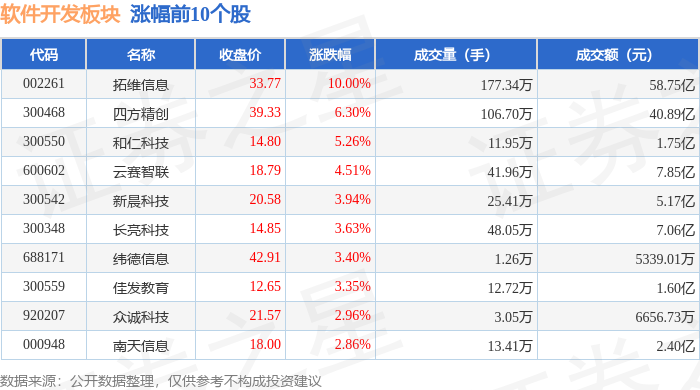
软件开发板块12月29日跌0.13%,广道退领跌,主力资金净流出8204.1万元
Zheng Xing Xing Ye Ri Bao· 2025-12-29 09:06
| 代码 | 名称 | 主力净流入(元) | 主力净占比 游资净流入 (元) | | 游资净占比 散户净流入 (元) | | 散户净占比 | | --- | --- | --- | --- | --- | --- | --- | --- | | 002261 | 拓维信息 | 16.4514 | 27.99% | -8.09 Z | -13.77% | -8.36 Z | -14.23% | | 600602 | 云赛智联 | 1.48 Z | 18.89% | -3151.65万 | -4.01% | -1.17 Z | -14.88% | | 300348 | 长亮科技 | 9691.55万 | 13.72% | -1097.97万 | -1.55% | -8593.57万 | -12.17% | | 300468 | 四方精创 | 8294.58万 | 2.03% | 679.15万 | 0.17% | -8973.73万 | -2.19% | | 002987 | 京北方 | 7431.39万 | 8.90% | 869.52万 | 1.04% | -8300.91万 | -9.94% | | 600 ...


京北方(002987) - 关于公司高级管理人员股份减持计划实施完成的公告
2025-12-26 09:48
证券代码:002987 证券简称:京北方 公告编号:2025-057 京北方信息技术股份有限公司 注:颜志顺先生本次减持的股份来源为股权激励股份及公司权益分派(资本 关于公司高级管理人员股份减持计划实施完成的公告 公司副总经理颜志顺先生保证向本公司提供的信息内容真实、准确、完整, 没有虚假记载、误导性陈述或重大遗漏。 本公司及董事会全体成员保证公告内容与信息披露义务人提供的信息一致。 京北方信息技术股份有限公司(以下简称"公司")于2025年11月26日披露 了《关于公司高级管理人员减持股份的预披露公告》(公告编号:2025-053), 公司副总经理颜志顺先生(持有71,172股,占公司总股本的0.0082%)计划自上 述公告披露之日起十五个交易日后的三个月内(即2025年12月17日至2026年3月 16日)通过集中竞价交易方式减持其持有的公司股份不超过17,793股,即不超过 公司总股本的0.0021%。 公司于近日收到副总经理颜志顺先生出具的《关于股份减持计划实施完成的 告知函》,截至本公告披露日,颜志顺先生本次股份减持计划已实施完成,现将 有关情况公告如下: 一、股东减持情况 | 股东名称 | 减持方 ...
京北方:副总经理颜志顺减持约1.78万股,减持计划已实施完成
Mei Ri Jing Ji Xin Wen· 2025-12-26 09:45
Group 1 - The company Jingbeifang (SZ 002987) announced that its vice president Yan Zhishun has completed a share reduction plan, selling approximately 17,800 shares, which accounts for 0.0021% of the company's total shares [1] - As of the announcement date, Jingbeifang's market capitalization is 17.7 billion yuan [1] - For the first half of 2025, Jingbeifang's revenue composition is as follows: banking accounts for 83.68%, non-banking financial services for 8.91%, and other sources for 7.41% [1]