宏海科技

Search documents
武汉激活创新“根”力量,专精特新 “雁阵”托起民营经济新生态
2 1 Shi Ji Jing Ji Bao Dao· 2025-11-28 08:17
Group 1: Core Insights - The Ministry of Industry and Information Technology announced the list of newly recognized and re-evaluated national-level specialized and innovative "little giant" enterprises for 2025, highlighting several companies in Wuhan's AI, integrated circuits, and industrial robotics sectors [1] - Wuhan's systematic cultivation model, focusing on "seedling cultivation - chain innovation - ecological symbiosis," has effectively positioned specialized and innovative enterprises as a core engine for high-quality development of the private economy [1] - The city plans to deepen the cultivation system for "root enterprises" and implement the "20 measures for private economy" to foster a nurturing brand for technological and industrial innovation [1] Group 2: Policy and Support Initiatives - The "Spark Seedling Venture Capital Cultivation Plan" was launched to focus on the initial stages of technology transfer and the growth of tech enterprises, aiming to develop 100 seedling investment partners and nurture 1,000 tech innovation projects [2] - Government support has been crucial for startups facing funding pressures and market demand alignment, particularly in the semiconductor high-end equipment sector [2] Group 3: Company Case Studies - QianDa Intelligent Technology, which specializes in high-temperature gas detection electronic ceramic chips, has successfully transitioned from research to commercialization, aided by government support and local innovation ecosystems [3][4] - Wuhan QiNa New Energy Technology, established in September 2022, focuses on sodium-ion battery materials and has received angel investment and government support to accelerate technology transfer [4][5] - YiMo Technology, a company specializing in industrial software, has grown into a national-level specialized and innovative "little giant," successfully implementing 2,000 digital factories with significant market share [6][7] Group 4: Economic Impact - From January to October, the high-tech manufacturing sector, driven by private enterprises, saw a value-added growth of 15.5%, significantly outpacing the overall industrial growth rate [10] - The private economy in Wuhan has become a strong driving force for economic transformation, with a contribution of 48.4% to GDP and a total import-export volume growth of 16.7% year-on-year [12]
乘风破浪立潮头——解析武汉经开区高质量发展“车谷样本”
Zhong Guo Zheng Quan Bao· 2025-11-14 00:31
Core Insights - Wuhan Economic Development Zone is transforming from traditional automotive industry to new energy and intelligent connected vehicles, showcasing a high-quality development model known as "Car Valley" [1][2][3] Policy Guidance - The establishment of the "Car Valley" began in 1991 with a project to produce 300,000 vehicles, marking the start of the region's automotive journey [2] - The region is focusing on the transition from traditional fuel vehicles to new energy vehicles, with a significant increase in production capacity [2][3] Production and Growth - In the first nine months of this year, the production of vehicles in Wuhan Economic Development Zone reached nearly 600,000, with over 300,000 being new energy vehicles, reflecting a year-on-year growth of nearly 60% [3] - The average production time for vehicles at Lantu Automotive's factories is 63 seconds per vehicle, indicating efficient manufacturing processes [2] Financial Empowerment - Lantu Automotive has submitted an application for listing on the Hong Kong Stock Exchange, highlighting the region's efforts to connect enterprises with capital markets [6] - The establishment of the "Wuhan Car Valley Science and Technology Investment Fund" with a total scale of 1 billion yuan aims to support hard technology enterprises [7] Industry Ecosystem - The integration of innovation, industry, and supply chains is being emphasized to stimulate high-quality development [8] - The "Changjiang Automotive Chain" platform has been established to connect nearly 30,000 enterprises and facilitate over 4,000 orders, enhancing the supply chain [9][10] Future Outlook - The region aims to cultivate leading enterprises and enhance the influence of the "Car Valley" brand in the global market [10] - The transformation practices in Wuhan Economic Development Zone serve as a replicable model for traditional industrial clusters across the country [10]
乘风破浪立潮头
Zhong Guo Zheng Quan Bao· 2025-11-13 20:02
Core Insights - Wuhan Economic Development Zone is transforming from traditional automotive manufacturing to new energy and intelligent connected vehicles, showcasing a successful model of high-quality development in the automotive industry [1][8]. Policy Guidance - The development of the "Car Valley" is supported by policies that encourage the transition from traditional fuel vehicles to new energy vehicles, with a focus on enhancing the entire industrial chain [1][3]. - The establishment of the Wuhan Intelligent Automotive Software Park and supportive policies for smart connected vehicles are part of the efforts to foster innovation in the sector [3]. Production and Growth - In the first nine months of 2023, the production of vehicles in Wuhan Economic Development Zone reached nearly 600,000 units, with over 300,000 being new energy vehicles, marking a year-on-year growth of nearly 60% [2]. - The production capacity of major projects is being accelerated, with a goal of achieving a million new energy vehicles [2]. Capital Empowerment - Lantu Motors has submitted an application for listing on the Hong Kong Stock Exchange, marking a significant step in connecting enterprises with capital markets [5]. - The establishment of the Wuhan Car Valley Science and Technology Investment Fund, with a total scale of 1 billion yuan, aims to support hard technology enterprises [5][6]. Industry Ecosystem - The integration of innovation, industry, and supply chains is being emphasized to stimulate high-quality development in the automotive sector [6][7]. - The "Yangtze River Automotive Chain" platform has been established to enhance collaboration among nearly 30,000 enterprises, facilitating over 4,000 orders [7]. Future Outlook - The Wuhan Economic Development Zone aims to cultivate leading enterprises and enhance the influence and competitiveness of the "Car Valley" brand on a global scale [7][8].
家电零部件板块10月31日跌1.28%,康盛股份领跌,主力资金净流出12.33亿元
Zheng Xing Xing Ye Ri Bao· 2025-10-31 08:41
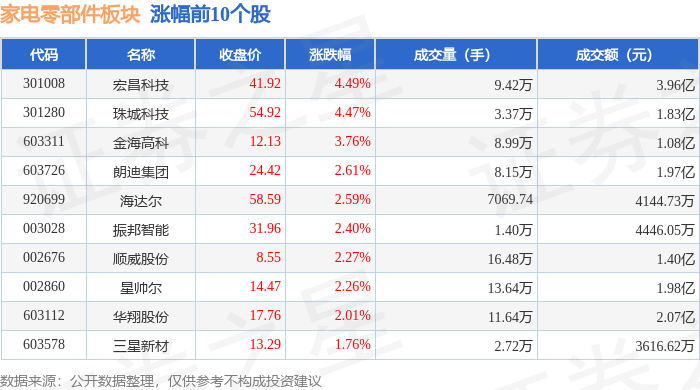
Market Overview - The home appliance parts sector declined by 1.28% on October 31, with Kangsheng Co. leading the drop [1] - The Shanghai Composite Index closed at 3954.79, down 0.81%, while the Shenzhen Component Index closed at 13378.21, down 1.14% [1] Stock Performance - Notable gainers in the home appliance parts sector included: - Hongchang Technology (301008) with a closing price of 41.92, up 4.49% [1] - Zhucheng Technology (301280) at 54.92, up 4.47% [1] - Dingxing Update (603311) at 12.13, up 3.76% [1] - Major decliners included: - Kangxi Co. (002418) with a closing price of 4.75, down 8.48% [2] - Chunguang Technology (603657) at 32.85, down 3.30% [2] - Sanhua Intelligent Control (002050) at 49.93, down 2.52% [2] Trading Volume and Capital Flow - The home appliance parts sector experienced a net outflow of 1.233 billion yuan from institutional investors, while retail investors saw a net inflow of 942 million yuan [2] - The trading volume for the sector was significant, with Kangxi Co. recording a trading volume of 2.6518 million shares and a transaction value of 1.268 billion yuan [2] Capital Flow Analysis - Key stocks with significant capital flow included: - Huaxiang Co. (603112) with a net inflow of 45.8372 million yuan from institutional investors [3] - Zhucheng Technology (301280) with a net inflow of 21.4004 million yuan from institutional investors [3] - Longdi Group (603726) with a net inflow of 17.8122 million yuan from institutional investors [3]




机构风向标 | 宏海科技(920108)2025年三季度已披露持仓机构仅5家
Xin Lang Cai Jing· 2025-10-31 02:59
Core Insights - Honghai Technology (920108.BJ) released its Q3 2025 report on October 30, 2025, indicating a total of 5 institutional investors holding shares, amounting to 3.8972 million shares, which represents 2.26% of the total share capital [1] Institutional Holdings - The institutional investors include CITIC Construction Investment Fund, Guotai Junan Securities, Guoxin Securities, Great Wall Securities, and Dongwu Securities, with a combined holding ratio increase of 0.63 percentage points compared to the previous quarter [1] Public Fund Participation - In this period, 13 public funds were disclosed, including Rongtong New Blue Chip Mixed Fund, Rongtong Leading Growth Mixed Fund (LOF) A/B, Dachen Multi-Strategy Mixed Fund (LOF) A, Dachen Two-Year Fixed Open Mixed Fund A, and Dachen Industry Rotation Mixed Fund A [1]
宏海科技(920108) - 对外投资设立全资子公司的公告
2025-10-30 10:19
对外投资设立全资子公司的公告 证券代码:920108 证券简称:宏海科技 公告编号:2025-114 武汉宏海科技股份有限公司 本公司及董事会全体成员保证公告内容的真实、准确和完整,没有虚假记载、 误导性陈述或者重大遗漏,并对其内容的真实性、准确性和完整性承担个别及连 带法律责任。 一、对外投资概述 (一)基本情况 根据公司发展战略规划及业务发展需要,为加强对小米等重点客户的深度服 务与市场辐射,提升市场占有率,公司拟在鄂州市葛店经济技术开发区投资设立 全资子公司,注册资本人民币 3,000.00 万元,子公司具体名称、注册地址、经 营范围等以当地市场监督管理部门最终核定为准。 (二)是否构成重大资产重组 本次交易不构成重大资产重组。 根据《上市公司重大资产重组管理办法》的相关规定,公司本次对外投资系 新设全资子公司,不构成重大资产重组。 (三)是否构成关联交易 本次交易不构成关联交易。 (四)决策与审议程序 2025 年 10 月 29 日,公司第六届董事会第八次会议审议通过了《关于对外 投资设立全资子公司》的议案,该议案已经公司战略与投资委员会审议通过。根 据《北京证券交易所股票上市规则》《公司章程》《对 ...
宏海科技(920108) - 第六届董事会第八次会议决议公告
2025-10-30 10:00
证券代码:920108 证券简称:宏海科技 公告编号:2025-112 武汉宏海科技股份有限公司 第六届董事会第八次会议决议公告 本公司及董事会全体成员保证公告内容的真实、准确和完整,没有虚假记载、 误导性陈述或者重大遗漏,并对其内容的真实性、准确性和完整性承担个别及连 带法律责任。 一、会议召开和出席情况 (一)会议召开情况 1.会议召开时间:2025 年 10 月 29 日 2.会议召开地点:宏海科技会议室 3.会议召开方式:现场 4.发出董事会会议通知的时间和方式:2025 年 10 月 17 日以通讯方式发出 5.会议主持人:董事长周宏先生 (二)会议出席情况 会议应出席董事 8 人,出席和授权出席董事 8 人。 董事周宏因工作原因以通讯方式参与表决。 董事江艳因工作原因以通讯方式参与表决。 董事严本道因工作原因以通讯方式参与表决。 二、议案审议情况 (一)审议通过《2025 年第三季度报告》 1.议案内容: 根据《公司法》《证券法》《北京证券交易所上市规则》等法律法规及《公司 章程》有关规定,公司编制了 2025 年三季度报告。具体内容详见公司于同日在 北京证券交易所官方信息披露平台(www.bse ...
1-10月A股81家IPO成功!10家企业的中介机构收费过亿,北交所中介费占募资比例最高占12.34%
Xin Lang Cai Jing· 2025-10-23 02:00
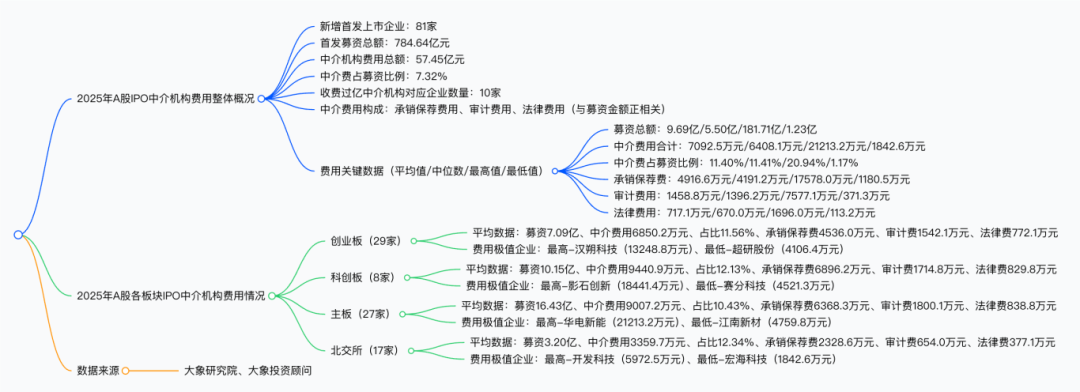
Core Insights - In 2025, a total of 81 companies successfully went public on the A-share market, raising a total of 78.464 billion yuan, with 5.745 billion yuan allocated for intermediary fees, accounting for 7.32% of the total fundraising [1][3] Summary by Category Overall Market Performance - The average fundraising amount per company was 969 million yuan, with an average intermediary fee of 70.925 million yuan, resulting in an average intermediary fee percentage of 11.40% [3] - The highest fundraising amount recorded was 18.171 billion yuan, with the highest intermediary fee reaching 212.132 million yuan, which accounted for 20.94% of the total fundraising [3] Intermediary Fees by Market Segment - **ChiNext**: - Total fundraising: 709 million yuan - Total intermediary fees: 68.502 million yuan - Intermediary fee percentage: 11.56% [5] - **STAR Market**: - Total fundraising: 1.015 billion yuan - Total intermediary fees: 94.409 million yuan - Intermediary fee percentage: 12.13% [5] - **Main Board**: - Total fundraising: 1.643 billion yuan - Total intermediary fees: 90.072 million yuan - Intermediary fee percentage: 10.43% [5] - **Beijing Stock Exchange**: - Total fundraising: 320 million yuan - Total intermediary fees: 33.597 million yuan - Intermediary fee percentage: 12.34% [5] Notable Companies and Their Fees - **ChiNext**: - Highest intermediary fee: Han Shuo Technology (301275.SZ) with 132.488 million yuan, accounting for 11.41% of its 1.162 billion yuan fundraising [6] - Lowest intermediary fee: Chao Yan Co. (301602.SZ) with 41.064 million yuan, accounting for 9.54% of its 430 million yuan fundraising [6] - **STAR Market**: - Highest intermediary fee: Ying Shi Innovation (688775.SH) with 184.414 million yuan, accounting for 9.52% of its 1.938 billion yuan fundraising [7] - Lowest intermediary fee: Sai Fen Technology (688758.SH) with 45.213 million yuan, accounting for 20.94% of its 216 million yuan fundraising [7] - **Main Board**: - Highest intermediary fee: Huaneng New Energy (600930.SH) with 212.132 million yuan, accounting for 1.17% of its 18.171 billion yuan fundraising [8] - Lowest intermediary fee: Jiangnan New Materials (603124.SH) with 47.598 million yuan, accounting for 12.39% of its 384 million yuan fundraising [8] - **Beijing Stock Exchange**: - Highest intermediary fee: Kai Fa Technology (920029.BJ) with 59.725 million yuan, accounting for 5.11% of its 1.169 billion yuan fundraising [9] - Lowest intermediary fee: Hong Hai Technology (920108.BJ) with 18.426 million yuan, accounting for 14.38% of its 128 million yuan fundraising [9]
10家企业中介机构收费过亿!2025年IPO中介机构赚了多少钱?
Sou Hu Cai Jing· 2025-10-21 17:03
Core Insights - As of October 17, 2025, a total of 81 new IPOs have been launched, raising a total of 78.464 billion yuan, with 5.745 billion yuan allocated for intermediary fees, indicating that 7.32% of the raised funds are absorbed by intermediaries [1][2] Intermediary Fees Overview - The total intermediary fees for IPOs range from a minimum of 18.426 million yuan to a maximum of 212 million yuan, with the fee percentage varying from 1.17% to 20.94% [2] - The highest underwriting and sponsorship fee reached 17.6 million yuan, while audit and legal fees also increased with the raised funds [2] Average Intermediary Fees by Board - **ChiNext Board**: Average total intermediary fees are 68.502 million yuan, accounting for 11.56% of the raised funds; underwriting fees average 45.362 million yuan, audit fees 15.421 million yuan, and legal fees 7.721 million yuan [3] - **Sci-Tech Innovation Board**: Average total intermediary fees are 94.409 million yuan, accounting for 12.13% of the raised funds; underwriting fees average 68.962 million yuan, audit fees 17.148 million yuan, and legal fees 8.298 million yuan [3] - **Main Board**: Average total intermediary fees are 90.072 million yuan, accounting for 10.43% of the raised funds; underwriting fees average 63.683 million yuan, audit fees 18.001 million yuan, and legal fees 8.388 million yuan [3] - **North Exchange**: Average total intermediary fees are 33.597 million yuan, accounting for 12.34% of the raised funds; underwriting fees average 23.286 million yuan, audit fees 6.54 million yuan, and legal fees 3.771 million yuan [3] Detailed Intermediary Fees by Board - **ChiNext Board**: The highest intermediary fee is 132.488 million yuan by Hanshuo Technology, while the lowest is 41.064 million yuan by Chaoyan Co. [3] - **Sci-Tech Innovation Board**: The highest intermediary fee is 184.414 million yuan by Yingshi Innovation, while the lowest is 45.213 million yuan by Saifen Technology [3] - **Main Board**: The highest intermediary fee is 212.132 million yuan by Huadian New Energy, while the lowest is 47.598 million yuan by Jiangnan New Materials [3] - **North Exchange**: The highest intermediary fee is 59.725 million yuan by Kaifa Technology, while the lowest is 18.426 million yuan by Honghai Technology [3]
家电零部件板块10月21日涨1.8%,东贝集团领涨,主力资金净流入2.37亿元
Zheng Xing Xing Ye Ri Bao· 2025-10-21 08:21
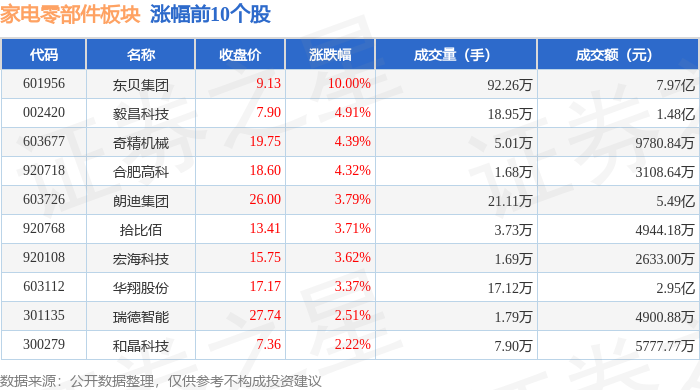
Core Insights - The home appliance parts sector experienced a 1.8% increase on the previous trading day, with Dongbei Group leading the gains [1] - The Shanghai Composite Index closed at 3916.33, up 1.36%, while the Shenzhen Component Index closed at 13077.32, up 2.06% [1] Stock Performance - Dongbei Group (601956) closed at 9.13, with a 10.00% increase and a trading volume of 922,600 shares, amounting to a transaction value of 797 million [1] - Yichang Technology (002420) closed at 7.90, up 4.91%, with a trading volume of 189,500 shares and a transaction value of 148 million [1] - Qijing Machinery (603677) closed at 19.75, up 4.39%, with a trading volume of 50,100 shares and a transaction value of 97.81 million [1] - Hefei Gaoke (920718) closed at 18.60, up 4.32%, with a trading volume of 16,800 shares and a transaction value of 31.09 million [1] - Longdi Group (603726) closed at 26.00, up 3.79%, with a trading volume of 211,100 shares and a transaction value of 549 million [1] - Other notable stocks include Shibibo (920768), Honghai Technology (920108), and Ruide Intelligent (301135), all showing positive performance [1] Capital Flow - The home appliance parts sector saw a net inflow of 237 million from main funds, while retail funds experienced a net outflow of 68.22 million [3] - Speculative funds recorded a net outflow of 169 million [3]