3SBio

Search documents
中国生物技术:下一代免疫肿瘤(IO)领域的机遇;管线更新及目标价变动-China Biotechnology_ Opportunities in Next-generation IO Space; Pipeline Updates and TP Changes
2025-07-30 02:33
Summary of Key Points from the Conference Call Industry Overview - The focus is on the next-generation immuno-oncology (IO) therapeutics, which include bi/trispecific PD-1/VEGF, PD-1/IL-2, and PD-1/VEGF/CTLA4 candidates that have the potential to significantly alter cancer treatment landscapes [1][11][19]. Market Potential - The total addressable market (TAM) for next-generation IO products is estimated to exceed US$62 billion, driven by the expiration of key patents like Keytruda and Opdivo in 2028 [2][19][24]. - The current market for PD-1 IO therapies is projected to reach over US$50 billion, with significant growth expected as new candidates enter the market [11][19]. Company-Specific Insights Akeso Inc (9926.HK) - Akeso's ivonescimab has demonstrated statistically significant improvements in progression-free survival (PFS) in the HARMONi-2/HARMONi-6 trials, with promising overall survival (OS) data [2][29]. - Target price (TP) raised to HK$185 from HK$98, reflecting strong revenue growth and a robust pipeline [5][31]. - The company has achieved significant revenue of Rmb2.1 billion in 2024 and has transitioned from a high-risk rating to a buy rating [5][31]. Innovent (1801.HK) - Innovent's IBI363 has shown promising data in IO-treated non-small cell lung cancer (NSCLC) and is expected to launch pivotal trials in 2H25 [2][32][33]. - TP increased to HK$105 from HK$90, with a focus on next-generation IO and antibody-drug conjugate (ADC) combinations [5][34]. 3SBio (1530.HK) - 3SBio is developing SSGJ-707 (PD-1/VEGF) and is expected to present more data in upcoming meetings [27]. - TP raised to HK$36 from HK$21, reflecting increased peak sales forecasts [5][28]. Shanghai Junshi Biosciences (1877.HK) - Junshi is conducting Phase 2 studies for JS207, with data expected in 3Q25 [35]. - TP adjusted to HK$32 from HK$17, indicating growth potential [5][36]. Sino Biopharmaceutical (1177.HK) - Sino Biopharmaceutical announced the acquisition of LaNova Medicines to enhance its innovative pipeline [37]. - TP increased to HK$8.80 from HK$6.20, reflecting progress in drug development [5][38]. Investment Opportunities and Risks - There are numerous business development (BD) opportunities as multinational corporations (MNCs) seek to replenish their pipelines with new drugs [3][24]. - The expiration of patents for leading IO products creates a competitive landscape, necessitating innovation and strategic partnerships [3][24]. Clinical Data and Progress - Promising clinical data for next-generation IO candidates, including head-to-head comparisons, have garnered investor interest [11][16]. - The report emphasizes the importance of clinical data in determining market share and probability of success (PoS) for each candidate [4][18]. Conclusion - The next-generation IO space presents significant investment opportunities, with several companies showing promising clinical data and strong market potential. Adjustments in target prices reflect the anticipated growth and success of these candidates in the evolving oncology landscape [5][18][19].
高盛:中国创新药迎结构性重估,出海授权是关键突围路径,夏季将迎来低吸窗口?
Hua Er Jie Jian Wen· 2025-07-09 08:27
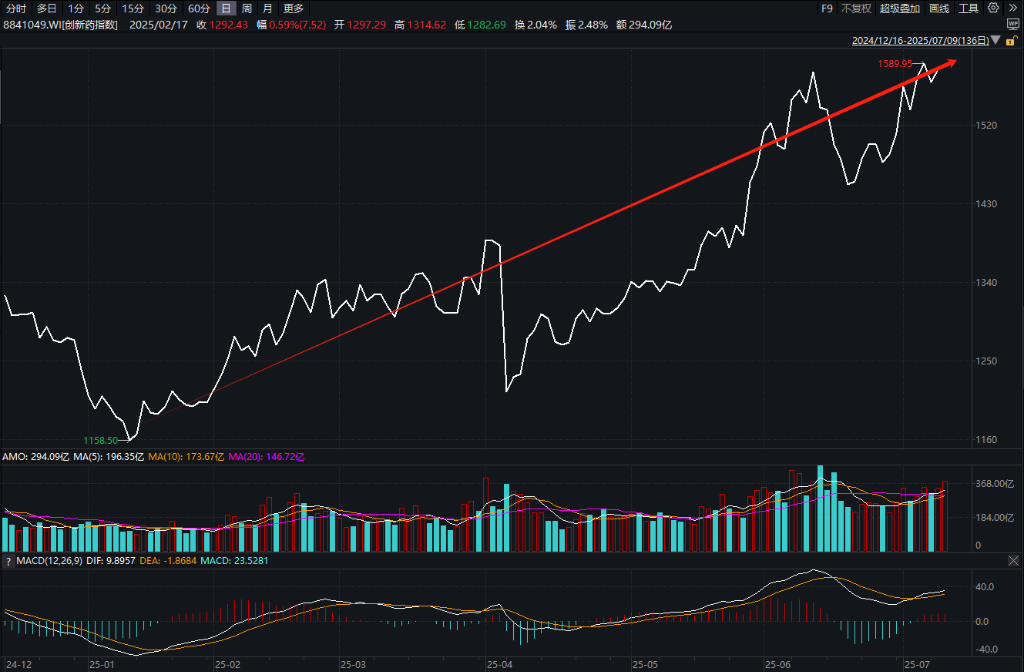
Core Insights - The Chinese pharmaceutical industry has transitioned from a focus on "generic drugs" to "original innovation and global licensing" [1] - Goldman Sachs reports that the surge in the innovative drug sector is driven by the globalization of Chinese innovative drugs, particularly through licensing agreements [1][3] - As of mid-2025, the Chinese biotech sector has seen a 78% increase, outperforming major indices [1] Group 1: Market Dynamics - The Chinese biotech industry is undergoing a structural revaluation, with current market capitalization at only 14%-15% of U.S. counterparts, despite contributing nearly 33% to global innovation [3][4] - China contributed 50% of new drug molecules entering human clinical trials globally and holds about one-third of the global innovative drug pipeline [4] - The active participation of Chinese companies in global business development (BD) transactions has increased significantly, accounting for 27% of global transaction numbers and 32% of transaction value in the first half of 2025 [4] Group 2: Innovation and Technology - Chinese companies are leading in the development of ADCs (Antibody-Drug Conjugates) and BsAbs (Bispecific Antibodies), with ADCs representing 70% of global clinical entries since 2023 [5][6] - Oncology remains the primary focus for Chinese innovative drug licensing, contributing over 60% of transactions in the past three years [6] Group 3: Investment Opportunities - The summer market is seen as a potential window for long-term investors to accumulate quality innovative drug stocks, as fewer clinical data releases may keep stock prices stable [7] - Goldman Sachs introduces the "PoLS" framework to assess the investment value of licensing agreements based on product competitiveness, clinical data maturity, and potential transaction interest [7][8] - Future valuation increases are expected from successful licensing transactions, clinical data releases, and new projects entering the global market [8]

摩根士丹利:中国医疗保健_2025 年国家医保药品目录和商业保险药品目录启动谈判
摩根· 2025-07-01 00:40
Investment Rating - The industry investment rating is Attractive [6]. Core Insights - The 2025 National Reimbursement Drug List (NRDL) and Commercial Insurance Drug List negotiations are set to begin, with eligibility criteria similar to previous years, including new drugs approved before June 30, 2025, and rare disease drugs [2][3]. - The role of commercial insurance in China's healthcare system is currently limited, accounting for only 7.7% of total spending on innovative drugs and devices in 2024, indicating significant potential for growth [4][8]. - The NHSA is expected to lead the formulation of the first national-level Commercial Insurance Drug List, with negotiations possibly starting in August-September 2025 [3][8]. Summary by Sections NRDL and Commercial Insurance Drug List - The NRDL negotiations may be advanced to August-September 2025 to accommodate the release of the Commercial Insurance List, anticipated in late 2025 [3]. - Eligible drugs for the Commercial Insurance List include new drugs approved from January 1, 2020, to June 30, 2025, and rare disease drugs [2]. Role of Commercial Insurance - Commercial insurance represented only 7.7% of total spending on innovative drugs and devices in China as of 2024, which is less than 5% of total healthcare expenditures [4][10]. - Strengthening the role of commercial insurers through national policy initiatives is expected to alleviate funding constraints and benefit innovative biopharma and medtech players [4]. Spending Insights - In 2024, out-of-pocket expenses accounted for RMB 78.6 billion (48%), commercial insurance for RMB 12.4 billion (8%), and basic government-funded health insurance for RMB 71 billion (44%) of the total spending on innovative drugs and devices [10].
巴克莱:中国行_加速生物制药创新及业务发展机遇
2025-06-16 03:16
Summary of Key Points from the Conference Call Industry Overview - The report focuses on the **biopharmaceutical sector in China**, highlighting its resurgence driven by innovation and increased deal activity with multinational corporations (MNCs) [1][2]. Core Insights - **Global Competitiveness**: China's pharma sector is confirmed to be globally competitive, with significant partnerships such as Summit Therapeutics' licensing agreement with Akeso for ivonescimab (up to $5 billion) and Pfizer's deal with 3SBio for SSGJ-707 (up to $6 billion) [2]. - **Investment in Obesity Treatments**: Companies are investing in the obesity treatment space, with notable deals including Merck's $1.9 billion agreement with Hansoh Pharma and Novo's $2 billion deal with United Bio-Technology [2]. - **Long-Term Winners**: AstraZeneca (AZN) and Sanofi (SAN) are identified as long-term winners in the region, with both companies actively investing and expanding their R&D presence in China [7][11]. R&D and Business Development Opportunities - **Rapid R&D Advancement**: China's biopharma industry is shifting from generics to genuine innovation, with improved R&D efficiency and lower costs [8][41]. - **Rich Pipeline of Assets**: MNCs are increasingly seeking business development (BD) deals in China, with a wealth of attractive pipeline assets available for international partnerships [9]. - **Key Asset Types**: Bispecific antibodies, GLP-1 therapies, and antibody-drug conjugates (ADCs) are highlighted as prominent areas for BD opportunities [10][65]. Market Dynamics - **Market Share Growth**: The share of innovative drugs in China's core hospital pharmaceutical market increased from 21% in 2015 to 29% in 2024, with local companies' share rising from 18.7% to 27.8% [24][25]. - **Declining Contribution**: There is a modest decline in China sales as a percentage of global sales among large-cap EU pharma companies, with AstraZeneca's share dropping from 20% in 2020 to an estimated 12% in 2024 [29][31]. Strategic Collaborations - **M&A Activity**: The report notes a boom in M&A activity as companies seek to acquire innovative pipeline assets amid global pricing pressures and patent expirations [40]. - **Emerging Global Innovation Hub**: China is becoming a global hub for innovative drug R&D, with a significant increase in out-licensing deals, reaching a total value of $50.8 billion in 2024 [40][48]. Specific Therapeutic Areas - **Bispecific Antibodies**: The report emphasizes the growing interest in bispecific antibodies, particularly those targeting PD-1/VEGF pathways, with significant licensing deals indicating global confidence in these assets [66][68]. - **GLP-1 Therapies**: The report outlines the evolution of GLP-1 therapies, with a focus on long-acting formulations and oral small molecules, highlighting numerous ongoing clinical trials and licensing deals [70][72]. - **Antibody-Drug Conjugates (ADCs)**: China is emerging as a leader in ADC innovation, with approximately 40% of the global ADC pipeline originating from China and a significant increase in international licensing transactions [77][78]. Conclusion - The biopharmaceutical sector in China is positioned for growth, with strong R&D capabilities, a rich pipeline of innovative assets, and increasing global interest from MNCs. Companies like AstraZeneca and Sanofi are well-positioned to capitalize on these opportunities, while the landscape for innovative therapies continues to evolve rapidly.
BMY Collaborates for Oncology Drug: Will This Boost Its Portfolio?
ZACKS· 2025-06-06 14:21
Core Insights - Bristol Myers Squibb (BMY) has entered a strategic collaboration with BioNTech (BNTX) for the co-development and co-commercialization of the bispecific antibody BNT327, targeting multiple solid tumor types [1][9]. Company Developments - BNT327 is a next-generation bispecific antibody that targets PD-L1 and VEGF-A, currently in trials with over 1,000 patients, including phase III studies for extensive stage small cell lung cancer (ES-SCLC) and non-small cell lung cancer (NSCLC) [2][4]. - BMY will make an upfront payment of $1.5 billion to BioNTech, with additional non-contingent anniversary payments of $2 billion through 2028, and up to $7.6 billion in potential milestone payments [3][9]. Financial Performance - BMY's shares have declined by 13.6% year-to-date, compared to a 3.3% decline in the industry [8]. - The company is trading at a price/earnings ratio of 7.31x forward earnings, lower than its historical mean of 8.55x and the large-cap pharma industry's average of 14.95x [10]. Earnings Estimates - The Zacks Consensus Estimate for BMY's 2025 earnings per share has increased to $6.85 from $6.75 over the past 60 days, while the estimate for 2026 has decreased [11].


Pfizer's 7.5% Dividend: Income Haven or House of Cards?
MarketBeat· 2025-05-23 19:21
Core Viewpoint - Pfizer's high dividend yield of 7.5% attracts income-seeking investors, but underlying concerns about future growth and financial stability exist due to revenue declines and patent expirations [1][2][13]. Dividend Overview - Pfizer currently pays an annual dividend of $1.72 per share, translating to a quarterly payment of $0.43 per share, resulting in a dividend yield of 7.5% as of May 22, 2025 [2][3]. - The company has a strong track record of increasing dividends for 16 consecutive years, appealing to investors seeking reliable income [4]. Financial Metrics - Pfizer's annualized 3-year dividend growth stands at 2.50%, with a dividend payout ratio of 124.64% based on trailing earnings, indicating that dividends exceed earnings [4][6]. - The dividend payout consumes approximately 47.69% of its cash flow, suggesting a more sustainable dividend based on cash generation [5]. Revenue Challenges - In Q1 2025, Pfizer's total revenues decreased by 8% year-over-year to $13.7 billion, primarily due to a 75% drop in Paxlovid sales as COVID-19 demand normalized [7]. - The company faces a significant revenue loss of $17-$18 billion annually between 2026 and 2028 due to the impending loss of exclusivity for key drugs like Eliquis and Prevnar [8]. Strategic Initiatives - Pfizer is pursuing a strategy focused on pipeline rejuvenation, particularly in oncology, highlighted by the $43 billion acquisition of Seagen in March 2023, which contributed $3.4 billion to revenue in FY 2024 [9]. - The company has entered a licensing agreement with 3SBio, Inc. for SSGJ-707, with an upfront payment of $1.25 billion, potentially worth up to $6 billion, aiming to launch eight new cancer medicines by 2030 [10]. Pipeline Developments - Positive developments in the oncology pipeline include FDA approval for Adcetris in large B-cell lymphoma and promising clinical data for Padcev in urothelial cancer [11]. - The Abrysvo RSV vaccine has seen expanded recommendations, potentially increasing market reach, although setbacks occurred with the discontinuation of the oral GLP-1 candidate danuglipron [12]. Investment Outlook - Pfizer's stock forecast indicates a 12-month price target of $29.17, representing a 25.08% upside, with a Moderate Buy rating based on 15 analyst ratings [13]. - The current high dividend yield is attractive, but the company faces significant operational challenges and uncertainties regarding future revenue growth [14][15].

Pfizer Buys Rights to PD-1 & VEGF Inhibitor From China Biotech
ZACKS· 2025-05-20 13:51
Group 1 - Pfizer announced the in-licensing of global development and commercialization rights, excluding China, for SSGJ-707, a bispecific antibody targeting PD-1 and VEGF, from Chinese biotech 3SBio [1][2] - SSGJ-707 is currently being developed in China for non-small cell lung cancer (NSCLC), metastatic colorectal cancer, and gynecological tumors, with the first phase III study expected to begin this year [1][2] - The deal includes an upfront payment of $1.25 billion to 3SBio, milestone payments of up to $4.8 billion, and tiered double-digit royalties on sales if SSGJ-707 is approved [2] Group 2 - Pfizer's stock has declined 10.2% so far this year, compared to a 4.0% decrease for the industry [3] - Summit Therapeutics is also developing a dual PD-1 and VEGF inhibitor, ivonescimab, which has shown positive data in a phase III study and is believed to have the potential to replace Merck's Keytruda as the next standard of care for NSCLC [5][6]