American Homes 4 Rent

Search documents
Trump Administration Plans to Prohibit Institutional Investors from Owning Single-Family Real Estate Properties
Crowdfund Insider· 2026-01-08 18:57
Core Viewpoint - The proposal by President Trump to restrict large institutional investors from purchasing single-family homes aims to improve housing affordability for individual Americans, particularly younger families [1][2]. Group 1: Proposal Details - The initiative seeks to bar major institutional investors, such as private equity firms, from acquiring additional single-family homes, which have been linked to rising property prices and rents [2][3]. - Trump plans to push for immediate action on this proposal and will discuss it further at the World Economic Forum in Davos [2]. Group 2: Market Reaction - The announcement led to a significant backlash in the stock market, with shares of firms involved in single-family rentals experiencing sharp declines [3]. - Blackstone's stock fell by as much as 9.3% intraday, closing down around 5-6%, while Invitation Homes saw a drop of up to 10%, ending approximately 6% lower [4]. Group 3: Industry Impact - Other related stocks, including American Homes 4 Rent and various homebuilders, also faced steep declines, indicating investor concerns over potential disruptions in the rental housing sector [5]. - Although institutional investors own only about 3-4% of single-family rental properties nationwide, their impact is more significant in certain markets, particularly in the Sun Belt [5]. Group 4: Expert Opinions - Some experts suggest that the overall impact on housing prices may be limited, as smaller investors might fill the gap left by institutional buyers, and broader issues like low housing supply remain unaddressed [6]. - The proposal aligns with criticisms from housing advocates and some bipartisan lawmakers who have previously suggested similar restrictions [6].


3 things Trump did in 24 hours to show that he’s in control of American business
Fortune· 2026-01-08 18:41
Market Interventions - President Trump has initiated three significant state interventions in various markets, indicating a shift from traditional Republican laissez-faire policies to more direct control over economic activities [2][3] - The interventions include a ban on large institutional investors from purchasing single-family homes, a cap on executive compensation in the defense sector, and control over Venezuelan oil proceeds [5][9][16] Housing Market - Trump announced a ban on "large institutional investors," such as private equity firms and real estate trusts, from buying single-family homes, emphasizing that "people live in homes, not corporations" [5] - Following the announcement, stocks of institutional investors like Blackstone and Invitation Homes dropped by 6%, with American Homes 4 Rent experiencing trading halts due to volatility [6] - Institutional investors currently own only 2% of the housing stock, but their presence is concentrated in cities like Atlanta and Jacksonville [7] Defense Sector - Trump expressed frustration with the slow pace of weapons production and announced a cap on executive compensation at major defense contractors at $5 million annually, contrasting with typical CEO salaries of $18 million to $25 million [9][10] - An executive order formalized this policy, restricting how defense contractors can use profits and compensating executives, including barring stock buybacks and dividends for underperforming firms [11] - This move has raised concerns about the legal implications and the potential expropriation of decision-making power from shareholders to the state [12][14] Venezuelan Oil Control - Following the arrest of Venezuela's president, Trump announced U.S. control over approximately 50 million barrels of Venezuelan crude oil, valued at around $3.5 billion, with proceeds to be used exclusively for American-made goods [16][17] - This arrangement creates a "closed-loop" system that prioritizes American manufacturing over market-driven decisions, marking a significant shift towards managed trade [18] - The administration's approach reflects a broader trend of dictating market outcomes, including home purchases and executive pay, rather than allowing market forces to operate freely [19]



American Homes 4 Rent, Invitation Homes cut to Neutral at Mizuho after Trump post (AMH:NYSE)
Seeking Alpha· 2026-01-08 15:38
Group 1 - The article does not provide any relevant content regarding the company or industry [1]
American Homes 4 Rent (NYSE:AMH) Price Target and Market Outlook
Financial Modeling Prep· 2026-01-08 10:04
Core Viewpoint - American Homes 4 Rent (NYSE:AMH) is a significant entity in the residential real estate investment trust (REIT) sector, focusing on single-family home rentals across the U.S. [1] Company Overview - AMH's current stock price is $31.01, reflecting a decrease of 4.29% or $1.39 [2] - The stock has shown volatility, with a daily trading range between $28.86 and $32.64, and over the past year, it has reached a high of $39.49 and a low of $28.86 [2] - The company's market capitalization is approximately $11.49 billion, with a trading volume of 15.44 million shares on the NYSE [2] Competitive Landscape - In the REIT and Equity Trust - Residential sector, AMH competes with companies like Safehold (SAFE) [3] - Safehold holds a Zacks Rank of 2 (Buy), indicating a positive trend in earnings estimate revisions, while AMH has a Zacks Rank of 3 (Hold), suggesting a more stable earnings outlook [3][4] - The Zacks Rank system indicates that Safehold may be a more attractive option for investors seeking value opportunities compared to AMH [4][5] Price Target and Potential Upside - Mizuho Securities has set a price target of $32 for AMH, indicating a potential upside of 3.19% from its current trading price [1][5]


调控房价,特朗普要对华尔街开刀?
第一财经· 2026-01-08 09:23
Core Viewpoint - The article discusses President Trump's announcement to take measures to prevent institutional investors from purchasing single-family homes in the U.S., aiming to reduce housing costs for Americans. This move has led to a significant drop in the stock prices of major rental and management companies in the housing sector [3][4]. Group 1: Housing Affordability Crisis - Housing affordability has become a pressing issue for the White House, especially with the upcoming midterm elections. Trump highlighted that the dream of homeownership is increasingly out of reach for many Americans, particularly the youth [5]. - A report from the National Association of Realtors indicates that the proportion of first-time homebuyers has fallen to a historic low of 21%, with the median age of first-time buyers rising to a record 40 years [6]. - High home prices and mortgage rates hovering between 6% and 7% have made it difficult for many young Americans to own homes [6]. Group 2: Institutional Investors and Housing Market - Institutional investors have been criticized for contributing to high housing prices, particularly after purchasing foreclosed homes during the 2007-2009 financial crisis and converting them into rental properties [8]. - Various measures are being taken at federal and local levels to limit institutional investors, with 22 states proposing bipartisan legislation to restrict their activities in 2025 [8]. - The American Homeowners Alliance expressed support for government focus on housing affordability, noting that each home purchased by institutional investors reduces options for owner-occupiers [8]. Group 3: Market Data on Institutional Investors - A report from the American Enterprise Institute revealed that in Q1 2024, various investors purchased 25% of homes, while institutional investors accounted for only 1% of home purchases [9]. - Institutional investors hold a minimal share of the overall housing stock, with data showing they owned just 1% of single-family home inventory as of June last year [10]. - Blackstone's report indicated that it owned only 0.06% of single-family homes, and the overall share of institutional investors in the U.S. single-family housing market has decreased by 90% since 2022 [10].
拟禁止机构投资者购买独栋住宅,特朗普控房价先拿华尔街开刀?
Di Yi Cai Jing· 2026-01-08 09:05
Group 1 - The upcoming midterm elections have heightened the focus on housing affordability in the U.S., with President Trump announcing measures to prevent institutional investors from purchasing single-family homes, aiming to lower housing costs for Americans [1][3] - Following Trump's announcement, stock prices of major rental and management companies, including Invitation Homes and American Homes 4 Rent, experienced significant declines, with Invitation Homes dropping 6% and Blackstone Group's stock falling nearly 6% [1] - A report from the National Association of Realtors indicates that the percentage of first-time homebuyers has fallen to a historic low of 21%, with the median age of first-time buyers rising to a record 40 years, attributed to high home prices and mortgage rates between 6% and 7% [3] Group 2 - Institutional investors have been criticized for contributing to high housing prices, with a report from the U.S. Government Accountability Office suggesting that their concentrated ownership can drive up rents and home prices [5] - Various measures are being implemented at federal and local levels to limit institutional investors, including proposals to eliminate tax incentives for corporate investors and local bans on new single-family homes for long-term rental [5] - A report from the American Enterprise Institute indicates that institutional investors purchased only 1% of homes in the first quarter of 2024, with their overall share of the housing stock being minimal, owning just 0.5% of all single-family homes in the U.S. [6]

Trump’s threat to ban Wall Street’s investments in single-family housing jolts markets, hits homebuilder stocks
The Economic Times· 2026-01-08 04:59
Core Viewpoint - The U.S. President announced a move to ban Wall Street firms from purchasing single-family homes to reduce home prices, responding to rising living costs ahead of the midterm elections [1][11]. Group 1: Political Context - The proposed ban represents a significant shift for Republicans, aligning them with long-standing Democratic criticisms of corporate homebuying, which has been blamed for increasing housing costs and reducing supply [2][11]. - The announcement comes amid mounting political pressure on the White House regarding the cost of living [1][11]. Group 2: Market Reaction - Following the announcement, American Homes 4 Rent fell to a near three-year low, closing 4% lower, while Blackstone dropped about 5.6%, and the PHLX housing index decreased by 2.6% [5][11][12]. Group 3: Institutional Investors - A 2024 Government Accountability Office study indicated that institutional investors, including Blackstone, owned approximately 450,000 homes, or about 3% of all single-family rental homes in the U.S. by June 2022 [2][11]. - Blackstone stated that its exposure to single-family homes is minimal and that it has been a net seller of such properties over the past decade [6][12]. Group 4: Housing Market Trends - Since Trump's first election victory, U.S. home prices have increased by roughly 75%, significantly outpacing overall consumer inflation [8][12]. - However, home price growth has slowed, with a reported increase of only 1.7% in October, marking the weakest pace in over 13 years [8][12]. - Shelter-cost inflation has also decreased, with annual shelter inflation slowing to 3.0% in November, the lowest level in more than four years [9][12]. Group 5: Affordability Issues - Despite signs of cooling housing inflation, affordability remains a critical political issue, as many Americans continue to face high prices and limited inventory [10][12].

花旗:特朗普机构购房禁令引发下跌 这两只美股被过度抛售
智通财经网· 2026-01-08 02:44
Core Viewpoint - The sell-off of Invitation Homes (INVH.US) and American Homes 4 Rent (AMH.US) following President Trump's comments on banning institutional investors from purchasing homes appears to be excessive [1] Group 1: Company Impact - Following Trump's remarks, INVH and AMH experienced significant stock price declines, with INVH dropping approximately 6% and AMH falling around 4% [1] - Analyst Nick Joseph suggests that if INVH and AMH are forced to liquidate or decide to do so due to inability to expand their portfolios, it could actually serve as a positive catalyst for their stock prices, as both companies are currently trading well below their net asset values [1] Group 2: Market Context - The concept of banning institutional home purchases has been discussed for years, and while it seems more likely now, many investors have already considered the potential impacts if such a ban were to become law [1] - The report indicates that the Trump administration is unlikely to prevent AMH from advancing its development projects or to stop INVH from signing development agreements with home builders, as these activities would contribute to increasing housing supply [1]
S&P 500 ends lower, AI stocks buoy Nasdaq
The Economic Times· 2026-01-08 01:55
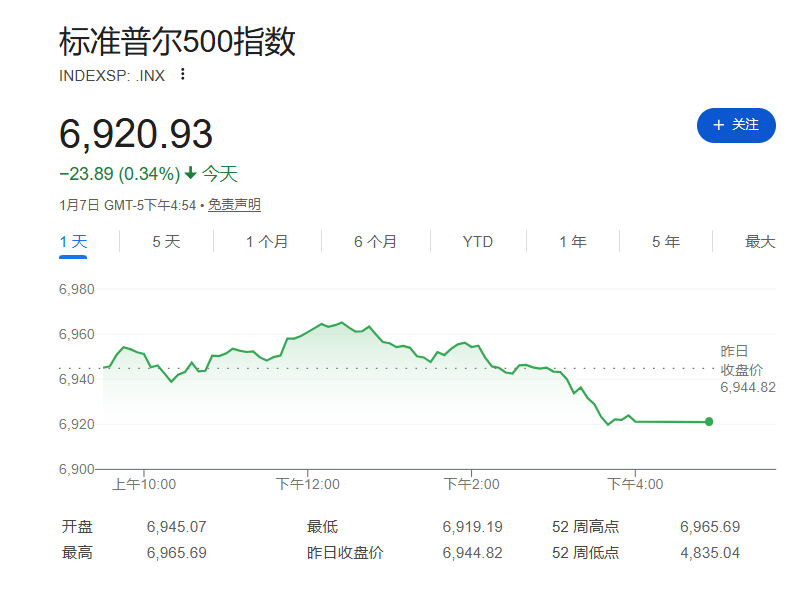
Market Overview - The S&P 500 and Dow Jones Industrial Average experienced declines after reaching intraday record highs earlier in the session [1] - The S&P 500 declined 0.34% to end at 6,920.93 points, while the Nasdaq gained 0.16% to 23,584.28 points, and the Dow Jones fell 0.94% to 48,996.08 points [6][7] Company Performance - Shares of housing acquisition companies fell sharply after President Trump announced plans to ban Wall Street investors from purchasing single-family homes, aiming to reduce home prices. Blackstone and Apollo Global Management dropped over 5%, contributing to a 1.4% decline in the S&P 500 financials index. American Homes 4 Rent fell 4.3%, while Zillow rose over 2% [1] - JPMorgan Chase fell 2.3% after Wolfe Research downgraded the bank from "outperform" to "peer perform" [2] - Northrop Grumman slid 5.5% and Lockheed Martin lost 4.8% following Trump's statement that dividends and stock buybacks would not be permitted for defense companies until production issues were resolved [4] - Nvidia and Microsoft rose about 1% each, and Alphabet increased more than 2% as investors returned to AI-related stocks [5][9] - Memory and storage technology companies saw declines, with Western Digital dropping almost 9% and Seagate Technology falling 6.7%. First Solar tumbled 10% after Jefferies downgraded its rating to "hold" from "buy" [7][9] Market Dynamics - The S&P 500 is currently trading at approximately 22 times expected earnings, down from 23 in November but above the five-year average of 19 [6][9] - The volume on U.S. exchanges was relatively high, with 17.4 billion shares traded, compared to an average of 16.2 billion shares over the previous 20 sessions [8]




禁止机构“买房”、限制军工“分红”,特朗普帖子搅动美股
Hua Er Jie Jian Wen· 2026-01-08 00:33
Core Viewpoint - The recent social media posts by President Trump have caused significant volatility in the U.S. stock market, particularly affecting the housing and defense sectors due to policy uncertainty [2][4]. Housing Sector - Trump announced plans to "immediately" prohibit large institutional investors from purchasing single-family homes, aiming to address housing affordability issues. This announcement led to panic selling in related stocks, including major private equity firms and large rental companies [2][4]. - The stock prices of major residential real estate investors like Blackstone and Invitation Homes saw significant declines, with Blackstone dropping as much as 9.3% during trading [6]. - Analysts express skepticism regarding the actual impact of institutional investors on housing affordability, noting that the largest 24 single-family rental owners only account for about 3.5% of the total rental market [10]. Defense Sector - Following the housing announcement, Trump targeted defense contractors, warning them against paying dividends or repurchasing stocks unless they accelerate production and maintenance of military equipment. This led to a decline in defense stocks, including RTX Corp. [8]. - However, after announcing a proposed military budget of $1.5 trillion for 2027, defense stocks rebounded in after-hours trading, indicating a mixed market reaction to Trump's statements [8][10]. Market Reaction - The S&P 500 index experienced a decline of 0.3% after initially approaching the 7000-point mark, reflecting the market's struggle to interpret the implications of Trump's rapid-fire social media communications [2][10]. - Market analysts highlighted the challenges of digesting information released directly via social media without any buffering, suggesting that this could lead to dangerous market adjustments [10].