沪农商行

Search documents
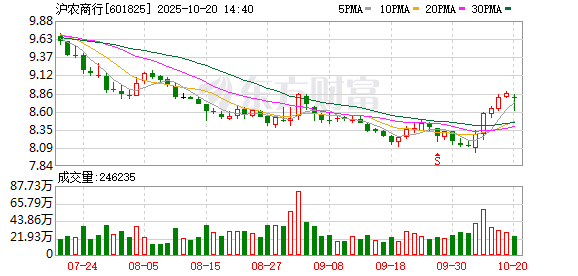
沪农商行:董事李冠莹因工作原因辞职
Xin Lang Cai Jing· 2025-10-20 08:11
Core Points - Shanghai Rural Commercial Bank announced the resignation of director Li Guanying due to work reasons [1] - Li Guanying's departure will not reduce the board members below the legal minimum and will not affect the normal operation of the board [1] - The company will express gratitude for Li Guanying's contributions during his tenure [1]
沪农商行亮相首届上海老年学习课程展
Xin Hua Cai Jing· 2025-10-20 06:40
在上海农商银行安享小屋健康服务体验区,远程健康问诊机具可供现场线上咨询,智能中医脉诊评估设 备、心脏评估仪器等健康检测可让参展老年人体验"心家园"更加精准的健康评估。"以前都是中医问 诊,没想到现在一个小小的仪器就可以评估健康情况,我们也来尝试新科技!"张阿姨对中医脉诊设备 非常感兴趣。 本次展会期间,上海农商银行融合"社区+教育+金融"模式,全方位展现老年教育办学特色和率先探索 体系化线下办学的创新成果。在课程展的"共享教室","心家园"老年大学《守好养老钱袋子》课程作为 2025年"上海市老年教育精品课程",以真实案例揭秘AI诈骗套路,提高银发群体法治意识和识诈反诈能 力。在"一网通学"线上课程展上,该校推出《名医进社区》《家庭教育》《沪剧》《守好养老钱袋子》 《养老规划》等百余门视频课程,为银发群体"云逛展""云学习"提供便利。此次老年学习课程展,也是 上海农商银行2025年敬老月"银发焕新彩,乐龄绽芳华"系列活动重要组成部分,是该行共建老年友好社 会的积极实践。 近年来,作为服务本市老年人最多的金融机构之一,上海农商银行积极贯彻"人民金融"理念,秉持"普 惠金融助力美好生活"使命,建设超千家"心家园" ...

区域银行高管互换那些事儿
3 6 Ke· 2025-10-20 02:59
Core Viewpoint - The article discusses the recent trend of leadership exchanges among major banks in China, particularly focusing on the mutual appointments of top executives between Chengdu Bank and Chengdu Rural Commercial Bank, as well as similar movements in Beijing and Shanghai banks, suggesting a potential industry trend towards such leadership rotations [1][15][22]. Group 1: Leadership Changes - Chengdu Bank and Chengdu Rural Commercial Bank announced a mutual exchange of their top executives, with Wang Hui resigning from Chengdu Bank and Huang Jianjun taking over as chairman [15][17]. - In Beijing, multiple executives have shifted roles among major banks, with significant movements including Mao Wenli's appointment as vice president of Beijing Bank from Beijing Rural Commercial Bank [2][7]. - Shanghai banks, including Shanghai Rural Commercial Bank and Shanghai Bank, have also seen leadership changes, with Wang Ming moving from Shanghai Bank to Shanghai Rural Commercial Bank as president [8][10]. Group 2: Executive Backgrounds - Wang Hui, former chairman of Chengdu Bank, has a long history in the banking sector, having joined in 2005 and led the bank to significant growth, including its listing on the stock exchange [18][20]. - Huang Jianjun, the new chairman of Chengdu Bank, has extensive experience within the bank, having held various positions before his recent appointment [20][22]. - In Shanghai, Gu Jianzhong, the new chairman of Shanghai Bank, has a deep understanding of the bank's operations, having worked there for over a decade before moving to Shanghai Rural Commercial Bank [10][12].




学无界 龄无限 沪农商行亮相首届上海老年学习课程展
Jin Rong Jie· 2025-10-20 02:44
"中奖信息勿要信,天上勿会落馅饼!要侬先交手续费,全是骗子设陷阱!""陌生电话要转账,侬 先冷静想一想,勿要急煞点链接,铜钿跑特哪能办!"2025首届上海老年学习课程展上,上海农商银 行"心家园"老年大学的C17展位循环播放着上海闲话反诈宣传标语以及反诈情景剧。亲切的沪语朗朗上 口,让驻足的阿姨爷叔边读边将反诈观念刻入心里。该校讲师现场授课,解析电信诈骗等真实案例场 景,帮助银发群体构筑金融安全防线。 本次展会期间,上海农商银行融合"社区+教育+金融"模式,全方位展现老年教育办学特色,体现 在金融同业中率先探索体系化线下办学的创新成果。在课程展的"共享教室","心家园"老年大学《守好 养老钱袋子》课程作为2025年"上海市老年教育精品课程",以真实案例揭秘AI诈骗套路,提高银发群体 法治意识和识诈反诈能力。在"一网通学"线上课程展上,该校推出《名医进社区》《家庭教育》《沪 剧》《守好养老钱袋子》《养老规划》等百余门视频课程,为银发群体"云逛展""云学习"提供便利。此 次老年学习课程展,也是上海农商银行2025年敬老月"银发焕新彩,乐龄绽芳华"系列活动重要组成部 分,是该行共建老年友好社会的积极实践。 近年来, ...
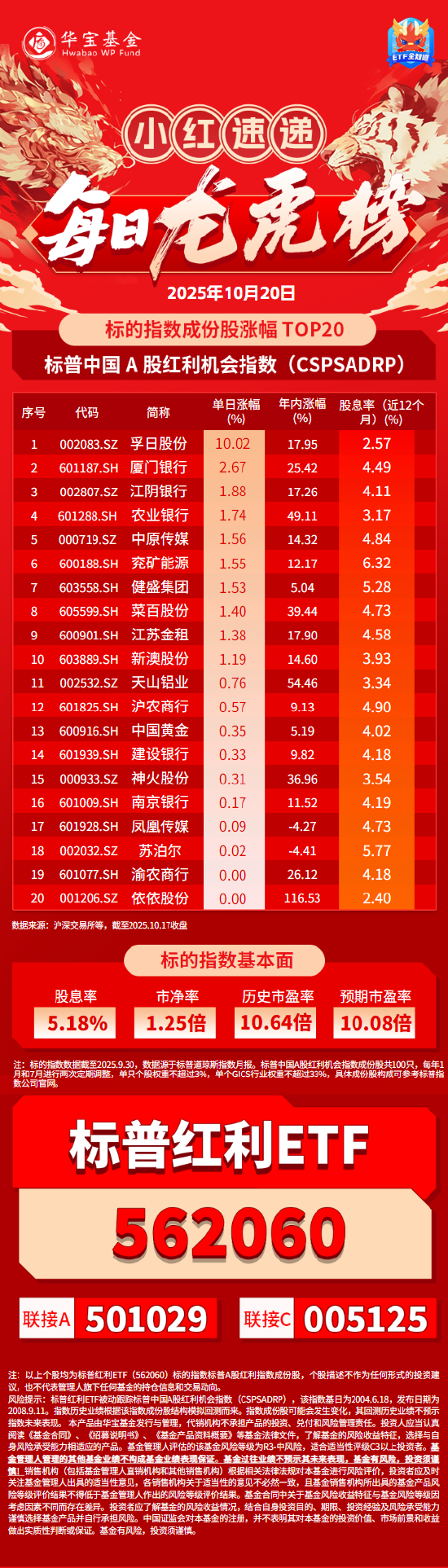
小红日报|标普红利ETF(562060)逆市秀肌肉!孚日股份涨停
Xin Lang Ji Jin· 2025-10-20 02:21
Group 1 - The article highlights the top 20 stocks in the S&P China A-Share Dividend Opportunity Index, showcasing their daily and year-to-date performance along with dividend yields [1][2] - The stock with the highest daily increase is Xingri Co., Ltd. (002083.SZ) with a rise of 10.02%, while the highest year-to-date performer is Yiyi Co., Ltd. (001206.SZ) with a remarkable increase of 116.53% [1][2] - The overall dividend yield for the index is reported at 5.18%, with a historical price-to-earnings ratio of 10.64 times and an expected price-to-earnings ratio of 10.08 times [2] Group 2 - The article mentions the formation of a MACD golden cross signal, indicating a positive trend for certain stocks [3]





中信证券:银行基本面稳定 绝对收益有望延续
智通财经网· 2025-10-20 00:19
Core Viewpoint - The macro-prudential management expansion and the enhancement of financial stability tools are expected to lead banks into a new phase of risk management, which will strengthen their balance sheets and accelerate the realization of net asset revaluation expectations [1][2]. Summary by Sections Macro-Prudential Management - The interview with the head of the Financial Stability Bureau of the People's Bank of China emphasizes the need to balance growth and risk prevention, expanding the macro-prudential management framework and enhancing the financial stability toolbox [2]. - Future regulations will likely deepen oversight of non-traditional banking activities, including wealth management and asset management subsidiaries [2]. Banking Sector Performance - The banking sector is expected to maintain a stable performance in Q3, with positive trends in interest margins and stable non-performing loan generation, although investment income may see a quarter-on-quarter decline [1][4]. - The KBW bank index experienced a significant drop due to concerns over credit risks in U.S. regional banks, leading to a market capitalization loss of over $100 billion for 74 major banks in a single day [3]. Stock Market Trends - Last week, both A-shares and H-shares in the banking sector outperformed the broader market, with notable gains in individual bank stocks, particularly Chongqing Bank and Agricultural Bank [4]. - The increase in mid-term dividends from banks, now reaching 17 institutions, contributes to the relative and absolute returns of bank stocks amid rising market uncertainties [4]. Investment Strategy - The banking sector is seen as offering significant value, with a shift towards alpha strategies in stock selection, focusing on companies with high and stable ROE and optimistic valuation space [1][4].

多家银行信用卡与直销银行App逐步关停
第一财经· 2025-10-19 13:46
Core Viewpoint - The banking industry's app integration trend is accelerating, with major banks like Beijing Bank and Bank of China consolidating their digital banking services into fewer applications, indicating a shift from quantity expansion to quality enhancement in digital strategies [3][4]. Group 1: App Integration Trends - Beijing Bank announced the closure of its direct banking app, integrating its functions into the "Jingcai Life" app, marking a significant move in the consolidation of independent banking apps [5]. - The credit card app sector is also experiencing rapid integration, with Bank of China migrating functions from its "Bountiful Life" app into its main app, signaling a trend among major banks to streamline their digital offerings [6]. - Smaller banks are following suit, with institutions like Beijing Rural Commercial Bank and Jiangxi Bank shutting down their credit card apps and merging functionalities into their primary mobile banking applications [6][7]. Group 2: Regulatory and Market Drivers - The app integration trend is driven by regulatory requirements and the need for improved user experience, as highlighted by the National Financial Regulatory Administration's directive to optimize and consolidate low-activity and redundant apps [9]. - High operational costs and low user engagement of standalone apps have become bottlenecks for banks' digital development, with data showing that the monthly active users of some banking apps are significantly lower than their main banking apps [10][11]. Group 3: Strategic Focus Post-Integration - Post-integration, banks are advised to focus on four key areas: reshaping mobile ecosystems, enhancing digital capabilities with AI and big data, expanding value-added services, and solidifying security and compliance foundations [12]. - The core of app integration is not merely about reducing the number of apps but optimizing the structure to improve operational efficiency and user engagement [12].

银行业瘦身,信用卡与直销银行App相继退场
Di Yi Cai Jing· 2025-10-19 12:52
Core Viewpoint - The banking industry is experiencing a trend of app integration, moving from a fragmented digital channel approach to a more centralized one, enhancing user experience and operational efficiency while shifting the digital strategy from quantity expansion to quality improvement [1][4]. Group 1: App Integration Trends - Several banks, including Beijing Bank and China Bank, have begun migrating functions from their direct banking and credit card apps to more centralized platforms, indicating a significant shift in the banking sector [2][3]. - The closure of independent direct banking apps is becoming a trend among both large and small banks, with institutions like Minsheng Bank and Kunlun Bank already having completed similar integrations [2][3]. - The integration of credit card apps is accelerating, with China Bank announcing the migration of its "Bountiful Life" app functions to its main app, marking a significant move in the industry [2][3]. Group 2: Regulatory and Market Drivers - The integration trend is driven by regulatory requirements and the need for improved user experience, as highlighted by the National Financial Regulatory Administration's directive to streamline low-activity and redundant apps [4]. - High operational costs and low user engagement of dispersed apps have become bottlenecks for digital development in banks, prompting a reevaluation of independent app strategies [5]. Group 3: Digital Transformation and User Behavior - The digital transformation of banks is entering a new phase focused on quality and efficiency, moving from merely adding functions to creating an integrated ecosystem [6]. - User behavior is shifting towards preferring a single app for comprehensive financial and lifestyle services, leading banks to recognize the importance of a unified digital experience [5][6]. Group 4: Future Directions Post-Integration - Post-integration, banks should focus on four key areas: reshaping mobile ecosystems, enhancing digital capabilities with AI and big data, expanding value-added services, and ensuring data security and compliance [7]. - The core of app integration is not just about reducing the number of apps but optimizing their structure to improve operational efficiency and user understanding [7].
银行三季报业绩增长可期
Xiangcai Securities· 2025-10-19 12:11
Investment Rating - The industry rating is maintained at "Overweight" [10][34] Core Views - The banking sector is expected to see positive growth in Q3, with revenue growth of 1.0% and net profit growth of 0.8% in the first half of the year, indicating a stabilization trend [8][32] - Credit growth has been slowing down due to a significant decrease in bill financing, reflecting a weakened demand for scale expansion among banks [8][32] - The introduction of new policy financial tools is anticipated to support medium to long-term corporate loans, improving the loan structure [8][33] - Deposit growth remains strong, which is expected to help stabilize funding costs and potentially lead to a recovery in net interest margins [8][33] Summary by Sections Industry Performance - The banking sector's performance has shown a relative return of 2.3% over the past month, with an absolute return of 1.5% [7] - The banking index increased by 4.89% during the period from October 13 to October 19, outperforming the CSI 300 index by 7.12 percentage points [12] Financial Metrics - The net interest margin decreased by 8 basis points in the first half of the year, but is expected to stabilize in the second half [8][33] - Non-interest income is projected to remain stable, supported by growth in intermediary business income and favorable market conditions for capital markets [9][32] Investment Recommendations - The report suggests focusing on state-owned banks for their stable high dividend yield and potential valuation recovery opportunities in joint-stock and regional banks [10][34] - Specific banks recommended include CITIC Bank, Jiangsu Bank, Chengdu Bank, Shanghai Rural Commercial Bank, Chongqing Rural Commercial Bank, Changshu Bank, and Suzhou Bank [10][34]
中小银行再撤退,广州银行撤回证券基金托管资格申请
Hua Xia Shi Bao· 2025-10-18 01:55
Core Viewpoint - The recent withdrawal of fund custody qualification applications by Guangzhou Bank and Chengdu Rural Commercial Bank reflects the impact of increased regulatory entry barriers set by the China Securities Regulatory Commission (CSRC) [2][5]. Group 1: Regulatory Changes - The CSRC raised the entry threshold for banks applying for fund custody qualifications, increasing the net asset requirement from 20 billion yuan to 50 billion yuan [5]. - The revised regulations also require institutions to have a regulatory rating of at least level 2 for commercial banks or A for securities companies over the past three years [5]. - As of October 10, only two institutions, Mengshang Bank and Dongwu Securities, remain in the queue for fund custody qualification applications [3][4]. Group 2: Market Dynamics - A total of 68 institutions currently hold fund custody qualifications, with 36 being banks, including 6 state-owned banks, 12 joint-stock banks, and 11 city commercial banks [3]. - The fund custody market is dominated by a few large banks, with the top 15 institutions holding a combined market share of 87.89% [7]. - The fund custody business is crucial for banks as it provides non-interest income, helping to optimize revenue structures and reduce reliance on traditional interest income [6][8]. Group 3: Financial Performance - Guangzhou Bank's net commission income has been declining since 2021, with a year-on-year decrease of 8.13%, 2.79%, and 13.59% for 2022, 2023, and 2024, respectively [6]. - The specific income from "custody and other entrusted business commissions" has also seen a significant drop, with a 44.65% decrease from 2023 to 2024 [6]. - Despite meeting regulatory asset size and rating requirements, Guangzhou Bank's public fund sales retention scale did not rank in the top 100 as of mid-2025 [5].