中国东航

Search documents
中国航司大面积调整日本航线,每周减少156航班
2 1 Shi Ji Jing Ji Bao Dao· 2025-11-24 13:40
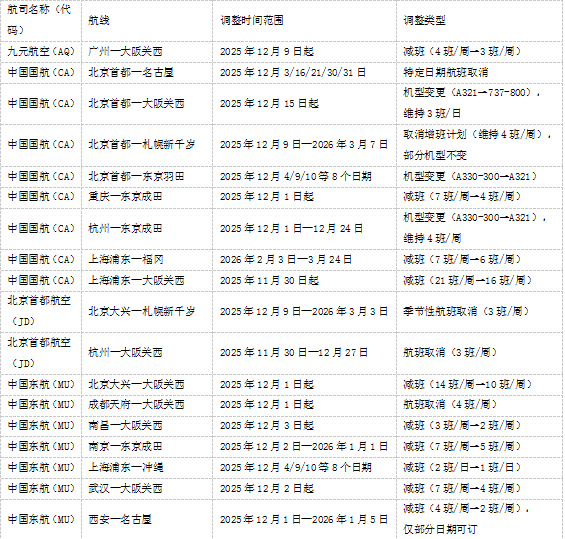
Core Insights - The impact of recent statements from the Japanese Prime Minister has led to significant reductions and cancellations of flights between China and Japan, affecting travel plans during peak seasons such as New Year and Spring Festival [1][2] Flight Reductions and Cancellations - Starting December 1, 16 Chinese airlines will reduce weekly flights to Japan by 156, with the most significant cuts from Juneyao Airlines, which will decrease its flights from 114 to 79 per week, a reduction of 31% [1] - China Southern Airlines, Shenzhen Airlines, and Eastern Airlines will also see reductions of 23, 22, and 18 flights per week, respectively [1] - The cancellation rate for planned flights to Japan is projected to reach 21.6% by November 27, with 12 routes canceling all flights [1][2] Specific Route Adjustments - High cancellation rates are noted on routes such as Tianjin Binhai to Kansai International (65.0%) and Nanjing Lukou to Kansai International (59.4%) [2] - Smaller airlines like Beijing Capital Airlines are canceling entire routes, such as the Beijing Daxing to Sapporo New Chitose, while Changlong Airlines is canceling all flights in December [2][3] Aircraft Type Adjustments - Airlines are also adjusting aircraft types, with Air China switching from larger Airbus A330-300 to smaller A321 on several routes, reducing passenger capacity [3] - Some airlines, like Shandong Airlines and Xiamen Airlines, have not made any adjustments to their Japan flight schedules [3] Pricing Implications - The reduction in flights is expected to increase travel costs for consumers planning trips to Japan during the winter season, with Spring Airlines raising minimum ticket prices significantly [3] Summary of Flight Adjustments - A detailed table outlines various airlines and their specific flight adjustments, including reductions and cancellations across multiple routes, effective from late November through March 2026 [4][5]



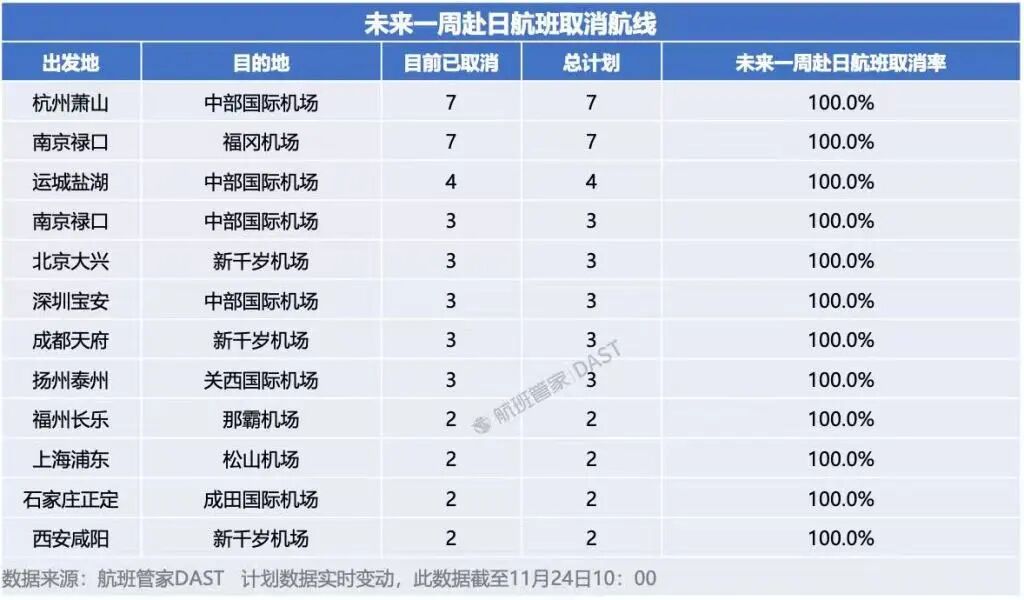
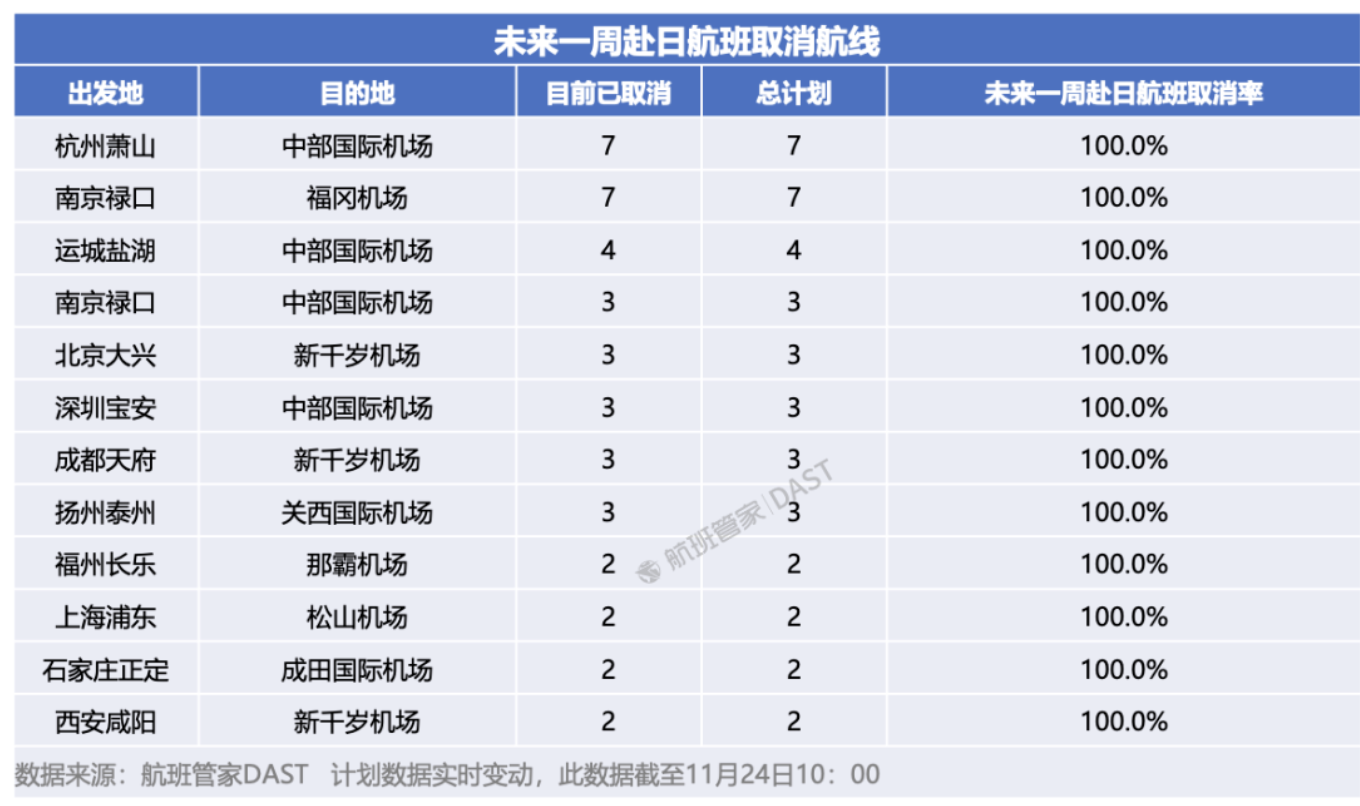
12条中日航线取消全部航班,涉名古屋、福冈、札幌、大阪等地!未来一周取消率将达1个月来最高值
Xin Lang Cai Jing· 2025-11-24 12:39
Core Viewpoint - A significant number of flights from China to Japan have been canceled, with a high cancellation rate expected in the coming weeks due to travel warnings and geopolitical tensions [1][5]. Flight Cancellations - As of November 24, 12 routes between China and Japan have canceled all flights, affecting cities like Nagoya, Fukuoka, Sapporo, and Osaka [1]. - The cancellation rate for planned flights to Japan is projected to reach 21.6% by December 27, the highest in a month [2]. - Routes with the highest cancellation rates include Tianjin Binhai to Kansai International (65.0%), Nanjing Lukou to Kansai International (59.4%), and Guangzhou Baiyun to Kansai International (31.3%) [2]. Government Warnings - Multiple Chinese government departments, including the Ministry of Foreign Affairs and the Ministry of Culture and Tourism, have issued warnings advising citizens to avoid travel to Japan [5]. - The Hong Kong government has also updated travel information, urging residents to remain vigilant if traveling to Japan [5]. Airline Adjustments - Chinese airlines are making significant adjustments to their Japan routes, with many flights being closed for booking [5]. - China International Airlines has canceled plans to increase flights from Beijing Capital to Sapporo from four to seven weekly [6]. - Other airlines, such as China Eastern Airlines and Spring Airlines, have also announced reductions in flight frequencies and cancellations across various routes to Japan [8][11][21]. Geopolitical Context - Recent controversial statements by Japan's new Prime Minister have sparked criticism and heightened tensions between China and Japan, contributing to the decline in travel [16].



12条中日航线取消全部航班,涉名古屋、福冈、札幌、大阪等地!未来一周取消率将达1个月来最高值
新浪财经· 2025-11-24 12:00
Core Viewpoint - The article highlights the significant cancellation of flights between China and Japan, primarily due to geopolitical tensions and travel advisories issued by Chinese authorities, leading to a drastic reduction in flight operations and future booking cancellations [9][4]. Flight Cancellations - As of November 24, 12 routes between China and Japan have canceled all flights, affecting cities like Nagoya, Fukuoka, Sapporo, and Osaka [2]. - The cancellation rates for specific routes are notably high, with 100% cancellations reported for several routes including Hangzhou to Central Japan and Nanjing to Fukuoka [3]. Future Cancellation Rates - The cancellation rate for planned flights to Japan is expected to reach 21.6% by December 27, marking the highest level in a month [4]. - Routes with the highest cancellation rates include Tianjin to Kansai International (65.0%) and Nanjing to Kansai International (59.4%) [4]. Airline Adjustments - Chinese airlines are making significant adjustments to their Japan routes, with many flights being closed for booking. This includes reductions in frequency and cancellations of previously planned increases in service [9][11][13]. - Specific adjustments include: - Air China reducing flights from Beijing to Sapporo from 7 to 4 weekly [11]. - China Eastern Airlines closing bookings for 6 out of 14 weekly flights from Beijing to Osaka [16]. - Spring Airlines canceling certain flights from Shanghai to Okinawa starting December 20 [25]. Overall Impact - The overall impact of these cancellations and adjustments indicates a substantial decrease in travel between China and Japan, driven by both political factors and operational decisions by airlines [9][4].

人民币升值受益板块11月24日跌0.55%,凯撒旅业领跌,主力资金净流出8047.44万元
Sou Hu Cai Jing· 2025-11-24 09:25
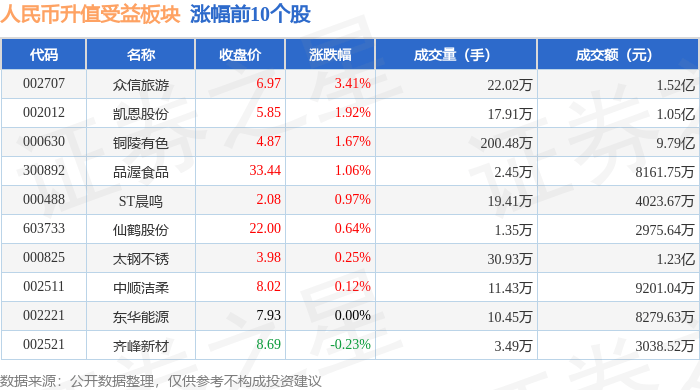
Core Insights - The Chinese yuan appreciated, leading to a decline of 0.55% in the benefiting sectors on the previous trading day, with Caesar Travel leading the losses [1][2] - The Shanghai Composite Index closed at 3836.77, up 0.05%, while the Shenzhen Component Index closed at 12585.08, up 0.37% [1] Sector Performance - The benefiting sector saw a mixed performance with notable gainers including: - Zhongxin Tourism (002707) with a closing price of 6.97, up 3.41% and a trading volume of 220,200 shares [1] - Kain Co. (002012) at 5.85, up 1.92% with a trading volume of 179,100 shares [1] - Tongling Nonferrous Metals (000630) at 4.87, up 1.67% with a trading volume of 2,004,800 shares [1] - Conversely, Caesar Travel (000796) experienced a significant drop of 6.69%, closing at 6.69 with a trading volume of 1,428,100 shares [2] Capital Flow Analysis - The benefiting sector experienced a net outflow of 80.47 million yuan from institutional investors, while retail investors saw a net inflow of 205 million yuan [2][3] - Notable capital flows included: - Tongling Nonferrous Metals (000630) with a net inflow of 114 million yuan from institutional investors [3] - Rongsheng Petrochemical (002493) with a net inflow of 42.31 million yuan from institutional investors [3] - Zhongxin Tourism (002707) with a net inflow of 13.34 million yuan from institutional investors [3]

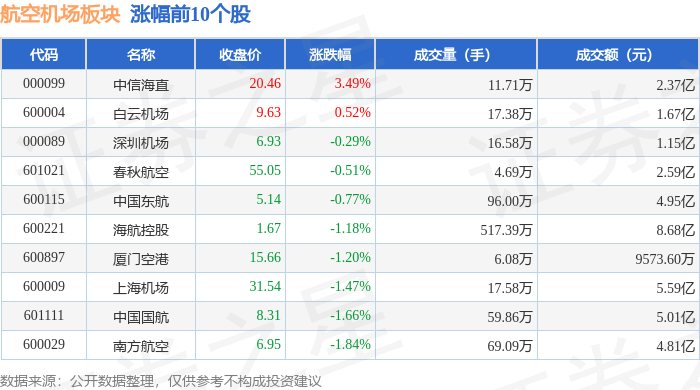
航空机场板块11月24日跌0.2%,吉祥航空领跌,主力资金净流出9081.93万元
Zheng Xing Xing Ye Ri Bao· 2025-11-24 09:12
证券之星消息,11月24日航空机场板块较上一交易日下跌0.2%,吉祥航空领跌。当日上证指数报收于 3836.77,上涨0.05%。深证成指报收于12585.08,上涨0.37%。航空机场板块个股涨跌见下表: | 代码 | 名称 | 收盘价 | 涨跌幅 | 成交量(手) | 成交额(元) | | | --- | --- | --- | --- | --- | --- | --- | | 000099 | 中信海直 | 20.46 | 3.49% | | 11.71万 | 2.37亿 | | 600004 | 白云机场 | 9.63 | 0.52% | | 17.38万 | 1.67亿 | | 000089 | 深圳机场 | 6.93 | -0.29% | 16.58万 | | 1.15亿 | | 601021 | 春秋航空 | 55.05 | -0.51% | 4.69万 | | 2.59亿 | | 600115 | 中国东航 | 5.14 | -0.77% | | 96.00万 | 4.95 乙 | | 600221 | 海航控股 | 1.67 | -1.18% | 517.39万 | | 8.68亿 | | ...
超50万张赴日机票被取消
Di Yi Cai Jing· 2025-11-24 08:58
Core Insights - The cancellation of flights on the China-Japan route has reached a critical level, with 12 routes canceling all flights as of November 24 [2][3] - The overall cancellation rate for planned flights from China to Japan has increased by approximately 56% compared to the same period last month [5] - The upcoming week is expected to see a peak cancellation rate of 21.6%, the highest in a month [6] Flight Cancellations - Specific routes with 100% cancellation include Hangzhou to Central International Airport, Nanjing to Fukuoka Airport, and several others [3] - Airlines such as Air China and Eastern Airlines are reducing their flight frequencies significantly, with Air China cutting its Shanghai to Osaka route from 21 to 16 flights per week [4] - The top routes with the highest cancellation rates include Tianjin to Kansai International (65.0%) and Nanjing to Kansai International (59.4%) [8] Impact on Tourism - The cancellation of flights has led to a significant drop in ticket bookings, with a reported decrease of 29% in bookings for the next 60 days compared to November 15 [9] - Approximately 543,000 flight orders have been canceled since the announcement of free cancellation policies for flights to Japan [9] - Japanese tourism operators are facing increased pressure due to the decline in Chinese tourists, with many tour groups canceling their trips during what is typically a busy season [10] Shift in Travel Preferences - As travel to Japan declines, there is a noticeable shift towards South Korea and Southeast Asia as alternative destinations for Chinese tourists [11] - Data indicates that South Korea has become a popular destination, with a significant increase in flight searches and bookings [12] - Other countries, including Thailand and Russia, are actively promoting their destinations to attract Chinese tourists [12]

中日航线大面积停售!在日中文导游:下个月要带的大陆团都取消了
Di Yi Cai Jing· 2025-11-24 08:25
Core Points - The cancellation of flights on the China-Japan routes has significantly increased, with 12 routes canceling all flights as of November 24, leading to a 56% increase in cancellations compared to the same period last month [1][2][6] - The majority of cancellations are affecting leisure travelers, particularly to Osaka, while business travel to Tokyo remains relatively stable [6][7] - The decline in flight bookings to Japan has resulted in a 29% decrease in ticket reservations since the announcement of free cancellation policies on November 15 [6][8] Flight Cancellations - A total of 12 routes have canceled all flights, with airlines like Air China and Eastern Airlines reducing their weekly flights significantly [1][2] - The highest cancellation rates are observed on routes such as Tianjin Binhai to Kansai International (65.0%) and Nanjing Lukou to Kansai International (59.4%) [5] Impact on Tourism Industry - Japanese tourism operators are facing increased pressure due to the drop in Chinese tourists, with many tour groups canceling their trips during what is typically a busy season [7][8] - The demand for travel from mainland China has decreased, particularly affecting hotel bookings and tour operations [8] Shift in Travel Preferences - As travel to Japan declines, there is a potential shift of Chinese tourists towards South Korea and Southeast Asia, with destinations like Thailand and Vietnam seeing a recovery in flight volumes [9][10] - South Korea has emerged as a popular destination, with a significant increase in flight searches and bookings [9]
中日间计划航班量取消量较上月同期增长约56%
Yang Shi Xin Wen· 2025-11-24 07:07
11月15日,国、东、南三大航公布涉及日本航线客票的特殊方案后,国内航司到日本的机票预订量呈现 下降态势。截至目前,国内航司(非九元春秋)未来60天国内至日本的机票预订量比11月15日的未来60 天机票预订量减少约29%。 记者今天从航旅纵横了解到,截至目前,11月24日到12月31日国内到日本的计划航班量取消量较上月同 期增长约56%。 (文章来源:央视新闻) ...
国泰海通:换季后航空行业量价保持双升 国际线票价同比大涨
智通财经网· 2025-11-24 06:16
Core Viewpoint - The aviation industry is expected to significantly reduce losses in November, with strong year-on-year growth in commercial demand and rising passenger load factors and domestic ticket prices [1][2]. Group 1: Industry Performance - In October, the aviation industry saw a year-on-year increase in ASK (Available Seat Kilometers) by 6%, RPK (Revenue Passenger Kilometers) by 9%, and passenger volume by 6%, with domestic growth at 4% and international growth at 20% [2]. - The passenger load factor improved by 2.2 percentage points to 87.4%, and domestic ticket prices rose by 3-4% compared to September [2]. - The overall performance of A-share airlines in Q3 2025 showed a counter-cyclical growth, marking the third consecutive year of performance exceeding Q3 2019, indicating a potential upward trend in profitability [1][2]. Group 2: International Routes - The international passenger load factor for September and October is estimated to exceed 80%, matching the peak season, with a year-on-year increase of over 3 percentage points, leading to a significant rise in international ticket prices, particularly for European routes [3]. - The ongoing benefits from visa-free policies and the construction of international transit hubs are expected to enhance long-term profitability for airlines [3]. Group 3: Market Dynamics - The decline in passenger flow on Japanese routes is anticipated to have a limited impact on the industry's profitability during the off-peak season, as the overall contribution of Japanese routes to the airlines' ASK is relatively small [4]. - Domestic trunk routes remain the core profit source for traditional airlines, and the performance of Japanese routes is not expected to alter the long-term growth logic of the aviation industry [4]. Group 4: Future Outlook - The Chinese aviation industry is poised to enter a "super cycle," driven by a significant increase in the profitability baseline as supply and demand recover, with a focus on high-quality networks for traditional airlines [5]. - Strategic investment opportunities are recommended, with a focus on companies like Air China, Juneyao Airlines, China Eastern Airlines, China Southern Airlines, and Spring Airlines [5].


12条中日航线取消全部航班,涉名古屋、福冈、札幌、大阪等地!未来一周取消率将达1个月来最高值!央视:高市早苗公然挑衅必将自取灭亡
Mei Ri Jing Ji Xin Wen· 2025-11-24 05:51
Group 1 - The core point of the article is the significant cancellation of flights from China to Japan due to rising tensions following controversial remarks made by Japan's new Prime Minister, which have led to diplomatic warnings and travel advisories from Chinese authorities [1][7][30] Group 2 - As of November 24, 12 routes between China and Japan have canceled all flights, affecting cities such as Nagoya, Fukuoka, Sapporo, and Osaka [1] - The cancellation rate for planned flights to Japan is expected to reach 21.6% by December 27, the highest in a month, with routes like Tianjin to Kansai seeing a 65% cancellation rate [3] - Major Chinese airlines have begun adjusting their flight schedules to Japan, with many flights being closed for booking [7][9][10] Group 3 - Specific flight cancellations include routes from Beijing to Sapporo, which will reduce from 7 to 4 weekly flights, and from Shanghai to Osaka, which will decrease from 21 to 16 weekly flights [8][9][10] - The overall impact on the airline industry includes a significant portion of flights being suspended, with approximately 24% of planned flights on certain routes no longer accepting bookings [11] Group 4 - The situation has prompted various responses from Chinese authorities, including travel advisories and the suspension of cultural exchanges, aimed at protecting national interests [27][30] - The broader implications of these cancellations reflect heightened geopolitical tensions and the potential for further disruptions in travel and trade between China and Japan [30]