信泰人寿

Search documents
险企偿付能力分化一季度加剧:5家不达标,14家未披露
Nan Fang Du Shi Bao· 2025-06-06 04:13
Core Insights - The insurance industry in China shows overall compliance with solvency requirements, but significant differentiation among companies is evident, with five companies flagged for inadequate solvency [2][3][4] - The solvency ratios for the industry are robust, with a comprehensive solvency adequacy ratio of 204.5% and a core solvency adequacy ratio of 146.5% as of Q1 2025, well above regulatory thresholds [3][4] - A total of 14 insurance companies have not disclosed their solvency reports for Q1 2025, raising concerns about their operational status and governance [6][7] Industry Performance - The solvency performance of over 160 insurance companies was reviewed, revealing that 56 companies achieved an A-class risk rating, while nearly 100 were rated B-class, indicating improved risk management capabilities [3][4] - Notable performers include China Life, which maintained an A-class rating for 26 consecutive quarters, with a core solvency ratio of 146.12% and a comprehensive solvency ratio of 199.34% [3][4] Underperforming Companies - Five companies, including Huahui Life and four property insurance firms, received a C-class risk rating, indicating significant operational challenges [4][5] - Huahui Life has consistently been rated C-class for over ten quarters due to governance issues and operational risks, despite having solvency ratios of 1999.59% and 2013.65%, which are exceptionally high [5] - The recent downgrade of APT Property Insurance from B-class to C-class is attributed to shareholder and governance issues [4][5] Disclosure Issues - Fourteen companies have not disclosed their solvency reports, with reasons ranging from transitional policy applications to internal adjustments and regulatory investigations [6][7] - Companies like Jun Kang Life and Shanghai Life, which have not disclosed reports for extended periods, are viewed as potential risk signals due to aggressive investment strategies [7] Industry Trends - In the context of a low-interest-rate environment, 36 companies reported a decline in solvency ratios, indicating systemic challenges within the industry [8][9] - The total capital increase across various insurance companies has exceeded 530 billion yuan in 2025, with additional capital plans in progress [9][10] - Experts suggest that insurance companies need to shift from broad expansion to refined management practices to enhance operational quality and navigate industry differentiation [10]


国资入股后又迎管理层“大换血”,信泰人寿十余年“连环劫”终告落幕
Hua Xia Shi Bao· 2025-05-13 04:45
Core Points - Xintai Life Insurance is undergoing significant management changes following the entry of Zhejiang state-owned assets, marking a new chapter for the company [2][7] - The company has faced a tumultuous history, including regulatory issues and financial mismanagement, leading to a series of ownership changes and governance challenges [3][4][5] - Recent capital injection of approximately 93.73 billion yuan has resulted in a new shareholding structure, with state-owned enterprises becoming the major stakeholders [7][8] Management Changes - A recent management overhaul involved 16 personnel changes, with 9 individuals stepping down from key positions and 7 new appointments made [2][9] - Key departments such as finance, risk management, and compliance have seen significant leadership changes, indicating a strategic shift in operations [9] Historical Context - Xintai Life was established in 2007 but has struggled with solvency issues and regulatory scrutiny, leading to multiple interventions by the China Insurance Regulatory Commission [3][4] - The company has experienced a series of ownership changes, with significant stakes being transferred among various entities, including a period of control by Baoshang Bank [4][5][6] Recent Developments - In September 2023, Xintai Life announced a capital increase plan to raise approximately 52.04 billion yuan, which was approved in January 2024, enhancing its registered capital to about 102 billion yuan [7][8] - The new major shareholders include state-owned enterprises, which are expected to help stabilize the company's operations and improve its financial health [7][8] Financial Performance - Xintai Life reported insurance revenue of 489.9 billion yuan in 2021 and 483 billion yuan in 2022, with net profits of 1.02 billion yuan and 2.26 billion yuan respectively [9] - However, the company reported a net loss of 4.63 billion yuan in the first half of 2023, indicating ongoing financial challenges despite the recent capital injection [9]


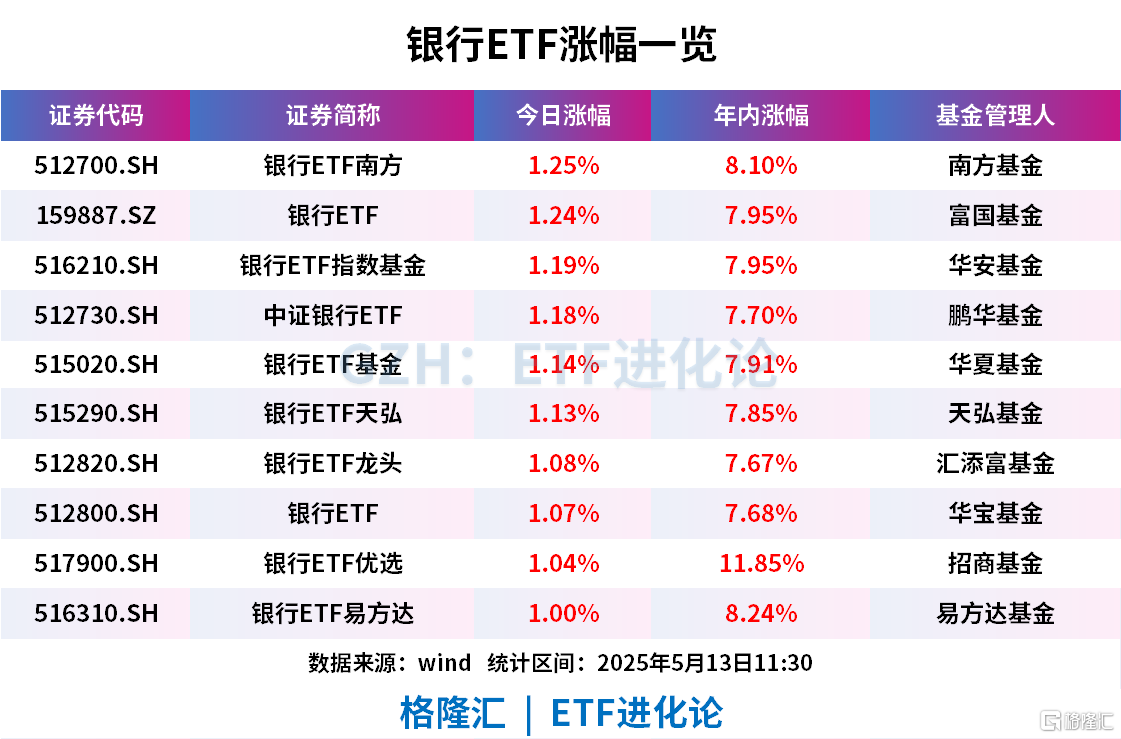
险资“爆买”银行股,银行ETF南方、银行ETF、中证银行ETF上涨
Ge Long Hui A P P· 2025-05-13 03:54
Market Overview - The A-share market showed mixed performance with the Shanghai Composite Index up by 0.08% at 3371.86 points, while the Shenzhen Component Index and the ChiNext Index fell by 0.24% and 0.23% respectively, and the North Star 50 Index decreased by 0.37% [1] - The total trading volume for the market reached 907.2 billion yuan, an increase of 43.4 billion yuan compared to the previous day, with over 3400 stocks declining [1] Banking Sector Performance - Bank stocks collectively strengthened, with several banks such as Shanghai Pudong Development Bank, Shanghai Bank, Jiangsu Bank, and Chengdu Bank reaching historical highs [1] - Various bank ETFs, including Southern Bank ETF, Fortune Bank ETF, and Huaxia Bank ETF, experienced increases in their indices [1] Insurance Investment in Banking Stocks - Insurance capital has made at least 13 significant investments in banking stocks this year, with six of these being direct investments in banks, including Agricultural Bank of China and Postal Savings Bank [5] - As of May 8, 2025, insurance capital held bank stocks valued at 0.69 trillion yuan, an increase of 0.16 trillion yuan from the end of 2023, indicating a strategic shift towards banking stocks due to their dividend yields and regulatory advantages [6] Future Outlook for Banking Sector - The banking sector is expected to benefit from intensified fiscal policies and a supportive monetary environment, which will positively impact credit growth and economic expectations [7] - The year 2025 is anticipated to be crucial for improving asset quality in banks, with expectations of reduced risks in real estate and local investment properties [7]



大股东物产中大带来哪些变化?信泰人寿经营状况依然成谜
Xin Lang Cai Jing· 2025-04-29 12:17
Core Viewpoint - The financial performance of Wuchan Zhongda (物产中大) in 2024 shows a slight increase in revenue but a significant decline in net profit, raising concerns about the company's financial health and the ongoing issues within its key affiliate, Xintai Life Insurance (信泰人寿) [1][9]. Financial Performance - Wuchan Zhongda reported a revenue of 599.52 billion yuan in 2024, representing a year-on-year growth of 3.34% [1]. - The net profit attributable to shareholders was 3.079 billion yuan, reflecting a year-on-year decrease of 14.88% [1]. - The financial services segment of Wuchan Zhongda generated revenue of 16.087 billion yuan, accounting for 2.68% of total revenue, with a profit contribution of 8.44 billion yuan, or 13.01% [1]. Xintai Life Insurance Developments - Xintai Life has undergone significant personnel changes, with 16 management positions affected, including the resignation of 9 key executives and the appointment of 7 new ones [3][4]. - The company has not disclosed its net profit data for six consecutive quarters, raising concerns about its operational transparency [1][9]. - Xintai Life's insurance business revenue decreased by 1.11% to 52.994 billion yuan in 2024, alongside a significant cash outflow from universal insurance accounts exceeding 7 billion yuan in a single quarter [9]. Historical Context and Challenges - Xintai Life has faced numerous challenges since its inception in 2007, including governance issues and significant changes in ownership due to financial crises [6][7]. - The company has experienced a series of major personnel changes, particularly after the entry of state-owned capital, which is seen as a potential opportunity for reform [8]. - The company is under pressure from upcoming maturity payouts of several insurance products, which could strain its cash flow [9][10]. Strategic Implications - The involvement of state-owned enterprises in Xintai Life's capital structure is intended to enhance its financial stability and operational efficiency, but internal restructuring is still ongoing [8]. - The company aims to integrate insurance investments with its broader financial services, particularly in the aging services sector, to improve its competitive edge [8].
南极电商(002127) - 2025年4月25日投资者关系活动记录表
2025-04-27 10:02
Group 1: Company Performance and Strategy - The company aims for long-term business sustainability, rejecting short-term competition and low-quality products [2] - In 2024, the company plans to restore high-quality products, with positive consumer feedback on new packaging and quality [2] - As of April 2025, the company has nearly 1,000 online stores, with 400 newly opened in 2025, aiming to reach around 2,000 by year-end [2] Group 2: Product and Market Development - The company’s light luxury series includes men's, women's, and underwear categories, with over 2,600 SKUs from franchise partners [4] - The company expects high-quality growth in GMV for 2025 compared to 2024 [4] - The company plans to open its first fixed store in June 2025, focusing on a limited number of high-quality products [3] Group 3: Marketing and Sales Channels - The company will adopt a more rational approach to marketing expenditures in 2025, aiming to enhance efficiency [6] - The overall GMV growth for the brand remains around 30%, with a significant increase in sales on the Alibaba platform [7] - The company is exploring partnerships with retail formats in Shanghai and surrounding areas for multi-category stores [8] Group 4: Financial Performance - The gross profit margin for the company's sales in 2024 is projected to be around 10% [6] - The company reported a net profit of 3,335.74 million yuan for the previous year [8] - The company’s GMV profit conversion rate is not directly comparable to previous years due to changes in revenue structure [6]

中高层人事大换防,9人卸任、7人调整,信泰人寿能否重开新局?
Sou Hu Cai Jing· 2025-04-25 06:56
董事会大换血后,今年上半年财务、人力、风管等中高层换防。 文/每日财报 栗佳 近日,关于信泰人寿上演一场中高层人事"大洗牌"的消息在保险圈内引起轩然大波,一方面,信泰人寿内部重大人事调整涉及多位核心高层管理人员,波 及面及影响力较广;另一方面,这轮调整距2024年7月该公司高层 "大换血"才不到9个月的时间,如此频繁且较大规模的高管人事换防,这在保险行业里 算是非常少见的。 当然,每一次高管人事调整的背后其实都与股东博弈密不可分,亦或是整个公司层面战略转化下所带来的必然结果。 从该维度来分析,信泰人寿一直以来持续进行的高管人事频繁换防,也是符合以上逻辑的,要知道作为浙江民营保险领域的先行者,信泰人寿自成立以来 的二十多年时间里便一直深陷资本博弈的漩涡,此前其股权架构背后暗藏的"明天系"金融版图操控痕迹尚未消退,又于原掌门人邹平笙治理下爆出高达 160亿元的违规资金腾挪丑闻,一系列股权代持暗流、关联交易迷局及资金挪用漩涡,使信泰人寿始终徘徊在监管风暴眼的中心地带。 直至2023年国资入驻及2024 年物产中大系全面进驻董事会后,信泰人寿才在形式上完成了股权重构,开始踏上新征程。而在这一系列股权动荡之路上, 信泰 ...