Atlassian

Search documents
繁荣之下,全是代价:硅谷顶级VC深入300家公司战壕,揭秘成本、路线、人才、产品四大天坑
AI科技大本营· 2025-07-07 08:54
Core Insights - The report titled "The Builder's Playbook" by ICONIQ Capital reveals the dual nature of the AI boom, highlighting both the rapid advancements and the significant challenges faced by builders in the AI space [1][2]. Group 1: Product Strategy - Builders in the AI sector must choose between being "AI-Native" or "AI-Enabled," with AI-Native companies showing a higher success rate in scaling [6][7]. - AI-Native companies have a 47% scaling rate, while only 13% of AI-Enabled companies have reached this stage [6]. Group 2: Market Strategy - Many AI-enabled companies offer AI features as part of higher-tier packages (40%) or for free (33%), which is deemed unsustainable in the long run [30][31]. - The report emphasizes the need for companies to develop telemetry and ROI tracking capabilities to justify pricing models based on usage or outcomes [38]. Group 3: Organizational Talent - Companies with over $100 million in revenue are more likely to have dedicated AI/ML leaders, with the percentage rising from 33% to over 50% as revenue increases [47][51]. - There is a high demand for AI/ML engineers (88%), with a long recruitment cycle of 70 days, indicating a talent shortage in the industry [54][56]. Group 4: Cost Structure - In the pre-launch phase, talent costs account for 57% of the budget, but this shifts dramatically in the scaling phase, where infrastructure and cloud costs become more significant [66][67]. - The average monthly inference cost for high-growth companies can reach $2.3 million during the scaling phase, highlighting the financial pressures associated with AI deployment [68][71]. Group 5: Internal Transformation - While 70% of employees have access to internal AI tools, only about 50% actively use them, indicating a gap between tool availability and actual usage [76][79]. - Programming assistants are identified as the most impactful internal AI application, with high-growth companies achieving a 33% coding rate assisted by AI [81][84].


澳洲年度富豪榜最新变化!看看富豪们的财富都来自于哪些行业?
Sou Hu Cai Jing· 2025-06-19 02:25
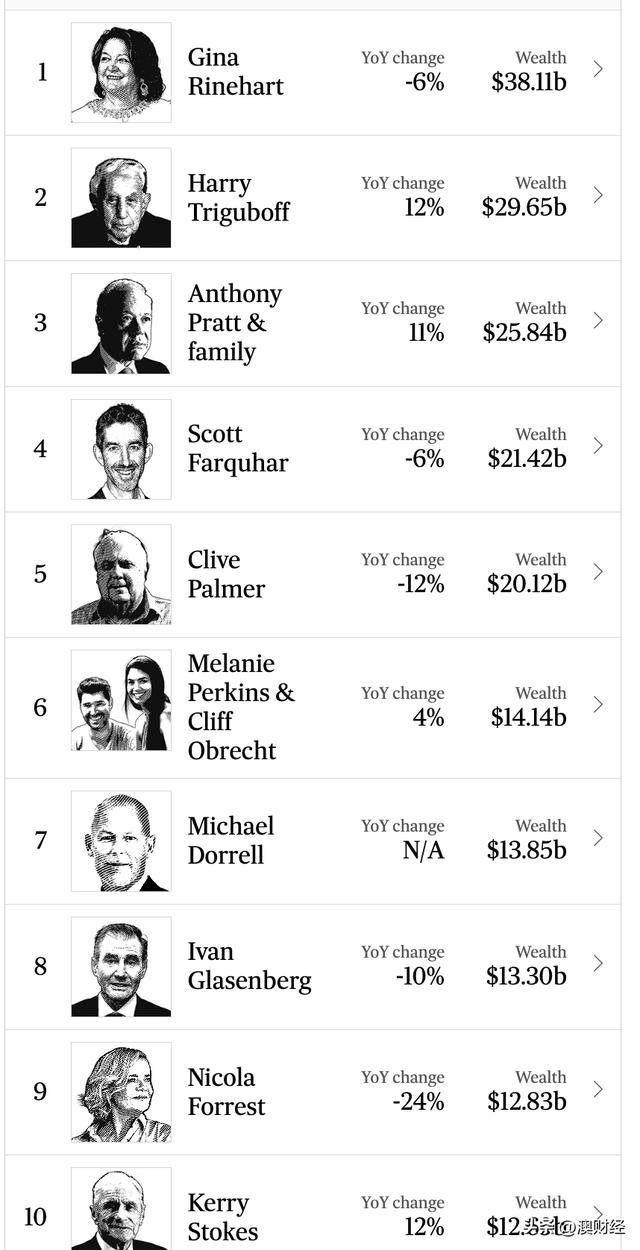
Summary of the 2025 Australian Rich List Core Insights - The total wealth of Australia's top 200 billionaires increased by 6.9% to AUD 667.8 billion despite a challenging economic environment. The top ten billionaires hold a combined wealth of AUD 202 billion, representing 11% of Australia's GDP [1]. Group 1: Wealth Distribution and Industry Representation - The threshold to enter the top 200 list reached a record high of AUD 747 million, with ten newcomers, of which only one inherited wealth [3]. - The mining and resources sector remains dominant, with 24 billionaires in this field, accumulating AUD 141.3 billion, although this represents a 4.6% decline from the previous year [4]. - The top ten billionaires include four from the mining sector, with Gina Rinehart leading at AUD 38.1 billion, while others like Clive Palmer and Ivan Glasenberg saw significant wealth reductions due to falling commodity prices [4]. Group 2: Emerging Industries - The technology sector is rapidly becoming a new wealth engine, with 22 billionaires and a total valuation of AUD 105.9 billion, ranking third among industries [6]. - Notable tech figures include Melanie Perkins and Cliff Obrecht of Canva, who rose to sixth place with AUD 14.1 billion, and Scott Farquhar of Atlassian, who ranked fourth with AUD 21.4 billion [7]. Group 3: Real Estate Sector - The real estate sector has the highest number of billionaires at 48, contributing AUD 125.8 billion, with Harry Triguboff of Meriton Group ranking second overall with AUD 29.65 billion [9][12]. - Triguboff's company is recognized for its significant contributions to high-density residential development in Australia [12]. Group 4: Newcomers and Notable Investments - Michael Dorrell, co-founder of Stonepeak, entered the list at seventh place with AUD 13.85 billion, marking the highest valuation for a newcomer in the list's history [13]. - Stonepeak's recent investments in energy infrastructure, including a significant stake in LNG facilities, highlight the growing importance of energy investments [13]. Group 5: Manufacturing and Diversified Businesses - Anthony Pratt, ranked third, has a wealth of AUD 25.85 billion from Visy Industries and Pratt Industries, focusing on sustainable products and significant investments in the U.S. manufacturing sector [16]. - Kerry Stokes, with a diversified business empire through Seven Group Holdings, returned to the top ten with a net worth of AUD 12.69 billion, despite challenges in energy and media sectors [18].
澳洲最强独角兽Canva冲刺上市,估值直逼500亿
Sou Hu Cai Jing· 2025-06-18 13:55
Core Viewpoint - Canva, one of Australia's most successful startups, is preparing to test its AUD 49 billion (approximately USD 32 billion) valuation through a highly anticipated equity transfer transaction, likely representing its last round of private share sales before going public [1][3]. Group 1: Equity Transfer and Valuation - Canva's co-founders are discussing an internal share transfer plan with a few key shareholders, aiming to provide a platform for early employees to sell some shares before Christmas this year [3]. - The transaction is still in preliminary stages, with the scale yet to be determined and broader shareholders not yet informed [3]. - Last year, Canva engaged Goldman Sachs and Morgan Stanley to facilitate a share transfer for early shareholders and employees, which totaled USD 1.6 billion at a valuation of USD 26 billion, significantly lower than its pre-rate hike peak of USD 40 billion [3][4]. Group 2: Future IPO and Market Position - In October of last year, Canva showcased a valuation of USD 32 billion based on an undisclosed share transfer, which did not raise new capital [4]. - The co-founders are expected to push for a sale at a valuation higher than USD 32 billion, likely marking the last round of financing as a private company before an anticipated IPO in the U.S. by 2026 [4]. - Canva's potential IPO would align it with another Australian software success, Atlassian, which went public on NASDAQ ten years ago [4]. Group 3: Strategic Growth and Acquisitions - Canva has expanded its product line through strategic acquisitions, including the purchase of London-based data visualization platform Flourish, Austrian background removal tool company Kaleido, and product display generation tool Smartmockups [5]. - The company made its largest acquisition to date by purchasing UK software company Serif for USD 1 billion, whose Affinity products directly compete with Adobe's photo editing software [5]. - Initially, Canva grew organically by providing better tools for small businesses and professional designers compared to traditional software like Adobe [5].

金十图示:2025年05月29日(周四)全球主要科技与互联网公司市值变化
news flash· 2025-05-29 03:08
Market Capitalization Changes - The market capitalization of major global technology and internet companies has shown varied changes as of May 29, 2025, with notable fluctuations in percentage terms [1][3][4]. - Companies like Tencent and Alibaba experienced declines of 2.3% and 2.33% respectively, while Oracle saw an increase of 1.2% [3][4]. Company Performance - Notable performers include Palantir with a slight increase of 0.3% and Adobe maintaining a stable position with a market cap of $1.76 billion [4][5]. - Companies such as AMD and Uber reported declines of 1.48% and 0.83% respectively, indicating a challenging market environment for these firms [3][5]. Sector Insights - The semiconductor sector remains under pressure, with companies like Intel and Micron showing declines of 0.88% and 0.21% respectively, reflecting ongoing challenges in the industry [5][6]. - Conversely, companies like SK Hynix and Keyence reported slight increases, suggesting some resilience within specific segments of the technology sector [5][6]. Emerging Trends - The data indicates a mixed outlook for the technology sector, with some companies like Shopify and Spotify showing positive growth trends, while others face headwinds [4][7]. - The overall market sentiment appears cautious, with several companies experiencing minor fluctuations in their market valuations [3][4].

金十图示:2025年05月02日(周五)全球主要科技与互联网公司市值变化
news flash· 2025-05-02 03:04
Group 1: Market Capitalization Changes - Tesla's market capitalization is $903.5 billion, with a slight decrease of 0.58% [3] - TSMC's market capitalization is $895.8 billion, showing an increase of 3.62% [3] - Tencent's market capitalization stands at $562.7 billion, with a minor increase of 0.41% [3] - Netflix's market capitalization is $482.3 billion, reflecting a slight increase of 0.15% [3] - Oracle's market capitalization is $407.9 billion, with an increase of 3.39% [3] Group 2: Notable Companies and Their Performance - Alibaba's market capitalization is $291.7 billion, with an increase of 0.92% [3] - Palantir's market capitalization is $274.1 billion, showing a decrease of 1.89% [3] - ASML's market capitalization is $262.1 billion, with a slight decrease of 0.2% [3] - Cisco's market capitalization is $231.2 billion, reflecting an increase of 0.68% [3] - IBM's market capitalization is $222.7 billion, with a decrease of 0.89% [3] Group 3: Emerging Trends - Adobe's market capitalization is $159.6 billion, with no significant change reported [4] - AMD's market capitalization is $157.0 billion, showing an increase of 0.72% [4] - Qualcomm's market capitalization is $149.5 billion, reflecting a notable increase of 8.92% [4] - Shopify's market capitalization is $125.3 billion, with an increase of 2.12% [4] - Airbnb's market capitalization is $77.0 billion, showing an increase of 1.71% [5] Group 4: Additional Insights - JD.com's market capitalization is $48.1 billion, with an increase of 0.71% [7] - Cloudflare's market capitalization is $42.4 billion, reflecting an increase of 1.52% [7] - Zscaler's market capitalization is $35.1 billion, with a slight increase of 0.39% [8] - HubSpot's market capitalization is $32.8 billion, showing an increase of 2.05% [8] - CoStar Group's market capitalization is $32.2 billion, reflecting an increase of 3.25% [8]

前瞻|全球SaaS云计算:需求趋稳,短期关注宏观预期改善、AI商业化进展
中信证券研究· 2025-03-21 00:03
文 | 陈俊云 近期市场对美国经济"滞胀"叙事的交易导致美股软件板块跟随市场出现大幅回调,但3 8家主流美 股软件公司2 0 2 4Q4财报显示,经历了过去三年的需求泡沫出清之后,欧美企业客户软件需求整体 趋于稳定,或呈现缓慢复苏迹象,部分软件企业2 0 2 5Q1和2 0 2 5全年偏保守的业绩指引亦和板块既 往的习惯相符,但近期特朗普政府系列政策对宏观的影响和预期扰动令市场明显担忧,需要谨慎关 注。投资节奏上,短期市场恢复趋势性的上行仍需要宏观不确定性的消除,AI在企业市场的商业 化部署,叠加企业云计算需求的持续向上料将使得基础软件板块在2 0 2 5H1显著受益,同时伴随宏 观预期的企稳,以及AI商业化收益的逐步体现,我们认为应用软件业绩有望在2 0 2 5H2显著改善。 ▍ 报告缘起: 参考软件板块2 0 2 4年四季报整体的业绩&指引,以及各公司对于下游需求环境的表述,我们判断 欧美企业IT支出短期仍将呈现稳步复苏态势。但近期特朗普政府在关税政策、政府部门裁员&预 算削减等层面的系列举措正在对美国宏观经济增长、通胀预期等构成持续的噪音和扰动,同时部 分软件企业较为保守的业绩指引等亦在一定程度上加剧了 ...

Atlassian: A Compelling Path Forward To Growth
Seeking Alpha· 2025-03-20 13:53
Group 1 - Atlassian is focusing on large enterprises with complex needs to reduce acquisition costs and ensure long-term sustainability [1] - The company has significant market penetration but still has room for growth [1] - Atlassian is expanding into various sectors to enhance its market presence [1]


多点数智:Full-year breakeven in FY24; focus on AI retail to drive long-term growth-20250320
Zhao Yin Guo Ji· 2025-03-20 01:39
Investment Rating - The report maintains a "BUY" rating for Dmall Inc, with a target price raised to HK$16.00 from the previous HK$8.50, indicating a potential upside of 22.5% from the current price of HK$13.06 [1][3]. Core Insights - Dmall achieved full-year breakeven in FY24, with total revenue increasing by 17% YoY to RMB1.86 billion and an adjusted net profit of RMB29.8 million, a significant turnaround from an adjusted net loss of RMB277 million in FY23 [1][2]. - The company is focusing on AI retail to drive long-term growth, having launched several AI agent products that are expected to contribute to revenue in the long term [1][6]. - For FY25E, management anticipates total revenue growth of 15-20% YoY, with further margin expansion expected [1]. Financial Performance - FY24 revenue was RMB1.86 billion, up 17.3% YoY, with adjusted net profit of RMB29.8 million compared to a loss of RMB233 million in FY23 [2][10]. - Revenue from the retail core service cloud solution grew by 39% YoY to RMB1.81 billion, with AIoT solutions revenue increasing by 65% YoY to RMB1.02 billion [6][10]. - Gross profit margin improved from 35.0% in FY23 to 40.1% in FY24, and adjusted net margin rose from -14.7% to 1.6% [6][10]. Revenue Forecasts - Revenue forecasts for FY25E and FY26E have been revised downwards due to a slower customer acquisition pace, with FY25E revenue now expected at RMB2.19 billion, a decrease of 14.6% from previous estimates [7][10]. - The adjusted net profit for FY25E is projected to be RMB134 million, reflecting a growth of 351% YoY [2][10]. Valuation Metrics - The target price of HK$16.00 is based on a valuation multiple of 6.0x FY25E EV/sales, which aligns with the average EV/sales of global SaaS peers [3][8]. - The report highlights a significant improvement in operating profit, projecting RMB121 million for FY25E, compared to a loss in previous years [7][10].
NVIDIA Launches Family of Open Reasoning AI Models for Developers and Enterprises to Build Agentic AI Platforms
Globenewswire· 2025-03-18 19:10
Core Insights - NVIDIA has launched the Llama Nemotron family of models, which are designed to provide advanced AI reasoning capabilities for developers and enterprises [1][4] - The new models enhance multistep math, coding, reasoning, and complex decision-making through extensive post-training, improving accuracy by up to 20% and optimizing inference speed by 5x compared to other leading models [2][3] Model Features - The Llama Nemotron model family is available in three sizes: Nano, Super, and Ultra, each tailored for different deployment needs, with the Nano model optimized for PCs and edge devices, the Super model for single GPU throughput, and the Ultra model for multi-GPU servers [5] - The models are built on high-quality curated synthetic data and additional datasets co-created by NVIDIA, ensuring flexibility for enterprises to develop custom reasoning models [6] Industry Collaboration - Major industry players such as Microsoft, SAP, and Accenture are collaborating with NVIDIA to integrate Llama Nemotron models into their platforms, enhancing AI capabilities across various applications [4][7][8][10] - Microsoft is incorporating these models into Azure AI Foundry, while SAP is using them to improve its Business AI solutions and AI copilot, Joule [7][8] Deployment and Accessibility - The Llama Nemotron models and NIM microservices are available as hosted APIs, with free access for NVIDIA Developer Program members for development, testing, and research [12] - Enterprises can run these models in production using NVIDIA AI Enterprise on accelerated data center and cloud infrastructure, with additional tools and software to facilitate advanced reasoning in collaborative AI systems [16]


Atlassian Stock Plunges 30% in a Month: Should You Buy the Dip?
ZACKS· 2025-03-17 15:00
Core Viewpoint - Atlassian's shares have significantly underperformed the market, dropping 30.3% in the past month, attributed to negative investor sentiment regarding rising operational costs due to tariff hikes [1][2]. Group 1: Financial Performance - Atlassian's shares are currently trading at a premium, with a Forward 12-month price/sales ratio of 9.76X, compared to the Zacks Internet - Software industry's 4.48X [5]. - The company projects revenue growth of 18.5-19% year-over-year for fiscal 2025, with a Zacks Consensus Estimate of $5.17 billion, indicating an 18.6% increase [16]. - Atlassian's fiscal 2025 earnings are estimated at $3.44, reflecting a year-over-year growth of 17.4% [16]. - The company has consistently beaten Zacks Consensus Estimates in the past four quarters, with an average surprise of 27.9% [17]. Group 2: Market Trends and Demand - Strong demand for Atlassian's collaboration and productivity tools is driven by the increasing trend of remote and hybrid work, with a market share of 18.26% in the team collaboration space [8]. - The implementation of AI features across major products has led to a 40% year-over-year increase in sales of Premium and Enterprise editions [10]. Group 3: Business Model and Growth Drivers - Atlassian's subscription-based business model generates strong recurring revenues, contributing to top-line stability and profitability [11][12]. - The company is nearing FedRAMP Moderate Authorization, which will facilitate secure cloud migrations for U.S. government agencies and regulated enterprises, further driving growth [13]. - Partnerships with technology providers like Amazon and Zoom enhance Atlassian's product offerings and support its cloud operations [14][15]. Group 4: Investment Recommendation - Given the strong growth drivers from AI implementation, subscription services, and market demand, Atlassian is positioned for continued growth, justifying its premium valuation [20].