PBF Energy Inc.

Search documents
Chevron Resumes Venezuela Oil Exports Amid Shifting U.S. Sanctions
ZACKS· 2025-08-19 14:21
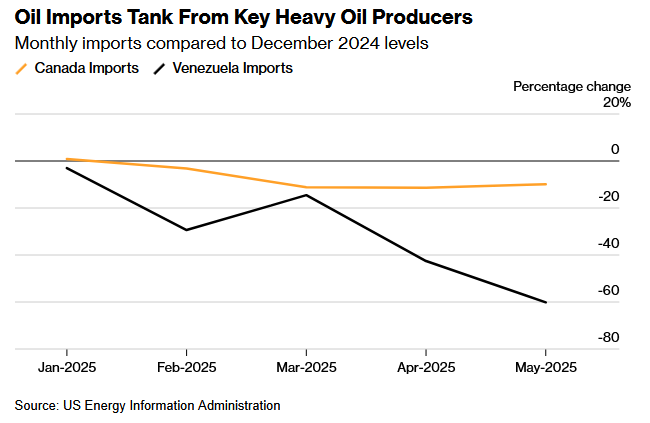
Core Insights - Chevron Corporation has resumed oil shipments from Venezuela to the U.S. after the restoration of its operating license, with two tankers carrying heavy crudes bound for the U.S. West Coast and Port Arthur, TX [1][10] - The resumption of shipments highlights the balancing act between U.S. energy security needs and sanction policies, especially as other sources like Mexico and Canada face supply constraints [2][10] - Chevron and PDVSA are expected to independently export their crude output without cash payments to the Venezuelan state, although Venezuelan authorities have disputed this arrangement [3][8] Industry Dynamics - Chevron's cautious return to the Venezuelan oil market, characterized by modest shipment volumes, could still influence the Gulf Coast heavy crude market, where refiners have been facing sourcing challenges [4] - Heavy Venezuelan crude is particularly valuable for U.S. refiners such as Valero Energy Corporation, which is negotiating to restart a supply deal with Chevron [5] - The anticipated return of Venezuelan crude supplies is expected to enhance profit margins for refiners in Texas and Louisiana, with companies like PBF Energy Inc. and Phillips 66 showing interest in purchasing Venezuelan oil [6] Geopolitical Context - The reinstated oil flows from Venezuela to the U.S. reflect a shift in U.S. foreign policy influenced by global energy realities, providing an economic lifeline for Venezuela's oil sector while ensuring feedstock security for U.S. refiners [9]



重质原油供应回升 美国炼油商盈利能力有望改善
Zhi Tong Cai Jing· 2025-08-08 13:52
Group 1 - The profitability of U.S. refiners is expected to improve in the second half of the year due to the ability to purchase discounted heavy crude oil as Canadian and Middle Eastern production rebounds [1] - Refiners, especially those along the Gulf Coast, have modified their facilities to process more discounted heavy crude oil, making the price differential between light and heavy crude a key profitability indicator [1][2] - Marathon Petroleum's CFO Rick Hessling anticipates that the price differential will widen in the second half of the year, influenced by OPEC's production increase plan [1] Group 2 - Canadian crude oil prices are expected to decline as producers finish maintenance and Gulf Coast refineries reduce operations due to seasonal maintenance [2] - Valero Energy's COO Gary Simmons noted that sanctions on Venezuelan oil and Canadian wildfires have limited the number of heavy crude barrels reaching the Gulf Coast, offsetting some benefits from earlier refinery outages [2] - Smaller refiner PBF Energy faced challenges from narrowing light-heavy crude price differentials but expects margins to improve in the second half as production returns during the seasonal maintenance period [2] Group 3 - An unexpected source of heavy crude returning to the market is California, where regulatory changes may lead to a revival in oil drilling [3] - The closure of Phillips66's Los Angeles refinery and Valero Energy's Benicia refinery will allow remaining West Coast refiners to access more California crude [3] - Potential sanctions on Russia could limit the flow of heavy crude and increase prices, with uncertainty surrounding the impact of such sanctions [5]
Murphy USA Q2 Earnings Top as Fuel Margins Improve, Sales Miss
ZACKS· 2025-08-04 13:56
Core Insights - Murphy USA Inc. (MUSA) reported second-quarter 2025 earnings per share of $7.36, exceeding the Zacks Consensus Estimate of $6.82 and slightly down from the previous year's profit of $6.92, primarily driven by higher fuel margins [1][10] - The company's operating revenues totaled $5 billion, reflecting an 8.2% year-over-year decline and missing the consensus estimate by $468 million due to lower petroleum product sales [1][10] Revenue Breakdown - Revenues from petroleum product sales were $3.9 billion, significantly below the estimated $4.2 billion and down 11.3% from the second quarter of 2024 [2] - Merchandise sales reached $1.1 billion, marking a 1.1% increase year over year [2] Fuel Contribution Analysis - Total fuel contribution increased by 0.7% year over year to $393 million, attributed to higher retail contributions and margin expansion, with total fuel contribution at 32 cents per gallon, up 1% from the previous year [3] - Retail fuel contribution decreased by 1.7% year over year to $359.1 million, with margins narrowing to 29.2 cents per gallon from 29.7 cents in the same period of 2024 [4] Merchandise Performance - Contribution from merchandise rose by 1% to $218.7 million, despite flat unit margins at 20% year over year [5] - On a same-store sales (SSS) basis, total merchandise contribution fell by 0.9% year over year, primarily due to a 2.4% decline in non-nicotine margins [5] Operational Metrics - Monthly fuel gallons sold decreased by 2.3% compared to the prior year, while merchandise sales saw a 0.7% decline on an average per-store monthly basis [6] - As of June 30, Murphy USA operated 1,766 retail locations, having opened six new stores and closed one [7] Financial Position - The company reported cash and cash equivalents of $54.1 million and long-term debt of $2.1 billion, resulting in a debt-to-capitalization ratio of 76.2% [7] - During the quarter, MUSA repurchased shares worth $211.9 million [7]


AFPM质疑美生物燃料及关税政策
Zhong Guo Hua Gong Bao· 2025-08-01 02:17
Core Viewpoint - The American Fuel and Petrochemical Manufacturers (AFPM) publicly criticized the EPA's proposal to increase the mandatory blending volume of biofuels for refiners, marking a significant divergence between the oil industry and the Trump administration since his return to the White House [1][2] Group 1: Industry Concerns - The AFPM highlighted that the EPA's biofuel proposal could lead to compliance costs reaching $70 billion for federal regulations [1] - Independent refiners like PBF Energy and CVR Energy expressed concerns that the biofuel policies impose heavy cost burdens, threatening their operational viability [1] - The letter addressed to Republican leaders pointed out that the current energy policy could negatively impact U.S. refiners, consumers, and Trump's "energy dominance strategy" [1] Group 2: Economic Impact - The U.S. refining industry has been in decline for the past decade due to factors such as improved vehicle fuel efficiency, the rise of electric vehicles, and the economic aftermath of the COVID-19 pandemic, leading to several plant closures [2] - The refining capacity in the U.S. has stagnated at just over 18 million barrels per day, according to the EIA [2] - The impending shutdown of two major refineries in California will reduce the state's refining capacity by nearly 300,000 barrels per day [2] Group 3: Policy Criticism - The AFPM criticized the EPA's handling of small refinery exemptions from biofuel blending obligations and the decision to allow summer sales of high-ethanol gasoline [1][2] - Concerns were raised regarding tariffs on imported renewable feedstocks, which could further complicate compliance for refiners [1]
原油期货四连阳!中美关税暂缓提振需求预期,WTI布伦特双双飙涨
智通财经网· 2025-05-14 02:14
Group 1 - The oil market continues its strong performance, with WTI crude oil futures rising 2.8% to $63.67 per barrel and Brent crude oil futures increasing 2.6% to $66.63 per barrel, marking the largest four-day gain since October of the previous year [1] - The positive market sentiment is driven by a breakthrough in US-China trade negotiations, where both parties agreed to suspend new tariffs for 90 days, alleviating concerns over weak energy demand [1] - The US Labor Department reported a narrowing year-on-year increase in the Consumer Price Index (CPI) to 2.3%, the lowest in four years, which has led institutions like JPMorgan and Barclays to lower recession forecasts for the US economy [1] Group 2 - Geopolitical factors are also providing support, with the Trump administration adopting a hardline stance towards Iran, raising concerns about the stability of Middle Eastern supply [2] - Demand signals are turning positive, as a JPMorgan report indicates that despite uncertainties in crude oil demand, the refined oil market remains strong, with gasoline and diesel prices stable [2] - The refining sector is experiencing a bullish response in the secondary market, with companies like PBF Energy rising 10.1% and Delek US increasing by 6.1% [2]





Earnings Preview: Marathon Petroleum (MPC) Q1 Earnings Expected to Decline
ZACKS· 2025-04-29 15:07
The market expects Marathon Petroleum (MPC) to deliver a year-over-year decline in earnings on lower revenues when it reports results for the quarter ended March 2025. This widely-known consensus outlook is important in assessing the company's earnings picture, but a powerful factor that might influence its near-term stock price is how the actual results compare to these estimates.The earnings report, which is expected to be released on May 6, 2025, might help the stock move higher if these key numbers are ...

PBF Energy to Release First Quarter 2025 Earnings Results
Prnewswire· 2025-04-01 21:00
PARSIPPANY, N.J., April 1, 2025 /PRNewswire/ -- PBF Energy Inc. (NYSE:PBF) announced today that it will release its earnings results for the first quarter 2025 on Thursday, May 1, 2025. The company will host a conference call and webcast regarding results and other business matters on Thursday, May 1, 2025, at 8:30 a.m. ET. PBF Energy Inc. (NYSE: PBF) is one of the largest independent refiners in North America, operating, through its subsidiaries, oil refineries and related facilities in California, Delawar ...
PBF Energy Announces Intention to Offer $750 Million of Senior Notes due 2030
Prnewswire· 2025-03-12 13:02
Core Viewpoint - PBF Energy Inc. plans to offer $750 million in senior notes due 2030 to repay outstanding borrowings and for general corporate purposes [1] Group 1: Offering Details - The senior notes will be offered in a private placement and are expected to be resold to qualified institutional buyers under Rule 144A and to non-U.S. persons outside the United States under Regulation S [2] - The offering will be made only by means of a private offering memorandum and has not been registered under the Securities Act or any applicable state securities laws [2][3] Group 2: Company Overview - PBF Energy Inc. is one of the largest independent refiners in North America, operating oil refineries and related facilities in multiple states including California, Delaware, Louisiana, New Jersey, and Ohio [5] - The company aims to operate its facilities safely and responsibly, provide a rewarding workplace for employees, positively influence local communities, and deliver superior returns to investors [5] Group 3: Joint Ventures - PBF Energy is a 50% partner in the St. Bernard Renewables joint venture, which focuses on producing next-generation sustainable fuels [6]

Chevron Gets Short 30 Days Notice to End Venezuela Operations
ZACKS· 2025-03-05 13:55
Core Viewpoint - Chevron Corporation has been ordered by the Trump administration to cease operations in Venezuela within 30 days, significantly impacting both U.S. and Venezuelan oil markets [1][2]. Group 1: Chevron's Operations and Impact - Chevron has been operating in Venezuela since 2022 under a U.S. sanctions exception, exporting crude oil and recovering billions in debt [2]. - The company’s joint ventures with PDVSA account for nearly 20% of Venezuela's oil output, which has stabilized the country's economy and controlled inflation [3]. - Chevron's operations have provided a steady revenue stream for Venezuela through royalties and taxes, benefiting its oil and banking sectors [6]. Group 2: Market Implications - The termination of Chevron's license will likely reduce Venezuela's oil revenues and could pressure U.S. gasoline prices, increasing risks for U.S. companies investing abroad [4]. - Chevron's Venezuelan oil exports decreased from 294,000 barrels per day in January to 252,000 barrels per day in February, indicating a downward trend that may affect global crude supply chains [5]. - The loss of Chevron's payments may weaken Venezuela's exchange market, leading to currency depreciation and further economic instability [7].