
Palantir

Search documents
Some Experts Argue Software Stock Sell-Off Was 'Too Harsh' Despite AI Fears
Investopedia· 2026-02-09 21:17
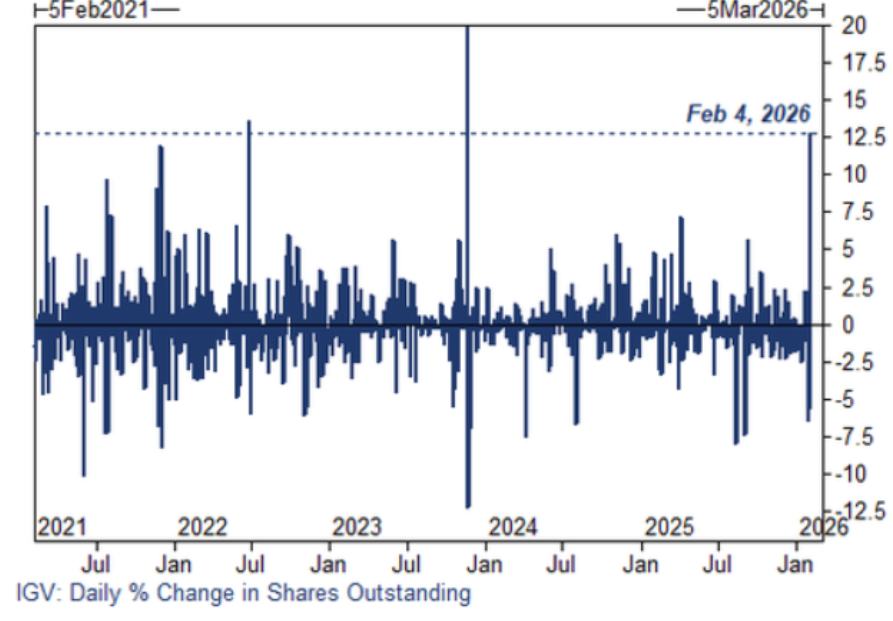
Core Insights - Software stocks experienced a significant sell-off due to heightened fears regarding AI disruption, with Jefferies analysts suggesting that the negative sentiment is overly harsh and premature [1][1][1] Group 1: Market Sentiment and Valuation - The iShares Expanded Tech-Software Sector ETF ([IGV]) fell approximately 8% last week, resulting in a 22% decline since the beginning of the year [1][1] - Over 40% of the software stocks covered by Jefferies are trading near historically low valuations, indicating potential buying opportunities for investors [1][1] - Sentiment among software investors is reported to be nearly as negative as during the 2008 Global Financial Crisis and the Dotcom Crash [1][1] Group 2: AI Impact on Software Industry - Concerns about AI-driven competition and "vibe coding" are seen as threats to existing software demand and industry margins [1][1] - Jefferies estimates that AI contributed no more than 3% of revenue for application software companies in its coverage last year, highlighting the current limited impact of AI on software revenues [1][1] - The transition from AI development to deployment has raised new concerns about the future of the software industry [1][1] Group 3: Long-term Outlook and Opportunities - Jefferies believes that fears surrounding AI will ultimately prove to be exaggerated, with long-term benefits expected for software providers that adapt to AI transformations [1][1] - Companies with superior access to data, established distribution networks, and integration into enterprise workflows are positioned to succeed in the evolving landscape [1][1] - Potential catalysts for a rebound in software stocks include clarity on the intentions of AI model providers and evidence of software companies benefiting from AI [1][1]


Five Below, IBD's Stock Of The Day, Hits 52-Week High
Investors· 2026-02-09 19:47
Core Viewpoint - Five Below's stock has reached a 52-week high, indicating strong market performance and investor interest in the discount retail sector [1]. Group 1: Company Performance - Five Below's stock price is currently at $206.72, reflecting a gain of $2.71 or 1.29% [1]. - The stock has shown a significant increase of 65% over the past year, highlighting its robust growth trajectory [1]. - The rebound buy zone for Five Below ended at $198.87, with an alternate entry buy zone extending to $215.48 [1]. Group 2: Market Context - The discount retail sector is experiencing positive momentum, as evidenced by several retailers exceeding earnings estimates [1]. - The industry group ranking for Five Below is 70 out of 197, indicating a competitive position within the discount retail market [1]. - The composite rating for Five Below stands at 96 out of 99, suggesting strong overall performance relative to peers [1].

“软件股末日论”点燃大变革! 恐慌抛售之后,市场将捧起AI时代的“软件基石”
美股IPO· 2026-02-07 00:35
Core Viewpoint - A portion of institutional funds is beginning to enter the market for "bottom-fishing" in software stocks that have recently experienced significant declines, agreeing with Jensen Huang's positive outlook on software stocks, suggesting that the market has misjudged strong software giants focused on "AI + core operational processes" [1][4] Group 1: Market Dynamics - The narrative of a "Software-mageddon" is gaining traction, with significant sell-offs in the software sector following the launch of new AI tools by Anthropic, leading to a notable drop in the S&P 500 Software & Services Index, which has fallen approximately 30% since its recent peak at the end of October [3][9] - The software sector faced its most severe sell-off since 2022, with the S&P 500 Software & Services Index experiencing a decline of over 5% in a single day, extending its losing streak to eight consecutive trading days [3][9] - Concerns about AI's impact on traditional SaaS business models have intensified, particularly following the introduction of Anthropic's AI tools, which are designed to handle complex workflows traditionally managed by SaaS providers [7][8] Group 2: Institutional Perspectives - Some institutional investors are starting to view the recent sell-off as an opportunity, believing that high-quality software companies embracing AI may soon experience a technical rebound [4][10] - Analysts from major financial institutions, including Goldman Sachs and Wedbush Securities, suggest that the selling pressure may have peaked, indicating potential for a market bottom and a return of institutional capital to the software sector [16][18] - Rick Sherlund, a prominent analyst, emphasizes that the software industry undergoes significant transformations every 10 to 15 years, and the current AI-driven changes may lead to a new bull market rather than a decline [20] Group 3: Long-term Outlook - Despite fears that AI could completely replace enterprise software, many analysts believe that AI will instead reshape the profitability trajectories of software companies, with a focus on enhancing existing platforms rather than replacing them [12][14] - The market's panic over AI's potential to disrupt software is viewed as exaggerated, with many analysts asserting that established companies with robust platforms, like SAP, will likely benefit from AI advancements [5][19] - The ongoing transition from consumer-facing AI applications to enterprise applications is expected to drive explosive growth in demand for reasoning and computational capabilities [20]


Palmer Luckey-backed Erebor receives US national banking charter, WSJ reports
Yahoo Finance· 2026-02-06 22:53
Group 1 - Erebor Bank has become the first bank to receive a national bank charter during the second term of the Trump administration, allowing it to operate nationwide [1] - The bank, backed by Palmer Luckey, received conditional approval from U.S. banking regulators in October, less than eight months after applying for the charter [2] - Erebor aims to serve technology businesses in sectors such as artificial intelligence, crypto, defense, and manufacturing, as well as individuals involved in these areas [2] Group 2 - The establishment of Erebor Bank is intended to fill the gap left by the collapse of Silicon Valley Bank in 2023, which was a crucial banking channel for early-stage technology firms and venture capitalists [3] - Many startups faced challenges in accessing capital and meeting immediate obligations, such as payrolls, following the collapse of Silicon Valley Bank [3] Group 3 - Erebor Bank is named after the "Lonely Mountain" from J.R.R. Tolkien's "The Lord of the Rings," symbolizing a fortress reclaiming treasures [4]
X @Nick Szabo
Nick Szabo· 2026-02-06 20:33
RT Mike Galsworthy (@mikegalsworthy)I want Palantir OUT of the UK.Every bit of it.Removed from the UK and banned from all contracting process with UK government, national, regional, local. ...
软件股末日论”点燃大变革! 恐慌抛售之后,市场将捧起AI时代的“软件基石
Zhi Tong Cai Jing· 2026-02-06 11:49
Core Viewpoint - The recent narrative of "Software-mageddon" has led to a significant sell-off in the software sector, particularly affecting SaaS stocks, following the launch of new AI tools by Anthropic, which are perceived as threats to traditional software business models [1][4][5]. Group 1: Market Reaction - The S&P 500 Software & Services Index has experienced a decline of approximately 30% since its recent peak at the end of October, marking the most severe sell-off since 2022 [1][6]. - Major software companies, including Thomson Reuters and Salesforce, have seen their stock prices drop significantly, with some experiencing declines of up to 10% in a single day [5][6]. - The sell-off has been exacerbated by disappointing earnings guidance from major companies, including Microsoft, and heightened expectations for AI infrastructure spending [5][6]. Group 2: Institutional Response - Some institutional investors are beginning to enter the market to buy undervalued software stocks, believing that the market has overreacted to the AI threat [2][12]. - Analysts express a divided view on the long-term impact of AI on software companies, with some believing that AI will reshape profit trajectories rather than eliminate the need for existing software [9][14]. Group 3: Expert Opinions - Rick Sherlund, a prominent analyst, argues that the software industry undergoes significant transformations every 10 to 15 years, and companies with strong fundamentals, like SAP, will likely benefit from AI rather than be threatened by it [3][16]. - Nvidia's CEO Jensen Huang emphasizes that the notion of AI completely replacing software is illogical, suggesting that AI will enhance existing software rather than replace it [7][8]. - The current market panic is described as "micro-hysteria," with experts suggesting that the fears surrounding AI's impact on software are exaggerated [8][12]. Group 4: Future Outlook - The software sector is expected to experience a technical rebound as investors reassess the long-term value of companies that integrate AI into their operations [2][11]. - High-quality software companies that embrace AI are likely to emerge stronger from the current turmoil, as the market begins to differentiate between those with robust business models and those that are more vulnerable [11][15].
最终带崩AI叙事的只会是AI自己
虎嗅APP· 2026-02-06 10:18
Core Viewpoint - The capital market is experiencing unexpected downturns, contrary to predictions of a strong 2026 due to anticipated monetary easing and improved geopolitical relations. The primary issue is the "new technology advancements consuming old technology applications" [4]. Market Performance - As of February 5, the North American Technology Software Index has declined by 25% year-to-date [5]. - Major companies within this index, including Palantir, Microsoft, Oracle, Salesforce, and ServiceNow, have seen their stock prices drop by an average of over 30% in the past two months [10]. Company Analysis - Notable companies in the index include Palantir, Microsoft, Oracle, Salesforce, and ServiceNow, all of which have experienced significant stock price declines [9][10]. - Specific stock performance includes: - Palantir: -28.44% over 20 days, -26.93% over 60 days - Microsoft: -18.57% over 20 days, -20.61% over 60 days - Oracle: -29.09% over 20 days, -42.84% over 60 days - Salesforce: -28.61% over 20 days, -20.67% over 60 days - ServiceNow: -31.99% over 20 days, -40.47% over 60 days [11]. Impact of AI on Software Industry - The rise of AI tools is leading to reduced demand for traditional SaaS software, as companies may cut back on subscriptions when employees can enhance efficiency through AI [15]. - The second layer of impact suggests that as AI tools mature, companies might develop their own systems instead of purchasing from traditional vendors, posing a significant threat to existing software companies [16]. Broader Implications - The narrative surrounding AI has shifted from questioning its viability to considering the implications for existing software solutions, raising concerns about the future of traditional software companies [15]. - The private credit industry, heavily invested in software, is facing challenges due to the downturn in software stock prices, with significant exposure reported by firms like Barclays [19].
“软件股末日论”点燃大变革! 恐慌抛售之后,市场将捧起AI时代的“软件基石”
智通财经网· 2026-02-06 09:13
Core Viewpoint - The recent narrative of "Software-mageddon" has led to a significant sell-off in the software sector, particularly affecting SaaS stocks, following the launch of new AI tools by Anthropic, which are perceived as threats to traditional software business models [1][4][5]. Group 1: Market Reaction - The S&P 500 Software & Services Index has experienced a decline of approximately 30% since its recent peak at the end of October, marking the most severe sell-off since 2022 [1][6]. - Major software companies, including Thomson Reuters and Salesforce, have seen significant stock price drops, with some experiencing declines of up to 10% in a single day [5][6]. - The sell-off has been exacerbated by disappointing earnings guidance from major companies, including Microsoft, and heightened expectations for AI infrastructure spending [5][6]. Group 2: Institutional Response - Some institutional investors are beginning to enter the market to buy undervalued software stocks, believing that the market has overreacted to the AI threat [2][12]. - Analysts from firms like Goldman Sachs and Wedbush Securities suggest that the sell-off reflects an exaggerated "Armageddon scenario" and that companies will not abandon their existing software investments for new AI solutions [12][14]. Group 3: Expert Opinions - Rick Sherlund, a prominent technology analyst, argues that the software industry undergoes significant transformations every 10 to 15 years, and companies with strong fundamentals, like SAP, will likely benefit from AI rather than be replaced by it [3][16]. - Nvidia's CEO, Jensen Huang, emphasizes that AI will enhance existing software infrastructure rather than replace it entirely, countering the prevailing panic in the market [7][8]. Group 4: Long-term Outlook - Analysts believe that while AI may disrupt certain aspects of the software industry, it will also create new growth narratives, particularly for companies that can integrate AI into their existing platforms [9][10]. - The market is expected to see a bifurcation, where companies with strong data assets and integration capabilities, such as Microsoft and SAP, are likely to rebound more strongly than those with weaker competitive positions [11][15].
X @Bloomberg
Bloomberg· 2026-02-06 05:18
Peter Mandelson played no role in the award of a data-analytics contract to Palantir, the UK’s Defence Secretary John Healey said https://t.co/0vt74rG31o ...
X @Nick Szabo
Nick Szabo· 2026-02-06 00:16
RT Foz (@NickFozz)Palantir was rejected at least nine times by various Swiss federal agencies and the Swiss army over a seven-year period. Citing risks to national security and neutrality,UK is a vassal state. ...