
UMC

Search documents
花旗:台湾电子与半导体_ 台湾科技行业月度追踪 - 4 月销售基本符合预期,人工智能供应链持续表现强劲
花旗· 2025-05-14 03:09
Investment Rating - The report maintains a positive outlook on the Taiwan Electronics and Semiconductors sector, particularly favoring TSMC as the most preferred stock in the semiconductor space [1][2]. Core Insights - April sales in the technology sector were robust, with TSMC reporting NT$349.6 billion in revenue, reflecting a 48% year-over-year increase and a 22% month-over-month increase [2][10]. - The semiconductor supply chain is expected to face challenges in the second half of 2025 due to early order pull-ins and tariff uncertainties, although supply constraints are easing [1][2]. - Companies like Gold Circuit and Quanta are highlighted for their strong sales momentum and improving product mix and margins, particularly in the AI ASIC and server supply chain segments [1][3]. Summary by Sections Semiconductor - TSMC's April revenue was significantly above expectations, driven by solid AI demand and a healthy order flow, with a year-over-year growth of 48% [2][10]. - UMC and other fabless companies are also showing steady recovery, with April revenues tracking positively [2]. Server and ODMs - Server sales in April increased by 167% year-over-year, with companies like Wiwynn and Accton outperforming expectations due to strong ASIC server demand [3][14]. - ODMs reported a 1% month-over-month increase and a 33% year-over-year increase in sales, indicating a positive trend in the server supply chain [3]. Component and PCB - Largan is noted for its 28% year-over-year growth, attributed to market share gains and resilient ASP trends [5]. - Gold Circuit is expected to benefit from rising AI ASIC demand, while Unimicron is projected to capture a significant market share in AI GPU applications [6][10]. Overall Market Trends - The overall revenue trend for the Taiwan technology supply chain shows a 24% year-over-year increase, with significant contributions from the semiconductor and server sectors [14]. - The report anticipates a decline in sales for May due to NTD appreciation, but the long-term outlook remains positive as demand for AI-related products continues to grow [2][3].
UMC(UMC) - 2024 Q4 - Annual Report
2025-04-24 10:22
Financial Position - As of December 31, 2024, the total assets of United Microelectronics Corporation amounted to NT$570,200,677 thousand, an increase from NT$559,186,927 thousand in 2023, representing a growth of approximately 1.8%[30] - The company's total current assets decreased to NT$189,677,884 thousand in 2024 from NT$216,797,392 thousand in 2023, a decrease of approximately 12.5%[30] - The total non-current assets increased to NT$380,522,793 thousand in 2024 from NT$342,389,535 thousand in 2023, reflecting a growth of approximately 11.2%[30] - Total liabilities decreased to $192,015,673 in 2024 from $199,608,355 in 2023, a decline of about 3.3%[33] - Total current liabilities decreased to $75,260,189 in 2024 from $99,014,733 in 2023, a reduction of approximately 24%[33] - Total non-current liabilities increased to $116,755,484 in 2024, up from $100,593,622 in 2023, an increase of about 16%[33] - Total equity attributable to the parent company rose to $377,928,391 in 2024, compared to $359,237,713 in 2023, an increase of approximately 5.2%[33] Revenue and Profitability - Operating revenues for 2024 reached $232,302,584, an increase of 4% from $222,533,000 in 2023[35] - Gross profit decreased to $75,654,080 in 2024, down from $77,743,838 in 2023, reflecting a decline of approximately 2.7%[35] - Net income for 2024 was $47,106,256, a decrease of 23.4% compared to $61,439,817 in 2023[35] - Earnings per share (basic) fell to $3.80 in 2024 from $4.93 in 2023, representing a decline of 23%[35] - The company reported a total comprehensive income of $55,407,240 in 2024, down from $67,857,743 in 2023, a decrease of about 18.3%[35] Cash Flow and Investments - Cash generated from operations increased to NT$98,761,663 in 2024, compared to NT$94,809,302 in 2023, reflecting a growth of 4.1%[41] - Net cash provided by operating activities rose to NT$93,872,042 in 2024, up from NT$85,999,709 in 2023, indicating an increase of 9.8%[41] - Net cash used in investing activities decreased to NT$85,941,103 in 2024 from NT$97,786,542 in 2023, a reduction of 12.1%[41] - Cash dividends paid in 2024 were NT$37,585,606, down from NT$45,014,783 in 2023, representing a decrease of 16.3%[41] - The company reported a net decrease in cash and cash equivalents of NT$27,553,389 in 2024, compared to a decrease of NT$41,265,162 in 2023, showing an improvement of 33.2%[41] Assets and Liabilities - The company's cash and cash equivalents decreased to NT$105,000,226 thousand in 2024 from NT$132,553,615 thousand in 2023, reflecting a decline of about 20.8%[30] - Property, plant, and equipment increased significantly to NT$279,059,037 thousand in 2024, up from NT$239,123,248 thousand in 2023, marking an increase of about 16.7%[30] - The balance of unappropriated earnings as of December 31, 2024, is $190,120,643, highlighting retained earnings growth[37] - The acquisition of property, plant, and equipment in 2024 was NT$88,543,595, slightly lower than NT$91,473,668 in 2023, a decrease of 3.2%[41] Research and Development - Research and development expenses increased to $15,616,039 in 2024, up from $13,283,830 in 2023, reflecting a growth of approximately 17.5%[35] Changes in Ownership and Investments - The percentage of ownership in WAVETEK MICROELECTRONICS CORPORATION decreased from 80.00% in 2023 to 79.54% in 2024[69] - The company experienced changes in subsidiaries' ownership resulting in a net impact of $11,519 for the year 2024[37] - Cash dividends from investments accounted for under the equity method decreased to NT$1,071 million in 2024 from NT$1,870 million in 2023, reflecting a decline of approximately 42.6%[184] Compliance and Accounting Standards - The Company is currently evaluating the potential impact of new IFRS standards on its financial position and performance, with disclosures to follow upon completion of the evaluation[60] - The Company’s consolidated financial statements are prepared in accordance with IFRSs endorsed by the FSC, ensuring compliance with relevant regulations[61] - The company's consolidated financial statements are presented in New Taiwan Dollars (NTD), which is also the parent company's functional currency[78] Miscellaneous - The company executed a capital reduction and refunded NT$760 million from TRIKNIGHT in 2024, compared to NT$960 million in 2023, indicating a decrease of approximately 20.8%[188] - The company has various lease agreements with terms ranging from 2 to 31 years, with land use rights extending to 50 years, indicating a long-term commitment to its operational infrastructure[199]

UMC(UMC) - 2024 Q4 - Annual Report
2025-04-24 10:10
Semiconductor Industry Trends - The semiconductor industry has experienced an economic downturn since early 2023, leading to reduced demand for consumer electronics and products incorporating semiconductors [27]. - The company anticipates significant fluctuations in operating revenues due to the cyclical nature of the semiconductor industry, with seasonal lows typically occurring in the first half of the year [29]. - The semiconductor industry is highly competitive, with new entrants and consolidations likely to create pricing pressures and potential overcapacity [42]. - The trend of increasing mergers and acquisitions in the semiconductor industry could reduce the total available customer base, potentially resulting in customer loss [52]. Operational Risks and Challenges - The company faces risks related to overcapacity in the semiconductor industry, which may lead to reduced revenues, earnings, and margins if unable to offset adverse effects through technology and product mix [35]. - The company relies on third-party vendors for essential services, and any delays or failures in these services could significantly reduce operating revenues and profitability [36]. - The company may face challenges in adopting new technologies, which could result in decreased profitability and loss of market share if competitors advance more rapidly [37]. - The outbreak of infectious diseases, such as COVID-19, may disrupt operations and negatively impact sales activities and customer orders [41]. - The company is vulnerable to natural disasters, with significant operational risks from earthquakes and water shortages in Taiwan, potentially impacting manufacturing capacity and financial performance [73]. - The company has faced severe earthquakes in the past, including a 7.2 magnitude earthquake in April 2024 and a 6.4 magnitude earthquake in January 2025, which caused damage to work-in-progress wafers [73]. Financial Performance and Customer Base - The company's top ten customers accounted for 52.4%, 62.0%, and 55.6% of operating revenues in 2022, 2023, and 2024, respectively [50]. - The largest customer from the wafer fabrication segment represented 8.6%, 13.1%, and 10.4% of operating revenues in 2022, 2023, and 2024, respectively [50]. - The company does not typically operate with significant backlog, making revenue forecasting challenging due to the cyclical nature of the semiconductor industry [51]. - The company expects future operating revenues to be substantially dependent on purchase orders received in the respective quarter [51]. - In 2024, the top ten customers accounted for 55.6% of the company's operating revenues [125]. - The company has a diversified customer base, with wafer sales by application in 2024 being 42.1% for communication, 28.4% for consumer, 13.5% for computer, and 16.0% for others [121]. Strategic Collaborations and Investments - A collaboration with Intel Corporation was established to develop a 12nm semiconductor process platform, with expected production of 12nm products in 2027, but this collaboration introduces additional operational risks [48]. - The company completed a US$664 million investment to acquire 100% ownership of United Semiconductor (Xiamen) Co., Ltd. in July 2023 [126]. - The collaboration with Intel Corporation aims to develop a new 12nm semiconductor process platform targeting high-growth markets such as mobile and communication infrastructure [139]. - The company expects to strengthen its market share by collaborating with DENSO for the production of power semiconductors to meet growing automotive market demand [141]. Research and Development - The company plans to enhance capital expenditures in research and development, focusing on logic and specialty process development to accelerate access to next-generation technologies [138]. - In 2022, 2023, and 2024, the company spent NT$12,953 million, NT$13,284 million, and NT$15,616 million (US$476 million) on research and development, representing 4.6%, 6.0%, and 6.7% of operating revenues for those years, respectively [211]. - As of December 31, 2024, the company employed 1,466 professionals in research and development activities, with additional management and operational personnel also involved [212]. - The company recognizes the importance of intelligent and cost-effective investments in R&D to enhance competitive edge without diluting profitability [142]. Environmental and Regulatory Compliance - Compliance with environmental, safety, and health regulations may lead to increased operational costs and capital expenditures, affecting overall results [74]. - The introduction of a carbon tax in Singapore and the "Climate Change Response Act" in Taiwan may increase operating and investment costs for the company [76]. - The company has implemented extensive Environmental, Safety, and Health (ESH) management systems certified to ISO 14001 and ISO 45001 standards [216]. - The company aims for zero incidents in occupational safety and health, fully complying with environmental laws and striving for zero pollution [217]. - The company has received numerous awards for its efforts in environmental protection, safety, and health management [221]. Geopolitical and Economic Risks - Geopolitical tensions, particularly between the U.S. and China, have led to significant tariffs on imports, including a 125% tariff on Chinese imports and a 32% tariff on Taiwanese goods, which could adversely affect the company's operations [97]. - The U.S. government has expanded export controls on advanced semiconductors, which may significantly increase compliance costs and restrict customer base [98]. - Political tensions in the Taiwan Strait could adversely affect business operations, including revenue and investment plans [98]. - The ongoing war between Ukraine and Russia has led to trade barriers that may increase manufacturing costs and limit access to supplies [100]. - Potential disruptions in supply chains due to geopolitical developments could negatively impact financial performance [101]. Manufacturing Capacity and Technology - A new advanced manufacturing facility in Singapore is expected to have a design capacity of 30,000 wafers per month, utilizing proprietary 22/28nm processes [127]. - The operational data as of December 31, 2024, shows that Fab 12A has an estimated full capacity of 136,279 wafers per month, while Fab 12i has a capacity of 57,207 wafers per month [146]. - UMC's 14nm FinFET technology offers 55% higher speed and twice the gate density compared to the 28nm process, with approximately 50% less power consumption [153]. - The total estimated capacity for UMC's fabs is projected to increase from 4,458 thousand 12-inch wafer equivalents in 2022 to 5,022 thousand in 2024, indicating a growth of 12.7% [159]. - Average capacity utilization rates dropped from 100.6% in 2022 to 68.5% in 2023, with a slight increase to 68.7% expected in 2024 [161]. - UMC is actively developing a 12nm FinFET Compact (12FFC) process, expected to complete process verification in 2026 and enter production in 2027 [153]. - The company emphasizes maintaining high manufacturing quality standards to achieve consistent, high manufacturing yields, enabling customers to estimate wafer orders accurately [144]. Intellectual Property and Legal Risks - The company is subject to U.S. conflict minerals law, requiring due diligence on supply chains, which may impact the ability to source materials effectively [88]. - Intellectual property disputes could result in costly litigation and divert management resources, potentially harming business operations [93]. - The company may incur substantial legal expenses related to infringement claims, impacting operational costs [99]. Customer Relations and Services - The company has established a partnership business model to better accommodate customer needs and optimize the entire value chain [135]. - The company has been recognized among the top 5% of companies in corporate governance evaluations for ten consecutive years [119]. - The company has a strong commitment to high-quality service, which has been a key factor in attracting major customers like Texas Instruments and Intel [125]. - Company’s online service "MyUMC" provides 24-hour access to detailed account information and manufacturing data [189].
UMC(UMC) - 2025 Q1 - Quarterly Report
2025-04-23 10:08
Financial Position - As of March 31, 2025, total assets amounted to NT$572,962,283,000, a slight increase from NT$570,200,670,000 as of December 31, 2024[12] - Current assets reached NT$192,323,086,000, compared to NT$189,677,884,000 as of December 31, 2024, indicating a growth of approximately 1.9%[12] - Total liabilities were NT$652,673,000,000, up from NT$536,673,000,000 as of March 31, 2024, reflecting an increase of about 21.6%[13] - The company's equity attributable to the parent company was NT$125,583,590,000 as of March 31, 2025, slightly down from NT$125,607,164,000 as of December 31, 2024[13] - Total non-current assets were NT$380,639,197,000, showing a marginal increase from NT$380,522,793,000 as of December 31, 2024[12] Revenue and Profitability - Operating revenues for Q1 2025 reached NT$57,858,957, an increase from NT$54,632,099 in Q1 2024, representing a growth of approximately 4.1%[16] - Gross profit for Q1 2025 was NT$15,446,645, down from NT$16,899,430 in Q1 2024, indicating a decrease of about 8.6%[16] - Net income for Q1 2025 was NT$7,743,239, compared to NT$10,429,595 in Q1 2024, reflecting a decline of approximately 25.7%[16] - Total comprehensive income for Q1 2025 was NT$12,232,352, compared to NT$18,383,803 in Q1 2024, a decline of about 33.2%[17] Expenses and Costs - Research and development expenses increased to NT$3,963,703 in Q1 2025 from NT$3,407,407 in Q1 2024, marking an increase of about 16.3%[16] - The company recognized NT$40,360 million in operating costs for the three-month period ended March 31, 2025, compared to NT$35,375 million for the same period in 2024, representing an increase of 14.0%[59] Cash Flow and Liquidity - Cash generated from operations increased to $23,816,475 in Q1 2025, up from $20,143,385 in Q1 2024, representing a growth of 13.3%[22] - Net cash provided by operating activities rose to $23,825,705 in Q1 2025, compared to $20,819,871 in Q1 2024, an increase of 14.4%[22] - Cash and cash equivalents at the end of Q1 2025 were $106,353,757, down from $119,431,260 at the end of Q1 2024, a decrease of 10.9%[25] Investments and Financial Instruments - Investments accounted for under the equity method were NT$42,399,076,000, a decrease from NT$43,320,605,000 as of December 31, 2024[12] - Financial assets at fair value through profit or loss totaled $18,329,615 as of March 31, 2025, compared to $18,456,932 as of December 31, 2024[51] - Financial assets at fair value through other comprehensive income reached $17,632,064 as of March 31, 2025, up from $17,209,328 as of December 31, 2024[52] Debt and Liabilities - The total current portion of long-term loans was $5,617,402 as of March 31, 2025, compared to $5,528,409 as of December 31, 2024, indicating a slight increase of about 1.6%[99] - The total short-term loans as of March 31, 2025, decreased to $6,500,000 from $11,130,000 as of March 31, 2024, representing a reduction of approximately 41.5%[88] - Unsecured long-term loans from Bank of China decreased from $1,545,973 as of March 31, 2024, to $1,261,804 as of March 31, 2025, a reduction of approximately 18%[98] Shareholder Information - UMC's cash dividends for 2024 were NT$35,787,598, with a cash dividend per share of NT$2.85[112] - The total number of common shares issued as of March 31, 2025, was 12,558 million, with 433 million shares represented by ADSs traded on the NYSE[109] - UMC's dividend policy allows for cash dividends ranging from 20% to 100% and stock dividends from 0% to 80%[110] Other Comprehensive Income - Total other comprehensive income for the three-month period ended March 31, 2025, was NT$4,825,552, compared to NT$4,489,113 in 2024, showing an increase of 7.5%[141] - The company reported a share of profit or loss from associates and joint ventures of NT$(258,000,000) for the three-month period ended March 31, 2025, compared to NT$1,000,000 for the same period in 2024[8] Accounting Policies and Compliance - The company’s consolidated financial statements were prepared in accordance with IAS 34 "Interim Financial Reporting" and relevant regulations, ensuring compliance with financial reporting standards[41] - Significant accounting judgments and estimates applied in the financial statements for the three-month period ended March 31, 2025, are consistent with those from the previous year, indicating a stable approach to financial reporting[48]
2024 年 Q4 全球晶圆代工行业收入同比增长 26%
Counterpoint Research· 2025-03-18 09:14
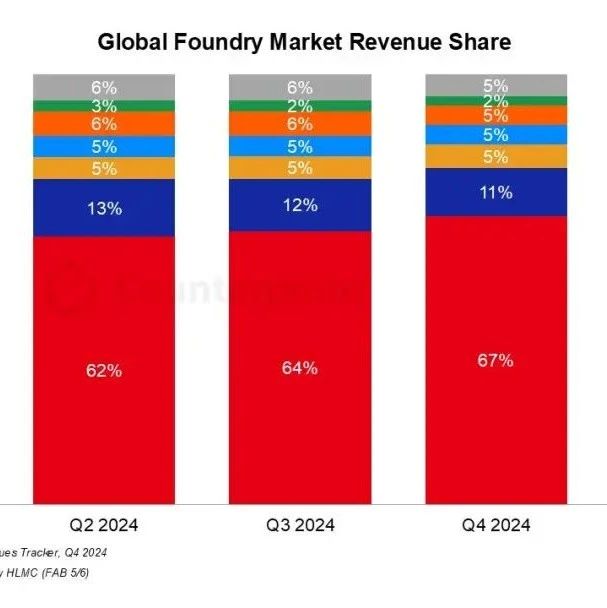
Core Viewpoint - The global wafer foundry industry is expected to see a 26% year-on-year revenue growth and a 9% quarter-on-quarter growth in Q4 2024, driven primarily by strong AI demand and the ongoing recovery of the Chinese market [1][3]. Summary by Sections Industry Performance - The advanced process capacity utilization remains high, driven by AI and flagship smartphone demand, particularly for TSMC's N3 and N5 processes [1][3]. - The overall utilization rate for global (excluding China) mature process foundries hovers between 65%-70%, with 12-inch processes recovering faster than 8-inch processes due to weaker demand in automotive and industrial sectors [1][3]. Demand Recovery - Non-AI demand is gradually recovering, particularly in consumer electronics and PC semiconductor sectors, supported by pre-production demand related to U.S. tariffs and demand driven by Chinese subsidies [1][3]. - Advanced packaging demand remains strong and stable, with TSMC actively expanding its CoWoS-L and CoWoS-R capacities, alleviating previous market concerns regarding capacity and order adjustments [1][3]. Company-Specific Insights - TSMC's revenue share reached a record 67% in Q4 2024, up from 64% in the previous quarter, primarily due to high capacity utilization in advanced processes [4]. - Samsung Foundry experienced a slight quarter-on-quarter revenue decline in Q4 2024, attributed to lower-than-expected demand for Android smartphones, leading to a decrease in its market share from 12% to 11% [5]. - SMIC's performance in Q4 2024 met expectations, with revenue growth driven by the recovery in consumer electronics and domestic localization efforts, although overall capacity utilization decreased from 90.4% to 85.5% [6]. - UMC's performance in Q4 2024 was stable, supported by occasional urgent orders in consumer electronics, but faced pricing pressure and a negative impact from a January earthquake [7]. - GlobalFoundries reported stable performance in Q4 2024, with strong wafer shipments offsetting seasonal weakness in the smartphone sector, driven by automotive demand and growth in communication infrastructure [8]. Analyst Commentary - The strong performance of the wafer foundry industry in Q4 2024 is largely attributed to the surge in AI and flagship smartphone demand, maintaining high capacity utilization in advanced processes [9].


全球晶圆厂TOP 10,中国大陆三家入围
半导体行业观察· 2025-03-11 00:53
Core Viewpoint - The global wafer foundry industry is experiencing a polarized development in Q4 2024, with advanced processes benefiting from the growth of emerging applications like AI servers and new flagship smartphones, leading to a nearly 10% quarter-on-quarter revenue increase for the top ten foundries, reaching a record high of $38.48 billion [1]. Group 1: Industry Overview - The advanced process segment is seeing growth due to demand from AI servers and new smartphone platforms, which is offsetting the decline in demand for mature processes [1]. - The new tariff policies from the U.S. government are beginning to impact the wafer foundry industry, with increased orders for TVs and PCs expected to continue into Q1 2025 [1]. - China's subsidy policy for upgrading appliances has led to increased inventory replenishment, further boosting demand for advanced chips from TSMC [1]. Group 2: Company Performance - TSMC's revenue in Q4 2024 is projected to grow to $26.85 billion, maintaining a market share of 67% [2]. - Samsung Foundry's revenue is expected to decrease slightly by 1.4% to $3.26 billion due to client transitions [2]. - SMIC's revenue is forecasted to increase by 1.7% to $2.2 billion, benefiting from new 12-inch capacity and improved product mix [2]. - UMC's revenue is expected to decrease marginally by 0.3% to $1.87 billion, while GlobalFoundries is projected to grow by 5.2% to $1.83 billion [2]. Group 3: Market Dynamics - HuaHong Group's revenue is anticipated to increase by 6.1% to $1.04 billion, driven by improved capacity utilization [3]. - Tower's revenue is expected to grow by 4.5% to $387 million, while VIS is projected to see a 2.3% decline to $357 million due to weakened consumer demand [3]. - Nexchip's revenue is expected to increase by 3.7% to $344 million, marking a rise in market ranking [3]. - PSMC's revenue is expected to decline, resulting in a drop in market ranking, although it remains slightly above Nexchip for the year [3].
UMC(UMC) - 2024 Q3 - Quarterly Report
2024-11-13 11:04
Financial Position - As of September 30, 2024, total assets of United Microelectronics Corporation amounted to NT$574,292,437 thousand, an increase from NT$547,270,956 thousand as of September 30, 2023, representing a growth of approximately 4.2%[12] - Current assets decreased to NT$193,608,328 thousand as of September 30, 2024, down from NT$219,280,222 thousand as of September 30, 2023, reflecting a decline of about 11.7%[12] - Total non-current assets increased to NT$380,684,109 thousand as of September 30, 2024, compared to NT$327,990,734 thousand as of September 30, 2023, showing an increase of approximately 16.0%[12] - Total liabilities as of September 30, 2024, amounted to $205.8 billion, an increase from $197.3 billion on September 30, 2023, representing a growth of approximately 4.8%[16] - Current liabilities totaled $88.3 billion as of September 30, 2024, compared to $92.1 billion a year earlier, indicating a decrease of about 4.1%[16] - Non-current liabilities reached $117.5 billion, up from $105.2 billion in the previous year, reflecting an increase of approximately 11.7%[16] - The equity attributable to the parent company was $368.2 billion as of September 30, 2024, compared to $349.7 billion a year prior, showing a growth of about 5.3%[16] - Total equity increased to $368.5 billion from $350.0 billion, marking a rise of about 5.4% year-over-year[16] Revenue and Income - Operating revenues for Q3 2023 were $57,068,867, an increase from $40,056,240 in Q3 2022, representing a growth of approximately 42.5%[19] - Net income for Q3 2023 reached $15,965,792, up from $11,965,792 in Q3 2022, indicating a growth of approximately 33.3%[19] - For the nine-month period ended September 30, 2023, net income was $47,794,836, with total comprehensive income of $58,020,170[22] - The company anticipates continued growth in revenues and net income for the upcoming quarters, driven by new product launches and market expansion strategies[19] Expenses and Costs - Total operating expenses for Q3 2023 were $36,607,915, compared to $28,000,000 in Q3 2022, reflecting an increase of approximately 30.9%[19] - Research and development expenses for Q3 2023 totaled $3,255,295, up from $2,401,919 in Q3 2022, which is an increase of approximately 35.6%[19] - The company recognized total other comprehensive loss of $(2,298,651) for the three-month period ended September 30, 2024, compared to a loss of $(1,789,949) in the same period of 2023[198] - The company reported total net other operating income of $961,732 for the nine-month period ended September 30, 2024, significantly lower than $2,750,179 in the same period of 2023[195] Cash Flow - Cash generated from operations for the nine-month period was NT$66,193,708, down from NT$69,403,913 in 2023, reflecting a decrease of 3.2%[24] - Net cash provided by operating activities increased to NT$60,894,868, compared to NT$59,782,937 in the previous year, showing a growth of 1.9%[24] - Total cash and cash equivalents at the end of the period were NT$103,407,426, down from NT$140,641,550 in 2023, representing a decrease of 26.5%[26] Investments - Investments accounted for under the equity method increased to NT$46,844,945 thousand as of September 30, 2024, compared to NT$43,163,604 thousand as of September 30, 2023, marking an increase of approximately 6.2%[12] - The fair value of investments with published price quotations was NT$44,783 million as of September 30, 2024, compared to NT$50,364 million in 2023, indicating a decline of 11.2%[82] - Cash dividends from investments accounted for under the equity method for the nine-month period ended September 30, 2024, were NT$974 million, down from NT$1,870 million in 2023, a decrease of approximately 48.0%[81] Shareholder Equity - The company reported retained earnings of $181.5 billion, an increase from $170.3 billion on September 30, 2023, representing a growth of approximately 6.6%[16] - Cash dividends for the nine-month period ended September 30, 2024, amounted to $37,587,102, with a net income of $38,714,347[22] - Cash dividends for 2023 were set at NT$3.00 per share, down from NT$3.60 per share in 2022, with total cash dividends amounting to NT$37,587,102 compared to NT$45,017,096 in 2022[158][159] Debt and Liabilities - Total long-term loans as of September 30, 2024, amounted to $33,550,489, an increase from $20,656,248 as of December 31, 2023, representing a growth of 62.5%[129] - The total bonds payable as of September 30, 2024, was $33,403,417, a decrease from $38,359,352 as of December 31, 2023[113] - Unsecured bank loans as of September 30, 2024, were $17,068,900, an increase from $13,530,000 as of December 31, 2023[111] Employee Compensation - Total employee benefit expenses reached $27,895,970, a decrease from $29,120,388 in the same period of 2023[189] - Employee compensation distributed in cash for 2023 was $5,439,059, down from $9,160,485 in 2022[192] Other Comprehensive Income - The company reported a share of other comprehensive income (loss) from associates and joint ventures of NT$(65) million for the three-month period ended September 30, 2024, which accounted for (0.53)% of the consolidated total comprehensive income[7] - The share of other comprehensive income (loss) from associates and joint ventures for the three-month period ended September 30, 2024, was NT$(65) million, compared to NT$226 million in 2023[83]
UMC(UMC) - 2024 Q4 - Earnings Call Transcript
2024-10-30 13:13
Financial Data and Key Metrics - Q3 2024 consolidated revenue was NT$50.5 billion, with gross margins at 33.8% [5] - Net income attributable to stockholders was NT$14.5 billion, and EPS was NT$1.16 [5] - Capacity utilization rate increased slightly to 71% from 68% in the previous quarter [5] - Sequential operating revenue grew 6.5% to NT$60.5 billion, while gross margin declined to 33.8% from 35.2% [6] - Cumulative revenue for the first three quarters of 2024 grew 2.6% to NT$171.9 billion, with a gross margin rate of 33.3% [7] - Cash dividend payout remained above NT$100 billion, reaching NT$103.4 billion at the end of Q3 2024 [8] - Total equity reached NT$368.5 billion at the end of Q3 2024 [8] Business Line Data and Key Metrics - Wafer shipments grew 7.8% sequentially due to strong demand for 22 and 28 nanometer products [13] - Revenue from specialty technology solutions reached a record high, accounting for 53.1% of total sales [13] - 22 to 28 nanometer revenue reached a record high of 35% in Q3 2024, while 40 nanometer remained stable at 13% [10] - Communication segment increased to 42% of revenue, while the computer segment declined to 13% [10] - IDM revenue rebounded to 15% in Q3 2024 [10] Market Data and Key Metrics - Asia represents 65% of total revenue, while Europe declined by 2 percentage points to 5% [9] - The company's 12A facility in Taiwan continues to increase leading-edge capacity, with a full-year capacity increase expected to exceed 7% [11] Company Strategy and Industry Competition - The company focuses on developing specialty technology solutions to deliver best-in-class performance [13] - Significant investments are made annually in technology development to support next-generation product features [14] - The company's diversified manufacturing footprint, including new fab expansion in Singapore and collaboration with Intel, enhances its value proposition [16] - The company revised its annual CapEx budget from NT$3.3 billion to NT$3 billion, reflecting updates to the Singapore capacity expansion schedule [11] Management Commentary on Operating Environment and Future Outlook - Demand is stabilizing across markets, with a clear downward trend in inventory levels [15] - The company expects flat wafer shipments and ASP in Q4 2024, with gross margins close to 30% and capacity utilization in the high 60% range [17] - The company foresees strong momentum in the upcoming months, driven by technology differentiation and customer collaboration [14][16] Other Important Information - The company maintains pricing resilience despite industry oversupply, with no significant changes in blended ASP [9][21] - The company anticipates a one-off pricing adjustment in early 2025, similar to the adjustment made in Q1 2024 [23][24] Q&A Session Summary Question: What is driving the better-than-expected Q4 revenue? - The computing segment is performing slightly better than expected, offsetting mild declines in communication and consumer segments [19] Question: Is there pricing stabilization or further competition expected? - Pricing remains flat for Q4 2024, with resilience demonstrated during demand/supply imbalances [21][22] - A one-off pricing adjustment is expected in early 2025, similar to Q1 2024 [23][24] Question: Why is Q4 gross margin expected to decline to 30%? - Lower capacity utilization (high 50% vs. 71% in Q3) and NT dollar appreciation are key factors [25] - Higher depreciation from capacity expansion will impact margins for several quarters [25][26] Question: What is the outlook for inventory levels and utilization rates? - Inventory levels in communication, consumer, and computing segments have normalized, while automotive and industrial segments may take until Q2 2025 to normalize [30] - Utilization rates are expected to rebound to 80%+ as the market recovers [31][32] Question: What is the strategy for 8-inch capacity? - The company has no plans to reduce 8-inch capacity and expects gradual improvement driven by differentiated technology solutions [34] Question: How is the Intel collaboration progressing? - The 12-nanometer collaboration is on track, with strong customer interest and potential for accelerated production schedules [36][37] - Applications focus on communication and consumer products, with capacity and profit-sharing details to be shared later [39] Question: What is the long-term gross margin outlook? - The company expects gross margins to stabilize in the low 30% to low 40% range post-2025, driven by cost management and technology differentiation [43][44] Question: How is the company managing geopolitical risks? - The company's diversified manufacturing footprint and technology differentiation mitigate oversupply risks and provide supply chain resilience [65][66] - Opportunities exist in customer porting projects and collaborations, such as the Intel partnership [67][69] Question: What is the outlook for RF SOI and OLED driver IC technologies? - The company is gaining market share in RF SOI and expanding its OLED driver IC solutions beyond smartphones [61][63] - The 22-nanometer OLED driver is expected to remain mainstream for the next 2-3 years [64] Question: What is the oversupply situation for 28-nanometer? - Despite oversupply, the company's 22 and 28-nanometer loading remains resilient, with growth expected in communication, computing, and consumer segments [71][72] Question: What is the depreciation growth outlook for 2025? - Depreciation growth in 2025 is expected to be slightly higher than the 20% increase seen in 2024 [77]
UMC(UMC) - 2024 Q3 - Earnings Call Presentation
2024-10-30 12:17
UMC UNITED FOR EXCELLENCE UMC 3Q24 Financial Review October 30, 2024 NOTE CONCERNING FORWARD-LOOKING STATEMENTS This presentation contains forward-looking statements within the meaning of Section 27A of the United States Securities Act of 1933, as amended, and Section 21E of the United States Securities Exchange Act of 1934, as amended, and as defined in the United States Private Securities Litigation Reform Act of 1995. These forward looking statements include, but are not limited to, statements relating t ...
UMC(UMC) - 2024 Q2 - Quarterly Report
2024-08-09 10:02
[Review Report of Independent Auditors](index=2&type=section&id=Review%20Report%20of%20Independent%20Auditors) [Conclusion and Scope](index=2&type=section&id=Conclusion%20and%20Scope) Ernst & Young, Taiwan, concluded that UMC's consolidated financial statements for H1 2024 and 2023 are fairly presented based on a limited scope review - The auditors issued a clean review conclusion, finding no material misstatements in the financial statements[6](index=6&type=chunk) - The review excluded certain equity-method associates and joint ventures, representing **5.12% of total consolidated assets**, relying on other auditors' reports[8](index=8&type=chunk) [Consolidated Financial Statements](index=4&type=section&id=Consolidated%20Financial%20Statements) [Consolidated Balance Sheets](index=4&type=section&id=Consolidated%20Balance%20Sheets) Total assets increased to NT$587.0 billion by June 30, 2024, driven by PP&E, while liabilities rose and equity slightly decreased Key Balance Sheet Items (in thousands of NTD) | Account | June 30, 2024 | Dec 31, 2023 | June 30, 2023 | | :--- | :--- | :--- | :--- | | **Total Current Assets** | $207,214,698 | $216,797,392 | $239,032,757 | | **Property, Plant and Equipment** | $274,030,951 | $239,123,248 | $198,618,079 | | **Total Assets** | $586,961,945 | $559,186,927 | $553,195,664 | | **Total Current Liabilities** | $124,973,558 | $99,014,733 | $142,978,303 | | **Total Liabilities** | $230,870,264 | $199,608,355 | $226,307,619 | | **Total Equity** | $356,091,681 | $359,578,572 | $326,888,045 | [Consolidated Statements of Comprehensive Income](index=6&type=section&id=Consolidated%20Statements%20of%20Comprehensive%20Income) Operating revenues slightly increased in H1 2024, but operating income, net income, and EPS all declined year-over-year Six-Month Performance Comparison (in thousands of NTD, except EPS) | Metric | Six Months Ended June 30, 2024 | Six Months Ended June 30, 2023 | | :--- | :--- | :--- | | **Operating Revenues** | $111,431,389 | $110,505,855 | | **Gross Profit** | $36,882,654 | $39,476,592 | | **Operating Income** | $25,555,933 | $30,155,441 | | **Net Income** | $24,204,809 | $32,281,220 | | **Basic EPS (NTD)** | $1.95 | $2.58 | | **Diluted EPS (NTD)** | $1.93 | $2.53 | Three-Month Performance Comparison (in thousands of NTD, except EPS) | Metric | Three Months Ended June 30, 2024 | Three Months Ended June 30, 2023 | | :--- | :--- | :--- | | **Operating Revenues** | $56,799,290 | $56,296,408 | | **Operating Income** | $13,891,432 | $15,674,743 | | **Net Income** | $13,775,214 | $15,896,673 | | **Basic EPS (NTD)** | $1.11 | $1.27 | [Consolidated Statements of Changes in Equity](index=7&type=section&id=Consolidated%20Statements%20of%20Changes%20in%20Equity) Total equity decreased to NT$356.1 billion by June 2024, primarily due to NT$37.6 billion in cash dividends, partially offset by net income - Key changes in equity for H1 2024 include **NT$24.2 billion net income**, **NT$37.6 billion cash dividend distribution**, and **NT$9.3 billion other comprehensive income** from foreign operations translation[19](index=19&type=chunk) [Consolidated Statements of Cash Flows](index=8&type=section&id=Consolidated%20Statements%20of%20Cash%20Flows) Net cash from operations increased to NT$43.5 billion in H1 2024, while investing and financing activities resulted in a net decrease in cash Cash Flow Summary (in thousands of NTD) | Activity | Six Months Ended June 30, 2024 | Six Months Ended June 30, 2023 | | :--- | :--- | :--- | | **Net Cash from Operating Activities** | $43,547,628 | $40,724,027 | | **Net Cash used in Investing Activities** | $(45,046,127) | $(53,252,770) | | **Net Cash provided by (used in) Financing Activities** | $(12,144,390) | $2,407,942 | | **Net Decrease in Cash** | $(10,889,220) | $(10,721,885) | - Acquisition of property, plant, and equipment was the largest cash outflow at **NT$48.5 billion** for the six-month period[22](index=22&type=chunk) [Notes to Consolidated Financial Statements](index=10&type=section&id=Notes%20to%20Consolidated%20Financial%20Statements) [1. History and Organization](index=10&type=section&id=Note%201.%20HISTORY%20AND%20ORGANIZATION) UMC, a Taiwan-incorporated semiconductor wafer foundry since 1980, is listed on both the TWSE and NYSE - UMC is a semiconductor wafer foundry established in **1980**, with dual listings on the **TWSE** and **NYSE**[25](index=25&type=chunk) [6. Contents of Significant Accounts](index=17&type=section&id=Note%206.%20CONTENTS%20OF%20SIGNIFICANT%20ACCOUNTS) This section details significant balance sheet and income statement accounts, including PP&E increases, revenue disaggregation, and equity changes [Property, Plant and Equipment](index=25&type=section&id=6.8%20Property,%20Plant%20and%20Equipment) Net PP&E significantly increased to NT$274.0 billion by June 2024, driven by NT$50.5 billion in additions from capital expenditure PP&E Movement (Assets Used by the Company, in thousands of NTD) | Description | Six Months Ended June 30, 2024 | | :--- | :--- | | **Beginning Balance (Jan 1, 2024)** | $237,376,554 (Net) | | **Additions** | $50,452,113 | | **Disposals** | $(17,522) (Net) | | **Depreciation** | $(20,376,482) | | **Ending Balance (June 30, 2024)** | $272,299,801 (Net) | [Equity](index=42&type=section&id=6.19%20Equity) The company's dividend policy allows 20-100% of distributable earnings as cash dividends, with NT$3.00 per share approved for FY2023 Dividend Distribution | Fiscal Year | Appropriation of Earnings (in thousands NTD) | Cash Dividend per Share (NTD) | | :--- | :--- | :--- | | **2023** | $37,587,102 | $3.00 | | **2022** | $45,017,096 | $3.60 | - The **cash dividend per share for 2023** was adjusted to **NT$3.00011747** due to restricted stock cancellation[116](index=116&type=chunk) [Operating Revenues](index=46&type=section&id=6.21%20Operating%20Revenues) H1 2024 operating revenues slightly increased to NT$111.4 billion, primarily from wafer sales, with Taiwan showing significant growth Revenue by Geography (Six Months Ended June 30, in thousands of NTD) | Region | 2024 | 2023 | | :--- | :--- | :--- | | **Taiwan** | $40,828,087 | $31,509,653 | | **USA** | $27,722,802 | $31,044,831 | | **China (includes Hong Kong)** | $16,861,007 | $14,138,303 | | **Korea** | $12,920,950 | $13,753,012 | | **Europe** | $8,354,862 | $12,532,246 | | **Japan** | $4,741,566 | $7,522,787 | | **Total** | **$111,431,389** | **$110,505,855** | Revenue by Product (Six Months Ended June 30, in thousands of NTD) | Product | 2024 | 2023 | | :--- | :--- | :--- | | **Wafer** | $105,885,331 | $105,070,128 | | **Others** | $5,546,058 | $5,435,727 | | **Total** | **$111,431,389** | **$110,505,855** | [Earnings Per Share](index=58&type=section&id=6.27%20Earnings%20Per%20Share) Basic EPS decreased to NT$1.95 and diluted EPS to NT$1.93 for H1 2024, reflecting lower net income compared to H1 2023 Earnings Per Share (NTD) | EPS Type | Six Months Ended June 30, 2024 | Six Months Ended June 30, 2023 | | :--- | :--- | :--- | | **Basic** | $1.95 | $2.58 | | **Diluted** | $1.93 | $2.53 | [7. Related Party Transactions](index=60&type=section&id=Note%207.%20RELATED%20PARTY%20TRANSACTIONS) Significant related party transactions include NT$1.44 billion in operating revenues from associates and NT$534 million in FARADAY share acquisitions - Operating revenues from associates reached **NT$1,438 million** in H1 2024, an increase from the prior year[160](index=160&type=chunk) - The company acquired **1,723 thousand shares** of FARADAY TECHNOLOGY CORP. for **NT$534 million** in H1 2024[164](index=164&type=chunk) - Key management personnel compensation for H1 2024 was **NT$879 million**, a decrease from H1 2023[167](index=167&type=chunk) [9. Significant Contingencies and Unrecognized Contract Commitments](index=65&type=section&id=Note%209.%20SIGNIFICANT%20CONTINGENCIES%20AND%20UNRECOGNIZED%20CONTRACT%20COMMITMENTS) The company has NT$20.8 billion in unrecognized construction commitments, and the Micron Technology trade secret case is globally settled - Unrecognized construction contract commitments for operational expansion totaled approximately **NT$20.8 billion** as of June 30, 2024[171](index=171&type=chunk) - The trade secret litigation with Micron Technology is fully resolved, with UMC completing its probation and sentence termination on January 27, 2024[172](index=172&type=chunk) [12. Others (Financial Risk Management)](index=67&type=section&id=Note%2012.%20OTHERS) This section outlines financial risk management, including market, credit, and liquidity risks, with sensitivity analysis and debt-to-capital ratio details - The debt-to-capital ratio increased to **23.47%** by June 30, 2024, up from **15.72%** at year-end 2023[232](index=232&type=chunk) - A **10% NTD appreciation against the USD** would decrease H1 2024 profit by **NT$783 million**[185](index=185&type=chunk) - A **5% change in listed financial asset prices** would impact H1 2024 profit by **NT$261 million**[189](index=189&type=chunk) [14. Operating Segment Information](index=84&type=section&id=Note%2014.%20OPERATING%20SEGMENT%20INFORMATION) The company operates as a single reportable segment, wafer fabrication, with no material accounting policy differences from consolidated statements - UMC operates as a single reportable segment: **wafer fabrication**[237](index=237&type=chunk) [Attachments](index=85&type=section&id=Attachments) [Attachment 11: Investment in Mainland China](index=104&type=section&id=Attachment%2011%20Investment%20in%20Mainland%20China) Accumulated investment in Mainland China reached NT$60.4 billion (USD 1.87 billion) by June 2024, below the MOEA-set upper limit Investment in Mainland China (as of June 30, 2024) | Description | Amount (in thousands of NTD) | | :--- | :--- | | **Accumulated Investment** | $60,415,446 | | **Investment Amount Authorized by MOEA** | $91,227,153 | | **Upper Limit on Investment** | $213,467,627 | - Hejian Technology's Board approved the disposal of its **100% interest in UNITEDDS SEMICONDUCTOR (SHANDONG) CO., LTD.** on April 2, 2024[279](index=279&type=chunk)