Circle

Search documents
CITI-稳定币2030
2025-12-31 16:02
Summary of Key Points from the Conference Call on Stablecoins Industry Overview - The report focuses on the **stablecoin** market and its evolution, highlighting its role in the broader **blockchain** and **digital asset** ecosystem [11][24][25]. Core Insights and Arguments 1. **Market Growth Projections**: - Stablecoin issuance is forecasted to reach **$1.9 trillion** in the base case and **$4.0 trillion** in the bull case by 2030, revised from previous estimates of **$1.6 trillion** and **$3.7 trillion** respectively [13][30]. - The issuance volume has increased from approximately **$200 billion** at the start of 2025 to about **$280 billion** [12][53]. 2. **Drivers of Growth**: - Growth is primarily driven by the **crypto-native ecosystem**, **e-commerce**, and **international demand** for holding USD [25]. - The report emphasizes that stablecoins will coexist with other on-chain money formats, particularly **bank tokens** [25][26]. 3. **Institutional Adoption**: - Institutional adoption of stablecoins is still in its early stages, rated at **0.5** on a scale of 0 to 10, but interest is growing among banks and asset managers [57]. - Transaction volumes in stablecoins are approaching **$1 trillion per month**, nearly double from the previous year [57][62]. 4. **Transaction Velocity**: - Stablecoins could support nearly **$100 trillion** in transaction activity by 2030 under the base case, with the bull case suggesting up to **$200 trillion** [30][89]. 5. **Regulatory Environment**: - The passage of the **GENIUS Act** is seen as a game changer for stablecoin legislation, promoting innovation and consumer protection [36][37]. - Regulatory clarity is expected to drive further institutional adoption and integration of stablecoins into existing financial systems [66][67]. 6. **Bank Tokens vs. Stablecoins**: - Bank tokens, which offer trust and regulatory safeguards, may see transaction volumes exceed those of stablecoins by 2030 [17][26]. - The report suggests that bank tokens could become a preferred choice for many corporates due to their integration with existing financial systems [92]. Additional Important Insights - **Ecosystem Integration**: Major payment networks are beginning to support stablecoin settlements, facilitating easier adoption for end-users [72]. - **Global Trends**: The report notes that while the U.S. is a significant market, regions like **Hong Kong** and the **UAE** are also becoming active hubs for stablecoin development [30][72]. - **Use Cases**: Stablecoins are increasingly being recognized not just for crypto trading but as infrastructure for **24x7 liquidity** and **real-time money movement** [62][104]. - **Challenges**: Despite the positive outlook, challenges remain for wider adoption, including regulatory hurdles and the need for interoperability among different digital money formats [45][75]. This summary encapsulates the key points discussed in the conference call regarding the stablecoin market, its growth potential, and the evolving regulatory landscape.

An 80% Wipeout Hasn’t Stopped Korean Retail From Chasing Tom Lee’s BitMine
Yahoo Finance· 2025-12-31 16:00
Core Insights - BitMine Immersion Technologies has experienced an 80% decline in stock price, yet it remains a top choice for South Korean retail investors in 2025, ranking second only to Alphabet in overseas stock purchases [1][2][3] Group 1: Stock Performance - BitMine's shares have plummeted approximately 82% from their peak in July, erasing most of the gains from an earlier rally [2] - Despite the significant drop, BitMine and USDC issuer Circle are still among the top 10 overseas securities purchased by South Korean investors this year [3] Group 2: Investment Behavior - South Korean retail investors have invested a net $1.4 billion in BitMine shares in 2025, including $566 million into a 2x leveraged ETF linked to the stock [6] - The behavior of Korean investors is described as "hoarding logic," where faith-driven capital flows do not necessarily align with price movements [7][8] Group 3: Company Strategy - BitMine has undergone a radical transformation from a Bitcoin miner to an Ether treasury, mirroring strategies popularized by other crypto investors [4] - The company's stock surged over 3,000% to a peak in July as retail traders sought exposure to Ethereum accumulation [5]
异动盘点1231 |英矽智能涨超25%,美联股份跌超18%;美股太空概念股走强,金银概念股盘前反弹
贝塔投资智库· 2025-12-31 04:01
Group 1 - Xunfei Medical Technology (02506) increased by over 5.2% after shareholders committed not to reduce their holdings until December 29, 2026 [1] - Yimei International Holdings (01870) rose nearly 4% as its subsidiary's independent energy storage project was included in Guangdong's energy construction plan for 2025 [1] - Yituo Co., Ltd. (00038) slightly decreased by 0.35%, focusing on overseas business expansion and aiming to create a world-class brand [1] - Damai Entertainment (01060) surged over 5.5%, with the 2025 New Year film box office surpassing 5 billion yuan, marking a new high in eight years [1] Group 2 - Meilian Holdings (02671) fell over 18% on its second day of trading, dropping below its IPO price of 7.1 HKD [2] - Tianli International Holdings (01773) increased by over 4.4% as the Ministry of Education plans to advance AI in education [2] - Xuanwu Cloud (02392) rose by 0.87% after a major shareholder agreed to extend the lock-up period for their shares [2] - Ganfeng Lithium (01772) dropped nearly 5% due to allegations of insider trading [2] Group 3 - Boke Vision Cloud-B (02592) increased by 3.38% after a major shareholder extended the lock-up period for their shares [3] Group 4 - Yingsi Intelligent (03696) surged over 11% on its second day of trading, with a significant increase in share price from the IPO [4] - The company has developed over 20 clinical or IND application assets using its AI platform, with a total contract value of up to 2.1 billion USD [4] Group 5 - Intel (INTC.US) rose by 1.69% after Nvidia purchased 5 billion USD worth of Intel shares [5] - The global market for advanced driver assistance systems (ADAS) and autonomous driving sensors is projected to reach 61 billion USD by 2035 [6] - NIO (NIO.US) increased by 3% as it announced the global launch of its 2026 model P7+ [6] - Baidu (BIDU.US) rose by 4.39% after announcing a partnership with a logistics company to provide high-precision mapping services [6]


Circle 在 Solana 上再次铸造 10 亿枚 USDC
Xin Lang Cai Jing· 2025-12-31 00:57
Core Insights - Circle has minted 1 billion USDC on Solana in the past 9 hours, indicating active engagement in the stablecoin market [1] - In total, Circle and Tether have minted 2 billion USD worth of USDC and USDT in the last 11 hours, reflecting significant liquidity movements in the cryptocurrency space [1] Company Activities - The recent minting activity by Circle highlights its ongoing strategy to expand USDC supply on the Solana blockchain [1] - Tether's involvement in minting USDT alongside Circle suggests a collaborative effort to enhance liquidity in the market [1]
South Korea’s long-awaited crypto law stalls over who can issue stablecoins
Yahoo Finance· 2025-12-30 17:36
Core Viewpoint - South Korea's Digital Asset Basic Act (DABA) has been delayed due to disagreements among regulators regarding stablecoin issuance, particularly concerning who should have the authority to issue KRW-pegged stablecoins [1][2]. Regulatory Disagreements - The Bank of Korea (BOK) insists that only banks with majority (51%) ownership should be allowed to issue stablecoins, citing their existing solvency and anti-money-laundering requirements as a basis for ensuring financial stability [2]. - The Financial Services Commission (FSC) argues against the strict "51% rule," suggesting it could hinder competition and innovation by excluding fintech firms capable of developing scalable blockchain infrastructure [3][4]. - The FSC references the European Union's Markets in Crypto-Assets regulation, which allows digital asset firms to issue stablecoins, and Japan's fintech-led yen stablecoin projects as examples of regulated innovation [4]. Political and Expert Opinions - The ruling Democratic Party of Korea (DPK) opposes the BOK's proposal, with experts expressing concerns that the 51% rule may not foster innovation or strong network effects [5]. - DPK lawmaker Ahn Do-geol emphasizes that stability concerns could be addressed through regulatory and technological measures rather than strict ownership requirements [5]. Foreign Issued Stablecoins - The FSC's earlier draft proposed allowing foreign-issued stablecoins in South Korea if they are licensed and have a local branch or subsidiary, impacting issuers like Circle, which issues USDC [6]. Legislative Timeline - The regulatory deadlock is expected to delay the passage of the DABA until at least January, with full implementation now unlikely before 2026, marking a significant shift for a country that previously banned crypto for nine years [7].
美股异动 | 比特币一度突破8.9万美元 部分加密货币概念股跟涨
智通财经网· 2025-12-30 15:24
Core Viewpoint - Bitcoin experienced a short-term surge of nearly 2%, briefly surpassing $89,000, which positively impacted related cryptocurrency stocks in the US market [1] Group 1: Bitcoin Performance - Bitcoin's price increased by nearly 2%, reaching above $89,000 [1] Group 2: Related Stocks Performance - Circle (CRCL.US) saw an increase of over 2.5% [1] - Strategy (MSTR.US) and Riot Platforms (RIOT.US) both rose by nearly 2% [1]


比特币一度突破8.9万美元 部分加密货币概念股跟涨
Zhi Tong Cai Jing· 2025-12-30 15:22
Group 1 - Bitcoin experienced a short-term surge, rising nearly 2% and briefly surpassing $89,000 [1] - U.S. cryptocurrency-related stocks also saw gains, with Circle (CRCL.US) rising over 2.5% [1] - Other notable stocks included Strategy (MSTR.US) and Riot Platforms (RIOT.US), both increasing by nearly 2% [1]
Stablecoins will be a key element of banking infrastructure in 2026
American Banker· 2025-12-30 15:00
Core Insights - The article outlines five key trends related to stablecoins that are expected to impact U.S. banks in the coming year, emphasizing the shift towards nonbank issuers and the integration of stablecoins into traditional banking systems [2][3]. Group 1: Nonbank Issuers - More new nonbank issuers of stablecoins are anticipated compared to bank issuers due to nonbanks' ability to implement new technology systems more rapidly and their broader access to blockchain talent [4][5]. - Recent announcements for 2026 stablecoin launches include companies like Sony, Cloudflare, and Western Union, with traditional banks lagging behind in this space [6]. Group 2: Integration with Banking - Traditional banks are expected to partner with fintech firms to facilitate stablecoin transactions rather than issuing their own stablecoins, thereby meeting client demand and increasing transaction revenue [7]. - New financial entities with banking charters, such as digital bank Erebor, are emerging to issue deposit tokens and stablecoins, blending traditional and new banking activities [8][10]. Group 3: Blurring Boundaries - The distinction between deposit tokens and stablecoins is expected to continue to blur, with banks realizing they can retain deposits while offering stablecoin flexibility [15]. - Recent developments include Custodia Bank and JPMorgan launching deposit tokens with stablecoin-like functionalities, indicating a trend towards integrating these financial instruments [14]. Group 4: Decentralization Experiments - Some traditional institutions are likely to experiment with decentralized mechanisms, introducing aspects of smart contract functionality to enhance client service and reduce costs [16]. - Progress in identity technology may widen the scope for disintermediation in banking functions, despite KYC and AML requirements limiting peer-to-peer transactions [17]. Group 5: Agentic Payments - Machine-to-machine payments are emerging, with stablecoins playing a crucial role in their evolution as digital money that can be programmatically distributed [18]. - While banks may not directly engage in this area, fintechs are expected to provide the necessary services for businesses adopting AI and robotics, pushing traditional banks to innovate [19][20].


The Year in Stablecoins 2025: Record Growth as GENIUS Act Opens the Floodgates
Yahoo Finance· 2025-12-30 14:01
Core Insights - The stablecoin market capitalization has increased by 49% in 2025, rising from $205 billion in January to $306 billion by the end of November [1] Group 1: Market Growth - The growth of the stablecoin category has been fueled by strong catalysts, including the establishment of a U.S. regulatory framework and the rollout of MiCA in Europe [2] - Stablecoins are designed to maintain a 1:1 peg to fiat currencies, with issuers holding fiat reserves to ensure tokens can be redeemed for cash [3] Group 2: Regulatory Developments - The GENIUS Act, signed into law by President Trump in July, created a federal regulatory framework for stablecoins, providing market clarity and addressing some associated risks [4][5] - The institutional adoption of stablecoins was already in progress prior to the GENIUS Act, with companies like Stripe and PayPal expanding their support for stablecoin transactions [5] Group 3: Company Developments - Circle successfully went public through an IPO, with its token experiencing significant trading activity shortly after its debut on the New York Stock Exchange [6] - However, not all stablecoin issuers have had positive developments; Tether's USDT was downgraded by S&P Global Ratings due to concerns over its reserves, particularly the inclusion of Bitcoin [6]
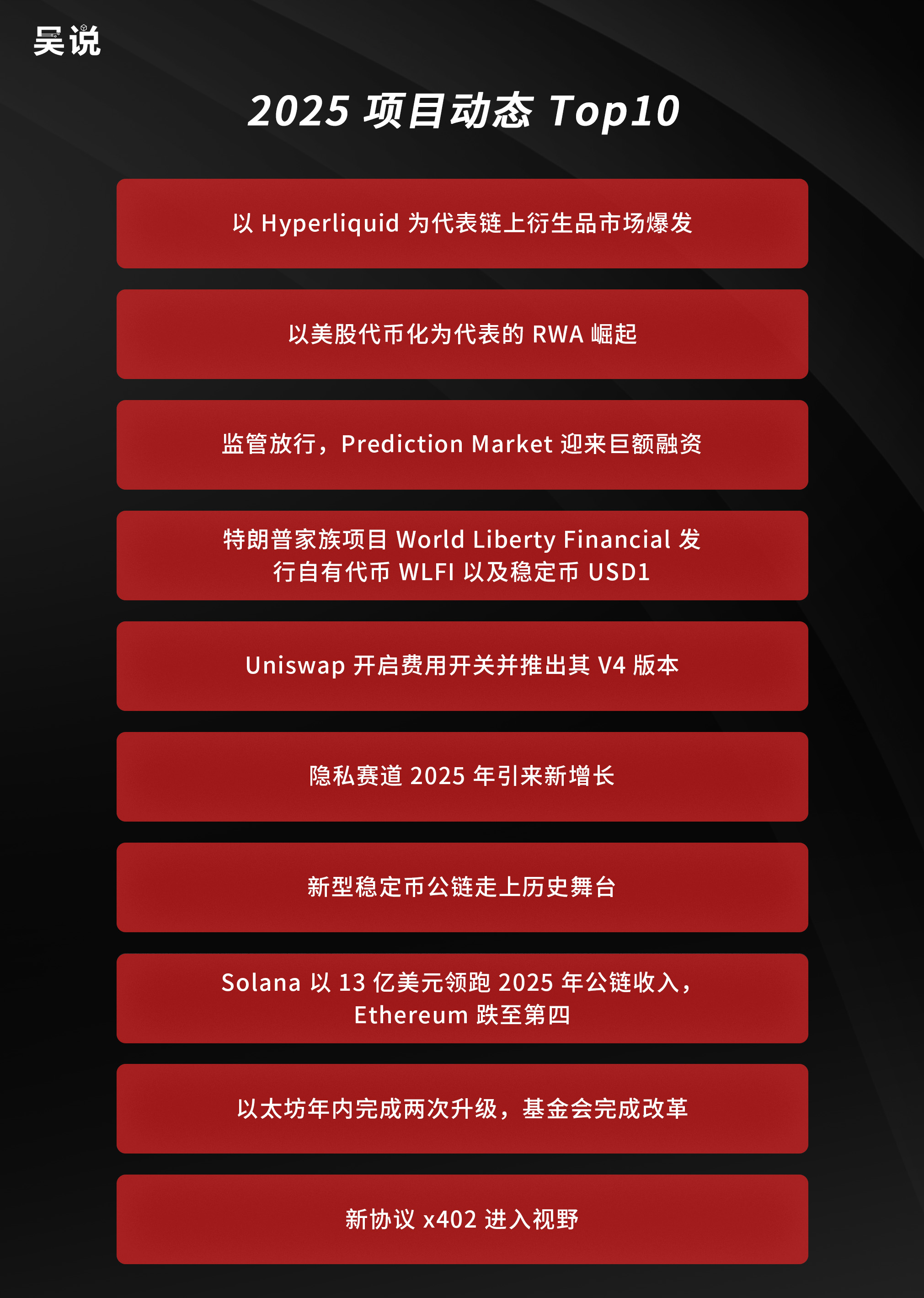
2025 项目动态 Top10:链上衍生品白热化、美股代币化崛起、预测市场吸引巨额融资等
Xin Lang Cai Jing· 2025-12-30 06:40
Group 1: On-chain Derivatives Market - Hyperliquid experienced significant growth in 2025, with approximately 609,700 new users, a total trading volume of about $2.95 trillion, and annual revenue of around $844 million [3] - During the market crash on October 11, Hyperliquid recorded the highest liquidation amount across exchanges, totaling $10.276 billion, with $9 billion from long positions [3] - Competitors Aster and Lighter are gaining market share, with Hyperliquid, Aster, and Lighter holding 47.6%, 15.9%, and 10.3% of the open interest market share, respectively [4] Group 2: Rise of Tokenized Real-World Assets (RWA) - Ondo Finance has launched over 100 tokenized U.S. stocks and ETFs on Ethereum, achieving a total trading volume exceeding $5.5 billion [5] - BlackRock's tokenized U.S. Treasury fund BUIDL has a total size of approximately $1.83 billion, with Ethereum leading at $572 million [6] - Predictions indicate that the market value of on-chain RWAs, excluding stablecoins, will grow from $35 billion to $2 trillion by 2028, primarily on Ethereum [7] Group 3: Prediction Market Developments - Regulatory relaxation in the U.S. has led to significant investments in the prediction market sector, with ICE investing $2 billion in Polymarket, raising its valuation to $8 billion [8] - Robinhood is launching a prediction market service through KalshiEX LLC, expected to open to eligible customers soon [9] Group 4: World Liberty Financial's Token Launch - World Liberty Financial, associated with the Trump family, launched its WLFI token and stablecoin USD1, with USD1's market cap reaching $3.199 billion [10] - A proposal to unlock up to 5% of WLFI tokens for partnerships has sparked internal community debate [11] Group 5: Uniswap's V4 Launch and Governance Changes - Uniswap Labs released Uniswap v4, introducing "hooks" contracts for developers and improving transaction efficiency [12] - A governance proposal to initiate a fee mechanism and reduce UNI supply was overwhelmingly approved, including the burning of 100 million UNI [13] Group 6: Growth in Privacy Sector - Zcash's token price surged by 375%, with a market cap exceeding $9 billion, while Monero's market cap reached $8 billion [14] - Vitalik Buterin emphasized the importance of privacy in crypto payments, advocating for a robust privacy solution [15] - The Ethereum Foundation is expanding its privacy technology efforts with a new "Privacy Cluster" [16] Group 7: Blockchain Innovations and Funding - Tempo, a blockchain startup supported by Stripe, raised $500 million in Series A funding, focusing on stablecoin payment infrastructure [17] - Circle launched the Arc blockchain for enterprise-level stablecoin payments, attracting participation from major institutions [18] Group 8: Solana's Revenue Leadership - Solana led public chain revenues in 2025 with $1.3 billion, while Ethereum fell to fourth place with $524 million [18] Group 9: Ethereum Upgrades and Foundation Reforms - Ethereum completed two major upgrades in 2025, Pectra and Fusaka, aimed at improving user experience and scalability [22] - The Ethereum Foundation underwent leadership changes and restructured its research and development teams [23][24]