VMware

Search documents
Marvell Appoints Rajiv Ramaswami to its Board of Directors
Prnewswire· 2025-07-23 13:05
Core Insights - Marvell Technology, Inc. has appointed Rajiv Ramaswami, the President and CEO of Nutanix, to its Board of Directors effective July 22, 2025 [1][2] - Ramaswami brings over 30 years of experience in the technology industry, having held leadership roles at various prominent companies including VMware, Broadcom, Cisco, Nortel, Tellabs, and IBM [2] - His expertise spans software, cloud services, network infrastructure, and semiconductors, which is expected to enhance Marvell's strategic direction in data infrastructure semiconductor solutions [2] Company Overview - Marvell Technology is recognized as a leader in data infrastructure semiconductor solutions, focusing on building technology that connects the world [4] - The company has been trusted by leading technology firms for over 30 years, providing solutions that move, store, process, and secure data [4] - Marvell emphasizes deep collaboration and transparency with customers to innovate and transform enterprise, cloud, automotive, and carrier architectures [4]



1 Unstoppable Stock That Could Join Nvidia, Microsoft, Apple, Amazon, and Alphabet in the $2 Trillion Club Before 2028
The Motley Fool· 2025-07-15 00:02
Core Viewpoint - The semiconductor company Broadcom is experiencing significant growth driven by the increasing adoption of artificial intelligence (AI) technologies, positioning it to potentially reach a $2 trillion market cap in the near future [3][10]. Company Performance - Broadcom reported record revenue of $15 billion in Q2, marking a 20% year-over-year increase, with adjusted earnings per share rising 44% to $1.58 [6]. - The company has successfully integrated VMware into its operations, with 87% of its 10,000 largest customers adopting VMware Cloud Foundation, contributing to an increase in infrastructure software operating margin from 60% to 76% [7]. Market Position and Growth Potential - Broadcom's market cap is approximately $1.3 trillion, and it plays a crucial role in the AI ecosystem, with its technology being integral to mobile, broadband, cable, and data center operations [3][5]. - Wall Street estimates project Broadcom's revenue to reach $62.74 billion by 2025, with a forward price-to-sales (P/S) ratio of around 20, indicating a need for approximately $97 billion in annual revenue to support a $1 trillion market cap [9]. - The company is expected to achieve a $1 trillion market cap as early as 2028, with annual revenue growth projected at 19% over the next five years [10]. AI Market Dynamics - The serviceable addressable market for Broadcom's AI revenue from its existing hyperscale customers is estimated to be between $60 billion and $90 billion by fiscal 2027, excluding new customers recently announced [11]. - The generative AI market is projected to reach between $2.6 trillion and $4.4 trillion annually over the next decade, with potential doubling when including embedded software contributions [12]. Stock Performance - Broadcom's stock has appreciated significantly, increasing by 2,070% over the past decade, compared to a 205% gain for the S&P 500, justifying its premium valuation at 34 times next year's expected earnings [13].



博通(AVGO.US)取消西班牙芯片厂计划 欧盟芯片本土化战略遇挫
智通财经网· 2025-07-14 13:06
智通财经APP获悉,据知情人士透露,美国芯片巨头博通(AVGO.US)已正式取消在西班牙投资建设微芯 片工厂的计划。这一决定标志着欧盟推动本土半导体产能扩张的战略遭遇重大挫折,同时也反映出地缘 政治变动对跨国科技投资产生的深远影响。 值得关注的是,博通已迅速启动亚洲产能补充计划。据公司第二季度财报显示,其将在马来西亚和越南 现有封装基地追加5亿至7亿美元投资,通过扩产2.5D封装及Chiplet技术产能,弥补欧洲项目取消带来的 缺口。 该项目可追溯至2023年7月,时任西班牙数字化转型大臣何塞·路易斯·埃斯克里瓦宣布,博通计划在西班 牙兴建一座价值10亿美元的先进半导体后端封装测试工厂。根据西班牙政府披露的信息,该设施被定位 为"欧洲独一无二的大型后端半导体设施",原计划从欧盟新冠疫情复苏基金中拨出120亿欧元专项补贴 支持半导体产业发展。 这一战略调整与公司整体转型方向一致——通过收购VMware等软件企业,博通正从传统半导体厂商向 综合科技解决方案提供商转变,2025财年第一季度其AI业务收入已达41亿美元,同比增长77%。 谈判破裂的核心矛盾集中在三方因素:首先,博通要求西班牙政府先行拨付数亿美元设备采 ...
Prediction: These 2 AI Chip Stocks Will Outperform Nvidia Over the Next 5 Years
The Motley Fool· 2025-07-13 13:15
Core Insights - Nvidia holds a dominant position in the AI infrastructure market, particularly in the GPU sector, with over 90% market share due to its CUDA software platform [1] - Nvidia's market cap recently reached $4 trillion, but its growth may slow down due to the law of large numbers, making it possible for AMD and Broadcom to outperform Nvidia in the next five years [2] Nvidia - Nvidia's data center revenue was $39.1 billion last quarter, reflecting significant growth but also indicating challenges in maintaining such rapid expansion [6][14] - The company has seen its data center revenue increase more than ninefold in two years, suggesting that sustaining this growth rate may become increasingly difficult [14] Advanced Micro Devices (AMD) - AMD is experiencing strong revenue growth and is beginning to capitalize on AI opportunities, particularly in AI inference, although it remains a distant second to Nvidia in the GPU market [4] - AMD's GPUs are being utilized by major AI model companies for daily inference workloads, and its ROCm software platform is considered adequate for inference tasks [5] - AMD's data center revenue was $3.7 billion last quarter, indicating that even modest market share gains could lead to significant growth [6] - AMD is also a leader in data center CPUs, which are essential as AI workloads expand, increasing demand for high-performance CPUs [7] - The UALink Consortium, formed by AMD and others, aims to develop an open standard for AI interconnects, potentially challenging Nvidia's proprietary technologies [8][9] Broadcom - Broadcom is not directly competing with Nvidia in the GPU market but is focusing on AI networking and custom AI chip design [10] - The company's AI networking revenue surged 70% last quarter, driven by the increasing demands of large AI clusters [10] - Broadcom is designing custom AI chips for hyperscalers, with potential revenue opportunities estimated between $60 billion to $90 billion by fiscal 2027 [12] - The acquisition of VMware enhances Broadcom's position in AI cloud environments, providing strong upselling opportunities for its Cloud Foundation platform [13] Conclusion - While Nvidia remains a strong player in the AI market, AMD and Broadcom are well-positioned for growth due to their smaller revenue bases and potential market share gains in AI-related sectors [15]

AI强劲需求助推博通(AVGO.US)业务多线增长 小摩重申“增持”评级
智通财经网· 2025-07-11 08:03
Core Viewpoint - Morgan Stanley's report highlights strong demand trends in artificial intelligence (AI) driving growth for Broadcom's custom AI XPU business and high-performance networking product portfolio [1][3] Group 1: AI Demand and Market Potential - AI demand remains robust, with inference workloads creating additional demand that was not included in the previous 2027 serviceable available market (SAM) forecast, indicating potential upside [2] - The execution in product technology development is strong, with 2nm 3.5D AI XPU products expected to complete tape-out this year, and the first generation AI XPU products also anticipated to complete tape-out, with partnerships established with key potential clients [2][3] Group 2: Networking and Non-AI Business Recovery - AI computing workloads are driving strong networking demand, significantly enhancing unit value in expanded networks, providing substantial revenue capture opportunities [2] - Non-AI semiconductor business is experiencing a "U-shaped" gradual recovery, with observed order/reservation inflection points expected to drive earnings per share (EPS) upgrades next year [2] Group 3: VMware and Overall Financial Outlook - The VMware Cloud Foundation (VCF) platform transition is expected to continue driving strong growth for VMware business, projected to reach an annual revenue of $20 billion by the end of 2026 or 2027, with growth rates returning to mid to high single digits thereafter [2] - Despite some margin pressure in AI XPU business, overall semiconductor operating profit margins are expected to continue expanding due to operational leverage, with management focusing on reinvestment in AI growth opportunities rather than acquisitions [3] Group 4: Market Position and Valuation - Broadcom is positioned as the second-largest AI semiconductor supplier globally and the largest custom chip (ASIC) supplier, with a strong presence in wireless communication, data center networking, AI/deep learning ASICs, storage, and infrastructure silicon chips [3][4] - Morgan Stanley maintains a price target of $325 for Broadcom by December 2025, representing approximately 18% upside from the closing price of $275.4 on July 10 [3]
博通管理层会议:AI推理需求激增,甚至超过当前产能,并未反映在当前预期内
Hua Er Jie Jian Wen· 2025-07-10 08:46
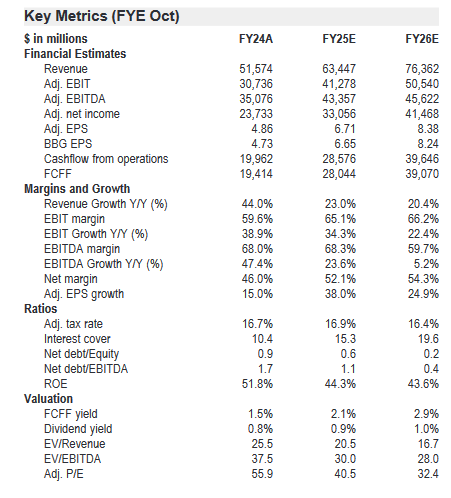
Core Insights - The management of Broadcom has indicated a significant and unexpected increase in demand for AI inference, which is currently exceeding existing production capacity, suggesting potential upward revisions in future profitability [1][2][3] - Non-AI business segments are also showing signs of recovery, particularly through VMware's growth, contributing to a multi-faceted growth strategy for the company [1][4] AI Inference Demand - Broadcom's custom AI XPU chip business remains strong, with a clear growth trajectory. The past year saw AI demand primarily focused on training workloads, but a notable surge in inference demand has been observed in the last two months as clients seek to monetize their AI investments [2][3] - The current inference demand is not included in Broadcom's 2027 market size forecast, which estimates $60-90 billion for three existing AI clients, indicating a potential upside opportunity [3] Technological Advancements - Broadcom is collaborating closely with four potential AI XPU clients, aiming to build 1 million XPU AI cluster infrastructures. The company plans to complete the first generation of AI XPU products for two major clients this year [3] - The company is leading the industry transition to next-generation 2nm 3.5D packaging AI XPU architecture, with plans to complete the 2nm 3.5D AI XPU tape-out this year [3] Non-AI Business Recovery - After several quarters of cyclical pressure in non-AI semiconductor businesses, Broadcom is witnessing a gradual "U"-shaped recovery, reflected in current booking and order situations. This recovery may drive positive EPS revisions next year [4] - VMware is leveraging its cloud infrastructure (VCF) platform to provide comprehensive solutions for large enterprise clients, with expected revenue growth to approximately $20 billion annually by 2026/2027 [4] Profitability and Financial Metrics - Despite potential pressure on gross margins from high demand for custom AI XPUs, Broadcom anticipates continued expansion of operating margins due to operational leverage. AI revenue is expected to grow by 60% year-over-year in fiscal 2026, while operating expenses are not expected to increase at the same rate [5] - Key financial estimates for Broadcom include projected revenues of $51.574 billion for FY24, $63.447 billion for FY25, and $76.362 billion for FY26, with adjusted EPS expected to grow from $4.86 in FY24 to $8.38 in FY26 [6] Market Outlook - JPMorgan maintains an "overweight" rating on Broadcom with a target price of $325, representing a 16.9% upside from the current stock price. Broadcom's stock has risen nearly 20% year-to-date [7]
Nvidia Is The Star―But Broadcom Is The AI Boom's Best-Kept Secret
Benzinga· 2025-07-09 11:34
Core Viewpoint - Nvidia may be prominent in AI discussions, but Broadcom is recognized for its critical role in building the infrastructure necessary for AI, being the "2 global AI semiconductor supplier" and a leader in custom ASICs [1] Group 1: AI Infrastructure and Strategy - Broadcom's AI strategy is focused on its custom AI XPU business, which is currently thriving, with plans to tape-out first-generation AI XPU products this year [2] - The company is collaborating with four AI customers, including OpenAI, to develop massive AI clusters of "1 million XPU" units, positioning Broadcom at the center of AI development [2] Group 2: Networking and Performance - AI models require not only computing power but also ultra-fast networking, where Broadcom excels, offering 5–10 times more dollar content per unit compared to traditional networks [3] - Broadcom's leadership in next-generation interconnects and silicon photonics strengthens its status as a preferred vendor for high-performance infrastructure [3] Group 3: Software Growth Potential - VMware's Cloud Foundation (VCF) platform is projected to sustain strong growth until late 2026/2027, with revenues expected to reach $20 billion before transitioning to mid- to high-single-digit growth [4] - Despite lower gross margins on custom AI chips, Broadcom is anticipated to expand operating margins due to business leverage [4] Group 4: Business Focus - The company is committed to reinvesting in its business rather than pursuing distractions such as mergers and acquisitions [5]


停更也不行?博通开始清算老客户!
半导体芯闻· 2025-06-27 10:21
Core Viewpoint - Broadcom has initiated audits on former VMware customers who have not renewed their support contracts, following a significant price increase of up to 300% for VMware products due to Broadcom's bundling strategy [1][3][7]. Group 1: Audit Initiation - Broadcom has begun sending "stop and cease usage" letters to VMware users whose support contracts have expired, demanding they stop using all updates and patches released since the termination of their contracts [1][2]. - An audit has been launched for a Dutch software supplier, which has been a VMware customer for about ten years, indicating that Broadcom is actively reviewing compliance with VMware software usage [3][4]. Group 2: Customer Concerns - Customers express concerns about the financial impact of the audits, with some fearing it could affect salary negotiations and lead to layoffs due to budget constraints [5]. - There are reports of companies receiving audit notifications despite having ceased using VMware products, raising questions about the validity of Broadcom's audit process [7][8]. Group 3: Market Reaction - Broadcom's aggressive enforcement of VMware licensing agreements has generated backlash among existing and former customers, with calls for regulatory scrutiny of its practices [9]. - The acquisition of VMware for $69 billion is viewed as a successful transaction, yet the ongoing issues with customer relations and compliance audits may tarnish Broadcom's reputation in the market [9].
专家访谈汇总:小马智行与文远知行高管“互撕”?
阿尔法工场研究院· 2025-06-24 10:14
Group 1: Solid-State Battery Developments - BYD, Guoxuan High-Tech, and FAW Group have successfully launched 60Ah automotive-grade battery cells with an energy density of 350-400Wh/kg, a charging rate of 1C, and a cycle life of 1000 times, ahead of schedule by about six months [1] - By the second half of 2025 to the first half of 2026, solid-state batteries are expected to reach a critical milestone in pilot testing, with equipment debugging and optimization nearing completion, significantly improving technology maturity [1] - With leading companies and the supply chain making strides, breakthroughs in equipment and materials are progressing smoothly, with sulfide electrolyte production surpassing kilometer-level rolls and pressure conditions reduced to 1-2Mpa [1] - By 2026, the price of sulfide electrolytes is projected to drop to 2.5 million per ton, with long-term potential to decrease to several hundred thousand per ton, bringing solid-state battery costs closer to those of liquid batteries [1] - This sets the foundation for large-scale applications of solid-state batteries in low-altitude aircraft, power systems, and robotics, with the market size expected to exceed 100GWh by 2030 [1] Group 2: Orders and Market Recovery - In November 2024, CATL and Leading Intelligent signed an agreement to further expand their cooperation, particularly in core equipment investment for battery cells, with CATL committing to prioritize 50% of new investments for Leading Intelligent [2] - From 2022 to 2024, despite high expectations, actual related transactions have declined, but orders are expected to rebound in Q1 2025, approaching levels seen in 2022-2023, indicating a gradual improvement in overall order conditions [2] - According to company forecasts, orders in 2025 are expected to increase by 20%-30%, reaching 24-26 billion, indicating a recovery trend for Leading Intelligent's orders [2] Group 3: VMware Pricing Controversy - Following Broadcom's acquisition of VMware for $69 billion, VMware implemented significant reforms, notably bundling its product offerings into the VMware Cloud Foundation (VCF) subscription suite, eliminating the previous perpetual licensing model [3] - Many users reported that this reform led to a dramatic increase in VMware product licensing costs, with some experiencing price hikes of 8 to 15 times, compared to purchasing specific products like vSphere or vSAN [3] - Broadcom responded by stating that this is not merely a price increase but a move to help users unlock greater value, highlighting that many customers overlook the comprehensive management, security, and automation features provided by VCF [3] - According to Broadcom's report, 53% of global enterprises prioritize deploying private clouds as a key IT task in the coming years, while 69% are evaluating the feasibility of migrating some workloads back to on-premises environments [3] - IDC's survey indicates that most enterprises maintain a hybrid architecture, with about 60% preferring on-premises IT systems for core workloads, and less than 2% opting for full public cloud adoption [3] Group 4: Technology and Market Competition in Robotaxi - Pony.ai's CTO recently stated that besides Waymo, Pony.ai, and Baidu, other companies have lagged behind in scaling and automation by two and a half years, while WeRide's CFO publicly countered, emphasizing WeRide's progress in practical implementation [4] - According to Grand View Research, the global Robotaxi market is projected to grow from $1.95 billion in 2024 to $43.76 billion by 2030, with Tianfeng Securities predicting it could reach 834.9 billion by 2030 [4] - Pony.ai's technology emphasizes redundancy and safety, utilizing a multi-sensor fusion approach, including LiDAR, cameras, and millimeter-wave radar, and continuously optimizing algorithms through a "shadow mode" [4] - The fleet has covered core areas in major cities and plans to expand to 1,000 vehicles by the end of 2025, with passenger fare revenue increasing by 800% year-on-year [4] - WeRide successfully listed on NASDAQ and earned the title of "Robotaxi First Stock" on October 25, 2024, with a closing market value of $4.491 billion on its first day [4] - This capital competition reflects the strategic intentions behind the technology and market rivalry, indicating that the company that gains an early advantage in the Robotaxi market will secure a favorable position in future market share battles [4] - From 2022 to 2024, Pony.ai's cumulative R&D investment reached $517 million (approximately 3.717 billion RMB), while WeRide's R&D expenses totaled 2.908 billion RMB during the same period [4] - Despite Pony.ai's slightly higher R&D investment, WeRide significantly leads in patent accumulation, having filed 921 patents compared to Pony.ai's 93 [4] - From 2022 to 2024, Pony.ai's main revenue figures were $68.39 million, $71.90 million, and $75.03 million, while WeRide's revenue during the same period was 528 million RMB, 402 million RMB, and 250 million RMB, indicating a significant decline in WeRide's revenue [4] - Both companies exhibit strong financial health, but WeRide faces challenges with decreasing operating cash flow, while Pony.ai has seen a significant decline in investment cash flow [4]

The Rise of Mobile Device Management Market: A $22.0 billion Industry Dominated by Tech Giants - VMware (US) and Microsoft (US)| MarketsandMarkets™
GlobeNewswire News Room· 2025-06-20 13:30
Market Overview - The global Mobile Device Management (MDM) Market is projected to grow from USD 6.9 billion in 2022 to USD 22.0 billion by 2027, reflecting a Compound Annual Growth Rate (CAGR) of 26.1% during the forecast period [1]. Market Dynamics Drivers - The growth of the mobile workforce within enterprises is a significant driver for the MDM market [5]. - The proliferation of new mobile devices is contributing to the increased demand for MDM solutions [5]. - Network access control initiated by MDM enhances security for corporate data [5]. - Increased productivity and employee satisfaction are also driving the adoption of MDM solutions [5]. - The trend of Bring Your Own Device (BYOD) is further propelling the need for MDM [5]. - Compliance with stringent government regulations is a key factor influencing MDM adoption [5]. - Security issues associated with devices necessitate robust MDM solutions [5]. - The advent of 5G technology is expected to transform the importance of mobile devices, thereby impacting MDM [5]. - Leveraging User and Entity Behavior Analytics (UEBA) into MDM solutions is becoming increasingly important [5]. - The adoption of cloud-based technology is boosting the usage of MDM solutions [5]. Restraints - Specific restraints were not detailed in the provided content. Opportunities - The report indicates potential growth opportunities in the MDM market, particularly in the Solutions segment, which is expected to capture a larger market share by 2027 due to the increasing adoption of MDM solutions [3]. Competitive Landscape - The MDM market features a diverse ecosystem with key players including VMware, Microsoft, IBM, Blackberry, Citrix, Google, Cisco, Samsung, Micro Focus, and ZOHO [5][6]. - MDM solutions enable IT teams to control and distribute security policies to mobile devices accessing sensitive corporate data, ensuring network security [6]. - Organizations are increasingly turning to MDM for enhanced data and network security and improved employee productivity [6].