
Reliance Industries

Search documents
JioStar moves Supreme Court against CCI probe over alleged abuse of dominance in Kerala TV market
MINT· 2026-01-25 07:04
Core Viewpoint - JioStar, owned by Reliance Industries, is challenging the Competition Commission of India's (CCI) investigation into alleged abuse of dominance and discriminatory pricing in Kerala's television distribution market [1][9]. Legal Proceedings - A Supreme Court hearing is scheduled for JioStar's appeal against a Kerala High Court ruling that upheld the CCI's investigation order [2]. - The case originated from a complaint by Asianet Digital Network, which accused JioStar of dominating the market by controlling popular Malayalam channels and exclusive rights to major sporting events [2][3]. Allegations of Discriminatory Pricing - Asianet claims that JioStar provided preferential discounts to Kerala Communicators Cable Ltd (KCCL), while denying similar terms to other distributors, violating the Telecom Regulatory Authority of India's (Trai) rules [3][4]. - It is alleged that JioStar effectively offered KCCL discounts exceeding 50% through marketing agreements, which Asianet argues were a facade to lower effective channel prices for KCCL [4][5]. Regulatory Context - The CCI initiated an investigation in February 2022 after finding a prima facie case against JioStar, clarifying that this step did not imply guilt [6]. - JioStar contends that the dispute falls under the jurisdiction of Trai and the 2017 Broadcasting Regulations, arguing that the CCI should not have intervened [7]. - The CCI maintains that its authority under the Competition Act applies even in regulated sectors, and its role in examining market power abuse is not excluded by the presence of another regulator [8]. Court Rulings - The Kerala High Court upheld the CCI's investigation, stating that competition law can coexist with sectoral regulation [8]. - JioStar's appeal was dismissed by a division bench of the Kerala High Court, allowing the CCI's investigation to proceed [9]. Company Background - JioStar was established in November 2024 following the merger of Reliance's media business with Disney's India operations, valued at approximately $8.5 billion [10]. - Reliance holds a controlling stake of around 63% in the joint venture, while Disney owns about 36.84% [10]. Market Position - As of the April-June quarter of 2025, JioStar's streaming platform JioHotstar led India's subscription video-on-demand market with a 25% share, followed by Amazon Prime Video at 23% and Netflix at 19% [11].


Bloodbath on D-Street! Investors lose over Rs 16 lakh crore this week as Nifty, Sensex crash; market down 5% from lifetime highs
The Times Of India· 2026-01-23 14:20
Market Performance - Indian stock markets experienced significant volatility, with Nifty closing near 25,050 and Sensex around 81,540 by the end of the week, marking a decline of 2.51% and 2.43% respectively [2][3] - The market capitalization of BSE-listed companies fell by Rs 6,95,963.98 crore to Rs 4,51,56,045.07 crore, equivalent to $4.93 trillion, with a total market value erosion of Rs 16,28,561.85 crore over the week [2][3] Key Drivers of Market Decline - Heavy selling pressure was noted, particularly in heavyweight stocks such as those from the Adani Group, which contributed to the overall market downturn [4][8] - Weak quarterly performances from major companies like ICICI Bank and HCL Technologies raised concerns about the earnings outlook, further dampening market sentiment [5][7] - The Indian rupee hit an all-time low against the US dollar, exacerbating macroeconomic worries related to inflation and trade deficits [5][9] Foreign Investment and Market Sentiment - Persistent foreign institutional investor (FII) outflows and a shift towards safe-haven assets have negatively impacted market sentiment [5][8] - The absence of strong domestic cues and the lack of major players in the artificial intelligence sector have been cited as reasons for the Indian market lagging behind global peers [5][6] Expert Insights - Analysts suggest that the market's direction in the coming week will be influenced by global macroeconomic signals and domestic fiscal expectations, with a focus on guidance from the Federal Reserve regarding interest rate cuts [9] - Stock-specific movements are expected to remain prominent as the Q3 earnings season continues, with cautious sentiment prevailing due to global developments and currency trends [9]
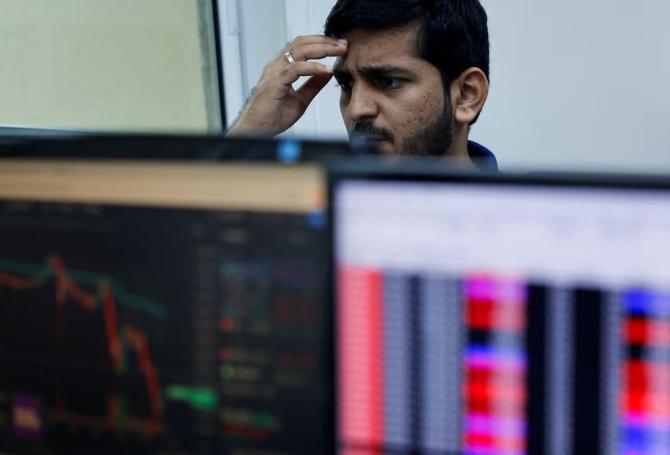
Sensex slips below 82K amid widespread sell-off
Rediff· 2026-01-23 12:23
Market Overview - Equity benchmark indices Sensex and Nifty ended nearly 1 percent lower, with the Sensex closing at 81,537.70 after a drop of 769.67 points, or 0.94 percent [4] - The Nifty settled at 25,048.65, down 241.25 points, or 0.95 percent [6] - The rupee depreciated to a record low against the US dollar, contributing to the market's decline [4] Market Sentiment - Investors are shifting towards safe-haven assets due to widespread sell-offs and foreign capital outflows, leading to a cautious market sentiment [4][12] - The upcoming Union Budget and the US Fed's interest rate decision are influencing investor positioning, with expectations remaining muted [14] Sector Performance - Realty and PSU bank stocks underperformed due to execution-related delays and profit booking [13] - The BSE smallcap gauge fell by 2.19 percent, while the midcap index decreased by 1.56 percent [9] Stock Performance - Major laggards included Adani Ports, IndiGo, Axis Bank, and Reliance Industries [8][9] - Gainers included Tech Mahindra, Hindustan Unilever, and Tata Consultancy Services [8][9] Foreign Investment Activity - Foreign institutional investors (FIIs) sold equities worth Rs 2,549.80 crore, while domestic institutional investors (DIIs) purchased stocks worth Rs 4,222.98 crore [10]

Sensex sinks below 82K; Nifty ended down 75 points
Rediff· 2026-01-21 11:50
Market Overview - Indian equity markets experienced losses for the third consecutive session due to heightened geopolitical tensions, weak global peers, and persistent foreign fund outflows [3][9] - The 30-share BSE Sensex closed at 81,909.63, down 270.84 points or 0.33 percent, while the NSE Nifty declined 75 points or 0.30 percent to 25,157.50 [4][5] Stock Performance - Major laggards included ICICI Bank, Trent, Bharat Electronics, Axis Bank, HDFC Bank, Larsen & Toubro, State Bank of India, and Maruti [6][7] - Gainers in the market were Eternal, UltraTech Cement, InterGlobe Aviation, and Reliance Industries [7][8] Investor Activity - Foreign institutional investors sold equities worth ₹2,938.33 crore, while domestic institutional investors purchased stocks worth ₹3,665.69 crore [8] Market Sentiment - Analysts noted that domestic markets were affected by global risk factors, leading to volatility, although some value buying helped recover early losses [10] - The weakening rupee and uncertainties regarding trade ties are expected to prolong market volatility [10]
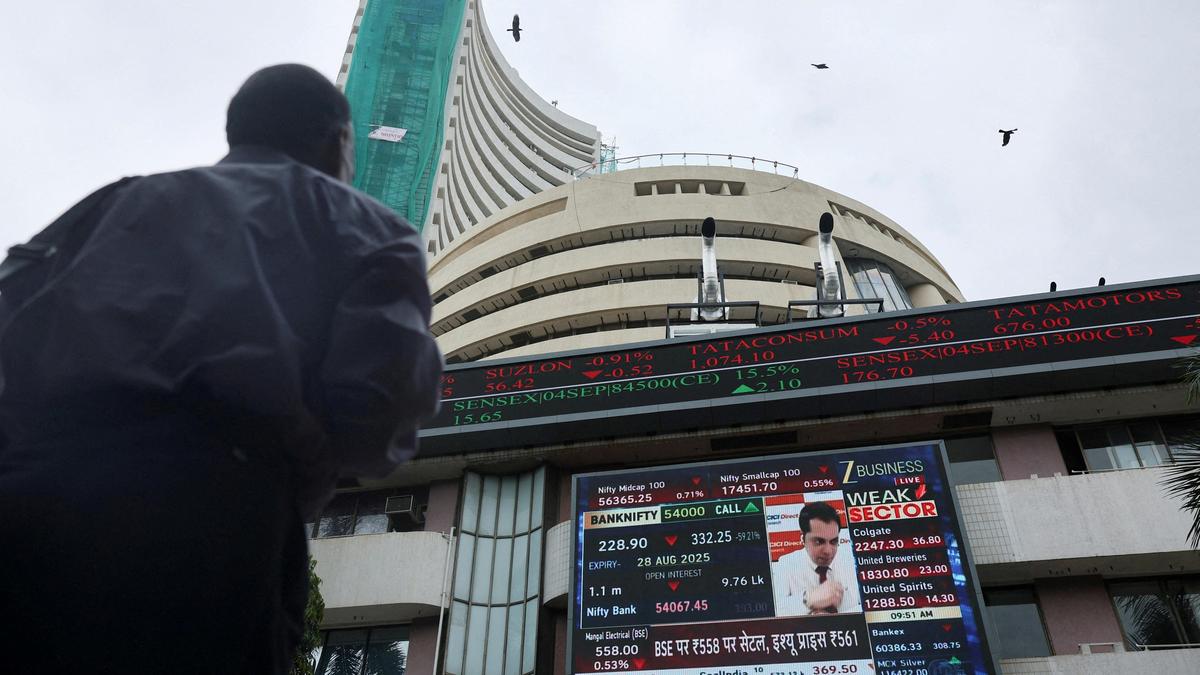
Reliance Retail reports 2.7% profit rise in Q3
Yahoo Finance· 2026-01-19 11:51
Core Insights - Reliance Retail Ventures Limited (RRVL) reported a 2.7% increase in profit for Q3 FY26, with profit after tax rising to Rs 35.51 billion ($390.6 million) from Rs 34.58 billion in Q3 FY25 [1] - The company achieved consolidated revenue growth of 8.1% year-on-year, reaching Rs 976.05 billion, with revenue from operations increasing by 9.2% to Rs 869.51 billion [2] Financial Performance - EBITDA from operations increased by 2.1% to Rs 67.70 billion, while overall EBITDA rose by 1.3% to Rs 69.15 billion, with the EBITDA margin narrowing to 8% [3] - For the nine months ending December FY26, gross revenue totaled Rs 2,717.94 billion, compared to Rs 2,422.50 billion in the same period last year, with nine-month EBITDA at Rs 201.12 billion [3] Operational Highlights - RRVL added 431 stores, bringing the total to 19,979 outlets, with retail area expanding to 78.1 million square feet [4] - Registered customers increased by 11.8% year-on-year to 378 million, and quarterly transactions surged by 47.6% to 524 million [4] E-commerce and Customer Engagement - JioMart expanded to over 5,000 pin codes across more than 1,000 cities, achieving 1.6 million daily orders [4] - Average daily orders rose by 53% quarter-on-quarter and over 360% year-on-year, with the merchant network increasing by 22% [5] Segment Performance - The fashion and lifestyle segment saw festive-driven demand across more than 1,300 cities, with Ajio's average basket value increasing by 21% year-on-year [5] - The Jewels business experienced a 73% year-on-year rise in average bill value, with old gold exchange sales accounting for 29% of total sales, up from 21% a year earlier [6]
Blue-chips Reliance, ICICI Bank drag Sensex down by 324 points
Rediff· 2026-01-19 11:09
Stock market benchmarks Sensex and Nifty ended lower on Monday, tracking deep losses in heavyweights Reliance Industries, Eternal, and ICICI Bank amid global tariff uncertainties.Photograph: Francis Mascarenhas/ReutersBesides, weakness in the rupee and unabated flight of foreign capital from Indian equities also made investors jittery, traders said.The 30-share BSE Sensex declined 324.17 points, or 0.39 per cent, to settle at 83,246.18.During the day, it tumbled 672.04 points, or 0.80 per cent, to 82,898.31 ...
Stock markets decline in early trade dragged by blue-chips Reliance, ICICI Bank
The Hindu· 2026-01-19 04:54
Market Overview - Equity benchmark indices Sensex and Nifty declined in early trade, with Sensex down 320.69 points to 83,249.66 and Nifty down 124.60 points to 25,573.40, influenced by blue-chip stocks like Reliance Industries and ICICI Bank, along with foreign fund outflows and global tariff uncertainties [1] Company Performance - ICICI Bank's consolidated profit for the December quarter fell by 2.68% to ₹12,537.98 crore, impacted by a ₹1,283-crore provision for misclassified agricultural loans, with standalone profit also declining over 4% to ₹12,883 crore [2] - Reliance Industries reported a nearly flat net profit of ₹18,645 crore for the third quarter, as declines in gas production and retail business offset gains in other segments, leading to a drop of over 2% in its stock [3] Institutional Investment - Foreign institutional investors sold equities worth ₹4,346.13 crore, while domestic institutional investors purchased stocks worth ₹3,935.31 crore, indicating a mixed sentiment in the market [4] Global Market Influence - Asian markets showed mixed performance, with South Korea's Kospi and Shanghai's SSE Composite indices trading higher, while Japan's Nikkei 225 and Hong Kong's Hang Seng indices were lower. U.S. markets ended marginally lower, influenced by President Trump's announcement of increased tariffs on several European nations [5] Commodity Prices - Brent crude oil prices increased by 0.16% to $64.23 per barrel, reflecting ongoing fluctuations in global oil markets [6]
行业聚焦:全球聚乙烯行业头部生产商市场份额及排名调查
QYResearch· 2026-01-19 04:50
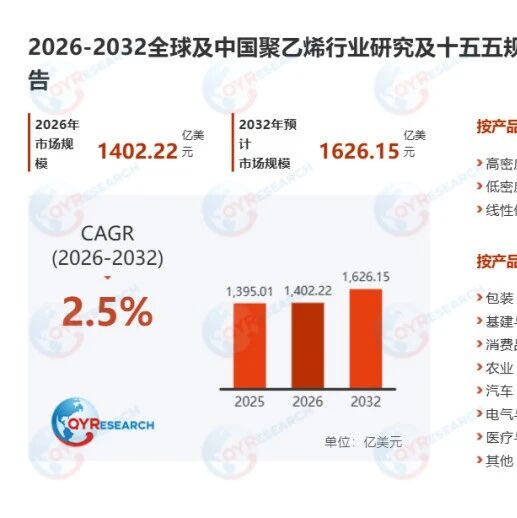
Core Viewpoint - Polyethylene (PE) is a widely used thermoplastic resin with a stable global consumption of approximately 120 million tons, growing at an annual rate of about 3% [4][5]. Market Overview - Polyethylene is a fundamental component of the petrochemical industry, with China being the largest consumer, accounting for about one-third of global consumption [4]. - The industry is transitioning from rapid expansion to a phase of supply-demand rebalancing, characterized by cyclical fluctuations in market conditions [4]. - Production is concentrated in regions with cost advantages, such as the Middle East and North America, while Asia-Pacific, particularly China, is a key center for demand and new capacity [4][7]. Application Structure - The primary applications of polyethylene are in various types of films and flexible packaging, which account for nearly half of total consumption [5]. - Other significant applications include pipes, containers, electrical insulation, and automotive parts, with different polyethylene types serving specific roles [5]. Cost Structure and Equipment Characteristics - The main cost driver for polyethylene production is the upstream ethylene monomer, which can be derived from various sources [6]. - Raw material and energy costs typically account for 60% to 70% of total costs, while the remaining costs include depreciation, labor, and environmental compliance [6]. - New world-class facilities often utilize integrated refining and petrochemical processes, achieving production capacities of 300,000 to 700,000 tons per year [6]. Industry Chain and Competitive Landscape - Polyethylene serves as a crucial link between upstream resources and downstream industries such as packaging, construction, and automotive [7]. - The industry is characterized by high concentration, with major players including Sinopec, ExxonMobil, and Dow, among others [10][7]. - Future capacity is expected to concentrate in regions with resource advantages, and competition will intensify as companies shift towards high-performance materials and sustainable practices [7]. Market Competition and Scale - The top 10 polyethylene producers globally hold approximately 46% of the market share [10]. - High-density polyethylene (HDPE) is the leading product type, accounting for 43.80% of the market [11][13]. Future Outlook - The report anticipates that during the 14th Five-Year Plan, China will focus on high-quality development and technological innovation, which will influence the polyethylene market dynamics [23]. - The analysis includes projections for supply and demand, competitive landscape, and potential opportunities along the Belt and Road Initiative [23].
Mcap of 3 of top-10 most valued firms jumps by ₹75,855 cr; State Bank, Infosys biggest winners
BusinessLine· 2026-01-18 10:02
Market Valuation Changes - The combined market valuation of three top firms, ICICI Bank, State Bank of India, and Infosys, increased by ₹75,855.43 crore in a holiday-shortened week [1] - SBI's market valuation rose by ₹39,045.51 crore to ₹9,62,107.27 crore, making it the largest gainer [3] - Infosys saw its market capitalization surge by ₹31,014.59 crore to ₹7,01,889.59 crore [3] - ICICI Bank's valuation increased by ₹5,795.33 crore, reaching ₹10,09,470.28 crore [3] Valuation Erosion of Other Firms - Reliance Industries, HDFC Bank, TCS, Bharti Airtel, Bajaj Finance, Hindustan Unilever, and Larsen & Toubro experienced a combined valuation loss of ₹75,549.89 crore [2] - Reliance Industries' market capitalization fell by ₹23,952.48 crore to ₹19,72,493.21 crore [3] - Larsen & Toubro's valuation decreased by ₹23,501.8 crore to ₹5,30,410.23 crore [3] - HDFC Bank's valuation dropped by ₹11,615.35 crore to ₹14,32,534.91 crore [4] - Bharti Airtel's market capitalization declined by ₹6,443.38 crore to ₹11,49,544.43 crore [4] - Bajaj Finance's valuation fell by ₹6,253.59 crore to ₹5,91,447.16 crore [4] - Hindustan Unilever's market capitalization diminished by ₹3,312.93 crore to ₹5,54,421.30 crore [4] - TCS's valuation dipped by ₹470.36 crore to ₹11,60,212.12 crore [4] Ranking of Firms - Reliance Industries remains the most valued domestic firm, followed by HDFC Bank, TCS, Bharti Airtel, ICICI Bank, State Bank of India, Infosys, Bajaj Finance, Hindustan Unilever, and Larsen & Toubro [5]

OPEC Boosts Oil Exports to India as Russian Flows Slump
Yahoo Finance· 2026-01-16 08:30
Core Insights - The share of OPEC crude oil in India's import mix reached its highest level in 11 months in December, while Russian oil shipments fell to a two-year low due to new U.S. sanctions [1][2]. Group 1: OPEC and Russian Oil Imports - OPEC crude oil's share in India's total imports increased to 53.25%, while Russian oil flows decreased by 22% to 1.38 million barrels per day, representing 27.4% of total Indian oil imports [2]. - Despite the decline, Russia remained the largest supplier of crude oil to India in December, followed by Iraq and Saudi Arabia, as Indian state-owned companies shifted to purchasing from non-sanctioned Russian firms [3]. - The share of OPEC crude in Indian imports rose from 49% in 2024 to 50% in 2025, while Russia's share decreased from 36% to 33% during the same period [4]. Group 2: Trends in Russian Oil Exports - Russian oil flows to India dropped by 29% month-on-month in December, while exports to China increased by 23% in November, contributing to an 11% rise in total Russian exports [5]. - The decline in shipments to India was less severe than predicted, with estimates suggesting flows could remain between 1.2 million and 1.4 million barrels daily [3][5].