
高密度聚乙烯

Search documents
万华化学,不可抗力!
DT新材料· 2026-03-09 16:04
Core Viewpoint - The ongoing geopolitical tensions in the Middle East, particularly the US-Iran conflict, have severely disrupted shipping routes in the Strait of Hormuz, leading to significant supply chain challenges and rising costs in the chemical and plastic industries [5][6]. Group 1: Impact on Companies - Wanhua Chemical has declared a force majeure on affected contracts and delivery obligations due to the shipping disruptions, effective from March 7, 2026, to ensure business sustainability and product quality for customers [3][10]. - The company has initiated an emergency response mechanism to monitor the situation closely [3]. Group 2: Price Increases and Market Reactions - Wanhua Chemical announced price increases across its entire product line shortly before the force majeure declaration [4]. - International oil prices surged, with New York and London crude oil futures both surpassing $100 per barrel for the first time in over three years, driven by a 90% drop in daily oil flow through the Strait of Hormuz, equating to 18 million barrels of supply disappearing [6]. Group 3: Broader Industry Implications - The disruption in the Strait of Hormuz is expected to have a cascading effect on various sectors, including petrochemicals, agriculture, and manufacturing, with potential crises outlined for multiple products and industries [6]. - The price of PVC has increased by over 12% this year, reflecting the strong performance of general-purpose resins amid market uncertainties [8]. - The plastic industry is facing extreme pressure, with companies caught in a dilemma between raising prices and losing customers or not raising prices and facing losses [9]. Group 4: Future Outlook - Analysts warn that if the Strait remains blocked, oil prices could challenge historical highs, potentially exceeding $150 per barrel [8]. - The current situation has shifted the industry's core challenges from "insufficient demand" to "uncontrolled costs and supply interruptions," leading to a potential reshuffling of the market as companies adapt to these pressures [9].



智领“十五五” 荣盛石化深化AI+前沿技术 树立全球智能炼厂新典范
Quan Jing Wang· 2026-02-25 09:45
Core Insights - The petrochemical refining industry is accelerating its transition to intelligent operations, leveraging AI technology for enhanced production efficiency and safety [1][2] Group 1: Intelligent Refining Operations - The world's largest single refining facility, operated by Rongsheng Petrochemical, has achieved a stable operation rate of ≥98.5% and an automatic control rate of ≥99%, significantly surpassing the global average of approximately 80% [1] - The integration of over 1 million online instruments for real-time monitoring, along with robotic inspections and intelligent control systems, has led to improved operational stability and safety [1] Group 2: Industrial AI Empowerment - Rongsheng Petrochemical has established a new industrial intelligence system centered on "smart instruments + predictive maintenance + data governance," which has notably enhanced production efficiency [2] - The automation levels in the ethylene glycol units exceed 99%, with a total utilization rate of over 99.99%, reducing the burden on operators and ensuring safe production [2] Group 3: Safety Management Innovations - The company has developed a comprehensive lifecycle management platform for equipment, covering selection, installation, operation, maintenance, and decommissioning [3] - The implementation of robotic inspections with various detection methods has effectively reduced the intensity of manual inspections while ensuring safety in production [3] Group 4: Commitment to High-Quality Development - Rongsheng Petrochemical ranks 5th in the "Global Chemical Most Valuable Brands" and 9th in the "Global Top 100 Chemical Companies," reflecting its strong brand value [4] - The company has achieved an MSCI ESG rating of A, positioning it among the leaders in sustainable development within the global petrochemical industry [4]


聚乙烯:步入深度调整期
Zhong Guo Hua Gong Bao· 2026-02-25 02:44
Core Viewpoint - The domestic polyethylene market in China is expected to reach a significant milestone in 2026, with total production capacity surpassing 45 million tons, leading to a shift from scale expansion competition to value enhancement competition, indicating a structural adjustment in the industry [1] Group 1: Capacity Growth and Structure - New polyethylene production capacity in China is projected to reach between 6.15 million to 7.29 million tons in 2026, with a growth rate of 15% to 18.5% [2] - The production capacity will be primarily driven by oil-based facilities, with major contributions from large refining and chemical enterprises like Huajin Amoco and Zhongsha Gulei, alongside a significant increase in coal-based production [2] - The product structure is showing an optimization trend, with the planned production capacity for high-density polyethylene (HDPE) at 2.05 million tons and linear low-density polyethylene (LLDPE) growth slowing to an estimated 4% in 2026, down from 24% in 2025 [2] Group 2: Supply and Demand Dynamics - The polyethylene industry is expected to experience ongoing adjustments in supply and demand, characterized by a phase of seeking balance and rapid price fluctuations [3] - The first half of 2026 will see limited new capacity release, while the second half will face market pressure as capacity expansion comes online [3] Group 3: Cost Trends and Profitability - There will be significant differentiation in cost structures, leading to widening profitability gaps among companies based on their production processes [4] - Oil-based polyethylene, which constitutes nearly two-thirds of total capacity, will face profit pressures due to high crude oil prices and declining polyethylene spot prices [4] - Coal-based polyethylene, accounting for about 20% of total capacity, is expected to benefit from a moderate decline in coal prices, maintaining a specific profitability level [4] Group 4: Domestic Demand and Export Challenges - Domestic apparent consumption of polyethylene is projected to reach approximately 41.5 million tons in 2026, reflecting a year-on-year growth of 7.8%, which is still lower than the growth rate of production capacity [5] - Traditional demand sectors such as packaging films and pipes are experiencing slow growth, while new industries like photovoltaic backsheet films and lithium battery separators are expanding, albeit still representing a small portion of overall consumption [6] - The export of polyethylene from China has seen a compound annual growth rate of 34.5% over the past five years, with expectations for steady growth in 2026, particularly in Southeast Asia [6]
从煤到新材料 绿氢+智能 宁东基地的硬核跃升
Xin Lang Cai Jing· 2026-02-24 11:11
Core Viewpoint - The Ningdong National Energy and Chemical Base is experiencing significant industrial growth, exemplified by Baofeng Energy's projected net profit of 11 to 12 billion yuan for 2025, reflecting a growth of over 70% compared to previous years [1][2]. Group 1: Company Performance - Baofeng Energy is expected to achieve a net profit of 110 to 120 billion yuan by 2025, up from 46 billion yuan in 2020, showcasing its strong resilience and leadership in the industry [1][2]. - The industrial output value of the Ningdong base is projected to exceed 200 billion yuan in 2024, placing it among the top ten chemical parks in China [2][9]. Group 2: Technological Innovation and Transformation - Baofeng Energy's growth is attributed to continuous technological innovation and a green transformation, including the establishment of a leading integrated hydrogen production project and the adoption of AI and IoT technologies [2][8]. - The base has achieved over 98% localization of key equipment through collaboration with national teams, enhancing its production capabilities [2][8]. Group 3: Industrial Ecosystem Development - The Ningdong base is evolving from a single enterprise model to a diversified industrial cluster, with key players like Baofeng Energy, Guoneng Ningmei, and Taihe New Materials driving innovation [2][9]. - The establishment of a complete industrial system from basic chemical raw materials to finished products has led to the creation of specialized clusters such as the "China Spandex Valley" [3][10]. Group 4: Innovation Ecosystem and Support - The Ningdong base has developed a high-level platform and innovation mechanisms to facilitate the integration of large and small enterprises, significantly reducing project entry times and attracting substantial social investment [4][11]. - Initiatives such as the AI intelligent coal blending system have improved efficiency and reduced costs for participating companies, promoting collaborative innovation [4][11]. Group 5: Future Development Strategies - The Ningdong base recognizes existing challenges in its industrial chain and aims to address these through targeted招商 and cultivation strategies during the 14th Five-Year Plan [5][12]. - Future plans include focusing on high-end polyethylene, electronic-grade chemicals, and high-performance fibers, while enhancing the resilience of the industrial chain through a "four-chain integration" approach [6][12].


吉林石化以科技创新赋能产业升级
Zhong Guo Hua Gong Bao· 2026-01-26 03:25
Core Viewpoint - In 2025, Jilin Petrochemical emphasizes technological innovation as a core element of its development strategy, achieving significant results in scientific research and product development, thereby enhancing its self-reliance in high-level technology [1][2][3] Group 1: Research and Development Achievements - Jilin Petrochemical established a comprehensive research system linking strategic guidance, scientific research breakthroughs, and results transformation, completing 51 technology projects and achieving 12 successful transformations in 2025 [1] - The company reported a total economic benefit of over 60 million yuan and direct revenue exceeding 46 million yuan, creating a virtuous cycle of "research empowering production and production feeding back into research" [1] Group 2: Key Technological Breakthroughs - The successful development of large-tow carbon fiber production technology fills a domestic technological gap, while breakthroughs in ethylene-propylene rubber were achieved through collaboration with domestic universities, overcoming 56 key technical challenges [2] - The stable operation of the second industrialization test for ENB-containing ethylene-propylene rubber products demonstrated the effectiveness of domestically produced catalysts, expanding product application areas and addressing high-quality development constraints in the industry [2] Group 3: Product Upgrades and Market Positioning - Jilin Petrochemical focused on high-end product development in key areas such as ABS, synthetic rubber, and polyolefins, achieving significant advancements in product quality, with the 0215H product passing RTI certification and large-diameter polyethylene pipe materials receiving national PE100 grade certification [3] - The commissioning of a new 400,000-ton/year high-density polyethylene facility enabled the successful development of new product grades, enhancing the product matrix and extending the value chain [3] Group 4: Innovation Mechanisms and Ecosystem - The continuous emergence of major technological innovations is supported by a robust institutional mechanism, addressing common challenges such as insufficient innovation motivation and low collaborative efficiency [3] - Jilin Petrochemical formed innovation alliances with universities and research institutes, implemented research management mechanisms like "ranking and leading," and improved result transformation mechanisms to accelerate the transition of laboratory technologies to production lines and markets [3]
行业聚焦:全球聚乙烯行业头部生产商市场份额及排名调查
QYResearch· 2026-01-19 04:50
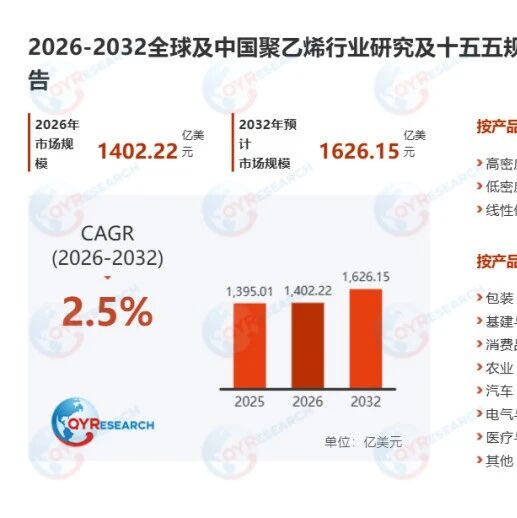
Core Viewpoint - Polyethylene (PE) is a widely used thermoplastic resin with a stable global consumption of approximately 120 million tons, growing at an annual rate of about 3% [4][5]. Market Overview - Polyethylene is a fundamental component of the petrochemical industry, with China being the largest consumer, accounting for about one-third of global consumption [4]. - The industry is transitioning from rapid expansion to a phase of supply-demand rebalancing, characterized by cyclical fluctuations in market conditions [4]. - Production is concentrated in regions with cost advantages, such as the Middle East and North America, while Asia-Pacific, particularly China, is a key center for demand and new capacity [4][7]. Application Structure - The primary applications of polyethylene are in various types of films and flexible packaging, which account for nearly half of total consumption [5]. - Other significant applications include pipes, containers, electrical insulation, and automotive parts, with different polyethylene types serving specific roles [5]. Cost Structure and Equipment Characteristics - The main cost driver for polyethylene production is the upstream ethylene monomer, which can be derived from various sources [6]. - Raw material and energy costs typically account for 60% to 70% of total costs, while the remaining costs include depreciation, labor, and environmental compliance [6]. - New world-class facilities often utilize integrated refining and petrochemical processes, achieving production capacities of 300,000 to 700,000 tons per year [6]. Industry Chain and Competitive Landscape - Polyethylene serves as a crucial link between upstream resources and downstream industries such as packaging, construction, and automotive [7]. - The industry is characterized by high concentration, with major players including Sinopec, ExxonMobil, and Dow, among others [10][7]. - Future capacity is expected to concentrate in regions with resource advantages, and competition will intensify as companies shift towards high-performance materials and sustainable practices [7]. Market Competition and Scale - The top 10 polyethylene producers globally hold approximately 46% of the market share [10]. - High-density polyethylene (HDPE) is the leading product type, accounting for 43.80% of the market [11][13]. Future Outlook - The report anticipates that during the 14th Five-Year Plan, China will focus on high-quality development and technological innovation, which will influence the polyethylene market dynamics [23]. - The analysis includes projections for supply and demand, competitive landscape, and potential opportunities along the Belt and Road Initiative [23].
中国石油:新材料产量“三级跳”助推转型跑出“加速度”
Zhong Guo Chan Ye Jing Ji Xin Xi Wang· 2026-01-14 22:13
Core Viewpoint - Since the "14th Five-Year Plan," China National Petroleum Corporation (CNPC) has accelerated the construction of a "refining and chemical materials" industry structure, implementing the "New Materials Acceleration Project" to enhance capacity release and new product development, achieving a continuous 50% growth in new materials production over four years, thus facilitating a rapid transformation [1] Group 1: Industry Structure and Strategy - CNPC has been addressing the structural contradictions of "low-end surplus and high-end shortage" in the chemical industry, intensifying competition and focusing on product innovation and technological breakthroughs [1][2] - The company has established a new materials division, elevating the development of new materials to a status equal to refining and basic chemicals, thereby optimizing its organizational structure and enhancing innovation capabilities [2] Group 2: Capacity and Production Growth - CNPC has set up several new materials bases across the country, including in Dongshanzi, Lanzhou, Jilin, and Liaohe, creating a capacity layout that covers both eastern and western regions [2] - The company has successfully launched key projects, such as the transformation upgrades at Jilin and Guangxi Petrochemical, and is steadily advancing high-end polyolefin and ethylene projects [2] Group 3: Product Development and Market Position - During the "14th Five-Year Plan," CNPC has significantly expanded its product development matrix, with the number of new product grades increasing by 83% compared to the end of the "13th Five-Year Plan" [3] - The company has made breakthroughs in high-performance, high-value new materials, achieving self-sufficiency in critical material supply chains, with products like carboxylated nitrile rubber and PETG copolyester being developed domestically [4]

兰州石化高密度聚乙烯装置在突破产能、降本增效赛道上跑出“加速度”
Xin Lang Cai Jing· 2026-01-07 09:57
Core Viewpoint - The article highlights the successful operational improvements and innovations at the Lanzhou Petrochemical's high-density polyethylene (HDPE) plant, which has significantly increased production efficiency and capacity, demonstrating the potential for older facilities to achieve new levels of performance through targeted upgrades and teamwork. Group 1: Production Achievements - In 2025, the HDPE plant produced 176,000 tons of polyethylene, exceeding its annual production target [1] - The average operational days per month increased from 26 to over 30, indicating a substantial improvement in stable operation levels [1] Group 2: Equipment Optimization - A "breakthrough battle" was initiated to address the insufficient pressure from the fan, which was critical for product delivery to downstream processes [4] - The utilization of an idle fan helped to resolve the pressure issue, leading to a nearly 10% increase in production capacity post-modification [5] Group 3: Production Efficiency Improvements - A task force was established to analyze and optimize the transition process between different product grades, reducing the transition time from 8 hours to 3-4 hours and decreasing the amount of off-spec products by approximately 40 tons per transition [7] - This optimization resulted in an annual economic benefit of around 500,000 yuan [7] Group 4: Cost Reduction Strategies - The introduction of ton packaging technology allowed for the direct packaging of powder materials, eliminating the need for the extrusion and granulation process, thus shortening the production chain and reducing energy consumption [10] - The packaging capacity was increased from 550 kg to 850 kg per bag, leading to a 30% reduction in packaging material costs and improved efficiency in packaging and transportation [10] Group 5: Continuous Improvement - Ongoing technological innovations and management optimizations are continuously revitalizing the aging plant, breaking through production capacity ceilings while achieving quality improvements and cost reductions [11]
恒力石化(600346):周期底部韧性足,反内卷推动炼化景气回升:——恒力石化(600346):2025年三季报点评
Guohai Securities· 2025-10-29 14:03
Investment Rating - The report maintains a "Buy" rating for the company [1] Core Insights - The company demonstrated resilience at the bottom of the cycle, with a rebound in refining sector profitability driven by "anti-involution" policies [2][8] - The company reported a significant improvement in profitability in Q3 2025, with a net profit of 19.7 billion yuan, a year-on-year increase of 81.5% [6][7] - The report highlights the company's strong cash flow and commitment to shareholder returns through consistent cash dividends [10] Financial Performance Summary - For the first three quarters of 2025, the company achieved revenue of 157.38 billion yuan, a year-on-year decrease of 11.5%, and a net profit of 5.02 billion yuan, down 1.6% year-on-year [5] - In Q3 2025, the company recorded revenue of 53.5 billion yuan, a year-on-year decline of 18.0% but a quarter-on-quarter increase of 14.2% [6] - The gross profit margin for Q3 2025 improved to 16.4%, up 8.6 percentage points year-on-year [6] Segment Performance - In Q3 2025, refining products generated revenue of 26.9 billion yuan, down 19% year-on-year but up 37% quarter-on-quarter, with sales volume of 5.53 million tons [7][14] - The PTA segment reported revenue of 13.2 billion yuan, a year-on-year decrease of 20% [14] - New materials contributed 9.8 billion yuan in revenue, a year-on-year decline of 6% [14] Future Outlook - The company is projected to achieve revenues of 211.4 billion yuan in 2025, with a net profit of 7.47 billion yuan, reflecting a growth rate of 6% [12] - The report anticipates continued growth in net profit, reaching 11.16 billion yuan by 2027 [12] - The company is expected to benefit from industry consolidation and increased competitiveness due to the "anti-involution" policies [8]

聚乙烯行业遭受三重挤压
Zhong Guo Hua Gong Bao· 2025-10-15 03:05
Core Viewpoint - The polyethylene industry in China is experiencing significant challenges, including price pressure, intensified competition, and squeezed profit margins, despite the growth in production capacity [1][2][3] Group 1: Price Pressure and Market Dynamics - The polyethylene market has not performed as expected this year, with the traditional peak season ("Golden September") failing to boost prices, leading to a general decline in price levels [1] - For instance, the average price of linear low-density polyethylene (LLDPE) film in North China dropped by 13.40% year-on-year in September, with prices decreasing by over 1,000 yuan per ton [1] Group 2: Capacity Growth and Industry Structure - China's polyethylene capacity has seen rapid development, increasing from 2.893 million tons in 2000 to 37.428 million tons by August 2025, significantly improving the self-sufficiency rate [2] - The emergence of large private integrated refining projects and the maturity of coal-to-olefins technology have diversified supply sources, with a compound annual growth rate of over 10% in capacity over the past five years [2] - By 2026, the total polyethylene capacity in China is expected to exceed 45 million tons, with 9.55 million tons of capacity under construction [2] Group 3: Structural Challenges and Future Directions - The industry faces significant structural contradictions, including severe low-end homogenization and insufficient high-end products, which hinder healthy development [2] - More than half of the newly added capacity in recent years has been concentrated in full-density and LLDPE facilities, severely squeezing overall profit margins [2] - High-end polyethylene products remain heavily reliant on imports, indicating a lack of domestic R&D and production capabilities in this area [2] Group 4: Strategic Recommendations - The polyethylene industry should shift focus from scale expansion to quality improvement, seeking breakthroughs in high-end products and building a more resilient industrial chain [3] - Emphasis should be placed on high-end and differentiated development, with increased investment in R&D and production of high-value-added products such as high-strength films and lithium battery separator materials [3] - The industry is expected to accelerate the construction of a new development pattern characterized by green, intelligent, and high-end growth amid ongoing adjustments [3]