
低密度聚乙烯

Search documents
聚乙烯:步入深度调整期
Zhong Guo Hua Gong Bao· 2026-02-25 02:44
Core Viewpoint - The domestic polyethylene market in China is expected to reach a significant milestone in 2026, with total production capacity surpassing 45 million tons, leading to a shift from scale expansion competition to value enhancement competition, indicating a structural adjustment in the industry [1] Group 1: Capacity Growth and Structure - New polyethylene production capacity in China is projected to reach between 6.15 million to 7.29 million tons in 2026, with a growth rate of 15% to 18.5% [2] - The production capacity will be primarily driven by oil-based facilities, with major contributions from large refining and chemical enterprises like Huajin Amoco and Zhongsha Gulei, alongside a significant increase in coal-based production [2] - The product structure is showing an optimization trend, with the planned production capacity for high-density polyethylene (HDPE) at 2.05 million tons and linear low-density polyethylene (LLDPE) growth slowing to an estimated 4% in 2026, down from 24% in 2025 [2] Group 2: Supply and Demand Dynamics - The polyethylene industry is expected to experience ongoing adjustments in supply and demand, characterized by a phase of seeking balance and rapid price fluctuations [3] - The first half of 2026 will see limited new capacity release, while the second half will face market pressure as capacity expansion comes online [3] Group 3: Cost Trends and Profitability - There will be significant differentiation in cost structures, leading to widening profitability gaps among companies based on their production processes [4] - Oil-based polyethylene, which constitutes nearly two-thirds of total capacity, will face profit pressures due to high crude oil prices and declining polyethylene spot prices [4] - Coal-based polyethylene, accounting for about 20% of total capacity, is expected to benefit from a moderate decline in coal prices, maintaining a specific profitability level [4] Group 4: Domestic Demand and Export Challenges - Domestic apparent consumption of polyethylene is projected to reach approximately 41.5 million tons in 2026, reflecting a year-on-year growth of 7.8%, which is still lower than the growth rate of production capacity [5] - Traditional demand sectors such as packaging films and pipes are experiencing slow growth, while new industries like photovoltaic backsheet films and lithium battery separators are expanding, albeit still representing a small portion of overall consumption [6] - The export of polyethylene from China has seen a compound annual growth rate of 34.5% over the past five years, with expectations for steady growth in 2026, particularly in Southeast Asia [6]
宜宾港迎来首票进口水水中转多式联运监管货物
Xin Lang Cai Jing· 2026-02-22 22:03
Group 1 - The core point of the news is the successful implementation of a new regulatory model for water-to-water multimodal transport logistics, marking the first import shipment from Saudi Arabia to Sichuan via this route, which significantly enhances the efficiency of cross-border trade [1][2] - The new model allows companies to simplify the import process by requiring only a single declaration for multimodal transport, thus reducing the complexity of customs procedures that previously hindered long-distance water transport [1][2] - The collaboration between Chengdu Customs and Shanghai Customs was crucial for the successful trial of this new model, which aims to lower logistics costs and improve the convenience of cross-border trade [2]
120万吨/年乙烯项目建设有新进展
Zhong Guo Hua Gong Bao· 2026-01-19 10:12
Core Insights - The Tarim Phase II Ethylene Project is a key initiative by China National Petroleum Corporation (CNPC) with a total investment of 29.7 billion yuan, focusing on the production of various polyethylene products and emphasizing innovation and green construction practices [1][2] Group 1: Project Preparation and Execution - The project team initiated comprehensive preparations one month in advance to ensure the accurate positioning of the cold box, employing a "dual crane lifting" technique with a 400-ton crawler crane for the main load and a 160-ton hydraulic truck crane for dynamic adjustments [1] - During the pearl sand filling phase, the project team worked continuously for 24 hours, overcoming adverse conditions such as winter construction and dust weather, to ensure the filling density and uniformity, which are critical for the cold box's insulation performance [1] Group 2: Project Specifications and Goals - The project includes the construction of 1.2 million tons/year of ethylene, two sets of 450,000 tons/year of high-density polyethylene, and 300,000 tons/year of low-density polyethylene, with over 99% application of proprietary technology and over 98% localization of equipment [1] - The project aims to achieve 100% use of green electricity and has industry-leading electrification rates and comprehensive energy consumption, aligning with its commitment to green and low-carbon development [1]
行业聚焦:全球聚乙烯行业头部生产商市场份额及排名调查
QYResearch· 2026-01-19 04:50
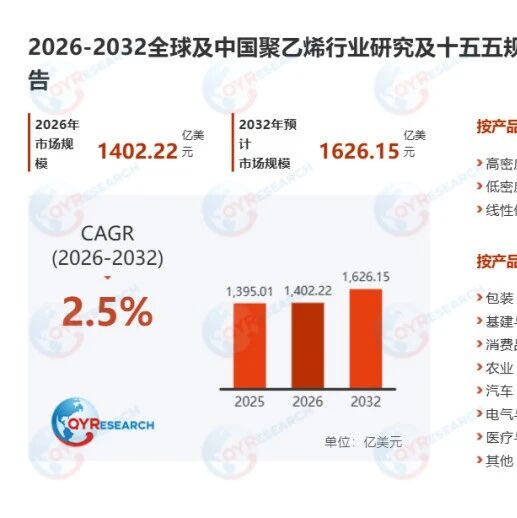
Core Viewpoint - Polyethylene (PE) is a widely used thermoplastic resin with a stable global consumption of approximately 120 million tons, growing at an annual rate of about 3% [4][5]. Market Overview - Polyethylene is a fundamental component of the petrochemical industry, with China being the largest consumer, accounting for about one-third of global consumption [4]. - The industry is transitioning from rapid expansion to a phase of supply-demand rebalancing, characterized by cyclical fluctuations in market conditions [4]. - Production is concentrated in regions with cost advantages, such as the Middle East and North America, while Asia-Pacific, particularly China, is a key center for demand and new capacity [4][7]. Application Structure - The primary applications of polyethylene are in various types of films and flexible packaging, which account for nearly half of total consumption [5]. - Other significant applications include pipes, containers, electrical insulation, and automotive parts, with different polyethylene types serving specific roles [5]. Cost Structure and Equipment Characteristics - The main cost driver for polyethylene production is the upstream ethylene monomer, which can be derived from various sources [6]. - Raw material and energy costs typically account for 60% to 70% of total costs, while the remaining costs include depreciation, labor, and environmental compliance [6]. - New world-class facilities often utilize integrated refining and petrochemical processes, achieving production capacities of 300,000 to 700,000 tons per year [6]. Industry Chain and Competitive Landscape - Polyethylene serves as a crucial link between upstream resources and downstream industries such as packaging, construction, and automotive [7]. - The industry is characterized by high concentration, with major players including Sinopec, ExxonMobil, and Dow, among others [10][7]. - Future capacity is expected to concentrate in regions with resource advantages, and competition will intensify as companies shift towards high-performance materials and sustainable practices [7]. Market Competition and Scale - The top 10 polyethylene producers globally hold approximately 46% of the market share [10]. - High-density polyethylene (HDPE) is the leading product type, accounting for 43.80% of the market [11][13]. Future Outlook - The report anticipates that during the 14th Five-Year Plan, China will focus on high-quality development and technological innovation, which will influence the polyethylene market dynamics [23]. - The analysis includes projections for supply and demand, competitive landscape, and potential opportunities along the Belt and Road Initiative [23].

2026年中国低密度聚乙烯行业发展现状、竞争格局及趋势预测
Sou Hu Cai Jing· 2025-12-13 05:31
Core Insights - The low-density polyethylene (LDPE) industry in China is experiencing steady growth in production capacity and output, but it still falls short of meeting domestic demand, leading to significant imports [1][16] - The market size for LDPE in China is projected to reach 61.193 billion yuan in 2024, reflecting a year-on-year growth of 13.36% [2][18] - The industry faces challenges such as product homogeneity and a lack of high-end products, necessitating continued imports [1][16] Group 1: Industry Overview - LDPE is characterized by its soft texture and high elasticity, making it dominant in the film products sector, including food and cosmetic packaging [1][14] - As of 2024, China's LDPE production is estimated at 3.6903 million tons, with apparent demand at 6.1034 million tons [1][14] - The production technology for LDPE in China is entirely imported, primarily from companies like LyondellBasell and ExxonMobil [7] Group 2: Import and Export Analysis - In 2024, China's LDPE imports are expected to be 2.9562 million tons, a decrease of 4.04% year-on-year, with an average import price of 8,388.81 yuan per ton, up 0.94% [1][16] - The export volume for LDPE in 2024 is projected at 243,100 tons, an increase of 2.82% year-on-year, with an average export price of 10,749.62 yuan per ton, down 5.26% [1][16] Group 3: Market Dynamics - The market price for LDPE in China has shown a trend of decline followed by growth, with an average price of approximately 10,026 yuan per ton in 2024, reflecting an 11.34% increase year-on-year [2][18] - The market dynamics are influenced by factors such as raw material prices, operating rates, downstream demand, and import/export prices [2][18] Group 4: Competitive Landscape - The production capacity in China's LDPE sector is predominantly held by state-owned enterprises, accounting for 59.04% of total capacity [20] - The largest LDPE producer in China is Yangzi-BASF Chemical Co., Ltd., with a market share of 7.28%, followed by Sinopec Beijing Yanshan Company at 6.92% [20][21]
百万吨级乙烯项目获超百亿元贷款
Zhong Guo Hua Gong Bao· 2025-12-11 11:13
Core Viewpoint - The signing of the syndicate loan for ExxonMobil's Huizhou Ethylene Phase I project marks the company's first syndicate loan in China, providing significant financial support for the project [1] Group 1: Project Financing - The syndicate loan exceeds 10 billion yuan, led by Industrial and Commercial Bank of China, with participation from Bank of China and China Construction Bank [1] - This financial backing is crucial for the Huizhou Ethylene Phase I project, which is part of a larger chemical complex investment exceeding 10 billion USD [1] Group 2: Project Overview - The Huizhou Chemical Complex is located in the Huizhou Daya Bay Petrochemical Park and commenced construction in April 2020 [1] - The Phase I project was put into production on July 15 of this year and includes a flexible feed steam cracking unit with an annual capacity of 1.6 million tons of ethylene [1] - Additional facilities include two high-performance linear low-density polyethylene units with a total annual capacity of 1.2 million tons, the world's largest single-unit low-density polyethylene unit with an annual capacity of 500,000 tons, and two differentiated high-performance polypropylene units with a total annual capacity of 950,000 tons [1]

首批人体样本研究揭示:微塑料会改变肠道微生物群
Ke Ji Ri Bao· 2025-10-10 11:36
Core Insights - A recent study presented at UEG Week 2025 indicates that microplastics alter the human gut microbiome, with changes resembling patterns associated with depression and colorectal cancer [1][2] - This research is among the first to directly examine how different types of microplastics interact with the human gut microbiome [1] Summary by Sections Study Methodology - The study utilized fecal samples from five healthy volunteers for in vitro gut microbiome cultivation, exposing these cultures to five common types of microplastics: polystyrene, polypropylene, low-density polyethylene, polymethyl methacrylate, and polyethylene terephthalate [1] - Concentrations of microplastics reflected estimated human exposure levels, with higher doses used to investigate potential dose-dependent effects [1] Findings on Bacterial Composition - While total bacterial cell counts and viable bacterial cell counts remained largely unchanged, the acidity of the microplastic-treated cultures significantly increased compared to the control group, indicating altered microbial metabolic activity [1] - Specific changes in bacterial composition were observed, with certain bacterial populations increasing or decreasing depending on the type of microplastic, particularly within the phylum Firmicutes, which is crucial for digestion and overall gut health [1] Chemical Changes and Disease Implications - Changes in the chemical substances produced by bacteria accompanied the shifts in bacterial composition, with some correlating with the observed increase in acidity [2] - Certain types of microplastics altered levels of pentanoic acid and 5-aminopentanoic acid, while others affected lysine or lactic acid, highlighting the complexity of microplastic-microbiome interactions [2] - Notably, some of the microbially induced changes reflect patterns previously associated with diseases such as depression and colorectal cancer, underscoring the potential health risks linked to microplastic exposure [2]
外资加码广东
2 1 Shi Ji Jing Ji Bao Dao· 2025-09-26 14:00
Core Viewpoint - Guangdong is becoming a preferred investment destination for multinational companies, showcasing significant growth in foreign direct investment (FDI) and new foreign enterprises, driven by its evolving economic landscape and strategic advantages [1][2]. Foreign Investment Growth - In the first eight months of this year, Guangdong established 21,000 new foreign enterprises, a year-on-year increase of 34%, with actual foreign investment amounting to 70.87 billion yuan, up 9.4% year-on-year [1]. - These growth rates significantly outpace the national averages of 14.8% and -12.7% for new foreign enterprises and FDI, respectively [1]. Investment in New Technologies - ExxonMobil's recent $10 billion investment in the Huizhou ethylene project represents a major shift towards high-end chemical production in Guangdong, featuring advanced technology and significant production capacity [3][4]. - The project will produce 1.6 million tons of ethylene annually and includes the world's largest single-unit low-density polyethylene facility, enhancing Guangdong's position in the global chemical supply chain [3][4]. Industry Transformation - The global petrochemical industry is undergoing a transformation towards reducing oil production and increasing chemical output, with Guangdong's robust industrial base supporting this shift [5]. - The region's extensive coastline and port infrastructure provide significant cost advantages for importing raw materials and exporting products, making it an attractive location for foreign investment [5]. Automotive Industry Development - The automotive sector is a key area for multinational investment, with companies like ZF Friedrichshafen establishing R&D centers in Guangdong to leverage the region's automotive ecosystem [7][8]. - The collaboration between ZF and local automotive manufacturers is fostering innovation in smart and electric vehicles, positioning Guangdong as a hub for automotive technology [9]. Consumer Market Dynamics - Guangdong's large and youthful population is driving demand for high-quality products, including beer, with foreign companies like Carlsberg investing in local production facilities to meet this demand [11][12]. - The region's beer market is experiencing growth, with Carlsberg's new brewery in Foshan expected to significantly enhance supply chain efficiency and profitability [11][12]. Strategic Investment Initiatives - Guangdong is enhancing its investment environment through targeted policies and initiatives aimed at attracting foreign capital, particularly in high-tech and emerging industries [14][15]. - The province's focus on "new quality investment" and the establishment of R&D headquarters for multinational companies reflect its commitment to fostering innovation and economic development [14][15]. Conclusion - The combination of Guangdong's market potential, strategic location, and supportive government policies is making it a focal point for foreign investment, particularly in high-tech and innovative sectors [17].
外资加码广东
21世纪经济报道· 2025-09-26 13:54
Core Viewpoint - Guangdong is becoming a preferred investment destination for multinational companies, driven by its strong economic indicators, innovative ecosystem, and large consumer market [3][4][10]. Investment Trends - In the first eight months of this year, Guangdong established 21,000 new foreign-funded enterprises, a year-on-year increase of 34%, with actual foreign direct investment (FDI) amounting to 70.87 billion yuan, up 9.4% year-on-year [3]. - The FDI growth rate in Guangdong is significantly higher than the national average, indicating a robust investment climate [3][4]. Industry Transformation - The shift from being a "world factory" to a hub for global technological innovation and emerging industries is evident, with Guangdong's population of 150 million providing a vast consumer base [4][10]. - Multinational companies are reassessing the value of investing in Guangdong, focusing on new fields and markets, and integrating advanced technologies with local innovation [4][10]. Major Projects - ExxonMobil's Huizhou Ethylene Project represents a significant investment of $10 billion, marking it as the first major wholly-owned petrochemical project by a U.S. company in China [6][9]. - The project will produce 1.6 million tons of ethylene annually and is expected to enhance Guangdong's production capacity for high-value basic chemical raw materials [6][10]. Environmental and Technological Innovations - The project incorporates advanced environmental technologies, aiming to reduce nitrogen oxides and sulfur oxides emissions by approximately 50% [7]. - ExxonMobil's R&D center in Daya Bay will focus on local development of materials recycling and carbon footprint reduction [7][10]. Automotive Industry Developments - ZF Friedrichshafen AG has established a research center in Guangzhou, aligning with Guangdong's automotive industry, which produced over 5 million vehicles in 2023, including 2.53 million new energy vehicles [12][13]. - The collaboration between ZF and local automotive companies is fostering innovation in smart driving technologies [12][13]. Consumer Market Dynamics - Guangdong's large and youthful population is driving demand for high-quality products, making it an attractive market for foreign beer companies like Carlsberg [20][21]. - Carlsberg's new brewery in Foshan is expected to significantly enhance its operational efficiency and market reach in Guangdong [20][21]. Strategic Investment Initiatives - Guangdong is enhancing its investment environment through targeted policies and initiatives aimed at attracting high-end manufacturing and innovative industries [26][27]. - The province is focusing on sectors such as artificial intelligence, new energy vehicles, and biomedicine as key areas for foreign investment [26][27]. Conclusion - The combination of a large consumer base, strong industrial support, and favorable investment policies positions Guangdong as a critical hub for multinational companies seeking growth and innovation opportunities in China [29].
埃克森美孚惠州乙烯项目投产
news flash· 2025-07-15 03:33
Core Insights - The ExxonMobil Huizhou Ethylene Project has officially commenced operations, marking it as a significant foreign investment project in China and the first major petrochemical project wholly constructed by a U.S. company in the country [1] - The total investment for the project exceeds $10 billion, and it is being developed in two phases [1] Project Details - Phase one includes a flexible feed steam cracking unit with an annual production capacity of 1.6 million tons of ethylene [1] - Additionally, it features two high-performance linear low-density polyethylene units with a combined annual output of 1.2 million tons [1] - The project also includes the world's largest single-unit low-density polyethylene facility with an annual capacity of 500,000 tons and two differentiated high-performance polypropylene units with a total annual production of 950,000 tons [1]