
平安银行

Search documents
系统重要性银行扩围至21家:浙商银行突围,兴业银行跌落第三组
Jing Ji Guan Cha Wang· 2026-02-14 06:32
Core Viewpoint - The People's Bank of China and the National Financial Regulatory Administration have updated the list of Domestic Systemically Important Banks (D-SIBs), increasing the total from 20 to 21, with Zhejiang Commercial Bank being newly included [2][3]. Group Summaries Group 1 - The first group now includes 10 banks, such as China Everbright Bank, Minsheng Bank, and Ping An Bank, reflecting a strong position in the financial system [6]. - Zhejiang Commercial Bank's inclusion in this group indicates its significant role and improved risk profile within the banking sector [4][8]. Group 2 - The second group consists of four banks, including Citic Bank, Shanghai Pudong Development Bank, and Postal Savings Bank, with the addition of Industrial Bank [3][6]. - The adjustment of Industrial Bank to this group signifies a shift in its risk assessment and regulatory requirements [4]. Group 3 - The third group includes three banks: Bank of Communications, China Merchants Bank, and Industrial Bank, which maintain advantages in cross-regional operations and market coverage [3][6]. - The downgrade of Industrial Bank from the third to the second group reflects a relative loss of competitive edge in the financial market [6]. Group 4 - The fourth group remains unchanged with the four major state-owned banks: ICBC, ABC, BOC, and CCB, which continue to be the backbone of the national financial system [3][6]. - These banks are subject to the highest regulatory scrutiny due to their systemic importance [3]. Regulatory Insights - The update of the D-SIB list demonstrates a dynamic adjustment in the assessment of systemic risk, emphasizing the importance of both macro and micro-prudential regulations [3][7]. - The additional capital requirements for each group range from 0.25% to 1.5%, with the first group facing the lowest and the fifth group (currently empty) facing the highest [7][8]. - The regulatory framework aims to ensure that banks not only meet micro-level indicators but also adhere to macro-level capital and leverage requirements [7].



广发银行资产托管中心获批筹建!银行业托管业务哪家强?
Nan Fang Du Shi Bao· 2026-02-14 05:55
近日,国家金融监督管理总局发布批复称,同意广发银行筹建广发银行股份有限公司资产托管中心。财 报显示,该行已设有一级部门资产托管部。2024年末,该行资产托管及基金服务业务规模达4.2万亿 元,较年初增长超一成。在业内人士看来,此番筹建资产托管中心,将助力其托管服务向精细化、专业 化的运营体系升级。 将视野放大,近年来,我国商业银行资产托管业务持续扩容。数据显示,截至2024年末,中国银行业资 产管理类产品托管规模为182.20万亿元,较上年末增长12.64%。从行业格局来看,四家银行资产托管规 模超过20万亿元,头部效应明显。 广发银行获批筹建资产托管中心 国家金融监督管理总局发布的批复显示,广发银行筹建广发银行股份有限公司资产托管中心获得同意。 筹建工作接受北京金融监管局的监督指导。筹建工作完成后,向北京金融监管局提出开业申请。 根据中国银行业协会发布的《中国资产托管行业发展报告(2025)》,截至2024年末,中国银行业资产 管理类产品托管规模为182.20万亿元,较上年末增长12.64%;与客户资金保管类产品服务规模合计达 239.90万亿元;资管产品营运外包业务规模8.88万亿元。 具体到国有大行和股 ...

我国系统重要性银行上新
Zhong Guo Xin Wen Wang· 2026-02-14 05:45
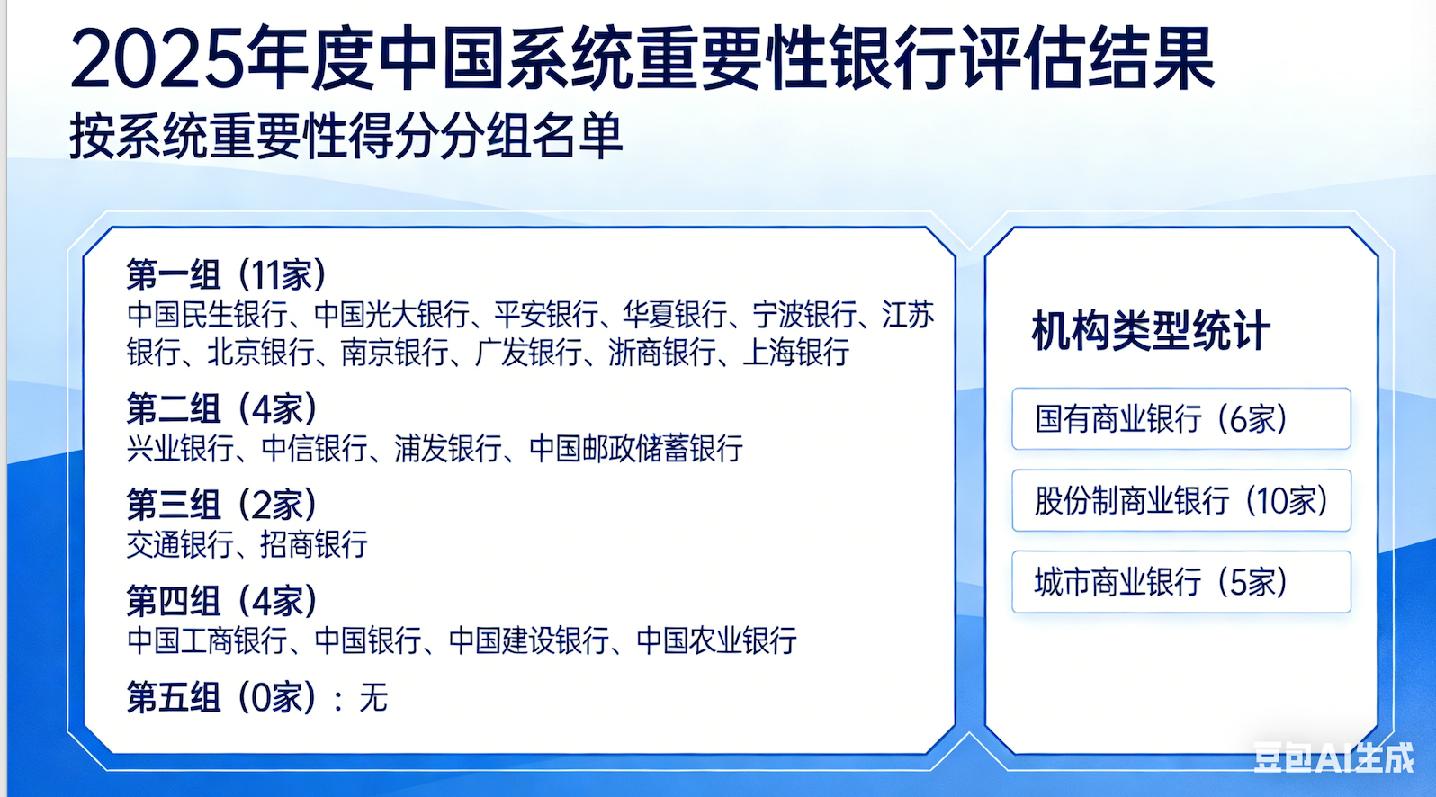
中新网北京2月14日电2月13日,我国系统重要性银行名单公布。 21家国内系统重要性银行入选其中,包括6家国有商业银行、10家股份制商业银行和5家城市商业银行。 按系统重要性得分从低到高分为五组:第一组11家,包括中国民生银行、中国光大银行、平安银行、华 夏银行、宁波银行、江苏银行、北京银行、南京银行、广发银行、浙商银行、上海银行;第二组4家, 包括兴业银行、中信银行、浦发银行、中国邮政储蓄银行;第三组2家,包括交通银行、招商银行;第 四组4家,包括中国工商银行、中国银行、中国建设银行、中国农业银行;第五组暂无银行进入。 什么是系统重要性银行?入选意味着什么? 按照《系统重要性银行评估办法》,系统重要性是指金融机构因规模较大、结构和业务复杂度较高、与 其他金融机构关联性较强,在金融体系中提供难以替代的关键服务,一旦发生重大风险事件而无法持续 经营,可能对金融体系和实体经济产生不利影响的程度。 二是兴业银行被调整至第二组。 自2021年系统重要性银行名单披露以来,兴业银行一直属于第三组。 对于此次位次调整,董希淼认为,系统重要性银行评估基于规模、关联度、可替代性、复杂性等维度, 组别下调通常反映其在这些维度的综 ...
2026年1月金融数据点评:存款搬家加速,M1、M2增速大幅回升
GF SECURITIES· 2026-02-14 05:23
Investment Rating - The industry rating is "Buy" [6] Core Insights - The overall social financing growth slightly declined to 8.2% in January, while M1 and M2 growth rates significantly rebounded, with M1 growing by 4.9% and M2 by 9.0% [6][16] - Government net financing increased significantly by 2,831 billion yuan year-on-year, contributing to the overall social financing growth [6][17] - The report indicates a shift in deposit structure due to accelerated deposit migration, impacting M1 negatively while having limited effect on M2 [6][16] Summary by Sections Overall Situation - Social financing growth decreased slightly to 8.2%, while M1 and M2 growth rates increased significantly [15][16] - M1 and M2 growth rates rose by 1.1 percentage points and 0.5 percentage points respectively compared to the previous month [6][16] Government Sector - Fiscal strength showed a year-on-year decline, impacting overall financing dynamics [39] Household Sector - Demand remained stable year-on-year, with short-term loan demand increasing [39] Corporate Sector - Short-term loan demand increased year-on-year, while bill financing saw a significant reduction [39] Non-Bank Sector - The acceleration of deposit migration was noted, with non-bank deposits increasing by 1.45 trillion yuan year-on-year [6][39]



最新21家系统重要性银行名单公布
Jing Ji Ri Bao· 2026-02-14 04:21
Group 1 - The People's Bank of China and the National Financial Regulatory Administration have conducted an assessment for the 2025 systemically important banks, identifying 21 domestic banks as systemically important, including 6 state-owned commercial banks, 10 joint-stock commercial banks, and 5 city commercial banks [1][3] - The list aims to establish a comprehensive macro-prudential management system and strengthen the regulation of systemically important financial institutions [2] Group 2 - Systemically important banks in China are categorized into five groups based on their importance scores, with the first group consisting of 11 banks, the second group having 4 banks, the third group with 2 banks, the fourth group containing 4 banks, and no banks in the fifth group [3] - The People's Bank of China plans to enhance the combined effect of macro-prudential management and micro-prudential regulation, continuing to solidify additional supervision for systemically important banks to promote their safe and sound operation and better serve the high-quality development of the real economy [3]



国内系统重要性银行名单发布 21家银行入选
Cai Jing Wang· 2026-02-14 02:03
Core Viewpoint - The People's Bank of China has conducted an assessment of systemically important banks for 2025, identifying 21 domestic banks categorized into five groups based on their systemic importance scores [1] Group 1: Assessment Overview - The assessment is part of a broader effort to establish a comprehensive macro-prudential management system and strengthen the regulation of systemically important financial institutions [1] - The evaluation was carried out in collaboration with the National Financial Regulatory Administration [1] Group 2: Classification of Banks - A total of 21 banks were recognized as systemically important, including 6 state-owned commercial banks, 10 joint-stock commercial banks, and 5 city commercial banks [1] - The banks are divided into five groups based on their systemic importance scores: - Group 1: 11 banks including China Minsheng Bank, China Everbright Bank, Ping An Bank, Huaxia Bank, Ningbo Bank, Jiangsu Bank, Beijing Bank, Nanjing Bank, Guangfa Bank, Zheshang Bank, and Shanghai Bank [1] - Group 2: 4 banks including Industrial Bank, China CITIC Bank, Shanghai Pudong Development Bank, and China Postal Savings Bank [1] - Group 3: 2 banks including Bank of Communications and China Merchants Bank [1] - Group 4: 4 banks including Industrial and Commercial Bank of China, Bank of China, China Construction Bank, and Agricultural Bank of China [1] - Group 5: No banks were classified in this group [1]

央行重要发布!名单公布
Sou Hu Cai Jing· 2026-02-14 01:14
Core Viewpoint - The People's Bank of China and the National Financial Regulatory Administration have conducted an assessment of systemically important banks for 2025, identifying 21 domestic banks categorized into five groups based on their systemic importance scores [1]. Group 1: Assessment of Systemically Important Banks - A total of 21 banks have been recognized as systemically important, including 6 state-owned commercial banks, 10 joint-stock commercial banks, and 5 city commercial banks [1]. - The banks are divided into five groups based on their systemic importance scores, with the first group containing 11 banks, the second group 4 banks, the third group 2 banks, the fourth group 4 banks, and the fifth group having no banks [1]. Group 2: Breakdown of Banks by Group - **First Group (11 banks)**: Includes China Minsheng Bank, China Everbright Bank, Ping An Bank, Huaxia Bank, Ningbo Bank, Jiangsu Bank, Beijing Bank, Nanjing Bank, Guangfa Bank, Zheshang Bank, and Shanghai Bank [1]. - **Second Group (4 banks)**: Includes Industrial Bank, China CITIC Bank, Shanghai Pudong Development Bank, and China Postal Savings Bank [1]. - **Third Group (2 banks)**: Includes Bank of Communications and China Merchants Bank [1]. - **Fourth Group (4 banks)**: Includes Industrial and Commercial Bank of China, Bank of China, China Construction Bank, and Agricultural Bank of China [1]. - **Fifth Group**: No banks are included in this group [1]. Group 3: Future Regulatory Actions - The People's Bank of China and the National Financial Regulatory Administration will implement additional regulatory measures for systemically important banks according to the "Regulations on Additional Supervision of Systemically Important Banks (Trial)" [1]. - The aim is to enhance the synergy between macro-prudential management and micro-prudential supervision, ensuring the safe and sound operation of systemically important banks and better supporting the high-quality development of the real economy [1].
我国系统重要性银行名单公布
新华网财经· 2026-02-14 01:10
Group 1 - The People's Bank of China and the National Financial Regulatory Administration have conducted an assessment for the 2025 systemically important banks, identifying 21 domestic banks, including 6 state-owned commercial banks, 10 joint-stock commercial banks, and 5 city commercial banks [3][4]. - The list aims to establish a comprehensive macro-prudential management system and strengthen the regulation of systemically important financial institutions [4]. - Systemically important banks are categorized into five groups based on their importance scores, with the first group including 11 banks such as China Minsheng Bank and China Everbright Bank, and the fourth group including major banks like Industrial and Commercial Bank of China and Bank of China [5]. Group 2 - The People's Bank of China and the National Financial Regulatory Administration will enhance the combined efforts of macro-prudential management and micro-prudential regulation to solidify additional supervision of systemically important banks, promoting their safe and sound operation to better serve the high-quality development of the real economy [5].

我国系统重要性银行再度“纳新”,多家银行组别、位次出现变化
Bei Ke Cai Jing· 2026-02-14 00:59
当前我国系统重要性银行已增至21家,浙商银行(601916)首次"入围"。 从名单上看,自我国系统重要性银行名单发布以来,兴业银行一直属于第三组银行,仅次于"国有五大 行"及招商银行,但是在最新的名单中,兴业银行位次下降、组别被调整至第二组。 记者注意到,当前我国系统重要性银行已增至21家,浙商银行首次"入围"。 准确而言,我国系统重要性银行名单披露最早始于2021年。彼时中国人民银行、原银保监会(即国家金 融监督管理总局)基于2020年数据,评估认定了19家国内系统重要性银行,包括6家国有商业银行、9家 股份制商业银行和4家城市商业银行。 2023年,我国系统重要性银行名单首度"扩军"、增至20家,新加入的南京银行,按照系统重要性得分被 分在第一组。2024年时这份名单未出现新的调整变化。 除浙商银行外,2025年我国多家系统重要性银行在组别、位次上出现明显调整。其中,变化最显著的当 数兴业银行。 新京报贝壳财经讯(记者黄鑫宇)马年农历春节前夕,我国系统重要性银行更新了名单。值得关注的 是,继2023年我国系统重要性银行增至20家后,2025年这份名单再度"纳新",此外另有多家银行的组别 或位次较此前出现了 ...
系统重要性银行名单公布 新增浙商银行
Zhong Guo Zheng Quan Bao· 2026-02-14 00:32
Core Insights - The People's Bank of China and the National Financial Regulatory Administration have conducted an assessment for the 2025 systemically important banks, identifying 21 domestic banks as systemically important [1] Group 1: Systemically Important Banks - The assessment categorized the 21 banks into five groups based on their systemic importance scores, with the first group consisting of 11 banks including China Minsheng Bank, China Everbright Bank, Ping An Bank, and others [1] - The second group includes 4 banks: Industrial Bank, China CITIC Bank, Shanghai Pudong Development Bank, and China Postal Savings Bank [1] - The third group has 2 banks: Bank of Communications and China Merchants Bank [1] - The fourth group consists of 4 major banks: Industrial and Commercial Bank of China, Bank of China, China Construction Bank, and Agricultural Bank of China [1] - No banks were placed in the fifth group [1] Group 2: Changes and Future Directions - Compared to the 2023 list of systemically important banks, Zhejiang Commercial Bank is a new addition [1] - The People's Bank of China and the National Financial Regulatory Administration plan to enhance macro-prudential management and micro-prudential supervision to ensure the safe and sound operation of systemically important banks [1] - The goal is to better support the high-quality development of the real economy [1]