郑州银行

Search documents
2025年金融大模型采购额暴增527%,AI竞速态势加剧
2 1 Shi Ji Jing Ji Bao Dao· 2026-01-15 08:24
Core Insights - The introduction of the AI model DeepSeek by Deep Exploration Company in early 2025 has sparked a significant application boom in the financial industry, marking a transformative technological force comparable to the mobile internet [1] - The banking sector is leading the procurement of large models, with a notable increase in project numbers and funding, indicating a shift in focus from computational power to application effectiveness [3][5] Group 1: Market Trends - In 2025, the financial industry saw a dramatic increase in large model procurement, with 587 projects awarded, representing a 341% year-on-year increase in project numbers and a 527% increase in disclosed funding to 1.506 billion yuan [3][5] - The banking sector accounted for nearly half of the total projects with 290 projects, and 75.2% of the total funding, establishing a dominant position in the market [5][6] Group 2: Project Distribution - The distribution of project types in the financial sector for large models in 2025 shows that banking projects comprised 49.4% of the total, with disclosed funding of 1.13221 billion yuan [6] - The focus is shifting from computational power projects to application projects, with application-type projects (including intelligent agents) rapidly increasing in number and becoming the primary procurement direction [7] Group 3: Driving Forces - Multiple factors are driving the banking sector's embrace of large models, including supportive government policies aimed at accelerating the intelligent transformation of the financial industry [8] - The maturity of technology has reached a turning point in 2025, with significant improvements in the accuracy, reliability, and practicality of large models, particularly with the rise of open-source models like DeepSeek [8][9] Group 4: Competitive Landscape - The competitive pressure in the banking sector, characterized by narrowing interest margins and intensified competition, necessitates new tools for efficiency and differentiation, with AI applications potentially reducing costs by up to 70% in certain categories [9] - Customer expectations for financial services are rising, demanding quicker responses and more personalized experiences, which traditional technologies struggle to meet [9] Group 5: Application Scenarios - Specific application scenarios in the financial sector are becoming concentrated, with intelligent customer service and digital personnel leading the number of awarded projects [10] - The focus on intelligent agents is increasing, with 49 projects explicitly mentioning "intelligent agents," indicating a growing interest in embedding AI capabilities into specific applications [11] Group 6: Future Outlook - As the application of large models deepens, the procurement of application-type projects is expected to grow, with banks likely to develop their own intelligent agents based on clear scenarios and engineering capabilities [11][12] - The financial industry is seen as a data and service-intensive sector, with significant potential for further exploration and application of large models [12]


多家上市银行大股东或高管增持落地!
Xin Lang Cai Jing· 2026-01-14 00:20
Core Viewpoint - The recent increase in shareholding by major shareholders and executives in several banks reflects confidence in the banking sector's development and may signal a potential valuation recovery for bank stocks [1][6]. Group 1: Shareholder and Executive Purchases - Yunnan Rural Commercial Bank announced that several directors and senior management purchased 192,000 shares between January 5 and January 7, 2026, at prices ranging from RMB 6.36 to RMB 6.42 per share [7]. - Nanjing Bank reported that its major shareholder, Zijin Group, increased its stake by 123,472,060 shares, representing 1.00% of the total share capital, between September 11, 2025, and January 12, 2026 [7]. - Qilu Bank disclosed that its directors, supervisors, and senior management successfully purchased 771,000 shares for a total of RMB 4.48 million, exceeding their initial commitment of at least RMB 3.5 million [2][7]. Group 2: Market Signals and Insights - Analyst Yang Haiping indicated that the increase in shareholding sends three signals: it supplements the capital of listed banks, demonstrates shareholder confidence in future performance, and may serve as a catalyst for valuation recovery [8]. - The insurance sector is increasingly investing in bank stocks, with significant purchases from companies like Ping An Life, reflecting a strategic long-term choice rather than a short-term tactical adjustment [9]. Group 3: Future Outlook - Multiple institutions predict that the trend of increasing interest in bank stocks will continue into 2026, with a focus on the dividend attributes of bank shares attracting long-term capital [10]. - Analysts believe that the valuation of bank stocks remains low, suggesting further potential for appreciation in the banking sector [11].



多家上市银行大股东或高管增持落地 或迎来估值修复
Zheng Quan Ri Bao· 2026-01-14 00:08
Core Viewpoint - The recent increase in shareholding by major shareholders and executives in several banks indicates confidence in the banking sector's development and potential valuation recovery [1][2][3]. Group 1: Shareholder Actions - Yunnan Rural Commercial Bank announced that six core executives collectively increased their holdings, buying 192,000 shares at prices between RMB 6.36 and RMB 6.42 per share [2]. - Nanjing Bank's major shareholder, Zijin Group, increased its stake by 123,472,060 shares, representing 1.00% of the total share capital [2]. - Qilu Bank's executives exceeded their planned share purchase, acquiring 771,000 shares for a total of RMB 4.48 million, surpassing the initial target of RMB 3.5 million [2]. Group 2: Market Signals - Analysts suggest that the increase in shareholding sends three key signals: it enhances the capital of listed banks, reflects shareholder confidence in future development, and may serve as a catalyst for valuation recovery [3]. - The actions of insurance companies, such as Ping An Life increasing their holdings in Agricultural Bank and China Merchants Bank, highlight a trend of insurance capital increasing their investments in bank stocks [4]. Group 3: Investment Outlook - The insurance sector is expected to inject over RMB 2 trillion into the market in 2026, with a growing demand for dividend-yielding assets, particularly state-owned banks offering over 4% dividend yields [4]. - Analysts from Galaxy Securities predict that the trend of long-term funds, represented by insurance capital, will continue to favor bank stocks due to their dividend characteristics and stable cash flow [5]. - Overall, the valuation of bank stocks remains low, suggesting potential for further appreciation in the sector [5].
房企“白名单项目”展期松绑在即,抵押物价值重估是关键
Di Yi Cai Jing· 2026-01-13 13:44
该政策对市场有何影响?机构普遍认为,央企、国企及优质民企凭借其信用优势,预期将获得更直接的流动性支持; 而对于困境房企,政策惠及有限。对银行而言,展期虽能暂时平滑不良贷款数据,但风险并未消除,市场销售回款的 根本好转才是化解风险的关键。 以时间换空间。 近日,有消息称,监管部门对房地产融资协调机制下发最新的政策指导。核心是对已经进入融资协调机制"白名单"的 项目,符合一定条件和标准的,可在原贷款银行进行展期。 第一财经记者从多方消息源核实,该政策属实。 业内受访人士认为,监管层此番政策调整,意在通过"以时间换空间",为资质合规但受困于市场低迷的优质项目争取 恢复期,以求在"保交付"与"防风险"之间达成平衡。然而,宽松的政策信号之下,足额抵押物仍是项目获得展期或进 入"白名单"的核心前提。第三方统计显示,近六成机构认为,"提供足值抵押物"是当前融资落地的主要难点,未来抵 押物价值重估等细则将影响政策实效。 (图片来源:中指数据) 展期放宽 以往,贷款展期期限受原贷款期限限制。根据国家金融监督管理总局《流动资金贷款管理办法》,借款人申请贷款展 期的,期限一年以内的贷款展期期限累计不得超过原贷款期限;期限超过一年的 ...

招行本周五“发红包” 超半数A股银行进行2025年度中期分红
Mei Ri Jing Ji Xin Wen· 2026-01-13 12:30
Core Viewpoint - The number of A-share listed banks implementing mid-term dividends is increasing, with several banks announcing their dividend plans for 2025, reflecting a commitment to shareholder returns and financial stability [1][4]. Group 1: Dividend Announcements - China Merchants Bank announced a cash dividend of approximately RMB 20.897 billion (including tax) for the first half of 2025, with a per-share dividend of RMB 1.013 (including tax) [1][2]. - As of now, over half of the 42 A-share listed banks have disclosed their mid-term dividend plans for 2025, with three banks, including China Merchants Bank, Postal Savings Bank, and Jiangsu Bank, announcing dividends this week [1][2][4]. - Postal Savings Bank distributed a cash dividend of RMB 0.123 per share (including tax) on January 12, 2026, while Jiangsu Bank announced a cash dividend of RMB 0.3309 per share (including tax) on January 14, 2026 [2]. Group 2: Regulatory Environment - The Chinese government has introduced guidelines to enhance cash dividend regulations for listed companies, encouraging multiple dividend distributions within a year and promoting higher dividend yields [3][4]. Group 3: Industry Trends - The mid-term dividend distribution among A-share listed banks has been growing, with 23 banks confirming their mid-term profit distribution plans for 2025, some of which are initiating mid-term dividends for the first time [4]. - Analysts note that the increase in the number of banks planning mid-term dividends and the stability of dividend rates indicate the banking sector's robust dividend value, which is attractive to long-term investors [5]. Group 4: Market Conditions - Despite a strong overall performance in 2025, many listed banks remain in a state of net asset value decline, primarily due to concerns over net interest margins and asset quality amid economic pressures [6]. - The average dividend yield for bank stocks is above 3%, with most banks expected to maintain a dividend yield of over 2% for their mid-term dividends in 2025 [6].
2026首份银行增持公告来了!顶流银行ETF(512800)上探1%,机构:历次春节前银行胜率最高,值得重视
Xin Lang Cai Jing· 2026-01-13 11:44
Core Viewpoint - The banking sector shows resilience with significant stock price increases, driven by executive buybacks and insurance capital inflows, indicating strong confidence in the sector's fundamentals and long-term value [3][12]. Group 1: Market Performance - On January 13, the market experienced a pullback, but the banking sector remained active, with notable gains: Ningbo Bank up over 4%, Hangzhou Bank up over 3%, and several others including CITIC Bank and Chongqing Rural Commercial Bank up over 2% [1][9]. - The top-tier banking ETF (512800) saw an intraday price increase of over 1%, closing up 0.37% and surpassing the 5-day moving average [1][10]. Group 2: Executive Buybacks - The first executive buyback announcement of 2026 was made by Chongqing Rural Commercial Bank, where some directors and executives purchased 192,000 shares from the secondary market, with a maximum investment of 1.23 million yuan [3][12]. - Nanjing Bank reported that its major shareholder, Zijin Group, increased its stake by 123,472,060 shares, representing 1.00% of the total share capital, continuing from previous increases since September 2025 [3][12]. Group 3: Insurance Capital Inflows - Insurance capital has been actively purchasing bank stocks, with Ping An Life announcing it reached a 20% stake in China Merchants Bank H-shares, triggering a mandatory bid [3][12]. - In 2025, insurance capital made 41 stake increases, the highest in nearly a decade, with bank stocks accounting for about 40% of these actions, highlighting their dominance in this area [3][12]. Group 4: Seasonal Trends - Historically, the banking sector has performed well before the Spring Festival, with the Shenwan Banking Index showing over 80% win rate in the past decade, except for 2020 [4][16]. - The average absolute return of the Shenwan Banking Index before the Spring Festival is 4.4%, with an average excess return of 4.9% compared to the Shanghai Composite Index, making it the highest among 31 industry indices [4][16]. Group 5: Future Outlook - Factors expected to drive the banking sector's performance leading up to the Spring Festival in 2026 include continued growth policies, ongoing insurance asset scarcity, and increased market volatility [7][16]. - The banking ETF (512800) is noted for its efficiency in tracking the banking sector, with a current scale of 11.95 billion yuan and an average daily trading volume exceeding 800 million yuan since 2025, making it the largest and most liquid banking ETF in A-shares [7][16].





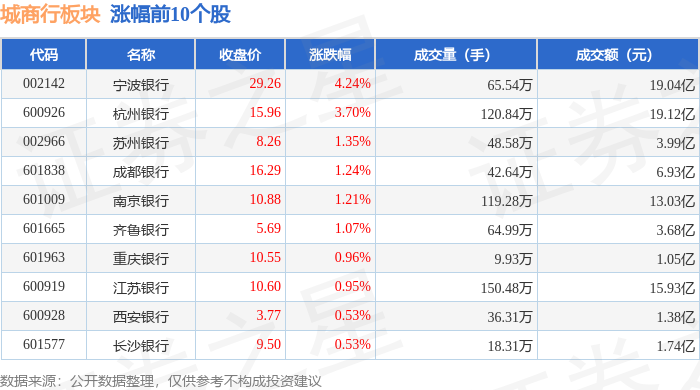
城商行板块1月13日涨1.55%,宁波银行领涨,主力资金净流入2.38亿元
Zheng Xing Xing Ye Ri Bao· 2026-01-13 09:06
Core Insights - The city commercial bank sector experienced a rise of 1.55% on January 13, with Ningbo Bank leading the gains [1] - The Shanghai Composite Index closed at 4138.76, down 0.64%, while the Shenzhen Component Index closed at 14169.4, down 1.37% [1] Stock Performance - Ningbo Bank (002142) closed at 29.26, up 4.24%, with a trading volume of 655,400 shares and a transaction value of 1.904 billion [1] - Hangzhou Bank (600926) closed at 15.96, up 3.70%, with a trading volume of 1,208,400 shares and a transaction value of 1.912 billion [1] - Suzhou Bank (002966) closed at 8.26, up 1.35%, with a trading volume of 485,800 shares [1] - Chengdu Bank (601838) closed at 16.29, up 1.24%, with a trading volume of 426,400 shares and a transaction value of 693 million [1] - Nanjing Bank (600109) closed at 10.88, up 1.21%, with a trading volume of 1,192,800 shares and a transaction value of 1.303 billion [1] - Qilu Bank (601665) closed at 5.69, up 1.07%, with a trading volume of 649,900 shares and a transaction value of 368 million [1] - Chongqing Bank (601963) closed at 10.55, up 0.96%, with a trading volume of 99,300 shares and a transaction value of 10.5 million [1] - Jiangsu Bank (616009) closed at 10.60, up 0.95%, with a trading volume of 1,504,800 shares and a transaction value of 1.593 billion [1] - Xi'an Bank (600928) closed at 3.77, up 0.53%, with a trading volume of 363,100 shares and a transaction value of 13.8 million [1] - Changsha Bank (601577) closed at 9.50, up 0.53%, with a trading volume of 183,100 shares and a transaction value of 174 million [1] Capital Flow - The city commercial bank sector saw a net inflow of 238 million from institutional investors, while retail investors contributed a net inflow of 199 million [2] - The sector experienced a net outflow of 437 million from speculative funds [2] Individual Stock Capital Flow - Hangzhou Bank (600926) had a net inflow of 70.42 million from institutional investors, while it faced a net outflow of 12.4 million from speculative funds [3] - Shanghai Bank (601229) saw a net inflow of 66.71 million from institutional investors, with a net outflow of 33.15 million from speculative funds [3] - Ningbo Bank (002142) had a net inflow of 37.18 million from institutional investors, with a net outflow of 1.4 million from speculative funds [3] - Suzhou Bank (002966) experienced a net inflow of 34.87 million from institutional investors, while facing a net outflow of 24.25 million from speculative funds [3] - Jiangsu Bank (601577) had a net inflow of 20.83 million from institutional investors, with a net outflow of 15.24 million from speculative funds [3]


这两家银行即将派发红包!过半A股上市银行已实施中期分红
Nan Fang Du Shi Bao· 2026-01-13 05:31
Core Viewpoint - Several banks are distributing cash dividends, indicating a stable profitability in the banking sector and providing tangible returns to shareholders [2][3][4]. Group 1: Dividend Distribution - Postal Savings Bank distributed a cash dividend of 0.1230 yuan per share, totaling 12.33 billion yuan [3]. - Jiangsu Bank plans to distribute a cash dividend of 0.3309 yuan per share, amounting to 6.07 billion yuan [2][3]. - China Merchants Bank intends to distribute a cash dividend of 1.013 yuan per share, totaling approximately 20.90 billion yuan [2][3]. Group 2: Overall Banking Sector Performance - As of January 13, over half of the 42 listed A-share banks have implemented mid-term dividends for 2025, with 31 banks announcing such distributions, an increase of 7 banks compared to 2024 [4][5]. - The total proposed dividend amount for these banks is 276.49 billion yuan, reflecting a growth of 7.05% compared to 2024 [4]. Group 3: Dividend Yields - The dividend yields for the banks are as follows: Postal Savings Bank at 2.30%, Jiangsu Bank at 3.15%, and China Merchants Bank at 2.46% based on their respective closing prices [3]. Group 4: Future Dividend Plans - Huaxia Bank has announced a profit distribution plan with a cash dividend of 1.00 yuan per 10 shares, totaling 1.59 billion yuan, pending a shareholder meeting [7]. - Industrial Bank plans to hold a shareholder meeting on January 20 to review its mid-term profit distribution proposal, which includes a cash dividend of 5.65 yuan per 10 shares, totaling 11.96 billion yuan [7].



智通港股通资金流向统计(T+2)|1月13日





智通财经网· 2026-01-12 23:32
Core Insights - The article highlights the net inflow and outflow of funds in the Hong Kong stock market, with Xiaomi Group, Tencent Holdings, and China Construction Bank leading in net inflows, while the Yingfu Fund, Hang Seng China Enterprises, and Southern Hang Seng Technology experienced the highest net outflows [1] Group 1: Net Inflows - Xiaomi Group-W (01810) recorded a net inflow of 1.07 billion, representing a 16.36% increase in its closing price [2] - Tencent Holdings (00700) saw a net inflow of 863 million, with a 7.49% increase in its closing price [2] - China Construction Bank (00939) had a net inflow of 699 million, with a significant 41.06% increase in its closing price [2] Group 2: Net Outflows - Yingfu Fund (02800) experienced the largest net outflow of 6.289 billion, reflecting a -31.44% change in its closing price [2] - Hang Seng China Enterprises (02828) had a net outflow of 2.880 billion, with a -17.89% change in its closing price [2] - Southern Hang Seng Technology (03033) faced a net outflow of 1.289 billion, showing a -11.37% change in its closing price [2] Group 3: Net Inflow Ratios - 361 Degrees (01361) led with a net inflow ratio of 74.40%, with a net inflow of 8.9117 million [3] - BRILLIANCE CHI (01114) followed with a net inflow ratio of 64.04%, amounting to a net inflow of 36.4910 million [3] - Qin Port Co. (03369) had a net inflow ratio of 61.05%, with a net inflow of 846,600 [3] Group 4: Net Outflow Ratios - Wisdom Hong Kong 100 (02825) had a net outflow ratio of -100.00%, with a net outflow of -18,200 [3] - Stone Pharmaceutical Group (02005) recorded a net outflow ratio of -68.86%, with a net outflow of -14.1501 million [3] - Dexion Shipping (02510) experienced a net outflow ratio of -53.53%, with a net outflow of -10.0204 million [3]
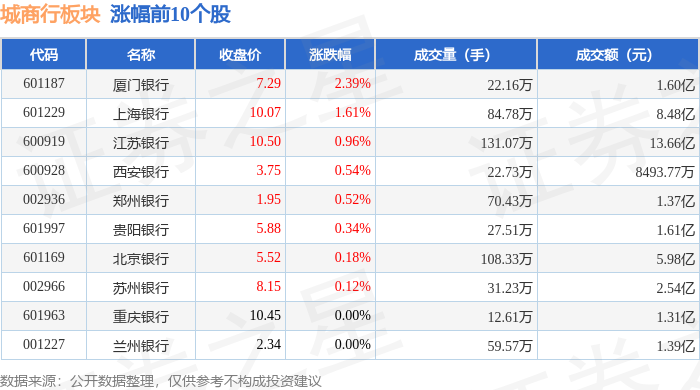
城商行板块1月12日涨0.25%,厦门银行领涨,主力资金净流出6140.56万元
Zheng Xing Xing Ye Ri Bao· 2026-01-12 09:10
Market Performance - The city commercial bank sector increased by 0.25% compared to the previous trading day, with Xiamen Bank leading the gains [1] - The Shanghai Composite Index closed at 4165.29, up 1.09%, while the Shenzhen Component Index closed at 14366.91, up 1.75% [1] Individual Bank Performance - Xiamen Bank (601187) closed at 7.29, up 2.39% with a trading volume of 221,600 shares and a transaction value of 160 million yuan [1] - Shanghai Bank (601229) closed at 10.07, up 1.61% with a trading volume of 847,800 shares and a transaction value of 848 million yuan [1] - Jiangsu Bank (616009) closed at 10.50, up 0.96% with a trading volume of 1,310,700 shares and a transaction value of 1.366 billion yuan [1] - Other banks such as Xi'an Bank, Zhengzhou Bank, and Beijing Bank also showed minor increases in their stock prices [1] Capital Flow Analysis - The city commercial bank sector experienced a net outflow of 61.41 million yuan from institutional investors, while retail investors saw a net inflow of 66.54 million yuan [2] - The individual capital flow for Jiangsu Bank showed a net inflow of 47.88 million yuan from institutional investors, while retail investors had a net outflow of 51.39 million yuan [3] - Xiamen Bank had a net inflow of 17.18 million yuan from institutional investors, but retail investors experienced a net outflow of 8.30 million yuan [3]