CATL

Search documents
韩国股民开年抢购中国AI股,Minimax-WP买入额居首
Mei Ri Jing Ji Xin Wen· 2026-02-12 00:39
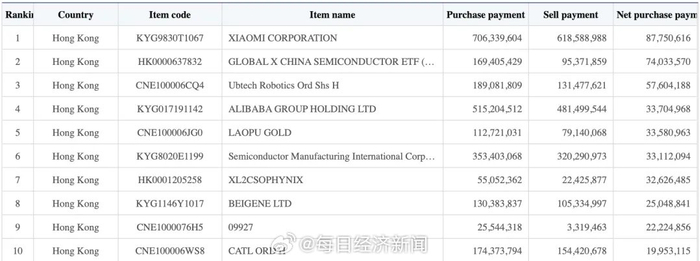
Core Viewpoint - Korean investors are aggressively purchasing Chinese AI stocks, particularly leading companies in the large model sector, indicating a strong interest in the Chinese market and AI technology [1]. Group 1: Investment Trends - As of February 10, 2026, Korean investors have significantly increased their buying activity in Chinese stocks compared to the previous year [1]. - The top ten stocks purchased by Korean investors include MiniMax-WP, 华夏沪深300ETF, 澜起科技, and others, reflecting a diverse interest in various sectors [1]. Group 2: Purchase Amounts - The purchase amounts for key stocks are as follows: MiniMax-WP at $2,067.12 million, 华夏沪深300ETF at $1,918.22 million, and 澜起科技 at $1,864.71 million [2]. - Other notable purchases include 安硕恒生科技ETF at $736.47 million and 南方东英每日杠杆三星电子 at $732.50 million, showcasing a strong preference for technology and ETF products [2].

中国股票策略-中国原材料价格上涨的影响-China Equity Strategy Implications from Raw Material Price Hikes in China
2026-02-10 03:24
Summary of Key Points from the Conference Call Industry Overview - **Commodity Price Surge**: Commodity prices have increased significantly and are stabilizing at higher levels, impacting various sectors in China positively and negatively [1][11]. Positive Impacts - **Basic Materials Sector**: Beneficiaries include aluminum, copper, and lithium suppliers, with companies like Chalco, Hongqiao, and Zijin Mining receiving Buy ratings [2][1]. - **Gold Jewelry Sector**: Gold jewelers are expected to benefit from rising gold prices, with brands in the high-end segment likely to gain market share [72][73]. - **CCL Players**: Companies in the copper-clad laminate (CCL) sector may see gross margin expansion due to rising copper prices [1][6]. Negative Impacts - **Automakers**: Mass-market battery electric vehicles (BEVs) and plug-in hybrid electric vehicles (PHEVs) are projected to face cost increases of Rmb6,565 and Rmb4,310 per vehicle, respectively, due to raw material price hikes [3][23]. - **Battery Industry**: Tier-2 battery makers are under pressure from rising raw material costs, while CATL is better positioned due to its bargaining power [4][27]. - **Energy Storage Systems (ESS) and Solar Equipment**: Companies like Sungrow and Trina Solar are vulnerable to margin cuts due to increased costs of silver and copper [5][45]. - **Industrial & Robotics Firms**: Companies such as Johnson Electric and Hongfa Technology may experience earnings pressure from rising copper and silver costs [6][51]. - **Home Appliances**: Producers like Gree and Midea are facing margin reductions due to increased copper costs in air conditioning units [66][67]. - **Technology Sector**: Xiaomi is expected to see pressure on smartphone margins due to high memory costs, which account for 10-20% of the bill of materials [7][81]. Sector-Specific Insights - **Basic Materials**: The demand for aluminum and copper is driven by infrastructure development and the growth of AI, data centers, and electric vehicles [2]. - **Automotive Sector**: BYD and Geely are better positioned to absorb cost increases compared to smaller players like Xpeng and GAC [3][24]. - **Battery Makers**: Rising lithium prices have increased LFP battery cell costs by Rmb80/kWh, with significant pressure on margins expected [27][29]. - **ESS and Grid Equipment**: Pinggao is identified as the most vulnerable to commodity price increases, with a significant portion of its profits derived from gas-insulated switchgears [41][42]. - **Industrial Sector**: KBL is expected to benefit from the copper upcycle, with projected earnings growth significantly outpacing competitors [55][56]. Additional Considerations - **Market Outlook**: The overall outlook for the PRC stock market in 2026 is optimistic, particularly for sectors like technology, healthcare, and basic materials [13]. - **Insurance Sector**: Gold price increases could benefit insurers participating in gold investment pilots, although current investments remain cautious [101]. Conclusion The report highlights the mixed impact of rising commodity prices across various sectors in China, with certain companies positioned to benefit while others face significant challenges. The insights provided can guide investment decisions in the context of the evolving market landscape.



Ford Reportedly In Talks With China's Geely To Explore European Manufacturing Partnership - Ford Motor (NYSE:F)
Benzinga· 2026-02-04 08:33
Group 1 - Ford Motor Co. is in discussions with Geely Automobile Holdings for a potential partnership involving the use of Ford's factory space in Europe for vehicle manufacturing [1] - The partnership talks include sharing vehicle technologies, particularly in automated driving, and are more advanced in European manufacturing [1][2] - A delegation from Ford was sent to China to further these discussions, following prior talks in Michigan between senior executives from both companies [2] Group 2 - Ford's 2023 partnership with Chinese battery-maker CATL to produce low-cost LFP EV batteries has faced criticism from U.S. lawmakers due to tariffs and security restrictions affecting Chinese automakers in the U.S. market [3] - The company is also exploring a potential battery partnership with BYD as part of its hybrid strategy, indicating active engagement in the electric vehicle sector [4] - Over the past year, Ford's stock has increased by 38.83%, closing at $13.73 recently [5]

人工智能能源:100 吉瓦的机遇-Powering AI-The 100GW Opportunity
2026-02-04 02:32
February 3, 2026 02:00 PM GMT Powering AI The 100GW Opportunity Asia's demand for compute is rising and accelerating power infrastructure investments in the region. We estimate compute power demand to grow at a similar rate to the US, reaching over 100GW by 2030 and driving US$140bn of value creation among our Powering AI preferred picks. Power consumption is outpacing expectations as demand rises from AI to onshoring around the world and in Asia. We estimate compute power needs will grow at a 23% CAGR thro ...
Ford, Xiaomi Deny JV Talks Even As Jim Farley Expressed Admiration For Chinese EVs While Flagging Them As Competitive Threat
Yahoo Finance· 2026-02-02 23:01
Group 1 - Ford Motor Co. and Xiaomi have both denied reports of a potential collaboration to produce electric vehicles in the U.S. [1][2] - Preliminary discussions were reported by the Financial Times, but both companies refuted these claims, with Ford stating the story is "completely false" [2] - The potential collaboration has raised concerns in Washington, with criticism from John Moolenaar, chair of the House China committee, regarding increased U.S. dependency on China [3] Group 2 - Ford CEO Jim Farley has expressed admiration for Chinese electric vehicles and has imported Xiaomi's SU7 model for personal use, highlighting the competitive threat posed by Chinese manufacturers [4] - The Pentagon has flagged Ford's licensing deal with China's CATL over alleged military ties, which CATL denies, raising further concerns from the House China committee [4] - Ford is actively seeking strategic partnerships to strengthen its position in the electric vehicle market, including discussions with General Motors and a potential partnership with BYD for battery supply [6][7]
How QuantumScape Stock Rises 2x To $22?
Forbes· 2026-01-22 14:15
Core Viewpoint - QuantumScape stock has seen significant price increases, with a potential to double again if certain catalysts are met [2][4] Group 1: Company Transition and Revenue Generation - QuantumScape is transitioning from a research-focused organization to a commercial business by 2026, expecting its first revenue of approximately $5 million from licensing deals with automakers [3] - The first revenue will shift QuantumScape's image from a "science project" to a "commercial business," potentially attracting institutional investors [4] Group 2: Growth Catalysts - Five key growth catalysts could lead to a doubling of the stock price to $22: 1. Validation and field testing of the QSE-5 cell in 2026, meeting specifications for energy density and charge time [7] 2. A licensing agreement with Volkswagen's PowerCo, providing an upfront payment and future royalties, allowing collaboration with other OEMs [7] 3. The efficiency of the Cobra heat-treatment process for high-volume production of the ceramic separator [7] 4. A realistic financial trajectory with nominal revenue in 2026, but significant growth expected in 2027 [7] 5. Competitive edge over rivals like Toyota and Samsung SDI by being first to B-sample testing [7] Group 3: Valuation Scenarios - Scenario 1: If QuantumScape secures significant OEMs, the market cap could reach around $13 billion based on anticipated royalty streams [8] - Scenario 2: Successful proof-of-concept for manufacturing could shift the stock's perception from speculative to essential infrastructure [8] - Scenario 3: Capturing even 5% of the solid-state market could support a share price of $22 today [9] Group 4: Key Milestones - Key milestones to monitor include: - Q1 2026: Launch of the Eagle Line to demonstrate the Cobra process at scale [13] - Mid-2026: Validation of QSE-5 cells under real-world conditions [13] - Late 2026: Announcement of new licensing agreements with major automakers [13] - 2027: First reported royalties and milestone payments as the company transitions to a commercial player [13] Group 5: Market Context - The solid-state battery market is projected to be worth $27.7 billion, with QuantumScape aiming to establish itself as a leader in this space [12][16] - The company is currently valued at approximately $6.3 billion, based on future potential rather than current revenue [7][12]


能源的未来:并非所有电力都等价-Future of Energy Kilowatts Not All Are Equal
2026-01-22 02:44
Summary of Key Points from the Conference Call Industry Overview - The power market is undergoing significant changes due to the rapid adoption of AI, leading to a premium on reliable power sources. This shift is particularly evident in the US, Japan, and Malaysia, which are at the forefront of implementing tiered power pricing systems [1][2][3]. Core Insights - **Tiered Power Pricing**: The global adoption of tiered power pricing is accelerating, benefiting both power generators and grids. High-load users, such as AI datacenters, are expected to pay more, which helps lower household bills and reduces regulatory risks [1][2]. - **Pricing Dynamics**: In Malaysia, datacenters are already paying 15-20% higher prices for power, while in the US, prices could increase by 30-40%. This pricing strategy aims to subsidize grid investments and protect residential consumers from costs associated with infrastructure upgrades [2][4]. - **Battery Storage**: The widening price differential between peak and off-peak power could incentivize datacenters to adopt battery storage solutions, allowing them to charge during low-demand periods and mitigate overall power costs [2][3]. Financial Implications - **Capacity Payments**: The demand for round-the-clock power from datacenters has reduced available generation capacity, leading to a significant increase in capacity payments in the PJM market, from US$29/MW-day to between US$270/MW-day and US$329/MW-day [3]. - **Cost Projections**: New generation costs could rise by approximately US$30/MWh, resulting in total prices for datacenters reaching around US$110-120/MWh, compared to the average of US$80-85/MWh [3]. Regional Developments - **Malaysia**: Regulators are implementing tiered pricing to support critical industries, with high-efficiency users potentially seeing a 5-13% reduction in bills, while ultra-high-voltage users like datacenters may face a ~14% increase [4][17]. - **Ireland**: The Commission for Regulation of Utilities (CRU) has noted that datacenters' share of national electricity consumption rose from 5% in 2015 to 21% in 2023, prompting policy changes to ensure cost-reflective pricing for large energy users [14]. Stock Recommendations - Key global stock picks include EQT, Vistra, NextEra, Reliance, Adani Power, RWE, CATL, Tenaga, Korea Electric Power, Keppel Ltd, and Hokkaido Electric. These companies are positioned to benefit from the evolving power market dynamics [3][24]. Additional Insights - The introduction of "mega-load" riders and differentiated pricing structures for large users is becoming common across major power markets, reflecting a shift towards more tailored energy solutions [7][13]. - The expected expansion of spark spreads for power generators indicates a favorable outlook for companies involved in power generation, particularly those adapting to the new pricing structures [11][13]. This summary encapsulates the key points discussed in the conference call, highlighting the transformative changes in the power industry and their implications for pricing, capacity, and investment opportunities.
Singapore tries to give its stock market a boost with a link to the NASDAQ
Fortune· 2026-01-16 09:00
Firms will soon get the opportunity to list in both the U.S. and Singapore in a first-of-its kind partnership. The SGX-NASDAQ dual listing bridge, which will commence later this year, is part of Singapore’s drive to revitalize its stock exchange, which has persistently lagged other regional bourses like the Hong Kong Stock Exchange in attracting IPOs and other deals. The bridge will likely appeal to Southeast Asian companies who want to draw on the U.S.’s deep capital market, yet still tap “strong brand rec ...
科达利-目标价隐含 70% 上涨空间;纳入瑞银亚太重点电话会清单
瑞银· 2026-01-13 11:56
Investment Rating - The report maintains a Buy rating for Shenzhen Kedali Industry and raises the price target to Rmb268.00 from Rmb218.00, indicating a potential upside of over 70% [1][6]. Core Insights - Shenzhen Kedali, as China's largest battery structural parts producer with approximately 50% market share, is expected to benefit significantly from strong downstream battery demand, forecasting a revenue CAGR of 34.5% from 2025 to 2027 [1][9]. - The company is actively expanding its overseas business, which is anticipated to become a key growth driver starting in 2027, with overseas revenue contribution expected to rise to 16% by 2027 from 9% in 2025 [3][28]. - The report highlights that Kedali's net profit is projected to grow at a CAGR of 38.0% from 2025 to 2027, with 2026 and 2027 net profit estimates being 11% and 27% above consensus, respectively [1][9]. Summary by Sections Revenue Growth - Kedali's revenue is forecasted to grow by 37.9% and 31.2% year-over-year in 2026 and 2027, respectively, significantly outpacing the average 17% growth for auto supply chain companies [2][9]. - The company has been operating at full capacity since Q4 2025 and plans to increase its production capacity by 30% in 2026 [2][9]. Overseas Expansion - The overseas business is expected to ramp up significantly from 2027, with plants in Hungary and Germany servicing orders from CATL's European plants [3][28]. - Kedali is currently the exclusive structural parts supplier to CATL overseas, which is projected to capture over 60% market share in Europe by 2027 [3][28]. Financial Projections - The report raises the 2026-30 profit forecasts by 12-38% due to higher revenue growth potential, with the price target implying a 29.6x PE for 2026, which is justified by strong demand and overseas expansion [4][47]. - Revenue projections for Kedali are revised upwards, with 2026 revenue now estimated at Rmb21,023 million, reflecting a 16% increase from previous estimates [32][34]. Market Positioning - Kedali's current PE is below its five-year average and lower than the average of A-share auto supply chain companies, indicating significant valuation upside potential [10][47]. - The report suggests that the market may be underestimating Kedali's earnings growth potential due to its strong ties with mainstream battery manufacturers and robust downstream demand [35][38].
CES亮点
数说新能源· 2026-01-08 03:20
Group 1: Consumer Electronics - Pebble launched the Pebble Index 0.1, a wearable device priced at $75, which focuses on functionality rather than health monitoring, featuring a programmable button and microphone for reminders and messaging, with a lifespan of 2-3 years and no need for charging [1] - January AI has transitioned its scientifically validated "virtual blood glucose monitoring" technology to an enterprise-level API application, aimed at health management systems and longevity tech companies, converting daily life data into structured metabolic health data for diabetes management [1] - Naqi Logix is redefining human-computer interaction by transforming smart earbuds into powerful neural interfaces, allowing users to control digital devices through subtle facial movements without the need for physical actions or voice commands [2][3] - ASUS and XREAL launched the AR glasses ROG XREAL R1, which provide a cinema-like experience equivalent to a 171-inch screen and feature a 240Hz refresh rate, enhancing gaming experiences significantly [4] Group 2: Physical AI - LG introduced the home robot CLOiD, designed for emotional interaction and household tasks, featuring flexible robotic arms for tasks like folding clothes and controlling home appliances, although its operational range is limited to above knee height [5] - Weifeng Power Technology developed an AI-driven smart firefighting robot capable of autonomous navigation in smoke, real-time identification of burning materials, and automatic fire suppression without human intervention, enhancing emergency response capabilities [6] Group 3: Intelligent Driving and Mobility - RAPA has overcome the inherent sparsity and noise issues of radar technology with its 4D imaging radar, providing a cost-effective solution for autonomous driving with superior performance, achieving over 40% higher accuracy in target detection and tracking compared to competitors [8]