
Hexagon

Search documents
Cadence(CDNS) - 2025 Q4 - Earnings Call Transcript
2026-02-17 23:02
Financial Data and Key Metrics Changes - Cadence reported a 14% revenue growth for the fourth quarter and a 45% operating margin for the year, finishing 2025 with a record backlog of $7.8 billion [5][16] - Total revenue for Q4 was $1.44 billion and $5.297 billion for the year, with GAAP operating margin at 32.2% for the quarter and 28.2% for the year [16][17] - Non-GAAP operating margin was 45.8% for the quarter and 44.6% for the year, with GAAP EPS at $1.42 for the quarter and $4.06 for the year [17] Business Line Data and Key Metrics Changes - The core EDA business grew by 13% in 2025, with the recurring software business re-accelerating to double-digit growth in Q4 [10] - The IP business saw nearly 25% revenue growth in 2025, reflecting strong demand in AI, HPC, and automotive verticals [12][13] - The System Design and Analysis (SDA) business delivered 13% revenue growth in 2025, with a strategic shift towards annual subscription arrangements impacting year-over-year comparisons [51] Market Data and Key Metrics Changes - The semiconductor industry is projected to reach $1 trillion this year, indicating a healthier environment for Cadence's solutions [61] - China accounted for 12%-13% of revenue in 2024 and 2025, with expectations to maintain this range in 2026 [31] Company Strategy and Development Direction - Cadence is focusing on AI-driven solutions, with the launch of ChipStack AI Super Agent aimed at automating chip design and verification, providing up to 10x productivity improvements [7][8] - The company is expanding partnerships with leading foundries, including TSMC and Intel, to enhance AI flows and support next-generation designs [9] - The strategy includes a strong emphasis on agentic AI workflows, which are expected to increase the usage of Cadence's tools rather than displace them [25][27] Management's Comments on Operating Environment and Future Outlook - Management expressed confidence in the ongoing demand for Cadence's engineering software, emphasizing that AI tools are increasing the usage of their products [27] - The outlook for 2026 includes expected revenue in the range of $5.9 billion to $6 billion, with a GAAP operating margin of 31.75%-32.75% and non-GAAP EPS in the range of $8.05-$8.15 [19][20] Other Important Information - The company plans to use approximately 50% of its free cash flow for share repurchases in 2026 [19] - Cadence's AI-driven EDA, SDA, and IP portfolio positions the company well to capture significant opportunities in the evolving market landscape [15] Q&A Session Summary Question: Disruption in AI affecting demand for EDA or IP tools - Management clarified that there has been no discussion from customers about reducing the usage of Cadence's tools; instead, AI tools are increasing the usage of their software [24][27] Question: Key contributors to recurring revenue improvements - Management noted that strong backlog and broad portfolio proliferation across EDA, IP, hardware, and SDA are driving recurring revenue growth [30][32] Question: Verification and emulation hardware cycle - Management indicated that demand for hardware systems remains strong, with expectations for continued growth in this segment [34][36] Question: Benefits from AI workflows - Management highlighted significant productivity improvements from AI, with customers reporting up to 10x productivity gains in certain areas [43][44] Question: Transition to one-year license terms for SDA - Management acknowledged that the shift to annual subscriptions impacted SDA revenue growth but remains optimistic about its strategic trajectory [51] Question: COT chip proliferation among hyperscalers - Management confirmed that the trend of hyperscalers designing their own chips is accelerating, with expectations for increased EDA consumption [56][59]

Cadence(CDNS) - 2025 Q4 - Earnings Call Transcript
2026-02-17 23:02
Financial Data and Key Metrics Changes - Cadence reported a 14% revenue growth for the fourth quarter and a 45% operating margin for the year 2025, with total revenue reaching $1.44 billion for the quarter and $5.297 billion for the year [5][16] - The company achieved a GAAP operating margin of 32.2% for the quarter and 28.2% for the year, while the non-GAAP operating margin was 45.8% for the quarter and 44.6% for the year [17] - GAAP EPS was $1.42 for the quarter and $4.06 for the year, with non-GAAP EPS at $1.99 for the quarter and $7.14 for the year [17] Business Line Data and Key Metrics Changes - The core EDA business grew by 13% in 2025, with the recurring software business re-accelerating to double-digit growth in Q4 [10] - The IP business saw nearly 25% revenue growth in 2025, reflecting the strength of the expanding IP portfolio [12] - The hardware business had over 30 new customers and significantly higher repeat demand from AI and hyperscalers, with expectations for another record year in 2026 [10] Market Data and Key Metrics Changes - The company finished 2025 with a record backlog of $7.8 billion, indicating strong demand across all business lines [5][16] - China accounted for 12%-13% of revenue in 2025, with expectations to maintain this range in 2026 [31] - The semiconductor industry is projected to reach $1 trillion in revenue, indicating a robust market environment for Cadence [62] Company Strategy and Development Direction - Cadence is focusing on AI-driven solutions, with the launch of ChipStack AI Super Agent, which automates chip design and verification, providing up to 10x productivity improvement [7] - The company is expanding its partnerships with leading foundries, including TSMC and Intel, to enhance its AI capabilities [9] - Cadence aims to capture opportunities in the emerging physical AI market, particularly in autonomous driving and robotics [9] Management's Comments on Operating Environment and Future Outlook - Management expressed confidence in the ongoing demand for Cadence's engineering software, emphasizing that AI tools are increasing the usage of their software rather than displacing it [27] - The outlook for 2026 includes expected revenue in the range of $5.9 billion to $6 billion, with GAAP EPS projected between $4.95 and $5.05 [19] - Management noted that the design activity is accelerating across both semiconductor and system companies, indicating a healthier environment for 2026 compared to the previous year [62] Other Important Information - The company plans to use approximately 50% of its free cash flow for share repurchases in 2026 [19] - Cadence's AI workflows are expected to enhance productivity significantly, with customers reporting improvements of up to 10x in certain areas [43] Q&A Session Summary Question: Disruption in AI affecting EDA demand - Management indicated that there has been no discussion among customers about reducing the usage of EDA tools due to AI; instead, AI is increasing the usage of Cadence's tools [27] Question: Recurring revenue outlook for 2026 - Management highlighted that 67% of 2026 revenue is expected to come from beginning backlog, providing strong visibility into recurring revenue growth [32] Question: Verification and emulation hardware cycle - Management expects continued strong demand for hardware systems, which are essential for designing complex chips, and anticipates that this trend will continue [35] Question: Benefits of AI workflows - Management reported significant productivity improvements from AI workflows, with customers achieving up to 4x productivity gains in certain tasks [43] Question: Transition to one-year license terms for SDA - Management acknowledged that the transition to annual subscription arrangements has impacted SDA revenue growth but remains optimistic about its strategic trajectory [51]
行业聚焦:全球三维激光扫描仪行业头部生产商市场份额及排名调查
QYResearch· 2026-01-21 05:29
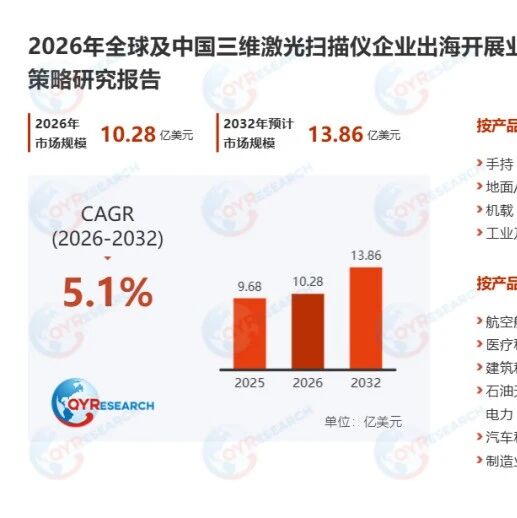
三维激光扫描仪是一种非接触式测量和数字化设备,它利用激光束精确捕捉物体或环境的形状、几何结构,有 时还能捕捉其外观(颜色和纹理)。其工作原理基于激光雷达( LiDAR ,即光探测和测距),发射激光束并 测量反射光的时间或相位差,从而计算出空间中数百万个离散点,最终生成高精度的"点云"模型。 根据 QYResearch 调研团队最新报告"全球三维激光扫描仪市场报告 2026-2032 "显示,预计 2032 年全球三维激 光扫描仪市场规模将达到 13.9 亿美元,未来几年年复合增长率 CAGR 为 5.1% 。 根据 QYResearch 头部企业研究中心调研,全球范围内三维激光扫描仪生产商主要包括 AMETEK (Faro, Creaform) 、 Hexagon (Leica, Zhongguan) 、 Trimble 、 Topcon 、 Riegl 、 Teledyne Optech 、 Quality Vision International 、 Maptek 、 Carl Zeiss 、 Kreon Technologies 等。 2025 年,全球前五大厂商占有大约 57.0% 的市 场份额。 三 ...

进军机器人全身检测,集智股份拟收购行业先驱
仪器信息网· 2026-01-12 03:55
Group 1 - The core viewpoint of the article is that Jizhi Co., Ltd. plans to acquire at least 51% of the shares of Pumai Technology, a leading company in the field of robot performance testing, to gain control and enhance its capabilities in the robot detection industry [1] - The acquisition is seen as a strategic move during a growth cycle, aiming to create a closed-loop detection capability from precision components to complete machines, highlighting its long-term strategic value [1] - Jizhi Co., Ltd., established in 2004, specializes in high-end equipment manufacturing, primarily focusing on automatic balancing machines for precision detection and correction of rotating parts [1] Group 2 - Pumai Technology, founded in 2016, is a pioneer in the industrial robot testing and calibration field, which was previously a market void in China, making it the first company to utilize binocular vision technology for industrial robot performance testing [2] - The company launched the ARTS-5025 robot performance testing and calibration system in late 2016, achieving micron-level detection accuracy, and it was recognized as the first product in Zhejiang Province's key intelligent equipment sector in 2018 [2] - Pumai Technology is considered a "scarce asset" due to its pioneering role, which is difficult to replicate through short-term internal R&D, and it has proactively extended its business into humanoid robots, launching full gait simulation and durability testing systems [2]


Hexagon - Generally It Outperformed, But 2026E Is Tricky Due To Spin-Off
Seeking Alpha· 2026-01-08 15:35
Core Viewpoint - The article discusses the investment potential and performance of HXGBF, highlighting the author's long position in the stock and expressing personal opinions on its future prospects [1]. Group 1 - The author has a beneficial long position in HXGBF shares, indicating confidence in the stock's future performance [1]. - The article emphasizes the importance of conducting due diligence and research before making investment decisions, particularly for investors with limited experience [2]. - It is noted that past performance does not guarantee future results, and the views expressed may not reflect those of Seeking Alpha as a whole [3].

Microsoft, Hexagon Put Humanoid Robots On Factory Floors - Microsoft (NASDAQ:MSFT)
Benzinga· 2026-01-07 18:16
Core Viewpoint - Microsoft Corporation has announced a partnership with Hexagon to develop humanoid robots utilizing AI and cloud tools, which has positively impacted its stock price [1] Group 1: Partnership Details - Hexagon Robotics and Microsoft will collaborate on adaptive robots aimed at manufacturing and inspection, supporting data-driven production and AI-based automation across various industries [2] - The partnership will focus on imitation learning and reinforcement learning, aiming to scale physical AI using multimodal vision-language-action models [2] - The collaboration intends to combine Hexagon's sensor fusion and spatial intelligence with Microsoft's cloud platforms, specifically utilizing Azure services for real-time intelligence and IoT operations [3] Group 2: Target Industries and Applications - Initial deployments of the technology will target automotive and aerospace customers, with plans to also serve manufacturing and logistics use cases [3] - Hexagon's AEON humanoid robot has demonstrated capabilities in real-time defect detection and operational intelligence [3] Group 3: Executive Insights - Arnaud Robert, president of Hexagon Robotics, stated that the partnership aligns with his vision for autonomy and can help address labor shortages in critical industries [4] - Aaron Schnieder, vice president of engineering and emerging technologies at Microsoft, highlighted the industrial impact of the collaboration, emphasizing that Azure's scale combined with AEON's capabilities can facilitate the deployment of adaptive humanoid robots [4] Group 4: Technical Analysis of Microsoft - Microsoft shares are currently trading 1.2% above the 20-day simple moving average (SMA), but 1.1% below the 50-day SMA and 2.9% below the 100-day SMA, indicating short-term strength but overall medium to long-term weakness [5] - The Relative Strength Index (RSI) is at 43.80, suggesting a neutral position with no strong momentum in either direction [6] - Key support for the stock is at $471.00, while resistance is at $489.50, indicating potential trend changes depending on price movements [7] Group 5: Stock Performance - Over the past 12 months, Microsoft has gained 15.58%, reflecting a solid long-term trend despite recent volatility [8] - Currently, Microsoft is trading at 68.1% of its 52-week range, indicating it is closer to its highs than its lows, suggesting potential resistance as it approaches the upper end of its range [8] - At the time of publication, Microsoft shares were up 2.15% at $488.81 [9]


Top Robotics Stocks That Could Drive Impressive Returns in 2026
ZACKS· 2026-01-06 16:16
Industry Overview - The American robotics industry is experiencing significant growth, driven by commercial breakthroughs, venture capital, and FDA approvals, positioning the U.S. as a leader in global automation [1] - The humanoid robotics market is projected to reach $15.26 billion by 2023, with a compound annual growth rate (CAGR) of 39.2% [2] - The global robotics market is expected to grow to $124.37 billion, with the surgical robotics market alone projected to reach $14.45 billion by 2026 [3] Investment Landscape - Global robotics funding surpassed $10.3 billion in 2025, the highest since 2021, with U.S. companies capturing the majority of this investment [3] - Notable funding rounds include Figure AI raising over $1 billion at a valuation of $39 billion and Physical Intelligence securing $400 million from investors [3] - SoftBank's acquisition of ABB's robotics division for $5.375 billion indicates a consolidation trend in the robotics sector [3] Healthcare Robotics - Recent FDA approvals for robotic surgery systems, including Medtronic's Hugo and CMR Surgical's Versius Plus, are expected to accelerate the adoption of healthcare robotics [4] - Johnson & Johnson's Ottava system is advancing through clinical trials, with FDA submission anticipated in early 2026 [4] Defense and Space Applications - The Pentagon allocated $13.4 billion for autonomous systems in its fiscal 2026 budget, with $5.3 billion specifically for unmanned vessels [5] - Upcoming missions, such as NASA's Artemis II and Astrobotic's Griffin lunar mission, will further validate U.S. capabilities in space robotics [5] Collaborative Robotics - The collaborative robotics segment is experiencing over 20% annual growth, with nearly half of small and medium manufacturers now integrating collaborative robots (cobots) [6] - Universal Robots is expanding its manufacturing capabilities, creating over 200 jobs in Michigan [6] Company Highlights - UiPath has transitioned from traditional robotic process automation to AI orchestration, achieving its first GAAP profitable quarter in Q3 of fiscal 2026, with revenues increasing 16% year over year to $411 million [9][10] - NVIDIA unveiled a comprehensive robotics ecosystem at CES 2026, including the Isaac GR00T N1.6 model and the Blackwell-powered Jetson T4000 module, enhancing its position in physical AI [11] - Cadence Design Systems is acquiring Hexagon's Design & Engineering business for $3.18 billion, enhancing its capabilities in robotics simulation [12] - Intuitive Surgical expanded its market presence with FDA clearance for the da Vinci Single Port system for various surgical procedures, supported by over 500 peer-reviewed publications [13]




Kennametal and Hexagon to Jointly Deliver Faster, Smarter Machining
Prnewswire· 2025-12-15 13:00
Core Insights - Kennametal Inc. has announced a new integration with Hexagon's cloud-based Tool Library, enhancing access to verified digital tooling data for machinists [1][3] - The collaboration aims to deliver faster and smarter machining solutions by combining Kennametal's tooling expertise with Hexagon's advanced Computer-Aided Manufacturing (CAM) technology [1][3] Company Overview - Kennametal Inc. has over 85 years of experience as an industrial technology leader, focusing on materials science, tooling, and wear-resistant solutions [5] - The company generated $2 billion in revenues in fiscal 2025 and employs approximately 8,100 people across nearly 100 countries [5] Integration Details - The integration allows machinists to import Kennametal tooling data into Hexagon's WORKNC CAM software, which reduces setup time and improves machining accuracy [2][3] - Currently, the integration supports solid carbide drills and end mills, with plans for expansion to additional CAM systems and product lines in the future [3] Hexagon Overview - Hexagon is a global leader in measurement technologies, providing solutions that ensure productivity, quality, safety, and sustainability across various industries [4] - The company has approximately 24,800 employees in 50 countries and reported net sales of approximately 5.4 billion EUR [4]


Cadence Design Systems (NasdaqGS:CDNS) 2025 Conference Transcript
2025-12-02 22:17
Summary of Cadence Design Systems Conference Call Company Overview - **Company**: Cadence Design Systems (NasdaqGS:CDNS) - **Industry**: Semiconductor and Electronic Design Automation (EDA) Key Points Company Role and Market Position - Cadence provides software, IP, and hardware products for chip and electronic system design, with nearly all chip designs utilizing Cadence products [3][4] - Approximately 45% of Cadence's business comes from system companies, including automotive and hyperscalers [3] AI Design Activity - Current focus is on the infrastructure phase of AI, primarily in data centers, with expectations for exponential growth in compute and AI usage over the next three to five years [4][5] - The physical AI phase is anticipated to reach critical mass in three to seven years, with ongoing design activity [5][6] - The sciences AI phase is projected to take five to ten years to develop [6] Financial Performance and Growth Expectations - Increased revenue growth expectations for calendar year 2025 from 12% to 14%, supported by a record backlog [8] - Current margin is approximately 44%, with a goal to maintain or improve this margin while achieving sustainable revenue growth [8][41] EDA Business Model and AI Integration - AI is expected to enhance productivity in EDA tools by at least 10x over the next five years, building on a historical 100x productivity improvement [10][11] - The complexity of chip design is projected to increase 30-40 times by 2030, necessitating greater reliance on AI tools [12] Hardware and Software Synergies - Cadence's hardware systems, such as Palladium, are essential for modern chip design, allowing for faster verification processes [17][18] - The integration of hardware and software is a key competitive advantage, particularly in the AI ecosystem [18] IP Business Dynamics - Strong momentum in leading-edge IP, with a focus on AI-related IP segments such as chip-to-chip interconnect and memory technologies [19][20] - The IP business is expected to grow, with a mix of royalty and license revenue contributing to profitability [22][24] Acquisition Strategy - The acquisition of Hexagon is aimed at enhancing capabilities in physical AI and 3D IC systems, which are expected to be significant growth drivers [26][30] - Cadence prioritizes organic growth but remains open to strategic acquisitions when beneficial [26] Regional Performance - China represents a significant market, with design activity returning to normal levels despite geopolitical uncertainties [39][40] Margin Management - Incremental margins are consistently above 50%, with a focus on maintaining or improving overall margins despite potential impacts from acquisitions [41][42] Capital Allocation - Cadence plans to allocate 50% of cash flow to stock buybacks to prevent dilution, while also considering opportunistic M&A [47][48] Future Outlook - The physical AI opportunity is expected to open new customer bases, particularly in automotive and robotics [31][33] - Cadence aims to remain well-positioned in both infrastructure and physical AI markets [33] This summary encapsulates the key insights and strategic directions discussed during the conference call, highlighting Cadence's role in the semiconductor industry and its growth prospects in AI and EDA.
Cadence Design Systems (NasdaqGS:CDNS) FY Conference Transcript
2025-11-18 17:47
Summary of Cadence Design Systems FY Conference Call Company Overview - **Company**: Cadence Design Systems (NasdaqGS:CDNS) - **Industry**: Engineering Software, specifically focused on Electronic Design Automation (EDA) and AI infrastructure Key Points and Arguments Company Positioning and Growth - Cadence is central to the AI infrastructure stack, providing engineering software that is essential for complex AI workloads, leading to exponential growth in demand for its services [3][4][6] - The company has experienced double-digit revenue growth over the past decade, with a recent upward revision of revenue growth guidance from 12% to 14% for the current year, driven by increased complexity in AI workloads [7][4] - Cadence's business model has evolved from being solely an EDA company to incorporating core EDA, IP business, and system design analysis, all of which are now sizable and interrelated [7][8] Record Backlog and Customer Demand - The company ended Q3 with a record backlog, indicating strong demand across all lines of business, particularly in AI and high-performance computing sectors [10][12] - Cadence is seeing significant design activity and new customer acquisition, especially in the automotive sector [12][10] Future Outlook and Visibility - Visibility for 2026 is considered strong, with expectations of continued demand for systems and hardware refresh cycles [18][19] - The company is cautious in its guidance, preferring to maintain a prudent approach to avoid inventory issues while ensuring steady growth [70][72] AI and EDA Market Dynamics - Most growth is expected to come from digital and remote sectors, with AI tools enhancing existing capabilities and driving additional revenue [23][47] - The complexity of designs is increasing, making EDA tools more essential for customers [46][47] Foundry Relationships - Cadence has strong partnerships with key foundries like TSMC, Samsung, and Intel, which are crucial for future customer engagements and design flows [41][42] - The foundry ecosystem is expanding, with Cadence increasingly engaged with companies like Samsung and Intel, which were previously less involved [41][42] Hardware Cycle and Production - The hardware refresh cycle is still in its early stages, with increasing demand for Cadence's products, particularly the Z2 and Z3 systems [55][61] - The company aims to maintain a backlog of orders with a lead time of 8 to 22 weeks, currently positioned in the middle of that range [63][65] Acquisition Strategy - Cadence announced the acquisition of Hexagon's Design and Engineering Business, which is expected to enhance its systems design analysis portfolio and provide new customer opportunities [87][88] - The integration process for acquisitions typically takes 12 to 15 months to realize revenue and cost synergies, with expectations of incremental margins improving over time [101][105] Design IP Focus - Cadence has shifted its stance on design IP, now recognizing its importance and potential for rational growth, particularly in advanced process nodes [167][180] - The company aims to build a robust IP portfolio aligned with market demands, focusing on advanced nodes and customer-driven development [180][206] Market Conditions in China - Demand in China has shown resilience post-restrictions, but the company anticipates a gradual decrease in the percentage of overall business from this region due to limited access to leading technology [260][266] - Growth in China is expected to be slightly below average compared to other regions over the next three to five years [275] Additional Important Insights - Cadence's approach to customer relationships is characterized by long-term partnerships rather than transactional engagements, which differentiates it from competitors like Synopsys [218][220] - The company emphasizes continuous improvement and learning from past acquisition experiences to enhance integration and profitability [136][140] This summary encapsulates the key insights from the Cadence Design Systems FY Conference Call, highlighting the company's strategic positioning, growth drivers, and market dynamics.