
一老一小服务

Search documents
老人下楼吃饭,孩子就近托管
Xin Lang Cai Jing· 2026-02-14 23:01
Core Viewpoint - The article highlights the initiatives taken by Leshan to enhance community services for the elderly and children, focusing on integrated support systems that cater to the needs of both demographics. Group 1: Elderly Services - Leshan has implemented community dining services and elderly care programs, such as the "central kitchen" and "assisted dining points," to provide affordable meals for seniors, with an average service of 100 elderly individuals per day [1][2] - The city plans to establish 1,724 family care beds and complete 1,081 home adaptations for elderly individuals by 2025, alongside providing home care services to 116,000 people [2][3] - Over the past five years, Leshan has invested 460 million yuan in 58 key elderly care projects, including the construction of nine new elderly care institutions and the addition of 2,070 nursing beds [3] Group 2: Child Services - Leshan has introduced "Tongxin Station" in community service centers to provide flexible childcare services for working families, allowing for nearby childcare and meal services for both children and the elderly [3][4] - The city has established a three-tier psychological health education network for minors, with over 800,000 students undergoing psychological assessments and various group counseling sessions conducted [4] - Financial support for disadvantaged children has been enhanced, with over 11.67 million yuan allocated for basic living expenses in the past year, continuing a five-year initiative to support vulnerable children [4]
民生为大 内蒙古百姓生活更暖了
Xin Lang Cai Jing· 2026-02-01 19:21
Core Viewpoint - Inner Mongolia is committed to improving and safeguarding people's livelihoods by implementing various initiatives aimed at enhancing employment, social security, healthcare, and elderly and child care services by 2025 [1][2][3][5][6][7][8] Employment and Economic Development - Inner Mongolia plans to implement an "employment +" service model, hosting 3,960 job fairs and providing 1,604,900 job opportunities by 2025 [2] - The region aims to create 209,000 new urban jobs and reduce the average annual unemployment rate to its lowest level in five years [2] - A total of 67,400 training sessions will be conducted for urgently needed skills across various industries [2] Social Security and Welfare - By 2025, the number of participants in basic pension insurance, work injury insurance, and unemployment insurance will reach 17.75 million, 3.77 million, and 3.41 million respectively, exceeding target goals [2] - Basic medical insurance coverage will expand to 21.78 million, with a financial subsidy for urban residents increasing from 550 yuan in 2020 to 700 yuan by 2025 [2] Healthcare Improvements - Inner Mongolia is enhancing its healthcare system by investing 180 million yuan in building 39 specialized regional medical centers and 4 national regional medical centers [3] - The region has seen a significant increase in medical resources, improving public health services and patient care [3] Elderly and Child Care Services - By 2025, Inner Mongolia will complete renovations for 5,000 rural mutual aid elderly care facilities and establish 93 regional elderly service centers [5] - The region will implement subsidies for childcare services, benefiting 74,000 infants and increasing the number of childcare spots to 46.4 per 1,000 children under three years old [5][6] Infrastructure and Consumer Support - Inner Mongolia plans to renovate 895 urban old residential communities, improving living conditions for 179,000 households [6] - The region has introduced 24 specific measures to promote consumption and industry upgrades, with a total of 6.18 billion yuan allocated for consumer subsidies, stimulating 64 billion yuan in consumption [7]
保障“一老一小”就是守护城市未来
Xin Lang Cai Jing· 2026-01-30 16:38
Core Viewpoint - The article emphasizes the urgent need for comprehensive community services to support the growing "one elderly and one child" demographic in Haikou, highlighting the challenges posed by an aging population and the need for improved facilities and policies to meet diverse needs [1][2]. Group 1: Demographic Insights - As of the end of 2024, Haikou's permanent population is projected to reach 3.0314 million, with 14.93% aged 60 and above and 17.26% aged 0-14, indicating a significant "one elderly and one child" demographic [1]. - The demand for high-quality, inclusive community services is increasing, particularly in areas such as scientific nurturing, medical care integration, and mental health support [1]. Group 2: Current Challenges - There is an uneven distribution of elderly care facilities, with many older communities lacking adequate support [1]. - The average occupancy rate of elderly care institutions is below 60%, and many rely heavily on government funding [1]. - The cost of childcare exceeds the financial capacity of most families, complicating access to necessary services [1]. Group 3: Proposed Solutions - Strengthening top-level design by creating guidelines for community embedded "one elderly and one child" service facilities, including standards for configuration, functionality, and operation [1]. - Optimizing spatial supply by enforcing the "four synchronizations" requirement for new developments, ensuring that elderly and child care facilities are prioritized in urban renewal and old community renovations [1]. - Promoting innovative integration through models like "community service complexes" and "neighborhood centers," encouraging early childhood education institutions to offer classes for younger children and supporting elderly care facilities to extend their services into the community [1]. - Enhancing talent support by collaborating with local universities for targeted training programs and establishing a robust certification and continuing education system for professionals in the field [1]. - Establishing a differentiated operational subsidy system to attract state-owned enterprises and private capital to participate in the construction and operation of these facilities, exploring long-term capital investment paths [1].
家门口的幸福圈! 一刻钟便民生活圈扩围升级
Yang Shi Wang· 2026-01-18 03:36
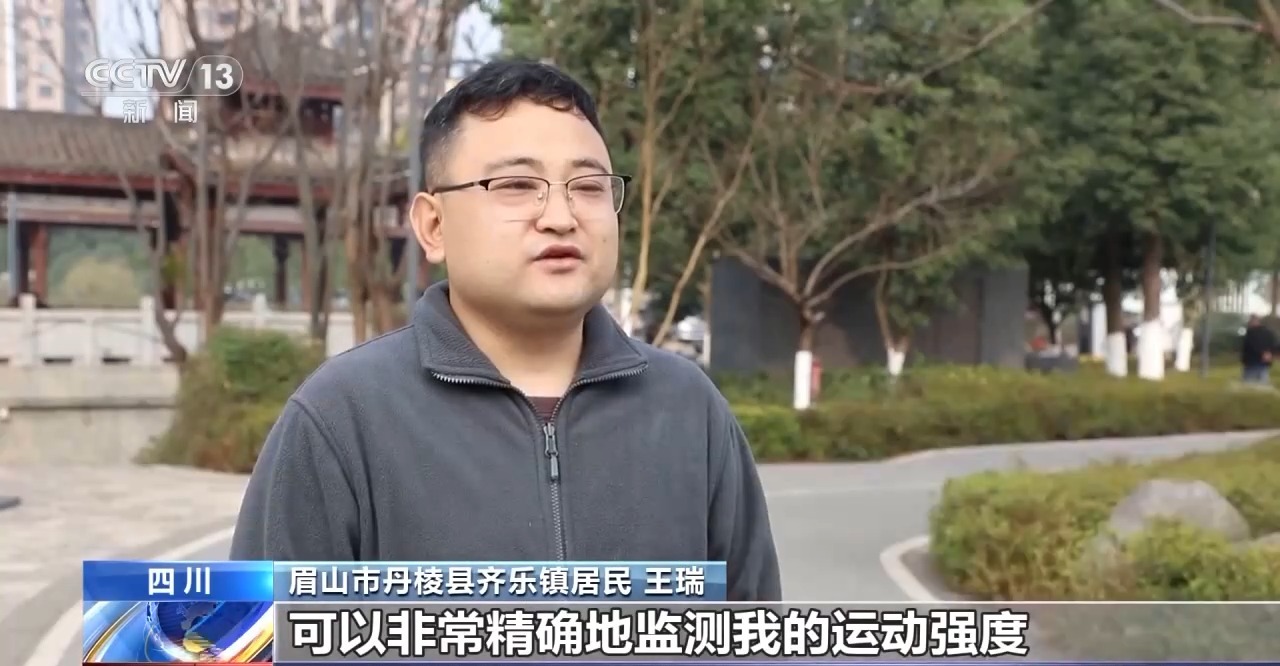
Core Insights - The "15-minute convenient living circle" is a tangible benefit for residents, enhancing their quality of life by providing accessible services within a short distance [1] - By the end of December 2025, 8,132 convenient living circles are expected to be established, serving 168 million residents through 1.954 million commercial outlets [1] Group 1: Development of Convenient Living Circles - Over 1,600 convenient living circles have been established in county communities, extending urban conveniences to rural areas [2] - In Danleng County, Sichuan Province, 12 "pocket parks" and over 200 fitness devices have been built, achieving 100% coverage of a 15-minute fitness circle [6] - The Ministry of Commerce reports that over 300 cities have adopted maps for convenient living circles, attracting more than 5 million businesses [6] Group 2: Community Engagement and Modernization - The construction of convenient living circles is increasingly guided by resident needs, utilizing big data to enhance service offerings [6] - In Shanghai's Changning District, a transformed open commercial street offers diverse shopping and leisure options, creating a one-stop service experience for residents [6][8] - The "One Square Meter Action" plan invites community participation in micro-renovations, fostering a sense of ownership among residents [8] Group 3: Enhancements for Elderly and Children - Initiatives to improve services for the elderly and children are being accelerated, with community-based programs like "shared grandmothers" providing childcare support [13][15] - In Qujing, Yunnan, community dining services for the elderly are being established to offer affordable and healthy meals [17] - Harbin, Heilongjiang, is creating a 15-minute elderly care service circle, enhancing the quality of life for senior residents through new facilities [17]

暖心服务呵护“一老一小”
Liao Ning Ri Bao· 2025-11-03 01:09
Core Points - The community has launched a new initiative called "Abacus Enlightenment: Healthy Silver Age" aimed at enhancing cognitive abilities among the elderly through activities like abacus training [1] - The community is focusing on improving the quality of life for both the elderly and children, with recent upgrades to facilities and the establishment of a community service center [1][2] - Plans are in place to collaborate with large hospitals to create "home hospital beds" for chronic disease management, providing regular health check-ups and medication guidance at home [2] - The community is expanding educational offerings for children, including a variety of courses and the introduction of AI educational equipment [2] - A smart community service platform is being developed to facilitate services such as elderly care appointments, medical registration, and fall prevention reminders [2] Summary by Sections Community Initiatives - The "Abacus Enlightenment: Healthy Silver Age" program aims to slow cognitive decline in the elderly through engaging activities [1] - The community has improved its infrastructure and services, including the establishment of a party-mass service center and a happy dining hall for the elderly [1][2] Healthcare Services - The community plans to partner with major hospitals to offer home-based medical services for chronic conditions like hypertension and diabetes [2] - There will be ongoing adaptations for homes of elderly individuals with disabilities to enhance their living conditions [2] Educational Programs - The community offers a variety of after-school programs for children, including science exploration and traditional crafts [2] - Future plans include the introduction of new educational technologies and services for preschool children [2] Smart Community Development - A community smart service platform is being developed to streamline access to various services, enhancing convenience and safety for residents [2]
数读中国 “十四五”绘就“一老一小”幸福图景
Ren Min Wang· 2025-10-19 00:57
Core Insights - The "14th Five-Year Plan" period has seen significant advancements in services for the elderly and children in China, enhancing the quality of life for these demographics [1] Elderly Care Services - By the end of 2024, there will be 1 National Center for Geriatric Medicine and 6 National Clinical Research Centers for Geriatric Diseases, with 6,151 secondary and above general hospitals having geriatrics departments, accounting for 84.6% of total general hospitals [3] - 94.4% of secondary and above public hospitals have established "green channels" for elderly patients, and medical social workers are available to assist them [3] - Approximately 140 million health management services are provided annually for individuals aged 65 and above [3] Rural Elderly Services - Over 140,000 rural mutual aid elderly service facilities and more than 16,000 rural nursing homes have been built, offering diverse elderly care services [5] Aging Standards - As of May this year, China has released over 240 national standards related to aging and accessibility, establishing a preliminary national standard system that addresses the basic living needs of the elderly [7] Pediatric Services - By the end of 2024, the number of pediatric practitioners (including assistants) will reach 243,900, a 49.3% increase from 163,400 in 2020; the number of pediatric beds per 1,000 children will rise to 2.47, up 13.3% from 2.18 in 2020 [8] - Most secondary and tertiary public hospitals provide pediatric services, and 80% of grassroots medical institutions can treat common childhood illnesses [8] Child Health Improvements - The incidence of macrosomia has decreased for five consecutive years, and the overweight and obesity rate among children under 6 has dropped from 10.4% to 9.7% [10] - The stunting rate for children under 6 has decreased to 4.5%, and the low weight rate has fallen to 1.4% [10] - Average height for boys and girls aged 6-17 has increased by 2.1 cm and 2.2 cm, respectively [10] Education Achievements - By the end of 2024, the gross enrollment rate for preschool education has reached 92%, with 91.6% of children attending inclusive kindergartens [11] - 246 districts and counties have achieved balanced quality in compulsory education [11] - The gross enrollment rate for high school has reached 92%, and the enrollment rate for disabled children in compulsory education has reached 97% [11] Child Welfare Institutions - Nationwide, 600 county-level child welfare institutions have been transformed into institutions for the rescue and protection of minors, providing care and support for vulnerable children [12] Child Supervisory Personnel - A total of 42,000 child supervisors at the township (street) level and 583,000 child directors at the village (community) level have been appointed [13]
呵护好“一老一小”
Ren Min Ri Bao· 2025-10-11 08:46
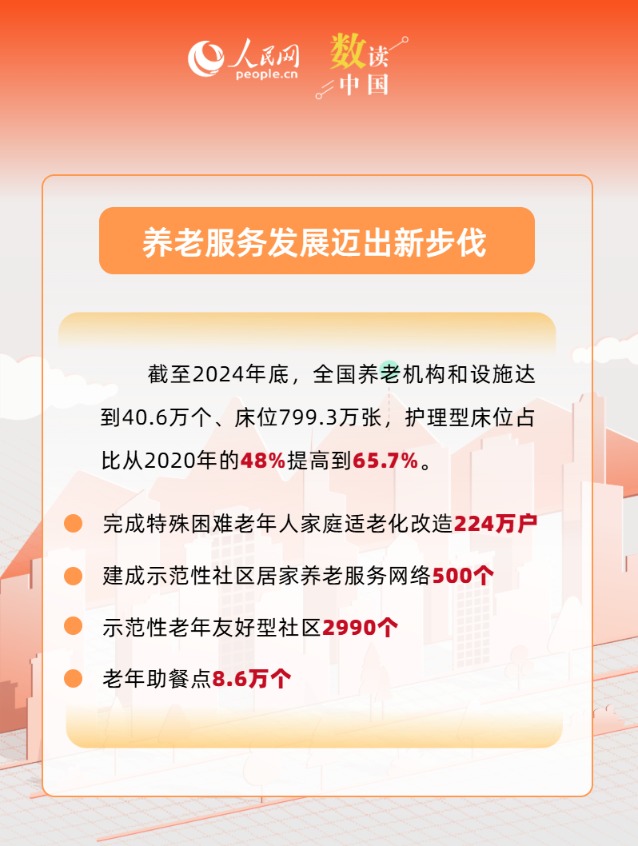
Core Points - The article emphasizes the importance of caring for the elderly and children, highlighting it as both a family and national issue, which is crucial for the well-being of the people [1] - Significant improvements in social services for the elderly and children are noted, including the completion of home modifications for 2.24 million elderly households and over 3 million elderly individuals dining at senior meal points daily [1] - The support standards for orphans and children without guardians have increased by over 26% compared to the end of the 13th Five-Year Plan [1] - During the 14th Five-Year Plan period, the service network for the elderly and children is set to be further strengthened, aiming to enhance the quality of life for both demographics [1] - Initiatives include enhancing community-based elderly care services, improving maternal and child health care, and increasing the availability of affordable childcare services [1] - The article reflects a commitment to cultural values of caring for the elderly and children, aligning with the broader goal of achieving "Chinese-style modernization" focused on people's livelihoods [1] - The overall message conveys that the happiness and health of the people are tied to the successful implementation of social welfare initiatives and ensuring a safety net for livelihoods [1]
居住配套指标修订:快递柜、电动车停车场,都要纳入新建小区规划
Xin Jing Bao· 2025-09-29 07:19
Core Viewpoint - The Beijing government has revised the public service facility configuration indicators for residential areas, set to be implemented on December 1, 2025, to address space utilization issues in new residential communities, including parking, education, healthcare, and community services [1][9]. Group 1: Community Space Utilization - The revised indicators aim to create vibrant community centers by integrating various service facilities, including cultural and sports activities, into a unified management system [2][5]. - The new indicators expand from 52 to 66, categorizing facilities into 12 types, including comprehensive services, education, healthcare, and public safety [1][9]. Group 2: Parking Solutions - The new configuration addresses the parking difficulties faced by older residential areas by increasing the number of electric bicycle parking and charging facilities, while adjusting motor vehicle parking requirements based on area and type [3][4]. - The indicators propose solutions for shared bicycle parking and temporary vehicle parking near schools to alleviate congestion [3][4]. Group 3: Child and Elderly Care Facilities - The indicators emphasize the need for childcare and elderly services by mandating the inclusion of daycare facilities and spaces for elderly care within community service buildings [4][5]. - The plan includes provisions for logistics facilities and waste sorting infrastructure to enhance community living standards [4][5]. Group 4: Commercial and Emergency Preparedness - The indicators propose the establishment of community-level commercial facilities to meet daily shopping needs, shifting from street-level to community-level services [5]. - The revised indicators also focus on enhancing community resilience to emergencies by improving healthcare service standards and incorporating disaster response spaces [5][6]. Group 5: Implementation and Management - The revised implementation guidelines clarify the responsibilities for planning, construction, and management of public service facilities, emphasizing a unified approach by local governments [6][8]. - The indicators will be updated every five years to adapt to urban development changes, ensuring ongoing relevance and effectiveness [7][8].
家门口养老 园区里托育 探索“一老一小”服务新路径
Si Chuan Ri Bao· 2025-09-06 01:22
Group 1 - The article highlights the development of community-based services for the elderly and children in Sichuan, particularly in Luzhou and Chengdu, focusing on the integration of various services to meet the needs of the population [3][4][5] - Chengdu's Jin Niu District has transformed a traditional nursing home into a multi-functional service center, providing elderly care, community dining, and childcare services, thus breaking the traditional boundaries of nursing homes [4][5] - The service center in Chengdu has over 25,000 elderly individuals registered, with 400 special needs cases highlighted, and offers a variety of facilities including dining, entertainment, and medical services [5] Group 2 - The Tianjiao Nursery in Luzhou's Baijiu Industrial Park provides convenient childcare services for employees, allowing parents to focus on work without worrying about childcare during working hours [6][7] - The nursery, which opened in February 2023, is the first of its kind in Luzhou, operating under a model that utilizes idle space and community funding to provide affordable childcare services [7] - As of August 2023, Luzhou has 352 inclusive childcare institutions, accounting for 96.70% of all childcare facilities, with a ratio of 4.6 childcare spots per 1,000 people, exceeding the targets set in the 14th Five-Year Plan [8]
擦亮高质量发展的民生底色——各地进一步保障和改善民生观察
Xin Hua She· 2025-06-10 03:03
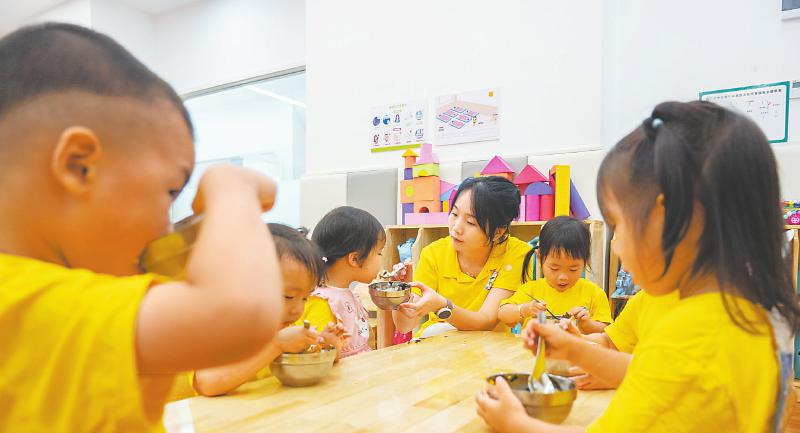
Group 1 - The article emphasizes the importance of improving people's livelihoods as a core aspect of high-quality development, highlighting various local initiatives aimed at enhancing community well-being and economic activity [1][2][3] - In Chengdu, Sichuan Province, over 100 fitness corners and micro-parks have been created to enrich the lives of the elderly, promoting social interaction and local consumption [1] - In Aksu, Xinjiang, a labor-based project has been implemented to provide job opportunities for low-income groups, with workers earning approximately 4,500 yuan per month [1] Group 2 - Various regions are enhancing support for low-income populations through tailored assistance programs, such as Zhejiang's dynamic monitoring application for low-income individuals and Shandong's "Sea Conch Girl" social assistance brand, which has served over 71,000 rural individuals [2] - Guangzhou is developing a housing security system focused on rental and sale-based housing to address the needs of migrant workers and new employees, while Luoyang has established policies to facilitate the education of children from migrant families [2] - The article stresses the need for equitable distribution of public services across urban and rural areas to ensure all citizens benefit from development [2] Group 3 - The article highlights the importance of education in improving living standards, showcasing significant improvements in facilities at a primary school in Chongqing due to supportive policies [3] - Various local governments are investing in educational infrastructure, with Wuhan expanding its school facilities and Gansu planning to enhance county-level education [4] - The focus is on ensuring that educational reforms benefit all citizens fairly, thereby addressing the aspirations of families for better educational opportunities for their children [4] Group 4 - The article discusses innovative service models for elderly and child care, with regions like Zhejiang and Shandong implementing market-driven solutions for elder care and establishing community-based childcare services [5] - Local governments are also enhancing cultural and recreational services, such as night museum visits and community dining facilities, to meet the diverse needs of the population [5] - The overarching message is that continuous improvement in livelihood policies is essential for addressing the challenges faced by communities and ensuring sustainable development [5]