上市公司控制权争夺

Search documents
300101,控制权争夺关键之战!临时股东会现场火药味浓烈!
证券时报· 2026-02-13 03:20
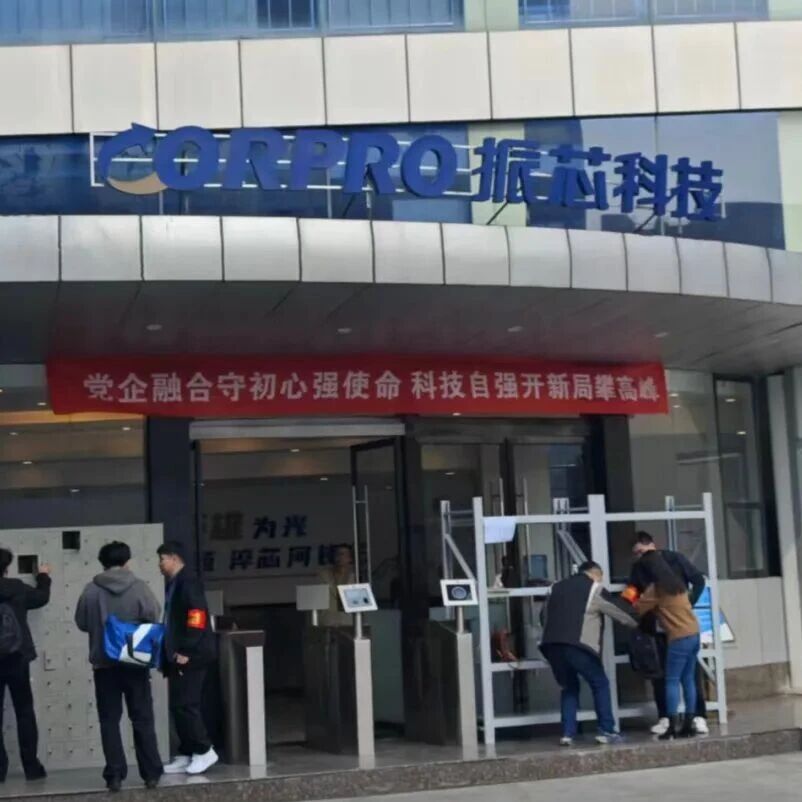
Core Viewpoint - The article discusses the recent extraordinary general meeting of Zhenxin Technology (振芯科技), highlighting the intense power struggle between the controlling shareholder, Chengdu Guoteng Electronics Group (国腾集团), and the current management team over the company's board control [3][6]. Group 1: Shareholder Meeting Dynamics - The extraordinary general meeting was held on February 12, 2023, after a delay, and was marked by a tense atmosphere with hundreds of employees leaving the company as the meeting commenced [4]. - Security measures were strict, with attendees required to deposit electronic devices outside the venue, indicating the high stakes involved in the meeting [4]. - The voting results showed that Guoteng Group regained five board seats, while the current management retained two board members and one independent director, suggesting an ongoing struggle for control [6][7]. Group 2: Board Member Nominations - Guoteng Group proposed seven candidates for non-independent board positions and three for independent director roles, with candidates having backgrounds in military, aviation, and advanced manufacturing [6]. - The current management team also attempted to nominate their candidates for the board, indicating a divided shareholder base and differing visions for the company's future [7]. Group 3: Shareholder Concerns - Shareholders raised concerns about the qualifications of the newly nominated directors and their ability to address the company's financing challenges and ensure sustainable development [9]. - Candidates from Guoteng Group responded to these concerns by emphasizing their commitment to all shareholders and the importance of a cohesive management team for the company's future [10]. Group 4: Compliance and Governance Issues - A compliance issue was raised regarding a subsidiary, Guoxing Communication, which faced a ban from participating in procurement activities due to previous violations, although the company stated that this would not significantly impact operations [13][14]. - The meeting also highlighted concerns about corporate governance, including the behavior of executives during the meeting, which some shareholders found disrespectful [14].


万科没有感谢他
Xin Lang Cai Jing· 2026-01-10 00:54
Core Viewpoint - The retirement of Yu Liang from Vanke is seen as a significant event, marking the end of an era for the company and reflecting the challenges faced by the real estate industry in China [3][6][10]. Group 1: Yu Liang's Career and Contributions - Yu Liang joined Vanke in 1990 and has been a pivotal figure in the company's growth, witnessing its rise to become one of China's leading real estate firms [3][4]. - Under his leadership, Vanke's sales grew from 3 billion in 2001 to over 700 billion, establishing it as a top player in the industry [3][4]. - Yu's tenure included navigating significant corporate governance challenges, successfully defending Vanke against hostile takeovers [3][4]. Group 2: Current Challenges and Context - Vanke is currently facing liquidity pressures, with the major shareholder, Shenzhen Metro, having injected 30.8 billion to help the company avoid default [6][9]. - The company's market value has dropped to below 60 billion, raising concerns about its financial stability and the effectiveness of its management [9][10]. - The transition of power within Vanke has shifted from professional managers to state-owned shareholders, indicating a significant change in governance and operational control [9][10]. Group 3: Retirement Implications - Yu Liang's retirement announcement lacked the customary expressions of gratitude typically extended to departing executives, highlighting the strained circumstances surrounding his exit [6][8]. - The timing of his retirement raises questions about accountability, as the company grapples with its current difficulties while he departs [10][12]. - The narrative suggests a disconnect between the rewards enjoyed by management during prosperous times and the responsibilities they face during downturns [9][12].

表决权委托“罗生门”:谁是ST银江“话事人”?表决权委托“罗生门”:谁是ST银江“话事人”?
Zhong Guo Zheng Quan Bao· 2026-01-04 06:10
Core Viewpoint - The regulatory letter from the Shenzhen Stock Exchange reveals a power struggle over the control of ST Yinjian, involving undisclosed agreements between its major shareholder, Yinjian Technology Group, and other parties [1][8]. Group 1: Control and Financial Issues - Yinjian Group and its actual controller, Wang Hui, signed multiple agreements, including a "Voting Rights Entrustment and Joint Action Agreement," which were not disclosed properly in the company's board resolutions [1][8]. - Wang Hui borrowed nearly 200 million yuan to repay non-operational fund usage to maintain ST Yinjian's listing status, with funds sourced from Yao Chengling and Shanghai Yuanzhuo [2][3]. - From 2023 to mid-2024, non-operational fund usage amounted to 663 million yuan and 435 million yuan, respectively, with end balances of 28.83 million yuan and 19.7 million yuan [3]. Group 2: Agreements and Financial Transactions - As of June 2025, Yao Chengling provided 198 million yuan to Wang Hui and Yinjian Group, with 153 million yuan used to repay funds owed to ST Yinjian [4]. - Shanghai Yuanzhuo provided 92 million yuan, with 70 million yuan allocated for repaying Yinjian Group's debts to Yao Chengling [4][6]. - A "Cooperation Memorandum" was signed, stipulating that Shanghai Yuanzhuo would provide additional funding to Yinjian Group to settle debts with Yao Chengling [5][6]. Group 3: Board Dynamics and Governance Issues - The board of ST Yinjian faced criticism for irregularities in the meeting process, particularly regarding the removal of directors nominated by Shanghai Yuanzhuo [8][9]. - The board's decision-making process was questioned, as two directors were excluded from a critical meeting, leading to allegations of governance failures [9][11]. - Despite the existence of the "Voting Rights Entrustment Agreement," Yinjian Group denied any delegation of voting rights, contradicting the agreements in place [11][12]. Group 4: Future Prospects and Performance - ST Yinjian's financial performance has been declining, with revenues of 548 million yuan in 2024 and a net loss of 941 million yuan, indicating a deteriorating financial health [14]. - The company aims to leverage strategic partnerships in artificial intelligence and other emerging sectors to improve its business outlook, although uncertainties remain due to governance issues [13][14]. - Shareholders have expressed concerns over internal conflicts and governance, emphasizing the need for stability to enhance stock performance [15].

表决权委托“罗生门”: 谁是ST银江“话事人”?
Zhong Guo Zheng Quan Bao· 2025-12-28 22:19
Core Viewpoint - The regulatory letter from the Shenzhen Stock Exchange reveals a power struggle over ST Yinjian, with the controlling shareholder, Yinjian Technology Group, and its actual controller, Wang Hui, failing to fulfill information disclosure obligations [1] Group 1: Control and Financial Issues - Wang Hui has borrowed nearly 200 million yuan to repay funds owed to ST Yinjian, with the loans coming from Yao Chengling and Shanghai Yuanzhuo [2] - The urgent need for Wang Hui and Yinjian Group to return occupied funds to ST Yinjian is highlighted, as failure to do so could lead to delisting [3] - The total amount of non-operating fund occupation reached 663 million yuan in 2023 and 435 million yuan in the first half of 2024 [3] Group 2: Agreements and Commitments - A series of agreements, including the "Voting Rights Entrustment and Joint Action Agreement" and "Cooperation Memorandum," were signed to address the occupied funds [1][6] - The "Cooperation Memorandum" stipulates that Yinjian Group will delegate voting rights of its 10.3% stake in ST Yinjian to Yao Chengling and Shanghai Yuanzhuo [6][7] - Shanghai Yuanzhuo has committed to providing additional loans to Yinjian Group to facilitate the repayment of debts to Yao Chengling [4][6] Group 3: Board Dynamics and Governance - The board of directors faced controversy over the process of electing new members, with two directors nominated by Shanghai Yuanzhuo being removed [8][9] - The board's decision-making process has been criticized for lacking transparency and failing to allow all directors to participate [9][11] - The ongoing disputes regarding the delegation of voting rights and the legitimacy of board decisions indicate significant governance challenges within ST Yinjian [11][12] Group 4: Business Outlook and Performance - ST Yinjian's financial performance has deteriorated, with a reported revenue of 548 million yuan and a net loss of 941 million yuan in 2024 [14] - The company is exploring business recovery strategies, including leveraging artificial intelligence and optimizing existing operations [13] - Shareholder concerns about internal conflicts and governance issues are prevalent, with calls for improved management to stabilize stock prices [15]
表决权委托“罗生门”:谁是ST银江“话事人”?
Zhong Guo Zheng Quan Bao· 2025-12-28 21:08
Core Viewpoint - The regulatory letter from the Shenzhen Stock Exchange reveals a power struggle over ST Yinjian, involving undisclosed agreements between its controlling shareholder, Yinjian Technology Group, and other parties, raising concerns about governance and financial stability [1][7]. Group 1: Control and Governance Issues - The regulatory letter indicates that Yinjian Group and its actual controller, Wang Hui, failed to fulfill information disclosure obligations, leading to a conflict regarding the control of ST Yinjian [1]. - Agreements such as the "Voting Rights Entrustment and Joint Action Agreement" and "Cooperation Memorandum" were signed, but the board's announcements contained conflicting information [1][9]. - Wang Hui's alleged misuse of non-operating funds led to a significant financial shortfall, necessitating borrowing to repay these funds to maintain ST Yinjian's listing status [2][3]. Group 2: Financial Transactions and Borrowing - Wang Hui repaid nearly 200 million yuan, primarily sourced from loans provided by Yao Chengling and Shanghai Yuanzhuo, to address the company's financial issues [2][3]. - Shanghai Yuanzhuo has committed to providing additional loans to Yinjian Group to facilitate the repayment of debts owed to Yao Chengling [3][4]. - The total amount of non-operating fund occupation reached 663 million yuan in 2023 and 435 million yuan in the first half of 2024, indicating a severe liquidity crisis [2]. Group 3: Board Dynamics and Conflicts - The board of ST Yinjian faced criticism for procedural irregularities during the election of new directors, with two directors nominated by Shanghai Yuanzhuo being removed [7][8]. - The board's decisions have been challenged due to the lack of transparency regarding the agreements that affect voting rights and control [8][9]. - The ongoing disputes and lack of clarity regarding the control structure have raised concerns among minority shareholders about the company's governance and future direction [11][12]. Group 4: Future Prospects and Market Reactions - Despite efforts to stabilize the company, ST Yinjian's financial performance remains poor, with significant losses reported in recent quarters [11]. - The potential for a shift in control dynamics exists as individual shareholders are increasingly buying into ST Yinjian, which could lead to a coalition that challenges the current governance structure [12]. - The company aims to leverage strategic partnerships and technological advancements to improve its business outlook, but uncertainties surrounding governance persist [11].
成都路桥股权法拍背后:已挂失公章被用于委托授权 | e公司调查
Sou Hu Cai Jing· 2025-11-19 20:26
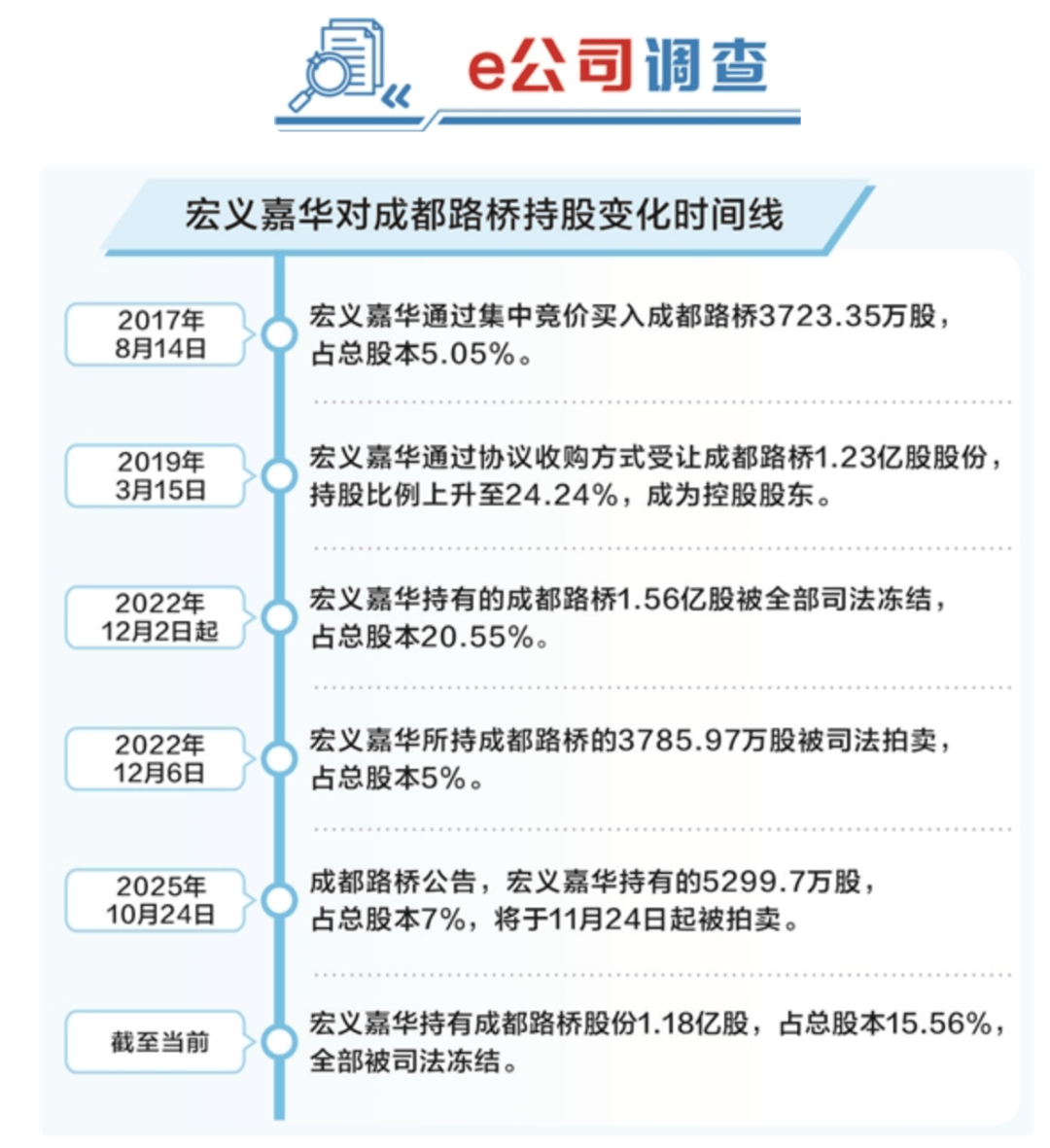
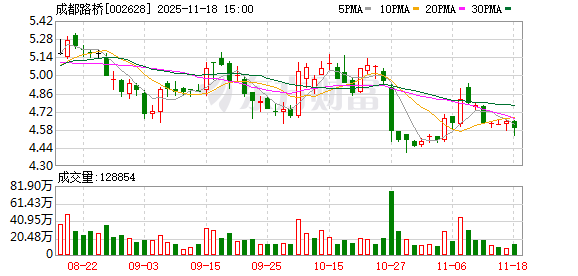
Core Viewpoint - The ongoing power struggle over Chengdu Road and Bridge (002628) is highlighted by the impending judicial auction of shares held by its former controlling shareholder, which could significantly alter the company's control dynamics [1][9]. Group 1: Control Changes Over the Years - The control of Chengdu Road and Bridge has changed hands multiple times over the past decade, starting with founder Zheng Yuli's departure in 2015 due to legal issues, which opened the door for external capital to intervene [3][4]. - In 2016, businessman Li Qin became the largest shareholder with a 20.06% stake, but he failed to maintain effective control due to financial pressures [4]. - In 2017, Liu Zhihong's Hongyi Jiahua acquired a 21.64% stake, becoming the new controlling shareholder after a significant investment of approximately 21 billion yuan [5]. Group 2: Legal and Financial Challenges - Hongyi Jiahua faced legal disputes over share transfer agreements, leading to the judicial freezing of 1.56 billion shares, which represented 20.55% of the total shares [6]. - In December 2022, a portion of Hongyi Jiahua's shares was auctioned off, resulting in a reduced stake of 15.56% [6][11]. - A debt repayment agreement was established, requiring Hongyi Jiahua to pay 417 million yuan by October 2025, but the company struggled to resolve its financial issues [7][8]. Group 3: Upcoming Judicial Auction - A judicial auction of 52.997 million shares, representing 7% of the total shares, is scheduled for November 24, 2025, with a starting price of approximately 183 million yuan [9][10]. - The auction could reduce the controlling shareholder's stake to 13.56%, raising concerns about the stability of control [11]. Group 4: Disputes Over Auction Process - Hongyi Jiahua's management has expressed strong opposition to the split auction, arguing it undermines shareholder rights and could lead to undervaluation of the shares [12][14]. - Allegations have emerged regarding the misuse of a lost company seal to authorize legal representation in the auction process, raising questions about the legitimacy of the auction [15][16]. - Legal actions have been initiated to contest the auction and reclaim the lost seal, indicating ongoing internal conflicts within Hongyi Jiahua [17][18].

成都路桥股权法拍背后: 已挂失公章被用于委托授权
Zheng Quan Shi Bao· 2025-11-18 22:22
Core Viewpoint - The ongoing power struggle over Chengdu Road and Bridge (成都路桥) highlights the complexities of governance in listed private enterprises, with significant implications for its control and ownership structure [1][2][3] Group 1: Control Changes - Chengdu Road and Bridge has experienced multiple changes in control over the past decade, starting from the founder Zheng Yuli's departure in 2015, leading to external capital involvement and subsequent ownership shifts [2][3] - In 2018, Hongyi Jiahua, led by Liu Zhihong, acquired a controlling stake in Chengdu Road and Bridge, spending approximately 2.1 billion yuan to purchase 21.64% of the shares [2][3] Group 2: Legal and Financial Issues - Hongyi Jiahua's shares were frozen due to contractual disputes, leading to a court-ordered auction of 37.86 million shares in December 2022, reducing its stake to 15.56% [3][4] - A new agreement in March 2023 allowed East Jun Taida to exercise voting rights over Hongyi Jiahua's remaining shares, effectively transferring control to East Jun Taida [3][4] Group 3: Upcoming Judicial Auction - A judicial auction of 52.997 million shares (7% of total shares) is scheduled for November 24, 2025, with a starting price of approximately 183 million yuan [6][8] - The auction could potentially reduce Hongyi Jiahua's stake to 8.56%, raising concerns about the stability of control within the company [6][8] Group 4: Disputes Over Auction Process - Hongyi Jiahua's management has expressed strong opposition to the split auction process, arguing it undermines shareholder rights and could lead to undervaluation of the shares [7][9] - Allegations have emerged regarding the misuse of a lost company seal to authorize legal representation in the auction process, complicating the situation further [10][12]
成都路桥股权法拍背后:已挂失公章被用于委托授权
Zheng Quan Shi Bao· 2025-11-18 18:14
Core Viewpoint - The ongoing power struggle over Chengdu Road and Bridge (成都路桥) highlights the complexities of governance in listed private enterprises, with significant implications for its control and ownership structure [2][3]. Group 1: Control Changes - Chengdu Road and Bridge has experienced frequent changes in control over the past decade, starting from the founder Zheng Yuli's departure in 2015, leading to external capital involvement and multiple ownership shifts [3][4]. - In 2015, Zheng Yuli was removed due to bribery allegations, allowing businessman Li Qin to become the largest shareholder by acquiring 20.06% of shares [3]. - In 2018, Liu Zhihong's Hongyi Jiahua acquired a controlling stake of 21.64% for approximately 2.1 billion yuan, becoming the new actual controller [3][4]. Group 2: Legal and Financial Issues - Hongyi Jiahua's shares were frozen due to disputes over share transfer agreements, leading to a court-ordered auction of 37.86 million shares in December 2022, reducing its stake to 15.56% [4][5]. - A new agreement in March 2023 allowed East Jun Taida to exercise voting rights over Hongyi Jiahua's remaining shares, effectively transferring control to East Jun Taida [5][6]. Group 3: Upcoming Judicial Auction - A judicial auction of 52.997 million shares (7% of total shares) is scheduled for November 24, 2025, with a starting price of approximately 1.83 billion yuan [6][7]. - The auction could reduce Hongyi Jiahua's stake to 8.56%, raising concerns about the stability of control over Chengdu Road and Bridge [7][8]. Group 4: Disputes Over Auction Process - Hongyi Jiahua's management has expressed strong opposition to the split auction, claiming it undermines shareholder rights and may not cover the debts owed [8][9]. - Allegations have emerged regarding the misuse of a lost company seal to authorize legal representation for the auction, complicating the situation further [11][12]. Group 5: Future Implications - The outcome of the auction and ongoing disputes will significantly impact the governance and control dynamics of Chengdu Road and Bridge, with potential shifts in shareholder power [14].
*ST建艺涨停背后 引入南方银谷背景人士获关注
Zheng Quan Shi Bao Wang· 2025-11-18 10:00
Core Viewpoint - The appointment of He Zhenxiang as the new deputy general manager of *ST Jianyi has attracted market attention, especially given the company's pressure to maintain its listing status [1][2][6]. Group 1: Company Management Changes - *ST Jianyi's board approved the appointment of He Zhenxiang as deputy general manager, which was proposed by the company's general manager and reviewed by the board's nomination committee [1]. - He Zhenxiang has a background in Southern Yingu Technology Co., Ltd., which has historical ties to the capital market and was previously the controlling shareholder of Wantong Technology [1][2]. Group 2: Background of He Zhenxiang - He Zhenxiang, born in 1984, holds a master's degree and has held various positions in different companies, including project manager at Shenzhen Maoye Group and investment manager at Shenzhen Kingdee Investment Development Co., Ltd. [2]. - Currently, he serves as a director at Southern Yingu and other companies, indicating a significant presence in the industry [3]. Group 3: Southern Yingu's Historical Context - Southern Yingu is known for its involvement in a control dispute over Wantong Technology, where it became the controlling shareholder in 2019 but faced internal and external challenges leading to a change in control by 2022 [4]. - The company has since reduced its visibility in the capital market, controlling over 20 enterprises, but is not listed among the top shareholders of *ST Jianyi [5]. Group 4: Financial Status of *ST Jianyi - As of the end of the third quarter, *ST Jianyi reported a negative equity of -1.148 billion yuan, indicating significant financial distress [7]. - The company is actively seeking to improve its financial situation, including a proposed transfer of 77% equity in its subsidiary Jianyi Mining to its controlling shareholder, with an estimated transaction value between 924 million and 1.155 billion yuan [8].

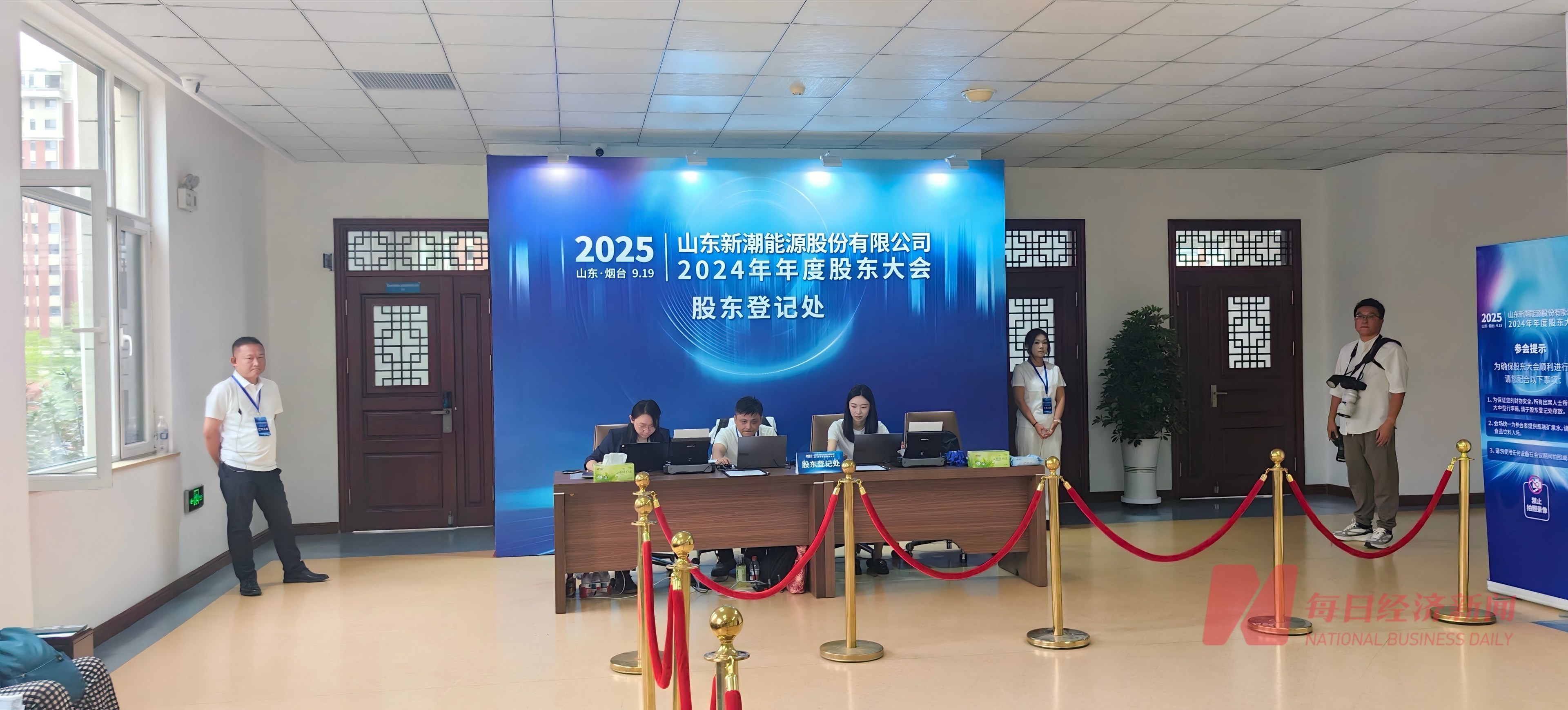
直击*ST新潮股东大会:持续不到20分钟,小股东驱车千里却未获提问机会
Mei Ri Jing Ji Xin Wen· 2025-09-20 01:09
Core Viewpoint - The article discusses the challenges faced by *ST New潮 (New潮 Energy) following a delayed annual shareholder meeting, regulatory penalties, and ongoing control disputes, highlighting investor concerns regarding asset management and company governance [1][2][7]. Group 1: Company Governance and Control - The annual shareholder meeting of New潮 Energy was delayed by over two months, resulting in a fine of 3 million yuan for the company and 2 million yuan for two former executives [1]. - The company is currently experiencing a power transition between old and new management, with control disputes over its core assets in the U.S. [7]. - Investors are particularly concerned about whether the current board has effectively taken control of overseas assets and the status of ongoing litigation in the U.S. [5][6]. Group 2: Shareholder Meeting Insights - The annual shareholder meeting lasted only about 18 minutes, with limited interaction between management and shareholders, leading to dissatisfaction among investors who traveled long distances to attend [2][6]. - Key issues raised by shareholders included the management of overseas assets and the company's ability to resolve its regulatory issues [5][11]. - The management's quick departure after the meeting left many shareholders feeling unheard and frustrated [6]. Group 3: Financial and Legal Challenges - New潮 Energy is facing significant legal challenges, including a lawsuit against its auditing firm, which could impact future financial reporting and investor confidence [11]. - The company has received "negative opinions" in its internal control audit reports for two consecutive years, raising concerns about its financial integrity [11]. - Despite being under "ST" (special treatment) status, the stock has seen a surge in trading, with nine limit-up days following its resumption of trading [11][12].