云网融合

Search documents
研判2026!中国宽带网络行业发展历程、产业链、固定宽带接入端口数、重点企业及未来前景:宽带网络建设持续推进,光纤接入(FTTH/O)端口占比达96.8%[图]
Chan Ye Xin Xi Wang· 2026-02-10 01:10
Core Viewpoint - The article highlights the significant growth and transformation of China's broadband network, emphasizing the shift from copper cable to fiber optic connections, and the increasing number of broadband access ports and users, reflecting a trend towards higher speed and full fiber networks [1][9]. Broadband Industry Overview - Broadband networks are defined as communication networks with bandwidth exceeding 155kbps, consisting of backbone and access networks that support various multimedia services [3]. - The industry has evolved from narrowband and dial-up internet to support high-definition video and immersive applications, with typical bandwidth increasing from 64Kbps to current levels of 1Gbps and beyond [3]. Broadband Industry Development History - The transition to fiber-to-the-home (FTTH) has been a key development, with significant upgrades in network infrastructure to meet growing user demands for high-quality digital services [3]. Current State of the Broadband Industry - The broadband network infrastructure in China is rapidly advancing, with a focus on broadband, intelligence, and integration to support diverse new business applications [5]. - As of the end of 2024, the number of fixed internet broadband access ports reached 1.202 billion, with a net increase of 66.12 million from the end of 2023 [1][9]. Key Companies in the Broadband Industry - Major players include China Telecom, China Unicom, and China Mobile, which dominate the market due to their extensive user bases and network coverage [2][10]. - Emerging companies like ZTE, FiberHome, and others are gaining traction in broadband network equipment manufacturing and services [10]. Industry Challenges - The broadband industry faces challenges such as unclear public infrastructure positioning, regional and urban-rural development imbalances, and insufficient service application diversity [12][13]. Future Trends in the Broadband Industry - The industry is expected to evolve towards "full-fiber" access and "cloud-network integration," enhancing speed and network architecture [14]. - The focus will shift from merely providing connectivity to offering comprehensive, intelligent digital service platforms, integrating various applications for enhanced user experience [15]. - There will be an emphasis on ensuring "deterministic experience" and "green low-carbon" development in network planning and operations [16].






【点金互动易】边缘计算+云网融合,公司部署全球节点提供低时延算力覆盖,实现“云+网+安全”一体化解决方案,并完成SD-WAN全栈国产化
财联社· 2026-02-06 00:44
Group 1 - The article emphasizes the importance of real-time information analysis in investment decision-making, focusing on extracting investment value from significant events and analyzing industry chain companies [1] - The company is deploying global nodes for low-latency computing coverage, integrating "cloud + network + security" solutions, and achieving full-stack domestic SD-WAN [1] - The introduction of AI servers and computing resource scheduling is highlighted, with the company launching training and inference integrated machines that support training large models with billions of parameters and intelligent resource scheduling for computing clusters [1]

多场景K歌系统行业研究报告
艾瑞咨询· 2026-02-05 00:06
多场景K歌系统行业 丨研究报告 摘要: 行业发展环境 经济层面:国内宏观经济稳增及消费能力提升,稳固了文娱消费根基;国民人均收支同步增长,尤其是消费 结构中文教消费规模攀升,也有助于释放大众娱乐消费潜力。 社会层面:音乐产业规模稳步复苏,从供给端为多场景K歌系统行业提供了丰富的内容储备与发展 动能;网 络K歌凸显的用户粘性以及K歌娱乐多维健康价值,为行业注入了持续的社 会消费活力。 技术层面:国内头部K歌系统商不断加码研发投入,专利布局向智能化延伸;同时K歌系统技术实现跨越式 迭代升级,AI已可全流程赋能K歌娱乐体验,成为驱动行业突破发展的"核心引擎"。 政策层面:文旅部、中娱协、音集协三方协同发力,构筑"内容+版权"双防线;曲库版权上,国内K歌场景 已确立"二合一"版权许可机制,保障曲库版权流转和使用合法合规。 行业发展现状 中国K歌系统行业正处于生态融合期,从初始封闭娱乐场景演进至全域开放生态。并且已形成以K歌系统商 为核心的结构清晰、涵盖多类参与者的完整产业生态。 2024年中国K歌系统行业市场规模达14.5亿元,受益于车载、户外等多场景业务拓展驱动,预计未来几年里 继续维持较高增速,2028年将突破3 ...

多场景K歌系统行业研究报告
艾瑞咨询· 2026-02-05 00:00
多场景K歌系统行业 丨研究报告 2024年中国K歌系统行业市场规模达14.5亿元,受益于车载、户外等多场景业务拓展驱动,预计未来几年里 继续维持较高增速,2028年将突破30亿元,增长态势稳健。 中国K歌系统行业正经历结构性转变,传统商用娱乐主导地位持续下滑,而家庭娱乐、车载娱乐、户外娱乐 等场景正在迅速崛起,尤其是车载和户外新场景业务有望成为行业未来增长主力。 软硬件服务业务夯实行业发展根基,付费增值业务成为推动市场规模增长与结构优化的核心动力,驱动行业 增长态势稳健且更具可持续性。 行业发展环境 经济层面:国内宏观经济稳增及消费能力提升,稳固了文娱消费根基;国民人均收支同步增长,尤其是消费 结构中文教消费规模攀升,也有助于释放大众娱乐消费潜力。 社会层面:音乐产业规模稳步复苏,从供给端为多场景K歌系统行业提供了丰富的内容储备与发展 动能;网 络K歌凸显的用户粘性以及K歌娱乐多维健康价值,为行业注入了持续的社 会消费活力。 技术层面:国内头部K歌系统商不断加码研发投入,专利布局向智能化延伸;同时K歌系统技术实现跨越式 迭代升级,AI已可全流程赋能K歌娱乐体验,成为驱动行业突破发展的"核心引擎"。 政策层面: ...

中国电信江苏公司“智云行动”赋能“数字江苏”建设
Xin Hua Ri Bao· 2026-01-22 00:24
Group 1 - The core narrative of Jiangsu's development is being rewritten by digital technology, focusing on cloud, network, and computing power as the foundation, with data and artificial intelligence as the soul [1] - Jiangsu Telecom is committed to building a strong network and technology nation, contributing significantly to the information "artery" of Jiangsu's economic and social development [1] - A strategic cooperation agreement was signed between Jiangsu Provincial Government and China Telecom Group, leading to the launch of the "Smart Cloud Jiangsu" brand and the "Smart Cloud Store" AI service platform [1] Group 2 - Jiangsu leads the nation with 44 out of 274 projects in the "2025 Annual Excellent Intelligent Factory Project List," marking a fundamental shift in development logic from "machine replacement" to "system reconstruction" [2] - The integration of AI and 5G technology in manufacturing has transformed production processes, shifting the focus from human experience to algorithmic insights [2][3] - The deployment of dedicated 5G networks and smart scheduling systems in ports has enhanced operational efficiency and safety, turning traditional factories into modern, collaborative environments [3] Group 3 - Digital technology is reshaping traditional agricultural practices in Jiangsu, introducing innovations such as drones and big data analytics for precision farming [4] - The integration of digital platforms has revitalized rural areas, enhancing tourism and local economies through improved connectivity and resource management [5] - Digital governance initiatives have made rural management more efficient and accessible, attracting younger generations back to rural communities [5] Group 4 - Jiangsu Telecom is enhancing urban infrastructure with a focus on smart city development, utilizing 5G networks and advanced computing capabilities to create a responsive urban environment [6][7] - The establishment of an integrated intelligent scheduling platform for computing resources addresses the challenges of uneven demand and supply in computing power [7] - Various smart systems have been implemented in cities to improve safety, healthcare, and community engagement, showcasing the practical applications of digital technology in urban life [8][9] Group 5 - The overall digital transformation in Jiangsu emphasizes the importance of practical applications of technology, moving from mere availability to effective usability in real-world scenarios [9] - Jiangsu Telecom's approach balances technological advancement with humanistic considerations, contributing to a unique blend of efficiency and warmth in digital governance [10]
多场景K歌系统行业研究报告
艾瑞咨询· 2026-01-22 00:07
Industry Development Environment - The macroeconomic stability and rising consumer spending in China have solidified the foundation for entertainment consumption, with GDP increasing from 70.3 trillion yuan to 134.9 trillion yuan from 2015 to 2024, nearly doubling [9] - Per capita disposable income rose from 22,000 yuan to 41,000 yuan during the same period, enhancing the public's willingness to spend on cultural and entertainment activities [11] - The music industry has shown steady recovery, with its total scale increasing from 301.8 billion yuan to 492.9 billion yuan, maintaining an average annual growth rate of over 5% [17] - High user engagement in online karaoke, with 100 million monthly active devices and an average usage time of 26.5 minutes per device per day, highlights the sector's social consumption vitality [20] - Leading karaoke system providers are increasing R&D investments, with an average of over 100 patent applications annually from 2015 to 2024, marking a shift towards intelligent technology [22] Industry Development Status - The Chinese karaoke system industry is in an ecological integration phase, evolving from a closed entertainment scene to an open ecosystem, with a market size projected to reach 1.45 billion yuan in 2024 and exceed 3 billion yuan by 2028 [2] - Traditional commercial entertainment is declining, while home, in-car, and outdoor entertainment are rapidly rising, with in-car and outdoor segments expected to become the main growth drivers [2] Industry Development Trends - The industry is transitioning from hardware dependence to cloud-network integration, enabling light-asset operations [3] - Deep integration of digitalization and AI is transforming operational intelligence, immersive experiences, and data-driven decision-making [4] - The shift from traditional closed operations to open, scenario-based services is creating a comprehensive karaoke entertainment coverage [5] Industry Structure and Ecosystem - The karaoke system industry has a clear structure with various participants, including content providers, hardware manufacturers, and service integrators, forming a complete ecosystem [33] - The industry faces three barriers to entry: qualification, technology, and ecosystem, which collectively raise the threshold for new entrants [36] Business Model and Market Size - The industry has developed a four-wheel-driven business model, including basic hardware sales, content licensing, operational maintenance, and value-added services, with the latter expected to become a core growth engine [42] - The market size is projected to reach 1.45 billion yuan in 2024, driven by multi-scenario expansion, with significant growth expected in the coming years [45] Segment Analysis - The traditional commercial entertainment segment is recovering slowly, with a projected size of 690 million yuan by 2028, while the in-car segment is experiencing explosive growth, expected to reach 1.1 billion yuan by 2028 [55][57] - The outdoor karaoke segment is rapidly emerging, with a projected size of 580 million yuan by 2028, driven by new leisure lifestyles [59] - The home karaoke segment is expected to grow steadily from 60 million yuan in 2019 to 640 million yuan by 2028, supported by increasing consumer willingness to pay for quality content and services [61] Regulatory Environment - The industry is governed by a tripartite collaboration among the Ministry of Culture and Tourism, the China Cultural Entertainment Industry Association, and the China Audio-Video Copyright Association, establishing a dual defense line for content and copyright [26] - The "two-in-one" copyright licensing mechanism has been established to regulate copyright circulation in karaoke scenes, ensuring compliance and legal use [29]

商道创投网·会员动态|星融元·完成新一轮融资
Sou Hu Cai Jing· 2026-01-17 11:38
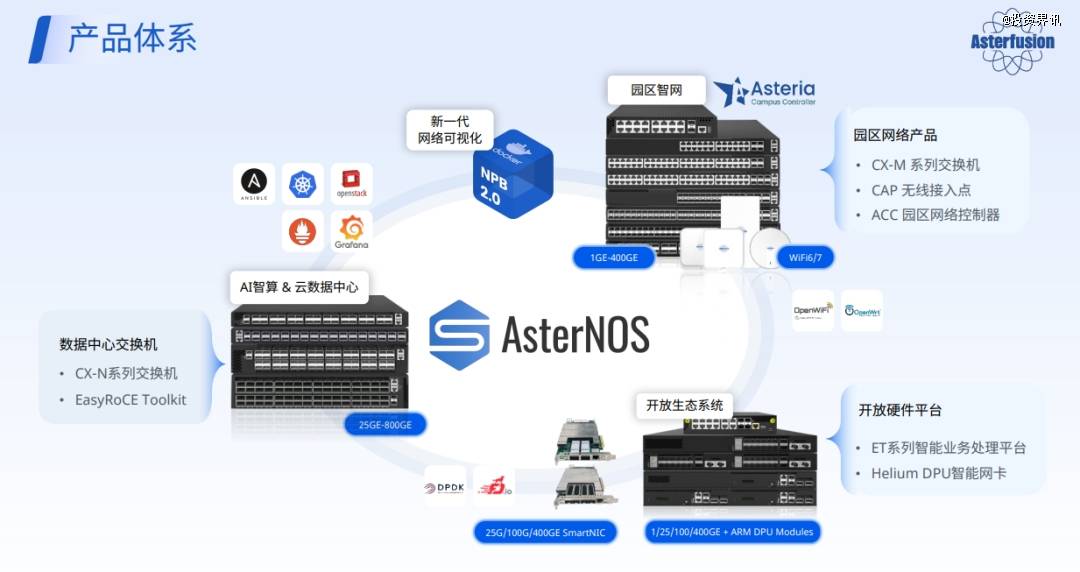
Core Insights - Asterfusion has recently completed a new round of financing led by Xiamen United and Hunan Caixin, with historical investors including Huaye Tiancai, Shanghai Jinpu, and Shenzhen High-tech Investment [2] Company Overview - Asterfusion specializes in providing open network solutions, focusing on a technology system centered around "cloud-network integration and open decoupling" [3] - The company aims to deliver full-stack network solutions for IT infrastructure in the AI era, featuring software decoupling, open-source software, hardware openness, and programmable chips [3] - Asterfusion's product matrix includes data centers, cloud/intelligent computing centers, and wide-area network edges, with its latest AI Fabric high-performance network solution already deployed at scale in several leading clients [3] Financing Purpose - The recent financing will primarily be used for technology research and product iteration, specifically to optimize the AI Fabric high-performance network solution to meet the high-performance demands of large-scale AI clusters [4] - Additionally, funds will be allocated for market expansion to accelerate global promotion and application of products, enhancing brand influence [4] Investment Rationale - The investment in Asterfusion is driven by its technological strength and market potential in the open network solutions sector, with its innovative "cloud-network integration and open decoupling" technology providing efficient and flexible network connectivity for IT infrastructure in the AI era [5] - The strong background of Asterfusion's team, with extensive industry experience and technical accumulation, is also a significant factor in attracting investment [5] Investment Perspective - The financing round for Asterfusion reflects a high recognition of technological innovation in the current venture capital market, supported by government policies promoting entrepreneurship and technological advancement [6] - Asterfusion's technological capabilities and market potential instill confidence in investors, and its entrepreneurial spirit and leading position in AI network solutions are commendable [6] - With ongoing technological iterations and market expansion, Asterfusion is expected to play a larger role in the AI infrastructure sector, driving industry development [6]

星融元完成新一轮融资,厦门联合、湖南财信出手
Sou Hu Cai Jing· 2026-01-16 04:14
Group 1 - Asterfusion has completed a new round of financing, with investments from Xiamen United and Hunan Caixin, alongside historical investors such as Huaye Tianc, Shanghai Jinpu, and Shenzhen High-tech Investment [1] - The company has established a core technology system focused on "cloud-network integration and open decoupling," aiming to provide full-stack network solutions for IT infrastructure in the AI era [1] - Asterfusion offers neutral and open network connectivity capabilities that are application scenario-centered and intelligently optimized for operational cost management [1] Group 2 - Asterfusion has developed a rich product matrix covering data centers, cloud/intelligent computing centers, and wide-area network edges [3] - The latest generation of Asterfusion's AI Fabric high-performance network solutions has been deployed at scale with several leading clients, effectively supporting stable and efficient operation of AI clusters at thousands to tens of thousands of nodes [3] - The company provides a range of products including network operating systems, data center switches, AI computing switches, campus switches, DPU network cards, P4 programmable hardware platforms, and network visualization products [3]
华为:2025年全域互联一键贯通-企业级骨干网云化演进趋势解析报告
Sou Hu Cai Jing· 2026-01-12 13:44
Group 1 - The core viewpoint of the report emphasizes the evolution of enterprise-level backbone networks towards cloud integration, driven by global digital transformation and the need for agile, reliable, and efficient digital infrastructure [1][9] - The report outlines the development background of cloud network integration, highlighting the supportive policies and increasing market demand for digital infrastructure upgrades [10][13] - The evolution of enterprise-level cloud networks is categorized into four stages: traditional networks, internet and mobile office, cloud computing and SDN integration, and the current phase of intelligence and 5G integration [27][30] Group 2 - The report identifies four core dimensions of cloud network integration: interconnectivity, scheduling, control, and reliability, focusing on the need for seamless connectivity and intelligent management [2][9] - Various enterprises have successfully upgraded their operations through cloud backbone networks, achieving significant improvements in latency, reliability, and operational efficiency [2][9] - Future trends in enterprise-level cloud networks include AI-driven standardization, enhanced network capabilities, and a shift from "network adapting to business" to "network sensing business" [2][9] Group 3 - The report discusses the challenges faced by existing cloud network solutions, including rigid architecture, insufficient performance guarantees, and low operational efficiency [36][38] - A new cloud network integration system is proposed, emphasizing capabilities such as one-click creation, multi-plane isolation, and intelligent control to overcome current limitations [44][49] - The design philosophy for future enterprise-level networks focuses on breaking boundaries and creating an integrated network that encompasses cloud, edge, and office environments [53][54]

多场景K歌系统行业研究报告
艾瑞咨询· 2026-01-11 00:05
Industry Development Environment - The macroeconomic stability and rising consumer spending in China have solidified the foundation for entertainment consumption, with GDP increasing from 70.3 trillion yuan to 134.9 trillion yuan from 2015 to 2024, and per capita disposable income rising from 22,000 yuan to 41,000 yuan, a 100% increase [9][11] - The music industry has shown steady recovery, with its total scale increasing from 301.8 billion yuan to 492.9 billion yuan during the same period, providing a rich content reserve for the karaoke system industry [17] - Leading karaoke system companies are increasing R&D investments, with an average of over 100 patent applications per year from 2015 to 2024, marking a shift towards intelligent technology [22] - The "two-in-one" copyright licensing mechanism has been established, ensuring legal compliance in the use of song libraries [26][29] Industry Development Status - The karaoke system industry in China is in an ecological integration phase, evolving from a closed entertainment scene to an open ecosystem, with a market size projected to reach 1.45 billion yuan in 2024 and exceed 3 billion yuan by 2028 [2] - Traditional commercial entertainment is declining, while home, in-car, and outdoor entertainment are rapidly rising, with in-car and outdoor segments expected to become the main growth drivers [2] Industry Development Trends - The industry is transitioning from hardware dependence to cloud-network integration, enabling light asset operations [3] - The deep integration of digitalization and AI is transforming operational intelligence, immersive experiences, and data-driven decision-making [4][66] - The shift from traditional closed operations to open scene-based services is creating a comprehensive karaoke entertainment coverage [5][69] Industry Structure and Competition - The karaoke system industry has a clear structure with various participants, including content providers, hardware manufacturers, and service providers [33] - Entry barriers are high due to qualifications, technology, and ecosystem constraints, which strengthen the industry's entry threshold [36] - Competition is driven by policy, market demand, technology, and maturity, shaping the industry's differentiated competitiveness [39] Business Model and Market Size - The industry has developed a four-wheel-driven business model, including hardware sales, content licensing, operational maintenance, and value-added services, with the latter expected to become a core growth engine [42] - The market size is projected to reach 1.45 billion yuan in 2024, driven by multi-scenario expansion, with significant growth expected in the coming years [45] - Revenue from software and hardware services is expected to reach 960 million yuan in 2024, while value-added services are projected to grow to 440 million yuan [48] Segment Analysis - The traditional commercial entertainment segment is recovering slowly, with a projected size of 690 million yuan by 2028 [55] - The in-car entertainment segment is experiencing explosive growth, with a projected size of 1.1 billion yuan by 2028 [57] - The outdoor entertainment segment is rapidly rising, expected to reach 580 million yuan by 2028 [59] - The home entertainment segment is steadily growing, projected to reach 640 million yuan by 2028 [61] Future Outlook - The karaoke system industry is expected to continue evolving towards intelligent, ecological, and refined directions, driven by technological advancements and changing consumer preferences [66][69]