数字化与AI融合

Search documents
多场景K歌系统行业研究报告
艾瑞咨询· 2026-02-05 00:06
Industry Development Environment - The macroeconomic stability and rising consumer spending in China have solidified the foundation for entertainment consumption, with GDP increasing from 70.3 trillion yuan to 134.9 trillion yuan from 2015 to 2024, and per capita disposable income rising from 22,000 yuan to 41,000 yuan, a 100% increase [9][11] - The music industry has shown steady recovery, with its total scale increasing from 301.8 billion yuan to 492.9 billion yuan during the same period, providing a rich content reserve for the karaoke system industry [17] - Leading karaoke system companies are increasing R&D investments, with an average of over 100 patent applications per year from 2015 to 2024, marking a shift towards intelligent technology [22] - The "two-in-one" copyright licensing mechanism has been established, ensuring legal compliance in the use of song libraries [26][29] Industry Development Status - The karaoke system industry in China is in an ecological integration phase, evolving from a closed entertainment scene to an open ecosystem, with a market size projected to reach 1.45 billion yuan in 2024 and exceed 3 billion yuan by 2028 [2] - Traditional commercial entertainment is declining, while home, in-car, and outdoor entertainment are rapidly rising, with in-car and outdoor segments expected to become the main growth drivers [2] Industry Development Trends - The industry is transitioning from hardware dependence to cloud-network integration, enabling light asset operations [3] - The deep integration of digitalization and AI is transforming operational intelligence, immersive experiences, and data-driven decision-making [4][66] - The shift from traditional closed operations to open scene-based services is creating a comprehensive karaoke entertainment coverage [5][69] Industry Structure and Competition - The karaoke system industry has a clear structure with various participants, including content providers, hardware manufacturers, and service providers [33] - The industry faces three barriers to entry: qualification, technology, and ecosystem, which collectively raise the entry threshold [36] - Competition is driven by policy, market demand, technology, and maturity, shaping the industry's differentiated competitiveness [39] Business Model and Market Size - The industry has developed a four-wheel-driven business model, including basic hardware sales, content licensing, operational maintenance, and value-added services [42] - The market size is expected to grow steadily, reaching 1.45 billion yuan in 2024 and over 3 billion yuan by 2028, driven by multi-scenario expansion [45] - Revenue from software and hardware services is projected to reach 960 million yuan in 2024, with value-added services expected to grow to 440 million yuan [48] Segment Analysis - The traditional commercial entertainment segment is recovering slowly, with a projected size of 690 million yuan by 2028 [55] - The in-car entertainment segment is experiencing explosive growth, with a projected size of 1.1 billion yuan by 2028 [57] - The outdoor entertainment segment is rapidly rising, expected to reach 580 million yuan by 2028 [59] - The home entertainment segment is steadily growing, projected to reach 640 million yuan by 2028 [61] Future Outlook - The karaoke system industry is expected to continue evolving towards intelligent, ecological, and refined directions, driven by the integration of AI and digital technologies [66][70]


多场景K歌系统行业研究报告
艾瑞咨询· 2026-02-05 00:00
Industry Development Environment - The macroeconomic stability and rising consumer spending in China have solidified the foundation for entertainment consumption, with GDP increasing from 70.3 trillion yuan to 134.9 trillion yuan from 2015 to 2024, and per capita disposable income rising from 22,000 yuan to 41,000 yuan, a 100% increase [9][11] - The music industry has shown steady recovery, with its total scale increasing from 301.8 billion yuan to 492.9 billion yuan during the same period, providing a rich content reserve for the karaoke system industry [17] - Leading karaoke system companies are increasing R&D investments, with an average of over 100 patent applications per year from 2015 to 2024, marking a shift towards intelligent technology [22] - The "two-in-one" copyright licensing mechanism has been established, ensuring legal compliance in the use of song libraries [26][29] Industry Development Status - The karaoke system industry in China is in an ecological integration phase, evolving from a closed entertainment scene to an open ecosystem, with a market size projected to reach 1.45 billion yuan in 2024 and exceed 3 billion yuan by 2028 [2] - Traditional commercial entertainment is declining, while home, in-car, and outdoor entertainment are rapidly rising, with in-car and outdoor segments expected to become the main growth drivers [2] Industry Development Trends - The industry is transitioning from hardware dependence to cloud-network integration, enabling light asset operations [3] - The deep integration of digitalization and AI is transforming operational intelligence, immersive experiences, and data-driven decision-making [4][66] - The shift from traditional closed operations to open scene-based services is creating a comprehensive karaoke entertainment coverage [5][69] Industry Structure and Participants - The karaoke system industry has a clear structure with various participants, including upstream content providers, hardware manufacturers, and downstream consumers across multiple entertainment scenarios [33] - The industry faces three barriers to entry: qualification, technology, and ecosystem, which collectively raise the threshold for new entrants [36] Business Model - The karaoke system industry has developed a four-wheel-driven business model, including basic hardware sales, content copyright services, operational technology maintenance, and value-added service subscriptions [42] - The market size is expected to grow steadily, driven by multi-scenario expansion, with the software and hardware service revenue reaching 960 million yuan and value-added service revenue reaching 440 million yuan in 2024 [48] Market Segmentation - The traditional commercial entertainment segment is recovering slowly, with a projected size of 690 million yuan by 2028, while the in-car entertainment segment is experiencing explosive growth, expected to reach 1.1 billion yuan by 2028 [55][57] - The outdoor entertainment segment is also rapidly rising, projected to reach 580 million yuan by 2028, driven by new leisure lifestyles [59] - The home entertainment segment is expected to grow steadily, reaching 640 million yuan by 2028, supported by the increasing popularity of smart home devices [61] Future Outlook - The karaoke system industry is expected to continue evolving towards intelligent, ecological, and refined directions, driven by the integration of cloud and network technologies [63][66]

多场景K歌系统行业研究报告
艾瑞咨询· 2026-01-22 00:07
Industry Development Environment - The macroeconomic stability and rising consumer spending in China have solidified the foundation for entertainment consumption, with GDP increasing from 70.3 trillion yuan to 134.9 trillion yuan from 2015 to 2024, nearly doubling [9] - Per capita disposable income rose from 22,000 yuan to 41,000 yuan during the same period, enhancing the public's willingness to spend on cultural and entertainment activities [11] - The music industry has shown steady recovery, with its total scale increasing from 301.8 billion yuan to 492.9 billion yuan, maintaining an average annual growth rate of over 5% [17] - High user engagement in online karaoke, with 100 million monthly active devices and an average usage time of 26.5 minutes per device per day, highlights the sector's social consumption vitality [20] - Leading karaoke system providers are increasing R&D investments, with an average of over 100 patent applications annually from 2015 to 2024, marking a shift towards intelligent technology [22] Industry Development Status - The Chinese karaoke system industry is in an ecological integration phase, evolving from a closed entertainment scene to an open ecosystem, with a market size projected to reach 1.45 billion yuan in 2024 and exceed 3 billion yuan by 2028 [2] - Traditional commercial entertainment is declining, while home, in-car, and outdoor entertainment are rapidly rising, with in-car and outdoor segments expected to become the main growth drivers [2] Industry Development Trends - The industry is transitioning from hardware dependence to cloud-network integration, enabling light-asset operations [3] - Deep integration of digitalization and AI is transforming operational intelligence, immersive experiences, and data-driven decision-making [4] - The shift from traditional closed operations to open, scenario-based services is creating a comprehensive karaoke entertainment coverage [5] Industry Structure and Ecosystem - The karaoke system industry has a clear structure with various participants, including content providers, hardware manufacturers, and service integrators, forming a complete ecosystem [33] - The industry faces three barriers to entry: qualification, technology, and ecosystem, which collectively raise the threshold for new entrants [36] Business Model and Market Size - The industry has developed a four-wheel-driven business model, including basic hardware sales, content licensing, operational maintenance, and value-added services, with the latter expected to become a core growth engine [42] - The market size is projected to reach 1.45 billion yuan in 2024, driven by multi-scenario expansion, with significant growth expected in the coming years [45] Segment Analysis - The traditional commercial entertainment segment is recovering slowly, with a projected size of 690 million yuan by 2028, while the in-car segment is experiencing explosive growth, expected to reach 1.1 billion yuan by 2028 [55][57] - The outdoor karaoke segment is rapidly emerging, with a projected size of 580 million yuan by 2028, driven by new leisure lifestyles [59] - The home karaoke segment is expected to grow steadily from 60 million yuan in 2019 to 640 million yuan by 2028, supported by increasing consumer willingness to pay for quality content and services [61] Regulatory Environment - The industry is governed by a tripartite collaboration among the Ministry of Culture and Tourism, the China Cultural Entertainment Industry Association, and the China Audio-Video Copyright Association, establishing a dual defense line for content and copyright [26] - The "two-in-one" copyright licensing mechanism has been established to regulate copyright circulation in karaoke scenes, ensuring compliance and legal use [29]

多场景K歌系统行业研究报告
艾瑞咨询· 2025-12-23 00:06
Industry Development Environment - The macroeconomic stability and rising consumer spending in China have solidified the foundation for entertainment consumption, with GDP increasing from 70.3 trillion yuan to 134.9 trillion yuan from 2015 to 2024, nearly doubling [9] - Per capita disposable income rose from 22,000 yuan to 41,000 yuan during the same period, enhancing the willingness to spend on cultural and entertainment activities [11] - The music industry has shown steady recovery, with its total scale increasing from 301.8 billion yuan to 492.9 billion yuan, averaging over 5% annual growth [17] - High user engagement in online karaoke, with 100 million monthly active devices and an average usage time of 26.5 minutes per device per day, highlights the social and health benefits of karaoke [20] - Leading karaoke system providers are increasing R&D investments, with over 100 patents filed annually from 2015 to 2024, focusing on AI and smart technologies [22] Industry Development Status - The Chinese karaoke system industry is in an ecological integration phase, evolving from a closed entertainment scene to an open ecosystem, with a market size projected to reach 1.45 billion yuan in 2024 and exceed 3 billion yuan by 2028 [2] - Traditional commercial entertainment is declining, while home, in-car, and outdoor entertainment are rapidly emerging as new growth areas [2] - The growth of paid value-added services is becoming a core driver for market expansion and structural optimization [2] Industry Development Trends - The industry is transitioning from hardware dependence to cloud-network integration, enabling light asset operations [3] - Deep integration of digitalization and AI is transforming operational intelligence, immersive experiences, and data-driven decision-making [4] - The shift from traditional closed operations to open, scenario-based services is creating a comprehensive karaoke entertainment coverage [5] Industry Structure and Ecosystem - The karaoke system industry is defined as a segment that has evolved from traditional video-on-demand services, focusing on providing song libraries and technical solutions for various entertainment scenarios [6] - The industry has a clear structure with multiple participants, including content providers, hardware manufacturers, and service integrators [33] Market Size and Growth - The karaoke system market is expected to grow steadily, reaching 1.45 billion yuan in 2024 and surpassing 3 billion yuan by 2028, driven by multi-scenario business expansion [45] - Revenue from software and hardware services is projected to reach 960 million yuan in 2024, with paid value-added services expected to grow to 440 million yuan [48] Segment Analysis - The commercial entertainment segment is recovering slowly, with a projected size of 690 million yuan by 2028, while the in-car segment is experiencing explosive growth, expected to reach 1.1 billion yuan by 2028 [55][57] - The outdoor entertainment segment is also rapidly rising, with a forecasted size of 580 million yuan by 2028, driven by new leisure trends [59] - The home entertainment segment is expected to grow steadily from 60 million yuan in 2019 to 640 million yuan by 2028, supported by increasing consumer willingness to pay for quality content and services [61] Regulatory Environment - The karaoke system industry is subject to collaborative management from the Ministry of Culture and Tourism, the China Cultural Entertainment Industry Association, and the China Audio-Video Copyright Association, focusing on content safety and copyright legality [26] - The establishment of a "two-in-one" copyright licensing mechanism is crucial for ensuring high-quality development in the karaoke scene [29]

多场景K歌系统行业研究报告
艾瑞咨询· 2025-12-07 00:05
Industry Development Environment - The macroeconomic stability and rising consumer spending in China have solidified the foundation for entertainment consumption, with GDP increasing from 70.3 trillion yuan to 134.9 trillion yuan from 2015 to 2024, and per capita disposable income rising from 22,000 yuan to 41,000 yuan, a 100% increase [9][11] - The music industry has shown steady recovery, with its total scale increasing from 301.8 billion yuan to 492.9 billion yuan during the same period, providing a rich content reserve for the karaoke system industry [17] - Leading karaoke system companies are increasing R&D investments, with an average of over 100 patent applications per year from 2015 to 2024, marking a shift towards intelligent technology [22] - The "two-in-one" copyright licensing mechanism has been established, ensuring legal compliance in the use of song libraries [26][29] Industry Development Status - The karaoke system industry in China is in an ecological integration phase, evolving from a closed entertainment scene to an open ecosystem, with a market size projected to reach 1.45 billion yuan in 2024 and exceed 3 billion yuan by 2028 [2] - Traditional commercial entertainment is declining, while home, in-car, and outdoor entertainment are rapidly rising, with in-car and outdoor segments expected to become the main growth drivers [2] Industry Development Trends - The industry is transitioning from hardware dependence to cloud-network integration, enabling light asset operations [3] - The deep integration of digitalization and AI is transforming operational intelligence, immersive experiences, and data-driven decision-making [4][66] - The shift from traditional closed operations to open scene-based services is creating a comprehensive karaoke entertainment coverage [5][69] Industry Structure and Competition - The karaoke system industry has a clear structure with various participants, including content providers, hardware manufacturers, and service providers [33] - The industry faces three barriers to entry: qualification, technology, and ecosystem, which collectively raise the entry threshold [36] - Competition is driven by policy, market demand, technology, and maturity, shaping the industry's differentiated competitiveness [39] Business Model and Market Size - The industry has developed a four-wheel-driven business model, including basic hardware sales, content licensing, operational maintenance, and value-added services [42] - The market size is expected to grow steadily, reaching 1.45 billion yuan in 2024, with significant contributions from in-car and outdoor entertainment segments [45][57][59] Segment Analysis - The commercial entertainment segment is recovering slowly, with a projected size of 690 million yuan by 2028, while the in-car segment is experiencing explosive growth, expected to reach 1.1 billion yuan by 2028 [55][57] - The outdoor entertainment segment is rapidly rising, projected to reach 580 million yuan by 2028, driven by new leisure lifestyles [59] - The home entertainment segment is steadily growing, expected to reach 640 million yuan by 2028, supported by increasing consumer willingness to pay for quality content and services [61] Future Outlook - The karaoke system industry is expected to continue evolving towards intelligent, ecological, and refined directions, driven by technological advancements and changing consumer preferences [66][69]

多场景K歌系统行业研究报告
3 6 Ke· 2025-11-25 01:07
Industry Development Environment - The macroeconomic environment in China is stable, with GDP increasing from 70.3 trillion yuan to 134.9 trillion yuan from 2015 to 2024, and per capita disposable income rising from 22,000 yuan to 41,000 yuan, indicating a 100% increase in consumer spending power [8][11] - The music industry in China has shown steady recovery, with its total scale growing from 301.8 billion yuan to 492.9 billion yuan during the same period, maintaining an average annual growth rate of over 5% [20] - The K-song system industry benefits from high user engagement and health value, with 100 million monthly active devices and an average usage time of 26.5 minutes per device per day, enhancing social consumption vitality [23] Industry Development Status - The K-song system industry in China is transitioning to an open ecological model, with a market size projected to reach 1.45 billion yuan in 2024 and expected to exceed 3 billion yuan by 2028, driven by the expansion of multi-scenario businesses [2][51] - The industry is experiencing a structural shift, with traditional commercial entertainment declining while home, in-car, and outdoor entertainment rapidly rise, particularly in-car and outdoor segments expected to become the main growth drivers [2][61] Industry Development Trends - The industry is shifting from hardware dependence to cloud-network integration, enabling light-asset operations and driving industrial upgrades [3][78] - The integration of digitalization and AI is providing new growth opportunities through intelligent operations, immersive experiences, and data-driven decision-making [81] Research Object Description - The multi-scenario K-song system industry, derived from traditional karaoke video-on-demand services, focuses on providing a comprehensive entertainment experience across various settings, including commercial, in-car, outdoor, and home entertainment [4] Regulatory Environment - The K-song system industry is regulated by a tripartite collaboration among the Ministry of Culture and Tourism, the China Cultural Entertainment Industry Association, and the China Audio-Video Copyright Association, ensuring content safety and copyright compliance [32][34] - The "two-in-one" copyright licensing mechanism has been established to streamline copyright management and ensure legal compliance in the K-song scene [35] Market Size and Growth - The K-song system industry is projected to reach a market size of 1.45 billion yuan in 2024, with expectations to surpass 3 billion yuan by 2028, driven by the expansion of multi-scenario businesses and the integration of AI and AR/VR technologies [51][66] - Revenue from software and hardware services is expected to reach 960 million yuan in 2024, while paid value-added services are projected to grow to 440 million yuan, indicating a robust growth trajectory [55] Segment Analysis - The commercial entertainment segment is recovering slowly, with a projected business scale of 690 million yuan by 2028, while the in-car entertainment segment is experiencing explosive growth, expected to reach 1.1 billion yuan by 2028 [64][66] - The outdoor entertainment segment is also rapidly rising, with a projected business scale of 580 million yuan by 2028, driven by new leisure activities and the integration of K-song systems into outdoor settings [71][73]
多场景K歌系统行业研究报告
艾瑞咨询· 2025-11-25 00:06
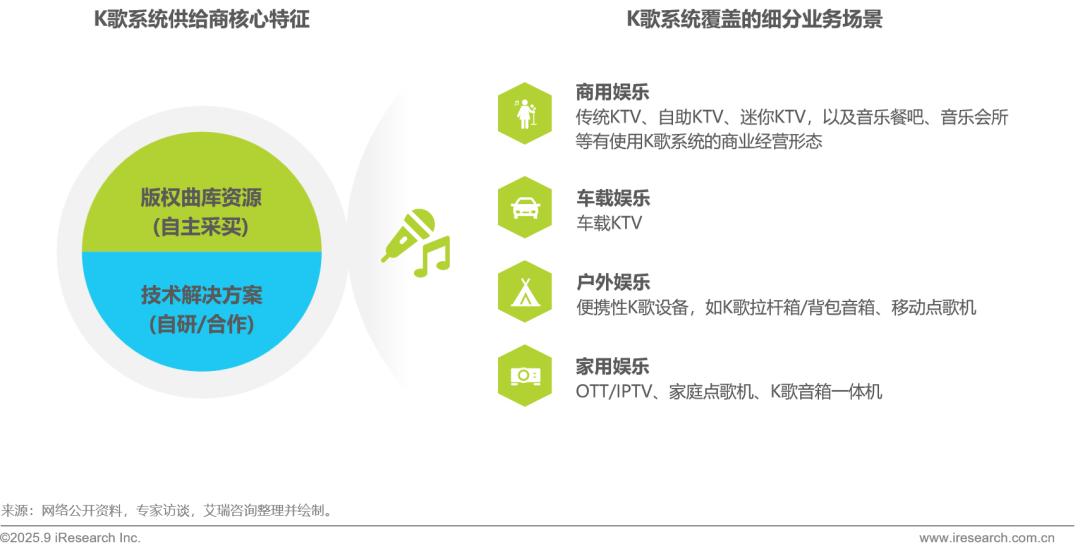
Core Viewpoint - The multi-scenario karaoke system industry in China is experiencing robust growth driven by macroeconomic stability, rising consumer spending, technological advancements, and supportive policies, leading to a projected market size of 14.5 billion yuan in 2024 and over 30 billion yuan by 2028 [1][2][45]. Industry Development Environment - Economic Factors: The macroeconomic growth from 70.3 trillion yuan in 2015 to 134.9 trillion yuan in 2024, alongside a 100% increase in per capita disposable income, has solidified the foundation for entertainment consumption [9][11]. - Social Factors: The music industry has shown steady recovery, with its total scale increasing from 301.8 billion yuan to 492.9 billion yuan from 2015 to 2024, enhancing the content supply for the karaoke industry [17][20]. - Technological Factors: Leading karaoke system providers are increasing R&D investments, with over 100 patent applications annually from 2015 to 2024, focusing on AI and smart technologies [22][24]. - Policy Factors: The establishment of a "dual protection" mechanism for content and copyright by the Ministry of Culture and Tourism, along with industry associations, ensures legal compliance in the karaoke scene [26][29]. Industry Development Status - The karaoke system industry is transitioning from a closed entertainment model to an open ecosystem, with a market size expected to reach 14.5 billion yuan in 2024 and surpass 30 billion yuan by 2028, driven by the expansion of in-car and outdoor scenarios [2][45]. - The industry is witnessing a structural shift, with traditional commercial entertainment declining while home, in-car, and outdoor entertainment rapidly rise, particularly in the in-car and outdoor segments [2][53]. Industry Development Trends - The industry is shifting from hardware dependence to cloud-network integration, enabling light asset operations and enhancing flexibility [3][63]. - The deep integration of digitalization and AI is driving intelligent operations, immersive experiences, and data-driven decision-making [4][66]. - The transition from traditional closed operations to open scenario-based services is creating a comprehensive karaoke entertainment landscape [5][69]. Industry Structure and Participants - The karaoke system industry features a clear structure with various participants, including upstream content providers, midstream system providers, and downstream consumers across multiple scenarios [33][36]. Market Size and Growth Drivers - The karaoke system market is projected to grow steadily, with a market size of 14.5 billion yuan in 2024, driven by the expansion of multi-scenario businesses and the increasing willingness of users to pay for services [45][48]. - The revenue from software and hardware services is expected to reach 9.6 billion yuan in 2024, while paid value-added services are projected to grow to 4.4 billion yuan, indicating a sustainable growth trajectory [48][50]. Segment Analysis - The traditional commercial entertainment segment is recovering slowly, while the in-car segment is experiencing explosive growth, with a projected increase from 0.5 billion yuan in 2021 to 11.0 billion yuan by 2028 [55][57]. - The outdoor karaoke segment is also rapidly emerging, with expected growth from 1.1 billion yuan in 2019 to 5.8 billion yuan by 2028, driven by new leisure activities [59]. - The home karaoke segment is anticipated to grow steadily, from 0.6 billion yuan in 2019 to 6.4 billion yuan by 2028, supported by the increasing popularity of smart home devices [61]. Conclusion - The multi-scenario karaoke system industry in China is poised for significant growth, driven by economic stability, technological advancements, and evolving consumer preferences, marking a transition towards a more integrated and immersive entertainment experience [1][2][66].

“减肥药巨头”诺和诺德裁 9000 人,跨国药企裁员风暴来袭,中国市场凭创新成“破局密钥”
Hua Xia Shi Bao· 2025-10-24 02:32
Core Insights - The global pharmaceutical industry is facing a significant downturn, with a total of 190 layoffs in the biopharmaceutical sector in the first three quarters of 2023, approaching the total of 192 expected for the entire year of 2024 [2][3] - Major companies like Merck and Novo Nordisk are leading this wave of layoffs, with Merck cutting 6,000 jobs and Novo Nordisk planning to lay off 9,000 employees, reflecting a broader industry trend [3][4] - The layoffs are driven by a combination of factors including patent cliffs, market competition, and inefficiencies in research and development [7][10] Layoff Trends - In Q3 2023, there were 62 layoffs in the global biopharmaceutical sector, with over 20,000 jobs cut in the second half of the year alone [2][3] - Merck's layoffs are part of a strategy to save $3 billion by 2027, while Novo Nordisk aims to save $1.26 billion by the end of 2026 [3] - Smaller companies are also affected, with companies like Biogen and Moderna announcing significant layoffs [4][5] Regional Focus: China - The Chinese market is experiencing unique adjustments, with companies like Gilead and Sumitomo Pharma restructuring their resources, while AstraZeneca is increasing its R&D investment by $2.5 billion [2][6] - The layoffs in China reflect a targeted approach, with Gilead confirming layoffs related to the integration of resources for a new HIV drug [4][6] - The Chinese market is becoming a critical area for innovation, with a significant increase in licensing deals for innovative drugs [6][10] Industry Dynamics - The underlying logic of the layoffs is attributed to pressures from patent expirations, low R&D efficiency, and intense market competition [7][10] - Companies are increasingly focusing on core therapeutic areas and optimizing resource allocation to adapt to changing market conditions [3][7] - The Chinese market is seen as a potential solution to these challenges, with lower clinical trial costs and a shift towards local innovation [7][10] Future Outlook - The ongoing layoffs are reshaping the industry landscape, with a notable talent migration from multinational companies to local firms in China [8] - The rise of CDMO (Contract Development and Manufacturing Organization) companies in China is facilitating the outsourcing of production by multinational firms [8] - The transformation of the industry is expected to continue, with China emerging as a core hub for innovation and development in the pharmaceutical sector [10]