
无障碍环境建设

Search documents
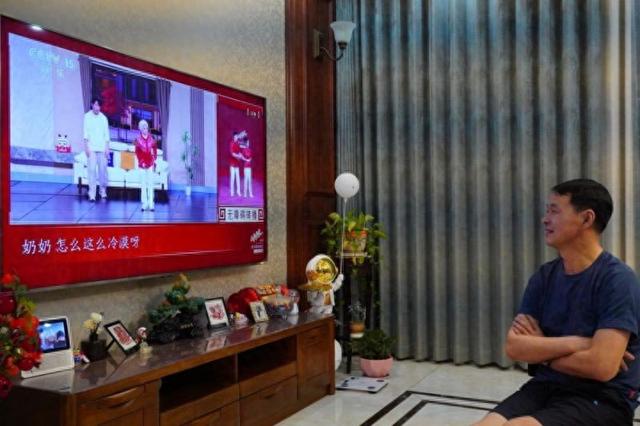
“之前陪着别人笑,今天我们自己笑”,无障碍春晚转播,让团圆没有缺憾
Xin Lang Cai Jing· 2026-02-17 15:25
Core Viewpoint - The 2026 Spring Festival Gala introduced an accessible broadcast version for the first time on CCTV-15, allowing hearing and visually impaired audiences to fully engage with the event, marking a significant step towards inclusivity in cultural events [5][9][10]. Group 1: Accessible Broadcast Features - The accessible broadcast featured a split-screen format with live subtitles, a sign language interpretation window, and a descriptive audio section for visually impaired viewers, enhancing the overall experience [5][7]. - The subtitles included a speed adaptation feature to match the rhythm of musical performances, while the sign language interpreters provided real-time translations of the performances [5][7]. - The audio descriptions for visually impaired audiences were designed to be vivid and detailed, allowing them to visualize the performances through descriptive language [7][9]. Group 2: Audience Reactions - Audience members expressed profound emotional connections to the gala, with many stating that they felt included for the first time, experiencing the joy and humor of the event alongside their families [2][8][10]. - Feedback highlighted the strong sense of immersion and emotional resonance provided by the accessible broadcast, with viewers appreciating the quality of sign language interpretation and audio descriptions [5][8][10]. - Social media reactions indicated a broader awareness and appreciation for the needs of disabled individuals, with many able-bodied viewers also benefiting from the accessible features [13][16]. Group 3: Social Impact and Future Prospects - The success of the accessible broadcast is seen as a milestone in the ongoing development of barrier-free environments, promoting greater societal inclusion for disabled individuals [9][15]. - There is an expectation that the positive impact of the gala will encourage more creators and organizations to focus on accessibility in cultural productions, leading to a wider range of inclusive offerings [16]. - The initiative reflects a commitment to shared experiences between disabled and able-bodied individuals, fostering a culture of inclusivity and mutual understanding [15][16].

【社评】97声“谢谢”藏着无障碍建设的成绩与期待
Xin Lang Cai Jing· 2026-02-09 20:20
Core Viewpoint - The article highlights the achievements in building an accessible environment in China, emphasizing the importance of support for individuals with disabilities to lead ordinary lives and access public services equally [1][4]. Group 1: Achievements in Accessibility - Significant progress has been made in the physical environment for accessibility, including the installation of tactile paths, smart traffic lights with audio prompts, and barrier-free services in public transport [2][3]. - The information environment is also improving, with technology companies developing comprehensive screen reader software and platforms optimizing their software for accessibility [2][3]. Group 2: Social Awareness and Community Support - The concept of "love without barriers" is increasingly resonating with the public, as evidenced by citizens actively providing feedback to local authorities to improve accessibility features [2][3]. - The article illustrates a heartwarming example of community support for a visually impaired student during her journey, showcasing the collective effort to make accessibility a part of daily life [1][2]. Group 3: Legislative and Policy Framework - Legislative measures such as the "Disability Education Regulations" and the implementation of the Accessibility Environment Construction Law are contributing to the improvement of conditions for individuals with disabilities [3]. - Initiatives like the inclusion of Braille in government reports and the trial of accessible drug instructions are steps towards enhancing the lives of visually impaired individuals [3]. Group 4: Future Directions - There is a call for further improvements in accessibility, including involving individuals with disabilities in urban planning to enhance the practicality of accessibility features [3]. - Encouraging technological advancements in assistive devices and fostering societal consensus on maintaining accessibility facilities are essential for future progress [3].
无障碍版升级 让春晚真正全民共享
Xin Lang Cai Jing· 2026-02-05 20:15
Core Viewpoint - The 2026 Spring Festival Gala is set to enhance its accessibility features, aiming to provide a more inclusive experience for individuals with disabilities, thereby promoting cultural sharing among all citizens [1][2]. Group 1: Accessibility Enhancements - The gala will implement comprehensive upgrades for its hearing-impaired and visually-impaired versions, utilizing advanced technology and humanistic care to ensure that everyone can participate in the cultural celebration [1][2]. - Over 85 million disabled individuals in China have historically faced barriers to cultural services, which the gala's upgrades aim to address by breaking down these cultural isolation barriers [2][4]. Group 2: Technological Integration - The use of AR and AI technologies will allow hearing-impaired viewers to see sign language interpreters synchronized with the performances, along with AI-generated subtitles for clarity [2][3]. - For visually-impaired audiences, professional narrators will provide detailed descriptions of the performances, transforming visual art into auditory experiences [3]. Group 3: Cultural Significance - The upgrades reflect a commitment to the "People's Spring Festival" concept, where sign language interpreters become integral to the performance, enhancing emotional communication [3]. - The initiative sets a societal benchmark for cultural rights, emphasizing that access to culture should not be hindered by physical differences [4]. Group 4: Societal Impact - The continuous improvement of accessibility in cultural events is part of a broader movement towards enhancing the dignity and cultural engagement of disabled individuals, fostering a sense of respect and inclusion within society [4]. - The gala's upgrades symbolize a commitment to the principle of "everyone shares," highlighting the importance of detailed care in achieving true inclusivity [4].
湖南人大代表倾力解民忧 让民意直通、办事直达
Xin Lang Cai Jing· 2026-02-05 13:06
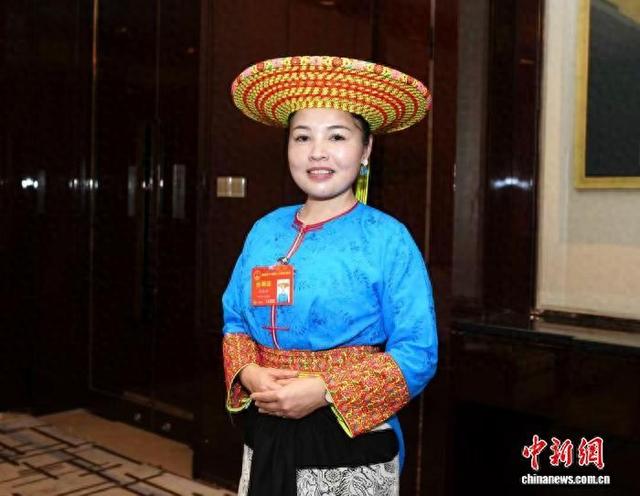
Group 1 - The article highlights the efforts of Hunan Provincial People's Congress representative Shen Yanxi in preserving the Huayao embroidery, a national intangible cultural heritage, by transforming it into various products, thus revitalizing the craft and increasing local income [1][3] - Shen Yanxi emphasizes the importance of collecting public opinions and suggests increasing funding support for intangible cultural heritage sites and improving incentive mechanisms for inheritors [3][4] - The article mentions that Hunan representatives collected over 5,100 public opinions last year and proposed 1,045 suggestions, focusing on quality rather than quantity [4][5] Group 2 - The Hunan government plans to invest approximately 60.1 billion yuan in 23 key livelihood projects for 2026, which is a 5.2% increase from the previous year [5] - Key projects include improving prenatal screening rates, expanding public high school enrollment, and establishing support systems for outdoor workers [5][6] - The Hunan Provincial People's Congress aims to enhance mechanisms for gathering public opinions and improve the effectiveness of representative liaison stations [6]
从基层治理到非遗传承,他们这样书写履职“答卷”
Chang Sha Wan Bao· 2026-02-04 00:13
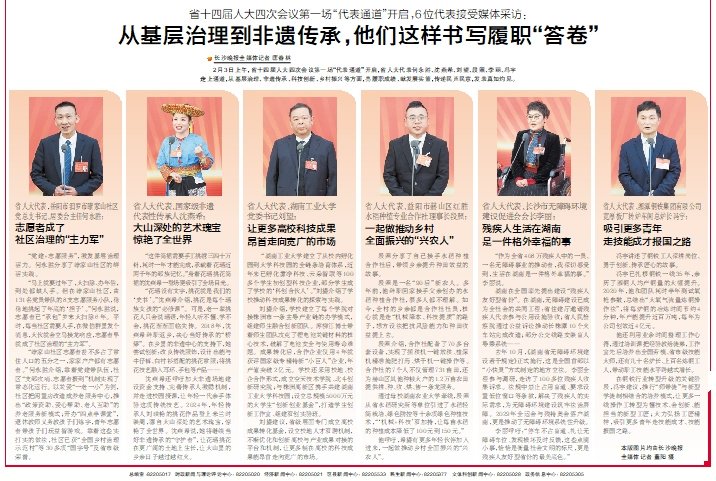
Group 1: Community Governance and Volunteerism - The community of Liaojiashan has effectively utilized volunteers, with 131 party members leading 8 volunteer teams, significantly contributing to community governance and activities such as year-end cleaning [5] - Approximately 20% of the community's permanent residents are volunteers, showcasing a strong culture of volunteerism and community engagement [5] - The community has received over 30 national and provincial honors, including being recognized as a "National Rural Governance Demonstration Village" [5] Group 2: Cultural Heritage and Non-material Cultural Inheritance - The art of embroidery in the Hmong culture, which requires extensive manual labor, is at risk of being lost as younger generations struggle to learn the craft [7] - Efforts to innovate traditional clothing and integrate embroidery techniques into modern products have been initiated to preserve this cultural heritage [7] - The call for increased funding for cultural heritage sites and improved incentive mechanisms for inheritors has been emphasized to ensure the continuation of these traditions [7] Group 3: Technology and Innovation in Education - Hunan University of Technology has established a comprehensive incubation system, resulting in the creation of over 100 student-led tech startups [9] - The university's collaboration with local industries has led to significant advancements in lithium battery technology, with a partner company achieving an annual output value exceeding 200 million yuan [9] - A proposal for a provincial-level fund to support the commercialization of university research outcomes has been made to enhance the connection between academia and industry [9] Group 4: Agricultural Innovation and Rural Revitalization - The rice planting cooperative led by a young entrepreneur has adopted mechanization and technology to improve farming efficiency and reduce costs by 100 to 150 yuan per mu [11] - The cooperative provides comprehensive agricultural services to local farmers, enhancing productivity across 12,000 mu of farmland [11] - There is a call for more young individuals to engage in agriculture and contribute to rural revitalization efforts [11] Group 5: Accessibility and Disability Rights - Hunan has taken the lead in establishing a "disability-friendly province," with initiatives involving disabled representatives in public facility assessments [13] - The implementation of local legislation aimed at improving accessibility for disabled individuals has been highlighted, addressing practical needs such as the prohibition of occupying blind paths [13] - The upcoming 2029 National Games and Special Olympics in Hunan is expected to further enhance the systematic upgrade of accessibility environments [13] Group 6: Skills Development in the Steel Industry - The steel industry has seen significant productivity improvements, with innovative practices leading to an annual increase in production capacity by nearly one million tons [16] - A focus on training and mentoring has resulted in the development of skilled workers, including national role models and skilled masters [16] - Recommendations for combining traditional apprenticeship models with modern training methods have been made to attract youth to skilled trades [16]
电动轮椅屡被拒 如何平衡尊严与安全
Xin Lang Cai Jing· 2026-01-29 17:43
Core Viewpoint - The article discusses the challenges faced by electric wheelchair users in accessing public spaces, particularly hospitals, due to safety concerns related to lithium batteries, highlighting the need for clearer regulations and standards in the industry [1][10][15]. Group 1: Safety Concerns and Regulations - Electric wheelchairs are being restricted in public spaces like hospitals due to safety concerns over lithium batteries, which have been linked to several accidents [1][10]. - Current standards for electric wheelchairs and their batteries are not mandatory, leading to inconsistent safety practices across manufacturers [1][12]. - The Chinese government is in the process of developing mandatory national standards for electric wheelchairs, which will include safety regulations for batteries and chargers [2][14]. Group 2: User Experiences and Challenges - Users of electric wheelchairs, such as elderly individuals and those with disabilities, face significant barriers when trying to access hospitals and public transport, often being forced to use less safe alternatives like manual wheelchairs [3][4][5]. - The article highlights specific incidents where users were denied entry to hospitals or public transport due to the presence of electric wheelchairs, raising questions about the practicality and fairness of such restrictions [3][6][8]. - Users express frustration over the lack of clear guidelines and the arbitrary nature of restrictions, which can hinder their mobility and access to necessary services [4][9][15]. Group 3: Recommendations for Improvement - Experts suggest that the government should enhance technical standards for electric wheelchairs, similar to those for electric bicycles, and establish a market entry system for compliant products [1][13]. - There is a call for proactive governance, including community surveys to assess safety risks and the establishment of charging facilities in public areas [13]. - The article emphasizes the importance of balancing safety with the rights of individuals to access public spaces, advocating for a more nuanced approach rather than blanket bans [10][15].
【前瞻分析】2025年中国无障碍行业产品市场规模及无障碍服务分析
Sou Hu Cai Jing· 2026-01-29 10:06
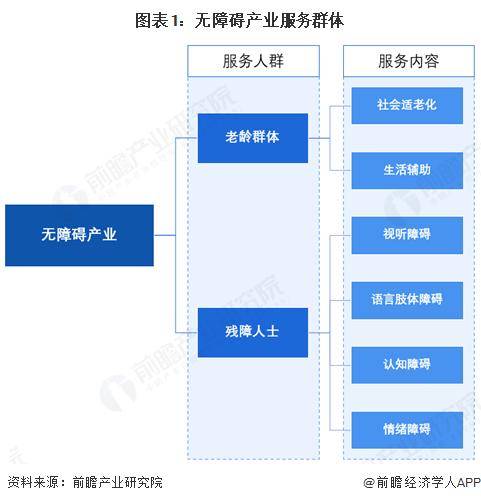
Core Insights - The accessibility industry focuses on providing services for the elderly and disabled, aiming to eliminate barriers to their daily lives and enhance their quality of life [1][3] - The industry includes a variety of products and services, such as mobility aids, communication devices, and smart technology, catering to different needs and scenarios [1][3] Industry Overview - The accessibility industry is characterized by its social care attributes, demand-driven features, and integration of resources across multiple fields [1] - Key products include rehabilitation aids like prosthetics and wheelchairs, communication tools like Braille software, and smart devices for navigation and monitoring [1] Market Trends - The electric wheelchair market is projected to grow from approximately 49.4 billion yuan in 2020 to about 70.5 billion yuan by 2024, with a compound annual growth rate (CAGR) of 7% [6][7] - The rehabilitation robot market is expected to expand significantly, from 3.7 billion yuan in 2019 to 15.29 billion yuan by 2024, reflecting a CAGR of over 30% [8] Policy Development - The legal framework for the accessibility industry began to take shape in 2023, with the implementation of the "Barrier-Free Environment Construction Law" marking a shift towards a regulated industry [12] - Prior to 2023, policies focused on basic support for disabled individuals and the elderly, with initiatives aimed at promoting rehabilitation and accessibility services [12]
就医被拦、乘车受阻,电动轮椅使用者:花了7年走出家门,现在又被“打”回去
Xin Jing Bao· 2026-01-29 00:16
Core Viewpoint - The article discusses the challenges faced by electric wheelchair users in accessing public spaces such as hospitals and transportation due to safety concerns related to lithium batteries, highlighting the need for clearer regulations and standards in the industry [1][11][16]. Group 1: Safety Concerns and Regulations - Electric wheelchairs are often prohibited in hospitals and public transport due to fears of lithium battery risks, leading to significant accessibility issues for elderly and disabled users [1][3][4]. - Current standards for electric wheelchairs and their batteries are not mandatory, allowing companies to choose whether to comply, which raises concerns about safety and quality [1][13]. - The Chinese government is in the process of developing mandatory national standards for electric wheelchairs, which would enforce safety regulations and potentially improve user access [2][15]. Group 2: User Experiences and Challenges - Users like Su and Liang have reported difficulties in using electric wheelchairs in hospitals and on public transport, often having to resort to less suitable alternatives like manual wheelchairs [3][5][9]. - The article highlights the emotional and physical challenges faced by users when navigating these restrictions, emphasizing the need for more inclusive policies [10][16]. - There is a growing recognition that electric wheelchairs are essential for many users, and the current restrictions can be seen as barriers to healthcare and mobility [4][16]. Group 3: Recommendations for Improvement - Experts suggest that the government should enhance technical standards for electric wheelchairs, similar to those for electric bicycles, and establish a market entry system for compliant products [14]. - There is a call for proactive governance, including community surveys and the establishment of charging facilities in public areas to ensure safety and accessibility [14]. - The article advocates for a balanced approach that prioritizes both safety and the rights of users, arguing against blanket bans that disproportionately affect vulnerable populations [11][16].
委员建议依托北京科创资源优势,研发智能盲道解决方案
Xin Jing Bao· 2026-01-25 14:46
Core Viewpoint - The Beijing government emphasizes the need to enhance the quality of life for disabled individuals through improved accessibility infrastructure, particularly in light of increasing demands due to an aging population [1][2] Group 1: Accessibility Infrastructure - The government work report highlights the ongoing efforts to promote the construction of barrier-free environments [1] - There is a recognized need for improvement in the planning, management, and smart technology integration of accessibility facilities such as blind paths [1] - The demand for barrier-free facilities has shifted from being a concern for a minority to a significant public welfare issue [1] Group 2: Recommendations for Improvement - It is suggested to implement the Barrier-Free Environment Construction Law, integrating accessibility facility construction into urban planning with synchronized planning, design, construction, and acceptance [1] - A "participatory experience" mechanism is recommended, requiring representatives of disabled individuals to be involved in the evaluation and testing of facility construction plans [1] - A special renovation plan should prioritize the improvement of blind paths in high-traffic areas for disabled individuals, such as transportation hubs and hospitals [1] Group 3: Technological Integration - The proposal includes leveraging Beijing's technological resources to develop smart blind path solutions, incorporating sensor modules for real-time obstacle alerts and directional guidance [1] - The development of a dedicated app to provide real-time updates on blind path conditions, accessible parking availability, and locations of barrier-free passages is recommended [2] Group 4: Management Mechanism - A management mechanism involving government leadership, departmental collaboration, and social participation is proposed to clarify responsibilities among various departments [2] - Regular assessments by third-party organizations and the establishment of feedback channels for the public are suggested to ensure the sustainability of accessibility facilities [2]
政协委员为广州交通治理精细化升级建言献策:高架桥底优化日间照明 智慧限高破解撞架难题
Xin Lang Cai Jing· 2026-01-19 00:41
Core Insights - The article highlights various transportation issues faced by citizens in Guangzhou, prompting local political representatives to propose targeted solutions for improving urban mobility and safety [1] Group 1: Bridge Lighting Improvements - The lack of adequate lighting under elevated bridges in Guangzhou poses safety risks, particularly during daytime when visibility is poor due to strong light contrast [2] - A proposal suggests implementing a time-based lighting strategy with low-intensity LED lights that activate during low-light conditions, alongside the installation of warning signs and physical barriers to enhance safety [2] Group 2: TOD Development and Urban Planning - The current state of transit-oriented development (TOD) around metro stations is hindered by planning disconnections and street congestion, despite the potential for increased land value and job creation [3] - Recommendations include integrating TOD into urban renewal plans, establishing a specialized fund for financing, and creating a comprehensive evaluation system for street-level improvements [3] Group 3: Smart Height Limit Systems - Traditional height limit structures are ineffective, leading to frequent accidents involving oversized vehicles, which threaten both traffic flow and infrastructure safety [4] - A proposal for an AI-driven height limit warning system aims to create a multi-layered defense mechanism to prevent such incidents, with successful pilot results reported in other cities [4] Group 4: Enhancing Accessibility - Accessibility issues in public spaces like Huacheng Square hinder the mobility of special groups, with existing facilities lacking coherence and maintenance [5][6] - Suggestions include elevating accessibility regulations to local laws, establishing rapid response mechanisms for facility issues, and integrating comprehensive navigation and assistance services to create an inclusive environment [5][6]