
房企债务重组

Search documents
千亿房企创始人涉嫌违法!昔日福建地产首富30年从业路蒙上阴影
Di Yi Cai Jing Zi Xun· 2025-08-22 16:08
2025.08.22 本文字数:1988,阅读时长大约3分钟 作者 |第一财经 孙梦凡 "意外事件"频发的泰禾集团,再次投出一枚"深水炸弹"。 8月22日,泰禾集团公告称,董事会于近日获悉,公司董事长兼总经理黄其森,因涉嫌违法被辽宁省新 民市监察委员会实施留置措施。 目前,泰禾集团存在资产被冻结、查封的情况,会对公司运营产生一定影响。除此之外,公司按原组织 架构和管理体系正常运转,经营活动正常进行。 公司早有高管接受调查 近几年的泰禾集团颇不太平,此前已出现过高管被调查事件。 2022年5月时,曾在建行任职多年、后任泰禾集团执行副总裁的黄曦被查。据中央纪委国家监委驻中国 建设银行纪检监察组、吉林省纪委监委消息,中国建设银行机构业务部原总经理黄曦涉嫌严重违纪违 法,正在接受调查。 黄其森也早有协助调查的经历。2022年3月时,泰禾集团公告称,公司董事长兼总经理黄其森正协助有 关机关调查。泰禾集团执行副总裁黄曦、副总裁林文华也被带走协助调查。 当时,在泰禾紧急召开的媒体沟通会上,管理层表示,董事长黄其森是协助调查,不是因为泰禾经营层 面的问题,与企业经营本身没有关系。同时表示,近年来,黄其森直接参与公司日常经营较 ...

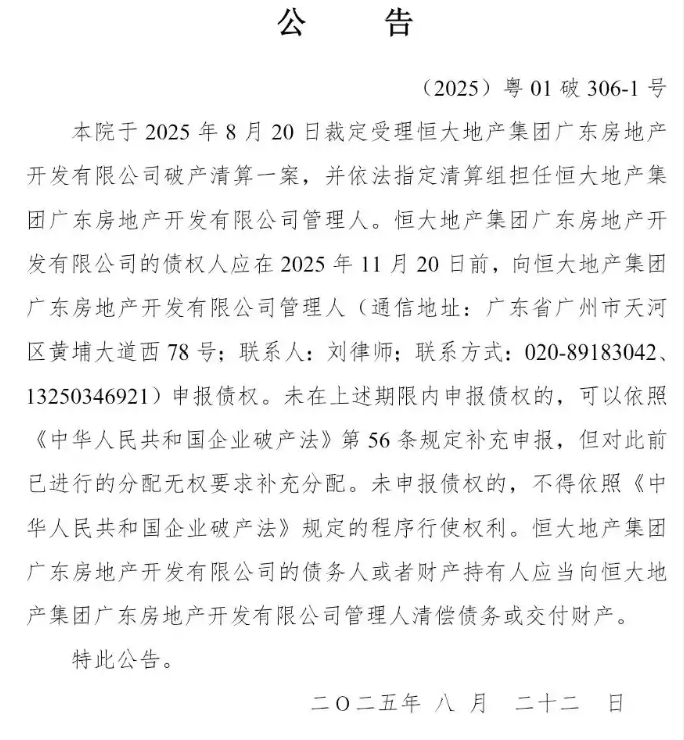
恒大地产广东公司,进入破产程序
Zheng Quan Shi Bao· 2025-08-22 11:36
Core Viewpoint - The announcement of the bankruptcy liquidation of Evergrande Real Estate Group's Guangdong subsidiary indicates a significant financial distress within the company, reflecting broader challenges in the real estate sector in China [1][2]. Group 1: Bankruptcy Proceedings - The Guangzhou Intermediate People's Court has accepted the bankruptcy liquidation case of Evergrande Real Estate Guangdong Company as of August 20, marking its entry into the bankruptcy liquidation phase [1]. - Other subsidiaries of the Evergrande Group, such as Guangzhou Kailong Real Estate and Shanghai Jinbi Real Estate, have also entered bankruptcy proceedings, highlighting a widespread issue across multiple cities [2]. Group 2: Impact on Projects - The impact of the bankruptcy on the "guaranteed delivery" projects will depend on whether there are any unfinished projects under the Guangdong subsidiary. If all projects are completed, the impact may be minimal [3]. - Even if projects are completed, the developer still has obligations such as warranty responsibilities, and there may be concerns about potential reductions in project quality upon delivery [3]. Group 3: Market Reactions and Trends - On August 20, the Hong Kong Stock Exchange announced that China Evergrande Group's listing status would be canceled effective August 25, due to failure to meet resumption requirements [3]. - The stock price of China Evergrande has plummeted from a peak of over 370 billion HKD to 2.15 billion HKD, reflecting a significant loss in market value [4]. - The cancellation of the listing may cause short-term market disruptions but is seen as part of a necessary process to clear risks and promote market purification [4]. - As of August 2025, 20 distressed real estate companies have received approval for debt restructuring, with a total debt relief exceeding 1.2 trillion CNY [5].
恒大地产广东公司,进入破产程序
证券时报· 2025-08-22 11:30
Core Viewpoint - The article discusses the bankruptcy proceedings of Evergrande Real Estate Group's Guangdong subsidiary, indicating a significant shift in the company's financial stability and the broader implications for the real estate industry in China [2][3]. Group 1: Bankruptcy Proceedings - On August 20, the Guangzhou Intermediate People's Court accepted the bankruptcy liquidation case of Evergrande Real Estate Guangdong Company, marking its entry into bankruptcy proceedings due to severe insolvency [2][3]. - Other subsidiaries of the Evergrande Group, such as Guangzhou Kailong Real Estate and Shanghai Jinbi Real Estate, have also entered bankruptcy or declared bankruptcy, affecting multiple cities across China [3]. Group 2: Impact on Projects - The impact of the bankruptcy on ongoing housing projects will depend on whether there are unfinished projects under the Guangdong subsidiary. If all projects are completed, the impact may be minimal, but obligations such as warranties still exist [3]. - If there are unfinished projects, it could lead to complications, but it does not necessarily mean that these projects will be abandoned [3]. Group 3: Market Reactions and Future Implications - On August 20, the Hong Kong Stock Exchange announced that China Evergrande Group's listing status would be canceled effective August 25, following its failure to meet the resumption requirements [4]. - The company's market capitalization has plummeted from over 370 billion HKD at its peak to 2.15 billion HKD at the time of suspension, reflecting a significant loss in investor confidence [4]. - Experts suggest that the withdrawal of Evergrande from the market may lead to short-term disruptions but could ultimately help in the orderly clearing of risks and restructuring of assets in the real estate sector [4]. Group 4: Debt Restructuring - As of August 2025, 20 distressed real estate companies have received approval for debt restructuring, with a total debt relief exceeding 1.2 trillion CNY [5]. - Since 2022, 27 listed real estate companies have been passively delisted, with several others opting for privatization, indicating a trend of companies exiting the real estate sector or shifting to lighter asset models [5].

机构:房地产风险加速出清,20家出险房企化债破1.2万亿
Xin Jing Bao· 2025-08-22 08:24
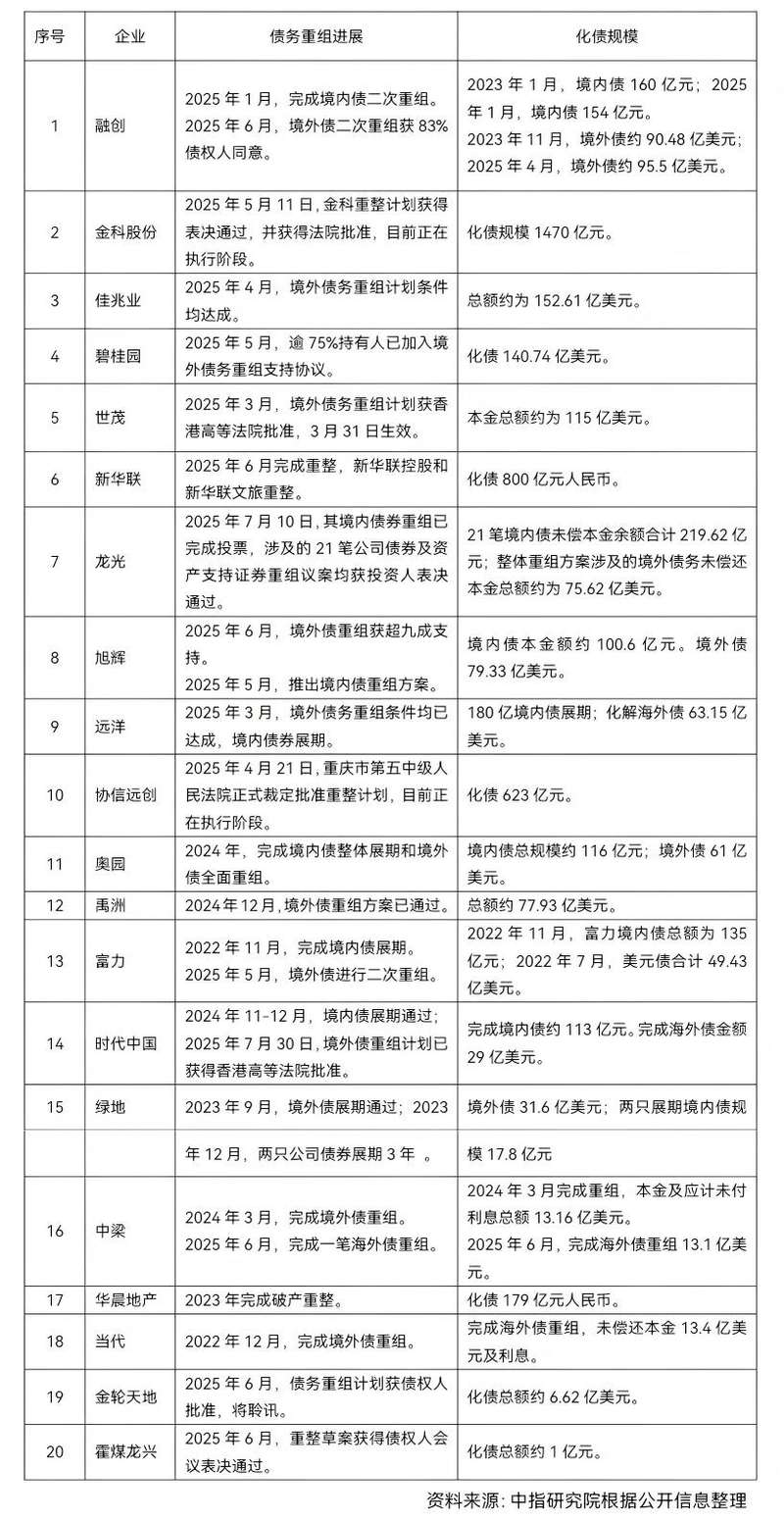
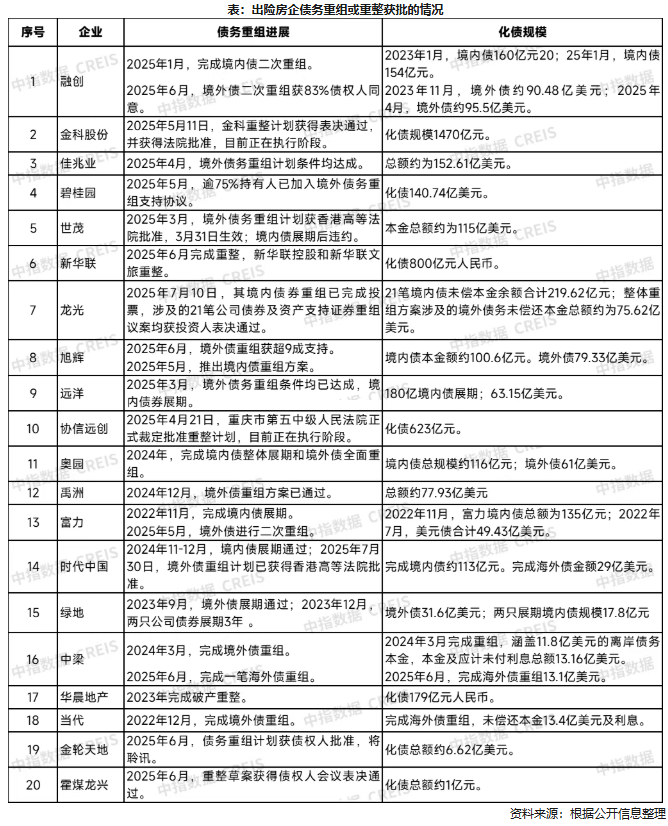
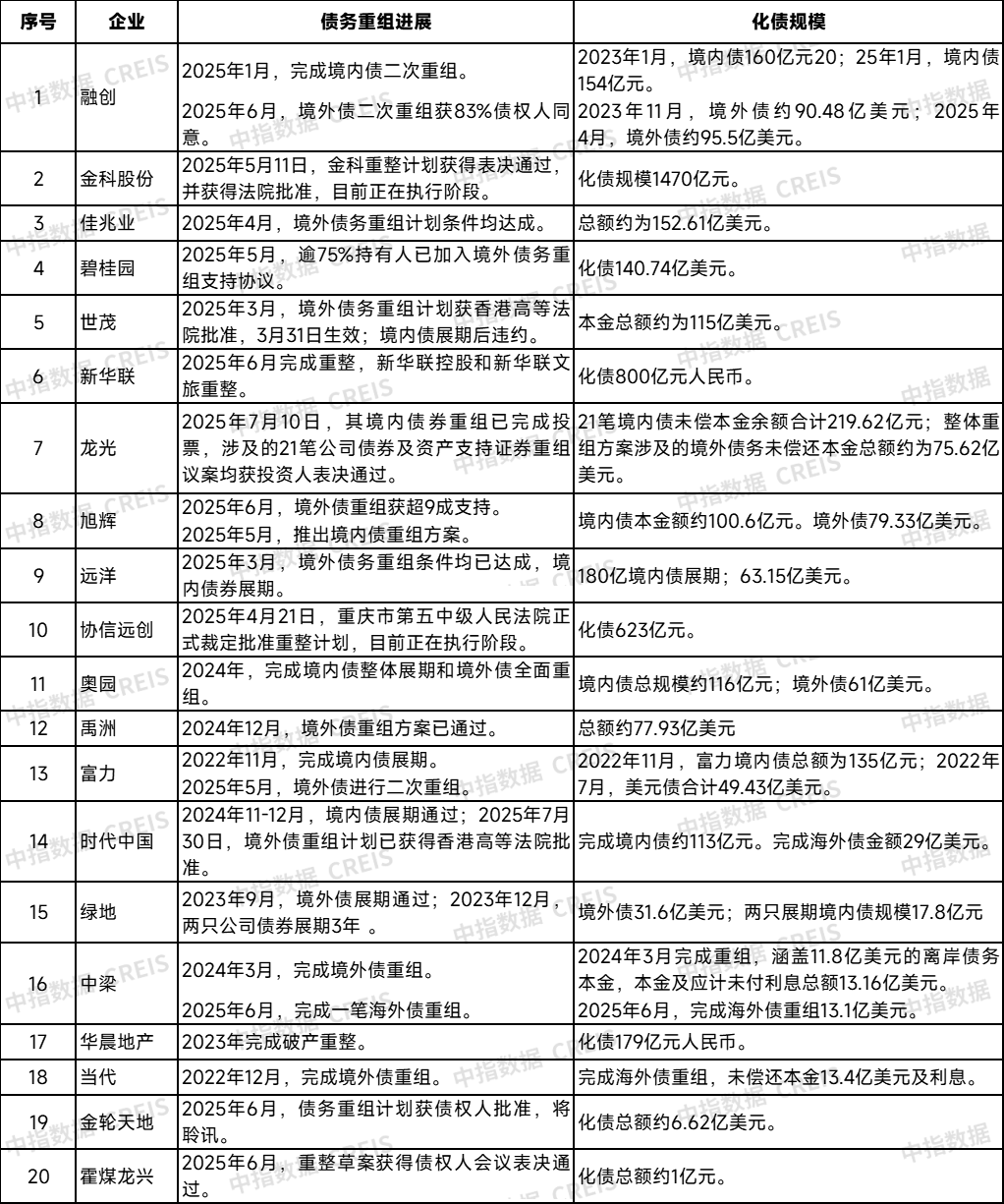
Core Insights - The report from the China Index Academy indicates that by August 2025, 20 distressed real estate companies will have approved debt restructuring or reorganization plans, with a total debt resolution scale exceeding 1.2 trillion yuan [1][2]. Debt Restructuring Progress - As of August 2025, a total of 77 real estate companies have experienced debt defaults since 2020, with the number of defaulting companies increasing from 16 in 2021 to 44 in 2022 [1]. - Companies such as Sunac, R&F, Aoyuan, and others have completed both domestic and international debt restructuring [1]. - Notable restructuring approvals include Xinhua Group in June 2025 and the restructuring plans for Jinke and Xiexin Yuanchuang, which have entered the execution phase [1]. Debt Resolution Scale by Company - Sunac: Completed domestic debt restructuring in January 2025, with a total of 160 billion yuan in domestic debt and approximately 90.48 billion USD in overseas debt [3]. - Jinke: Restructuring plan approved on May 11, 2025, with a debt resolution scale of 147 billion yuan [3]. - Kaisa: Achieved conditions for overseas debt restructuring in April 2025, with a total of approximately 152.61 billion USD [3]. - Country Garden: Over 75% of holders joined the overseas debt restructuring support agreement in May 2025, with a debt resolution of 140.74 billion USD [3]. - Shimao: Overseas debt restructuring plan approved by the Hong Kong High Court in March 2025, with a total principal amount of approximately 115 billion USD [3]. - Xinhua Group: Completed restructuring in June 2025, with a debt resolution of 800 billion yuan [3]. - Longguang: Completed voting for domestic bond restructuring on July 10, 2025, involving 21 domestic bonds with an unpaid principal balance of 21.962 billion yuan and approximately 75.62 billion USD in overseas debt [3]. - CIFI: Achieved over 90% support for overseas debt restructuring in June 2025, with domestic debt of approximately 10.06 billion yuan and overseas debt of 79.33 billion USD [3]. - Other companies such as R&F, Times China, Greenland, and more have also made significant progress in their debt restructuring efforts [3][4]. Financial Performance and Market Impact - As of August 20, 2025, 71 listed real estate companies in the Shanghai and Shenzhen stock exchanges have released their half-year performance forecasts, with 45 companies (63.4%) expecting losses, a slight increase of 1.1 percentage points from the previous year [1]. - The losses are attributed to factors such as declining project settlement scale, low gross margins, asset impairment provisions, and asset disposal prices below book values [1]. - Since 2022, 27 listed real estate companies have been passively delisted, with 14 from A-shares primarily due to stock prices falling below par value and continuous losses [5].
房企债务重组进程显著加速
Bei Jing Ri Bao Ke Hu Duan· 2025-08-21 22:29
Group 1 - The core viewpoint of the article highlights a significant acceleration in the debt restructuring process of real estate companies in the second half of the year, with 16 out of 60 distressed companies completing some form of restructuring by early August 2023 [1][2] - The restructuring trend has shifted from "extension" to "debt reduction," with companies utilizing asset swaps and cash buybacks to alleviate long-term debt pressure [1][3] - As of early August, 42 out of 60 distressed companies have disclosed their debt restructuring progress, indicating a more proactive approach compared to previous years [1][2] Group 2 - Among the 16 companies that completed debt restructuring, 8 had their plans approved this year, showcasing a notable increase in the pace of restructuring [2] - The current market conditions have led creditors to adjust their expectations for debt recovery, favoring restructuring over bankruptcy to improve debt repayment rates [2][4] - The debt reduction strategies employed by companies, such as debt-to-equity swaps, have resulted in some firms reducing their debt levels by over 50% [3][4] Group 3 - Several companies have shown signs of operational improvement and sales recovery, indicating a new phase of risk clearance in the real estate sector [5][6] - For instance, Sunac China reported a continuous increase in sales for three consecutive months, with sales figures showing significant year-on-year growth [6] - The Chinese government has implemented various measures to stabilize the real estate market, which is expected to facilitate a quicker return to normal operations for companies post-restructuring [6]

多家房企完成债务重组
Shen Zhen Shang Bao· 2025-08-21 17:45
Core Insights - As of August, 20 distressed real estate companies have received approval for debt restructuring, with a total debt resolution scale exceeding 12,000 billion RMB [1] - Notable companies that completed domestic and overseas debt restructuring include Sunac, R&F, Aoyuan, and others [1] - Several companies have divested from real estate development, such as Lushang Development and Zhujiang Investment Group, indicating a trend towards asset-light transformation [1] Debt Restructuring - The total scale of debt restructuring among the 20 companies surpasses 12,000 billion RMB [1] - Companies that completed overseas debt restructuring include Zhongliang and others, while companies like Xuhui and Kaisa have received approval for overseas debt restructuring [1] Corporate Actions - Xinhua Group completed its restructuring in June, while Hohhot Coal and Longxing Real Estate Company also received approval for restructuring [1] - Jin Ke Co. and Xiexin Yuanchuang are currently in the execution phase of their restructuring after court approval [1] Industry Trends - Many listed companies are actively divesting from real estate development due to both proactive transformation and reactive measures to protect their operations [1] - The trend of exiting the real estate sector or shifting to asset-light models is evident among companies like Guancheng New Materials [1]


20家房企债务重组,化债规模已超12000亿元
第一财经· 2025-08-21 15:09
Core Viewpoint - The article discusses the progress of debt restructuring among real estate companies in China, highlighting a smoother process in 2025 compared to previous years, with significant amounts of debt being restructured and approved by creditors [3][6]. Group 1: Debt Restructuring Progress - As of August 20, 2025, "21 Xuhui 03" approved its restructuring plan, bringing Xuhui's domestic debt restructuring close to completion, with a total of 96 billion yuan in six domestic bonds approved [3]. - Sunac has completed various terms of its domestic debt restructuring, with stock option registration completed for an amount of 5.59 billion yuan, and its domestic bonds resumed trading on August 11 [3]. - Country Garden's offshore debt restructuring has gained more support from creditors, while Times China successfully obtained approval from the Hong Kong High Court for its offshore debt restructuring plan [3]. Group 2: Debt Restructuring Scale - Approximately 60 distressed real estate companies have announced debt restructuring or corporate reorganization progress, with 20 companies having their debt restructuring or reorganization plans approved, totaling over 12 trillion yuan in debt [6]. - Companies that have completed both domestic and offshore debt restructuring include Sunac, Aoyuan, Yuanyang, Times China, and Longguang, while companies with approved offshore debt restructuring include Xuhui, Kaisa, Yuzhou Properties, Shimao, Greenland, and Country Garden [7]. Group 3: Restructuring Strategies - Many companies that completed debt restructuring earlier have faced new crises due to misjudgments about the industry, leading to a new round of self-rescue efforts [7]. - The main strategies for recent restructuring plans include cash buybacks, debt extensions, and debt-to-equity swaps, with many companies aiming for a debt reduction ratio of around 70% [8]. - Sunac's second offshore debt restructuring plan involves converting all its dollar bonds into equity, making it the first large developer to adopt this approach [7].

20家房企债务重组,化债规模已超12000亿元
Di Yi Cai Jing· 2025-08-21 13:55
Group 1 - The debt restructuring process for real estate companies has become smoother in 2023, with significant progress reported in both domestic and overseas debt restructuring [1][5] - As of early August 2025, approximately 60 distressed real estate companies have announced debt restructuring or corporate reorganization progress, with 20 companies having their debt restructuring or reorganization approved, totaling over 12,000 billion RMB in debt reduction [5][6] - Major companies that have completed domestic and overseas debt restructuring include Sunac, Aoyuan, Yuanyang, Times China, and Longguang, while companies like CIFI, Kaisa, Yuzhou Properties, Shimao, Greenland, and Country Garden have received approval for overseas debt restructuring [5][6] Group 2 - The mainstream options for debt restructuring among real estate companies include cash buybacks, debt extensions, and debt-to-equity swaps, with many companies opting for debt-to-equity swaps to preserve capital [6] - Sunac has become the first major developer to convert all its dollar bonds into equity in its overseas debt restructuring plan, which involves approximately 95.5 billion USD [6] - The average debt reduction ratio for most distressed companies is around 70%, as many are facing tight cash flows and reduced asset values [6]
中指研究:截至2025年8月20家出险房企债务重组、重整获批 化债超1.2万亿元
智通财经网· 2025-08-21 08:14
Group 1 - As of August 2025, 20 distressed real estate companies have received approval for debt restructuring and reorganization, with a total debt resolution scale exceeding 1.2 trillion RMB [1][2] - The companies that completed domestic and overseas debt restructuring include Sunac, R&F, Aoyuan, and others, with significant amounts of debt involved [2][4] - The restructuring efforts are a response to the deep market impact and operational challenges faced by real estate companies since 2022, leading to 27 listed companies being passively delisted [6] Group 2 - From 2020 to 2025, over 70 real estate companies experienced debt defaults, with 44 defaults occurring in 2022 alone, indicating a severe industry crisis [6] - The majority of listed real estate companies are facing significant financial difficulties, with 63.4% of 71 companies reporting losses in the first half of 2025, an increase from the previous year [9] - Many companies are divesting from real estate development to transition to lighter asset models, driven by both proactive transformation and the need to protect their market positions [6]
房企债务重组加速破局 年内8家方案落地、削债成主流
Xin Lang Cai Jing· 2025-08-18 03:58
Group 1 - As of early August, 42 out of 60 distressed real estate companies have disclosed debt restructuring progress, with 16 completing full or partial debt restructuring [1] - The current restructuring trend has shifted from "extension" to "debt reduction," with companies like Sunac China reducing over 50% of their 154 billion yuan debt [1] - Longguang Group's 219 billion yuan debt restructuring plan was approved by creditors within 20 days, utilizing asset swaps and cash buybacks [1] Group 2 - Major real estate companies are achieving breakthroughs in risk resolution through judicial reorganization, with Jinke Properties being the first nationwide listed company to complete this process, involving 147 billion yuan in debt and over 8,400 creditors [1] - The "judicial reorganization + strategic investment" model adopted by Jinke Properties has attracted strategic capital, facilitating its transformation into a comprehensive real estate operator [1] - Despite the acceleration of restructuring, companies like R&F Properties and Contemporary Land still face challenges, highlighting the importance of sales recovery and operational capability [2] Group 3 - By 2025, real estate companies will face 525.7 billion yuan in maturing debt, with a peak repayment of 157.4 billion yuan in the third quarter, indicating that market recovery will influence the effectiveness of restructuring [2] - The industry is transitioning from "effective resolution" to "systematic recovery," emphasizing the need for companies to improve both internally and externally for true revitalization [2]