
经济基本面

Search documents
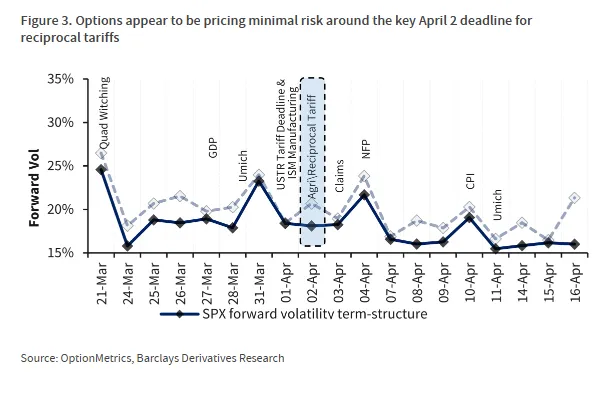
4月2日?不,期权市场更关心另外两个日期
Hua Er Jie Jian Wen· 2025-03-24 07:25
Group 1 - The core focus of the options market is on economic data releases rather than the tariff announcement scheduled for April 2, with significant implied volatility spikes noted on March 31 and April 4 [1][3] - March 31 corresponds to the first trading day after the release of the February core PCE price index, while April 4 aligns with the release of the March non-farm payroll report, indicating investor concerns about inflation and employment [3][4] - Despite a 10% decline in the S&P 500 index, volatility indicators remain calm, suggesting that some investors have reduced their positions and shifted focus to other regions, decreasing the need for hedging against further declines [4][5] Group 2 - The lack of volatility peaks indicates that the real risk may lie in economic fundamentals rather than policy announcements, as traders await certainty from upcoming economic data [4][5] - Many investors prioritize economic impacts over uncertainty, reflecting a significant focus on the implications of economic data releases [5] - The negative economic impact of tariff uncertainty may be more profound than previously anticipated, with potential increases in consumer prices and reduced real wages highlighted by Fitch's chief economist [5]

今年人民币汇率怎么走?田轩:或在波动中逐渐趋稳
Zhong Guo Jing Ji Wang· 2025-03-09 10:02
Core Viewpoint - The RMB exchange rate is expected to show a trend of gradual stabilization amidst fluctuations by 2025, influenced by both external and internal factors [1] External Factors - Increased uncertainty in the global economic environment, particularly due to the U.S. government's intensified measures against China, is likely to lead to greater volatility in the RMB exchange rate [1] - Recent market concerns regarding Trump's tariff threats have diminished, contributing to a weaker U.S. dollar index and declining U.S. Treasury yields, which may help stabilize the RMB [1] Internal Factors - Domestic issues such as insufficient demand and economic structural adjustments are also impacting the stability of the RMB exchange rate [1] - Continuous policy efforts are expected to improve the economic fundamentals in China, providing strong support for the RMB exchange rate [1] - Specific measures include the implementation of moderately loose monetary policy, potential reductions in reserve requirements and interest rates, and a fiscal deficit target of around 4% to boost consumption and investment efficiency [1] Central Bank Actions - In extraordinary circumstances, the central bank may take various measures, such as moderate intervention in the foreign exchange market and adjustments to foreign exchange reserves, to ensure the exchange rate remains stable at a reasonable equilibrium level [1]