创新药投资

Search documents
20cm速递|科创创新药ETF(589720)回调超3%,关注低位布局机会,“924”以来,科创新药指数跑赢主要港股创新药指数!
Mei Ri Jing Ji Xin Wen· 2025-08-12 03:18
相关机构表示,国家医保局推进的第十一批国家药品集采政策值得关注。此次集采纳入55种药品,优化 了报量规则,允许医疗机构按具体品牌报量,并调整了中选规则,避免企业过度低价竞争。通过优化价 差计算"锚点"和要求最低报价企业说明合理性,政策旨在保障产品质量与企业合理利润空间。有望帮助 医药企业通过合理报价扩大市场份额,同时,集采常态化促使企业向创新转型,推动行业结构优化升 级。 科创创新药ETF国泰(589720)聚焦科创板创新药企业,跟踪汇聚30家代表性优质公司的上证科创板创 新药指数,以高成长biotech为主,产品20%涨跌幅限制使其更贴合板块波动。从业绩表现来看,"924行 情"以来,科创新药指数跑赢主要港股创新药指数!2024年9月24日至2025年6月30日市场反弹期间,科 创新药/港股创新药/恒生港股通创新药指数涨幅分别为75%/70%/70%,科创新药指数或有助于在市场风 险偏好回升时更好地分享科创板的弹性。 展望后市,创新药行业在出海持续突破、政策红利不断释放以及中国创新药企业研发实力稳步提升的多 重驱动下,正迎来广阔的发展空间,具备较好的投资机会。想要把握创新药行业高成长潜力与国际化浪 潮机遇的 ...
创新药板块“过热”?绩优基金限购背后的投资逻辑
Guo Ji Jin Rong Bao· 2025-08-11 14:38
Group 1 - The core viewpoint of the news is that several funds focused on innovative pharmaceuticals have implemented subscription restrictions to ensure stable operations and protect the interests of existing investors [1][2][3][4] - The China Europe Medical Innovation Fund suspended large subscriptions starting August 11, with a limit of 100,000 yuan per account per day [2] - Other funds, such as Huatai-PineBridge Hong Kong Advantage Select and Yongying Ruixin Mixed Fund, also announced similar restrictions, indicating a trend among high-performing funds in the innovative drug sector [3][4] Group 2 - The innovative drug sector has seen significant growth this year, with the National Index for Hong Kong Stock Connect Innovative Drugs rising over 102% year-to-date as of August 8 [4] - The performance of these funds has attracted substantial capital inflow, leading to concerns about whether the innovative drug market is overheating [4][5] - Analysts suggest that the subscription limits are primarily to control fund size, protect investor interests, and match the liquidity of underlying assets [5]
指数尾盘翻红,编制方案“提纯”今日落地,恒生创新药ETF(159316)全天净申购达1000万份
Mei Ri Jing Ji Xin Wen· 2025-08-11 08:11
Core Insights - The Hong Kong innovative drug sector experienced a rebound, with Fosun Pharma and Hutchison China MediTech both rising over 2%, contributing to the positive performance of the Hang Seng Innovative Drug Index [1] - CITIC Securities forecasts a favorable pharmaceutical policy environment supporting innovative drug development from 2025 onwards, recommending investment in three areas: innovation-driven strategies, internationalization, and reforms in outpatient marketing models [1] - The Hang Seng Innovative Drug Index underwent a revision to exclude CXO companies, focusing solely on innovative drug firms, resulting in a "pure" index that has shown an annualized return of 47% since its launch on July 10, 2023 [1] Industry Summary - The Hang Seng Innovative Drug ETF (159316) recorded a trading volume exceeding 400 million yuan and net subscriptions of 10 million units, indicating strong market interest [1] - The revised index is the first to achieve 100% purity in tracking innovative drug companies, enhancing its ability to capture investment opportunities in the sector [1] - The Sharpe ratio of the index has improved post-adjustment, suggesting better risk-adjusted returns for investors [1]
恒生创新药ETF(159316)半天获1000万份净申购,标的指数“提纯”落地,聚焦创新药投资机会
Sou Hu Cai Jing· 2025-08-11 05:30
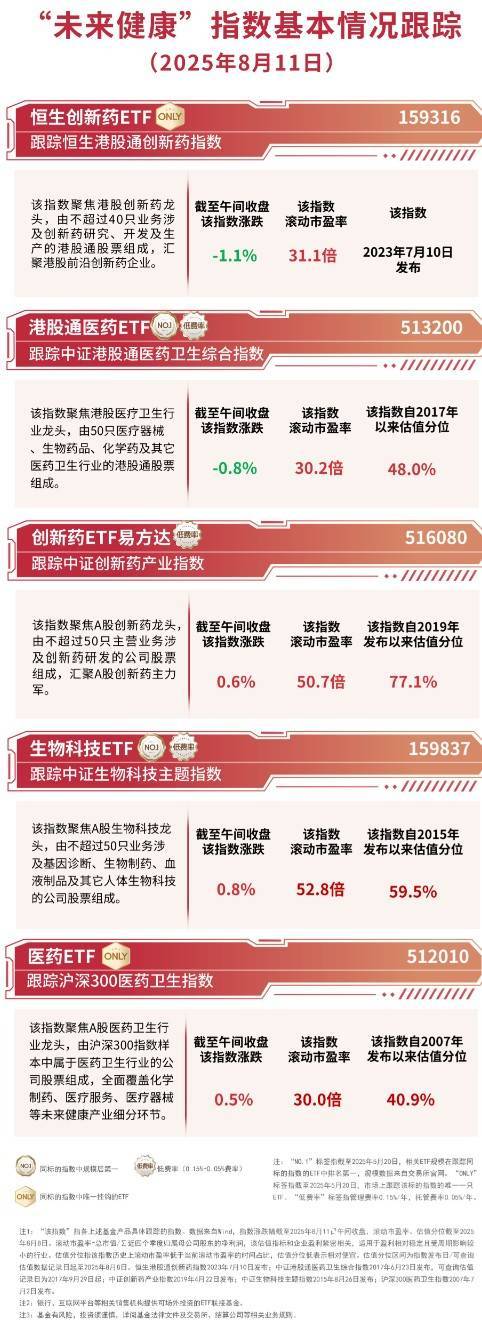
Group 1 - The Hang Seng Hong Kong Stock Connect Innovative Drug Index decreased by 1.1% at midday, while the CSI Hong Kong Stock Connect Pharmaceutical and Health Comprehensive Index fell by 0.8% [1] - The CSI Innovative Drug Industry Index rose by 0.6%, and the CSI Biotechnology Theme Index increased by 0.8%, with the CSI 300 Pharmaceutical and Health Index up by 0.5% [1] - The Hang Seng Hong Kong Stock Connect Innovative Drug Index has announced a revision to its compilation scheme, which officially took effect today [1] Group 2 - The revision explicitly excludes CXO companies, focusing solely on core innovative drug companies [1] - The revised Hang Seng Hong Kong Stock Connect Innovative Drug Index will be the first among ETF-tracked indices to achieve a "purity" level of 100% for innovative drug companies [1]

创新药十年蝶变,从跟跑到领跑,普通人的财富密码藏在哪?
Zheng Quan Shi Bao· 2025-08-10 23:59
Group 1 - The core viewpoint emphasizes that the investment value in innovative drugs is not a short-term pulse but a long-term industrial dividend, driven by technological breakthroughs, policy support, and capital recognition [1] - The National Index for Hong Kong Innovative Drugs and the China Securities Innovative Drug Industry Index have achieved significant year-to-date gains of 106.7% and 32.3% respectively as of July 31 [1] - The innovative drug industry in China has transformed from a "follower" to a "leader" over the past decade, with domestic innovations like IO dual antibodies and ADC drugs leading international trends [1][9] Group 2 - The recent adjustment of the Hong Kong Innovative Drug ETF (159567) to exclude CXO companies and increase sample adjustment frequency to quarterly aims to enhance the index's focus on core innovative drug enterprises [4] - The index now primarily includes biotech companies that directly lead drug development and hold core patents, reflecting their competitive products and advancements [4] - The adjustment is expected to improve the index's sensitivity to emerging growth forces within the innovative drug sector [4] Group 3 - The innovative drug industry is currently experiencing a "golden development period" supported by favorable policies, including a strategic goal to create a globally competitive innovation ecosystem [6][5] - Multiple government agencies have introduced supportive measures to optimize approval processes and facilitate financing for biotech companies, enhancing the overall industry environment [6][7] - By 2024, the expenditure on innovative drugs from the medical insurance fund is projected to be 3.9 times that of 2020, with an annual growth rate of 40% [7] Group 4 - The innovative drug sector is expected to see significant growth due to an aging population, with projections indicating that by the end of 2024, 15.6% of the population will be over 65 years old, leading to increased demand for innovative treatments [9] - The supply side is characterized by high technical barriers and a long development cycle, making quality innovative drugs relatively scarce and valuable [9][10] - China's innovative drugs currently account for less than 10% of the pharmaceutical market, indicating substantial room for growth compared to other G20 countries [10] Group 5 - The Hong Kong Innovative Drug ETF has achieved a year-to-date increase of 106.7%, leading the Hong Kong pharmaceutical sector [11] - The ETF focuses on biotech and pharmaceutical companies that are core to innovative drug development, ensuring high purity and precision in capturing industry growth [11] - The upcoming split of the Hong Kong Innovative Drug ETF on August 11 signifies the beginning of a long-term investment opportunity in the innovative drug sector [12]
创新药十年蝶变!从跟跑到领跑,普通人的财富密码藏在哪?
券商中国· 2025-08-10 23:30
Core Viewpoint - The investment value of innovative drugs is not a short-term pulse but a long-term industrial dividend, with optimal solutions for sharing this dividend through index tools in golden tracks [1] Group 1: Performance of Innovative Drug Indices - Since July, the National Index for Hong Kong Stock Connect Innovative Drugs and the China Securities Innovative Drug Industry Index have reached new highs, with year-to-date increases of 106.7% and 32.3% respectively as of July 31 [2] - The impressive performance of these indices reflects a decade-long transformation of China's innovative drug industry from "follower" to "leader" [2] - Recent inflows into ETFs tracking innovative drug indices have been significant, with a net inflow of 4.26 billion yuan from August 4 to August 8 and over 16 billion yuan since June [2] Group 2: Index Adjustments and Sensitivity - The recent upgrade of the Hong Kong Stock Innovative Drug Index aims to enhance its focus by excluding CXO companies and increasing adjustment frequency from semi-annual to quarterly, effective August 12 [3][4] - This adjustment allows the index to better capture the core drivers of the innovative drug industry, focusing on pharmaceutical companies that lead drug development and hold key patents [3] - The increased adjustment frequency enhances the index's sensitivity, enabling it to quickly identify emerging growth companies in a rapidly evolving market [4] Group 3: Policy Support for Innovative Drugs - The innovative drug industry has received significant policy support this year, with the State Council's 2025 strategic goal to create a globally competitive innovation ecosystem [5] - Multiple regulatory bodies have introduced supportive measures, including optimizing review processes and reopening IPO channels for unprofitable companies [6] - The 2024 medical insurance fund expenditure on innovative drugs is projected to be 3.9 times that of 2020, with an annual growth rate of 40% [7] Group 4: Market Dynamics and Future Outlook - By the end of 2024, China is expected to have 3,575 original innovative drugs in clinical trials, surpassing the U.S. and becoming the global leader [7] - The proportion of first-in-class (FIC) drugs has increased from less than 10% in 2015 to 24% in 2024, indicating a significant enhancement in original innovation capabilities [7] - The innovative drug market in China currently accounts for less than 10% of the total pharmaceutical market, indicating substantial growth potential compared to over 20% in other G20 countries [9] Group 5: Investment Opportunities in Innovative Drugs - The China Securities Innovative Drug Industry Index has shown a year-to-date increase of 32.3%, with significant upside potential remaining [8] - The long-term growth of the innovative drug market is supported by an aging population and increasing demand for treatments for chronic diseases and rare diseases [8] - Investing in ETFs that track the innovative drug sector provides a way to mitigate risks associated with individual stock investments while capitalizing on overall industry growth [9]





华丽家族(600503.SH)拟不超3亿元参与海和药物配股融资事项
智通财经网· 2025-08-10 22:21
Core Viewpoint - The company plans to invest up to 300 million yuan in Shanghai Haihe Pharmaceutical Research and Development Co., Ltd. through a share placement, indicating a strategic financial investment in the long-term potential of innovative drugs [1][2] Group 1: Investment Details - The company intends to subscribe for no more than 63,157,895 new shares of Haihe Pharmaceutical at a price of 4.75 yuan per share [1] - Post-investment, the company's shareholding in Haihe Pharmaceutical is expected to be between 5% and 8.09% [1] Group 2: Target Company Overview - Haihe Pharmaceutical focuses on the discovery, development, production, and commercialization of innovative drugs, particularly in the oncology field [1] - The company has developed over ten research pipelines, with three products already launched in China and Japan, and five products currently in clinical research [1] - Haihe Pharmaceutical's pipelines target various cancers and chronic diseases, aiming to meet unmet clinical needs [1] Group 3: Strategic Intent - The investment is aimed at ensuring stable operations of the main business while seeking reasonable financial returns and exploring opportunities in emerging industries [2]

创新药高位急刹,要熄火了?周末葛兰发声,时隔4年再限购!大V观点刷屏:“创新药或像过去10年新能源”、“2005年的房地产”……
雪球· 2025-08-10 07:19
Core Viewpoint - The innovative drug sector has experienced significant fluctuations, with recent adjustments raising questions about whether it is at a peak or still a primary growth line for the market [3][23]. Group 1: Market Performance and Adjustments - The Hong Kong innovative drug ETF saw declines of 3.05% and 1.33% on August 7 and 8, respectively, driven by multiple negative factors including disappointing mid-term earnings from some pharmaceutical companies and potential tariffs on imported drugs by Trump [4][10]. - Notable declines were observed in companies like Lee Ka Shing's Hutchison Whampoa, which saw its stock drop over 15% following a report of a 9.16% year-on-year revenue decline, despite a significant profit increase due to asset sales [5][7]. - The overall innovative drug sector has seen substantial gains this year, with many stocks doubling in value, leading to profit-taking and subsequent market corrections [10][12]. Group 2: Fund Management and Investment Strategies - The China Europe Medical Innovation Fund, managed by prominent fund manager Guo Lan, announced a purchase limit effective August 11, citing the need to ensure stable fund operations and protect investor interests [20][22]. - The fund has achieved a return of 62.28% this year and 80.12% over the past year, with its top ten holdings all in the innovative drug sector, reflecting strong performance across the board [22]. - Guo Lan remains optimistic about the innovative drug sector, highlighting the increasing global competitiveness of domestic companies and supportive domestic policies that enhance research and development [22]. Group 3: Diverging Opinions on Future Trends - Discussions among investors have intensified regarding whether the current innovative drug market is at a peak or if it will continue to grow, with some likening it to the real estate boom of 2005 [23][24]. - Some analysts argue that the current market dynamics are driven by fundamental improvements rather than speculative bubbles, suggesting a shift from broad market gains to selective stock performance [25][26]. - Caution is advised by several fund managers, who note that while the innovative drug sector has long-term potential, recent price increases may lead to inevitable corrections and volatility [26].

最牛板块,突然大跌!最新解读
Zhong Guo Ji Jin Bao· 2025-08-10 02:18
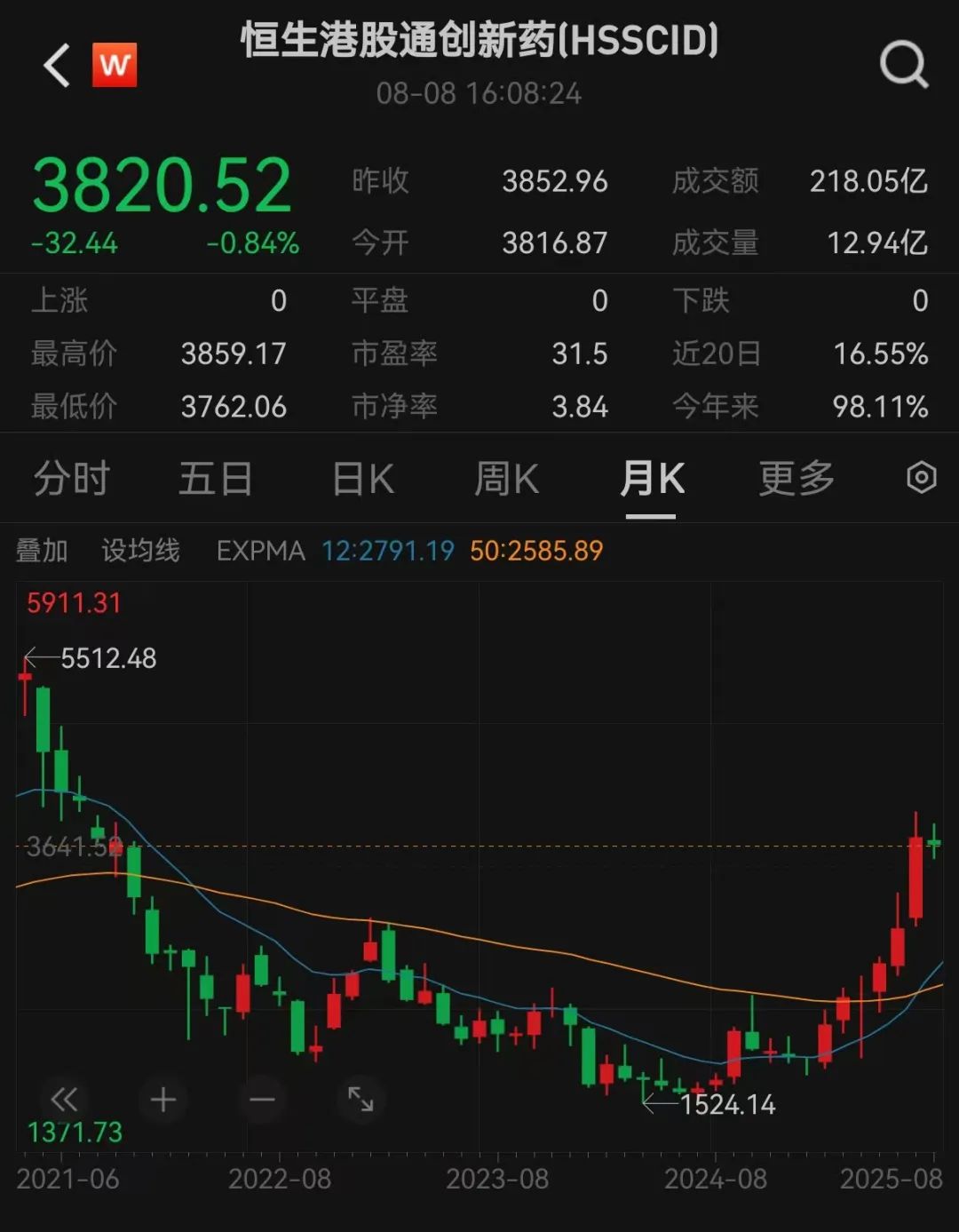
Core Viewpoint - The innovation drug sector has experienced significant growth in 2023, with the Hang Seng Innovation Drug Index rising over 98% year-to-date and more than 150% since its low in April 2022, indicating a strong market performance. However, recent adjustments have raised questions about potential bubbles and future performance in the sector [1][5][10]. Group 1: Current Market Performance - The Hang Seng Innovation Drug Index has increased over 98% year-to-date and more than 150% since April 2022, while the Wind Innovation Drug Index has risen over 46% in the same period [1]. - Recent adjustments began on July 30, with a maximum decline of -7.21% and a current adjustment of -6.25% [1][5]. - Fund managers believe that the current market for innovation drugs is experiencing a fundamental turning point, transitioning from a follower to a leader in the industry [5][10]. Group 2: Investment Opportunities and Risks - The investment value of innovation drugs remains promising, with a shift from broad market increases to selective stock picking expected [5][21]. - The current valuation of leading innovation drug companies in Hong Kong is still reasonable, with no signs of bubble formation, while some A-share companies may be overvalued due to speculative trading [12][13]. - The potential for profit in the innovation drug sector is substantial, with estimates suggesting future profits could reach 6000 to 7000 billion yuan, supporting a market capitalization of over 10 trillion yuan [18]. Group 3: Future Trends and Strategies - The innovation drug sector is expected to continue its growth trajectory, driven by unmet clinical needs and ongoing research and development [20][21]. - Investment strategies will focus on identifying companies with strong R&D capabilities and favorable competitive positions, while also considering valuation levels and risk-reward ratios [19][21]. - The overall market sentiment towards the pharmaceutical sector has improved, potentially benefiting related fields such as innovative medical devices and CRO services [23][24].
最牛板块,突然大跌!最新解读
中国基金报· 2025-08-10 02:08
Core Viewpoint - The innovation drug sector in China is experiencing a significant growth phase, transitioning from a follower to a leader in the industry, with a strong investment value outlook despite recent market adjustments [12][17][20]. Group 1: Market Performance and Adjustments - The Hang Seng Innovation Drug Index has seen a year-to-date increase of over 98% as of August 8, 2025, and a rise of more than 150% since the low in April of the previous year [2]. - The recent market adjustment began on July 30, with a maximum decline of -7.21%, currently at -6.25% [2][12]. - The A-share innovation drug companies have experienced significant price increases, but some may not have fundamental support, indicating potential valuation bubbles [12][21]. Group 2: Underlying Logic of Innovation Drug Market - The current growth in the innovation drug market is driven by two main factors: the previous undervaluation of the sector and the emergence of profitable products and positive earnings reports from many companies [14][15]. - The bottom-line logic supporting the innovation drug market remains unchanged, with ongoing growth in domestic healthcare market demand and the potential for global market expansion [14][17]. Group 3: Investment Value and Strategies - Long-term investment value in the innovation drug sector is still promising, with the industry expected to continue evolving and generating significant profits in the coming years [19][27]. - The investment strategy is shifting from broad market increases to selective stock picking, focusing on companies with strong fundamentals and competitive advantages [26][30]. - The potential profit for the entire innovation drug sector is estimated to be between 600 billion to 700 billion yuan, with future profits possibly reaching 6 trillion to 7 trillion yuan [27]. Group 4: Valuation Comparisons - As of August 7, 2025, the static valuation of the innovation drug index in A-shares is around 44 times, while the Hong Kong index is at 37 times, indicating that Hong Kong offers better investment value [21][22]. - Leading companies in the innovation drug sector have valuations around 3-4 times price-to-sales (P/S), suggesting that they have not yet entered a bubble phase [22][23]. Group 5: Future Opportunities in Related Sectors - The ongoing innovation drug market dynamics may lead to increased attention and investment in related sectors such as innovative medical devices and CRO services [32][33]. - The CXO sector is expected to benefit from the advancements in innovation drug development, with some leading companies reporting better-than-expected revenue and order situations [33].