
太空光伏

Search documents
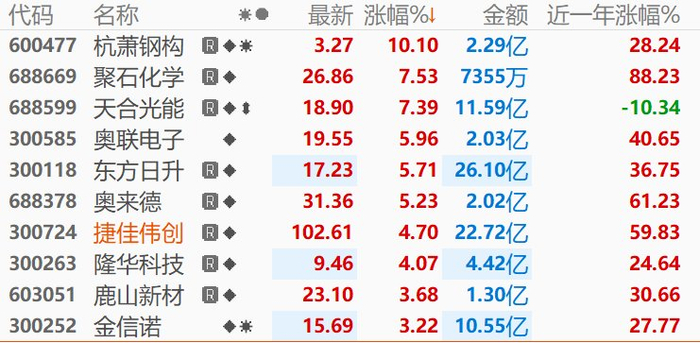
钙钛矿电池概念反复活跃,杭萧钢构涨停
Ge Long Hui A P P· 2026-01-08 05:35
| 代码 | 名称 | * ● | 最新 涨幅%↓ | | | 金额 近一年涨幅% | | --- | --- | --- | --- | --- | --- | --- | | 600477 | 杭萧钢构 圆�* | | 3.27 | 10.10 | 2.29 乙 | 28.24 | | 688669 | 聚石化学 | B ◆ | 26.86 | 7.53 | 7355 厂 | 88.23 | | 688599 | 天合光能 圆◆↑ | | 18.90 | | 7.39 11.59 乙 | -10.34 | | 300585 | 奥联电子 | � | 19.55 | 5.96 | 2.03 Z | 40.65 | | 300118 | 东方日升 圆◆ | | 17.23 | | 5.71 26.10 乙 | 36.75 | | 688378 奥来德 | | R ◆ | 31.36 | 5.23 | 2.02 Z | 61.23 | | 300724 | 捷佳伟创 圆◆ | | 102.61 | | 4.70 22.72 乙 | 59.83 | | 300263 | 隆华科技 ■◆ | | 9.46 | 4. ...


钙钛矿成太空光伏潜在"优选" 新能源公司敏锐布局抢占先机
Shang Hai Zheng Quan Bao· 2026-01-08 04:03
Core Viewpoint - JinkoSolar has signed a strategic cooperation agreement with Jingtai Technology to establish a joint venture focused on the research and development of AI-enabled high-throughput perovskite tandem solar cells, aiming for mass production within three years [1][2] Group 1: Strategic Collaboration - The partnership aims to create the world's first "AI decision-making - robotic execution - data feedback" closed-loop experimental line for perovskite-silicon tandem solar cells [1] - JinkoSolar's deep expertise in photovoltaic research combined with Jingtai Technology's strengths in quantum physics algorithms and AI predictive models will drive advancements in high-efficiency and high-stability perovskite tandem solar cells [1][2] Group 2: Market Potential and Applications - Perovskite tandem solar cells are expected to significantly reduce the levelized cost of electricity (LCOE) by approximately 15% compared to traditional technologies [2] - The lightweight, low-cost, and flexible characteristics of perovskite cells make them particularly suitable for space photovoltaic applications, potentially reducing the solar wing deployment area on satellites [2][6] Group 3: Industry Trends - There is a growing interest among photovoltaic companies in the potential applications of perovskite technology in space, with several firms, including JinkoSolar, Trina Solar, and others, exploring this area [3] - Companies like Renshou Energy and Xiexin Photovoltaic have conducted experiments on perovskite cells for space applications, indicating a shift towards more targeted development in this field [3][4] Group 4: Technical Advantages - Perovskite technology is recognized for its lightweight, thin, flexible, low-cost, high-efficiency, and radiation-resistant properties, making it a promising candidate for space photovoltaic applications [6] - The power-to-weight ratio and cost per watt are critical metrics for evaluating space photovoltaic products, with perovskite cells showing a maximum power-to-weight ratio of 50W/g compared to traditional silicon and gallium arsenide [6] Group 5: Future Development - The transition of perovskite technology to space applications will require rigorous testing and validation to meet the unique challenges posed by the space environment [8] - Companies are focusing on developing manufacturing capabilities that can meet the extreme conditions of space, including radiation resistance and extreme temperature variations [8]

太空光伏成为市场新风口!光伏ETF华夏(515370)上涨1.05%,光伏含量83.64%,指数维度全市场排名第一
Mei Ri Jing Ji Xin Wen· 2026-01-08 03:58
Group 1 - The core viewpoint of the article highlights the rising interest in space solar energy, particularly following Elon Musk's ambitious plan to deploy 100GW of solar AI satellites annually, which has brought renewed attention to this sector [1] - Major photovoltaic companies are actively discussing space solar energy, with JinkoSolar stating "this time, we go to space" and Trina Solar announcing plans to accelerate the commercialization of perovskite production in the new year [1] - Longjiang Securities' research report estimates that the space solar market corresponding to low Earth orbit satellites will reach approximately 29.5 billion yuan by 2030, indicating significant market potential for space computing [1] Group 2 - Musk's goal of deploying 100GW of data centers annually within 4 to 5 years corresponds to optimistic, neutral, and pessimistic scenarios for the photovoltaic market, projected at 2.38 trillion yuan, 1.33 trillion yuan, and 280 billion yuan respectively [1] - The Huaxia Photovoltaic ETF (515370) tracks the CSI Photovoltaic Industry Index, which includes upstream, midstream, and downstream companies in the photovoltaic industry, reflecting the overall performance of the sector [1] - The index has a photovoltaic content of 83.64%, ranking first in the entire market dimension [1]
钧达股份早盘涨超4% 与尚翼光电合作开发超轻量化、高抗辐照钙钛矿叠层电池产品
Xin Lang Cai Jing· 2026-01-08 02:43
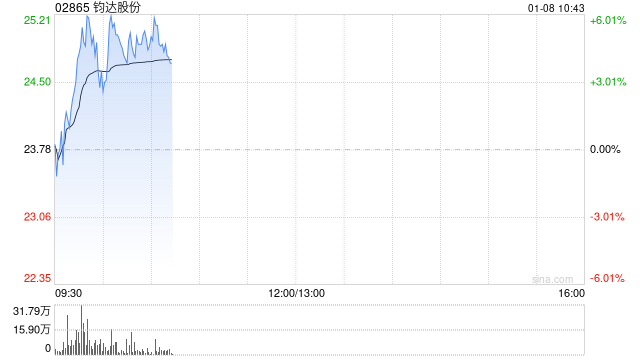
钧达股份(02865)早盘股价上涨4.54%,现报24.86港元,成交额1.11亿港元。 华金证券研究报告指出,据Research and Markets数据显示,2035年全球在轨数据中心市场将达390.9亿 美元(十年复合增长率67.4%),高能耗特性对"轻量化、高效率"能源的刚性需求,恰好与太空光伏的 技术优势深度契合。该行认为,细分环节机遇凸显,p型超薄HJT与钙钛矿光伏产品未来有增长潜力。 近日,东吴证券认为,商业航天+低轨卫星加速发展背景下,太空光伏供能最优,或有望迎来高速发 展。地面高效钙钛矿/晶硅叠层技术是关键支撑。国海证券认为,随商业航天产业化进程加速,太空产 业有望快速发展,产业链相关公司有望迎业绩、估值的同步提升。 责任编辑:卢昱君 责任编辑:卢昱君 客户端 热点栏目 自选股 数据中心 行情中心 资金流向 模拟交易 客户端 钧达股份(02865)早盘股价上涨4.54%,现报24.86港元,成交额1.11亿港元。 华金证券研究报告指出,据Research and Markets数据显示,2035年全球在轨数据中心市场将达390.9亿 美元(十年复合增长率67.4%),高能耗特性对"轻量化、 ...

钧达股份盘中涨超3% 与尚翼光电合作开发超轻量化、高抗辐照钙钛矿叠层电池产品
Zhi Tong Cai Jing· 2026-01-08 02:09
此前,钧达股份以战略股东身份投资尚翼光电,双方围绕钙钛矿电池在太空能源的应用,在技术研发、 在轨验证、产业化落地及场景拓展等方面建立协同机制,开拓国内及北美商业航天与太空算力市场。双 方针对低轨卫星、太空算力等场景需求,开发超轻量化、高抗辐照的钙钛矿叠层电池产品,推进地面测 试与在轨试验,计划2025年完成关键在轨试验,2026年实现规模化供应,后续还将推动产品列装中国卫 星(600118)体系,逐步实现商业化交付。 钧达股份(002865)(02865)盘中涨超3%,截至发稿,涨3.03%,报24.44港元,成交额6954.99万港元。 消息面上,华金证券研究报告指出,据Research and Markets数据显示,2035年全球在轨数据中心市场将 达390.9亿美元(十年复合增长率67.4%),高能耗特性对"轻量化、高效率"能源的刚性需求,恰好与太空 光伏的技术优势深度契合。该行认为,细分环节机遇凸显,p型超薄HJT与钙钛矿光伏产品未来有增长 潜力。 ...
港股异动 | 钧达股份(02865)盘中涨超3% 与尚翼光电合作开发超轻量化、高抗辐照钙钛矿叠层电池产品
智通财经网· 2026-01-08 02:06
消息面上,华金证券研究报告指出,据Research and Markets数据显示,2035年全球在轨数据中心市场将 达390.9亿美元(十年复合增长率67.4%),高能耗特性对"轻量化、高效率"能源的刚性需求,恰好与太空 光伏的技术优势深度契合。该行认为,细分环节机遇凸显,p型超薄HJT与钙钛矿光伏产品未来有增长 潜力。 此前,钧达股份以战略股东身份投资尚翼光电,双方围绕钙钛矿电池在太空能源的应用,在技术研发、 在轨验证、产业化落地及场景拓展等方面建立协同机制,开拓国内及北美商业航天与太空算力市场。双 方针对低轨卫星、太空算力等场景需求,开发超轻量化、高抗辐照的钙钛矿叠层电池产品,推进地面测 试与在轨试验,计划2025年完成关键在轨试验,2026 年实现规模化供应,后续还将推动产品列装中国 卫星体系,逐步实现商业化交付。 智通财经APP获悉,钧达股份(02865)盘中涨超3%,截至发稿,涨3.03%,报24.44港元,成交额6954.99 万港元。 ...
商业航天崛起,关注轻量化高效太空光伏技术
Zhong Guo Neng Yuan Wang· 2026-01-08 01:07
Core Insights - The report highlights the rapid development of space computing and solar energy technologies, with significant milestones achieved in 2023, including the launch of China's first space computing constellation and plans for large-scale solar-powered AI satellites [1][3]. Group 1: Space Computing Developments - In May 2023, China launched the world's first space computing constellation, marking a significant advancement in space technology [1][3]. - SpaceX delivered NVIDIA's H100 GPU to space in December 2023, indicating a growing interest in integrating advanced computing capabilities into space applications [1][3]. - Elon Musk announced plans to send 100 gigawatts of solar-powered AI satellites into orbit annually, showcasing a feasible technological pathway for future space energy solutions [1][3]. Group 2: Solar Energy Initiatives - Beijing proposed the construction of a space data center with over 1,000 megawatts of power in the 700-800 km dawn-dusk orbit, outlining a strategic plan from 2025 to 2035 [1][3]. - ResearchandMarkets projects that the global in-orbit data center market will reach $39.09 billion by 2035, with a compound annual growth rate (CAGR) of 67.4% [3]. - The high energy consumption characteristics of space computing create a rigid demand for lightweight and efficient energy solutions, aligning well with the advantages of space photovoltaics [3]. Group 3: Technological Innovations in Solar Cells - The report emphasizes the advantages of P-type ultra-thin HJT (Heterojunction Technology) solar cells, which can reduce launch payloads and save fuel in cost-sensitive applications like low Earth orbit satellites [2][5]. - The collaboration between Aerospace Hongtu and Zhongneng Energy Storage to develop new energy technologies for space computing marks a significant step in the commercialization of flexible perovskite photovoltaics [2][3]. - Perovskite solar cells are breaking traditional limitations in space photovoltaics, with their lightweight and high-efficiency characteristics making them suitable for space computing needs [6][7]. Group 4: Market Opportunities and Recommendations - The increasing number of satellites and demand for in-orbit data create opportunities in the solar energy sector, particularly for P-type ultra-thin HJT and perovskite photovoltaic products [8]. - Companies such as Dongfang Risen, Aerospace Hongtu, and GCL-Poly are recommended for tracking due to their potential growth in new technologies and applications [8]. - The report suggests monitoring the progress of related supply chain companies benefiting from the expansion of space computing and commercial aerospace scenarios [8].

全球能源竞争 太空光伏技术能飞多高?
Jing Ji Ri Bao· 2026-01-08 01:01
Core Viewpoint - The article discusses the emerging focus on space photovoltaic technology, highlighting its potential to meet the energy demands of future space exploration and artificial intelligence applications, as well as the strategic importance of this technology for energy security and technological advancement [2][4]. Group 1: Space Photovoltaic Technology Overview - Space photovoltaic refers to solar power systems installed on spacecraft or satellites, which can provide continuous energy supply by harnessing solar energy in space and transmitting it back to Earth [2]. - The technology has historical roots, with its first applications in aerospace due to high costs, and has evolved to become a critical component in modern space missions [2][3]. Group 2: Advantages of Space Photovoltaic - Space photovoltaic systems can generate energy without the limitations of weather and day-night cycles, offering a more efficient and stable power source compared to ground-based solar systems [3]. - The theoretical efficiency of space photovoltaic systems is significantly higher than that of terrestrial systems, making them essential for supporting deep space exploration and artificial intelligence computing needs [3]. Group 3: Challenges Facing Space Photovoltaic - The technology faces significant challenges, including the need for materials that can withstand extreme space conditions, high deployment and maintenance costs, and an immature supply chain for space-grade photovoltaic components [3][4]. - There is also a need for advancements in wireless energy transmission efficiency and precision for future energy transfer from space to Earth [3]. Group 4: Strategic Importance and Future Development - Space photovoltaic technology holds the potential to transform global energy supply structures and contribute to carbon neutrality goals, thereby enhancing national energy security [4]. - The development of this technology could drive innovations in various fields, including lightweight materials and robotics, creating a positive feedback loop that promotes industrial upgrades [4]. - Countries are increasingly recognizing the importance of space resource development, making early investments in space photovoltaic infrastructure crucial for future economic competition [4][5]. Group 5: Development Pathway - The commercialization of space photovoltaic technology is expected to be a gradual process, starting with energy supply for specific space facilities, progressing to support low Earth orbit satellite constellations, and eventually enabling large-scale energy transmission to Earth [5]. - For China, leveraging institutional advantages and fostering collaboration between public and private sectors in the photovoltaic and aerospace industries is essential for overcoming technical challenges and achieving breakthroughs [5].

中经评论:太空光伏能飞多高
Jing Ji Ri Bao· 2026-01-08 00:06
全球能源竞争的赛场,正从地球表面延伸至浩瀚星空。近期,美国企业家埃隆·马斯克公开表示, 计划未来每年向太空部署1亿千瓦太阳能人工智能卫星能源网络。在太平洋的这一侧,晶科能源和天合 光能两家中国光伏龙头企业,先后在新年致辞中将太空光伏列为重要发展方向。什么是太空光伏?为何 太空光伏会成为头部企业前瞻布局的焦点? 太空光伏面临的挑战也很突出。首先,极端环境适应性要求高,太空环境中无大气层保护,虽然避 免了困扰光伏组件的水氧侵蚀,但太空辐射强、温差大,太空极端环境下的材料可靠性仍需提升。其 次,设备成本居高不下,远超地面光伏电站,大规模太空光伏电站在轨部署、长期维护成本依旧高昂。 再次,产业链配套尚未成熟,新一代光伏电池的地面应用尚未实现规模化放量,航天级定制化产能和供 应链配套缺失。如果考虑未来对地传输能量,还需提高无线能量传输效率和控制精度。 挑战虽多,却无法掩盖太空光伏的深远战略价值。从能源安全看,太空光伏蕴含巨大清洁能源潜 力,若实现规模化对地供电,将彻底改变地球能源供给结构,为碳中和目标提供全新方案,筑牢国家能 源安全新防线;从科技牵引看,太空光伏研发攻关,将倒逼超轻新材料、无线能量传输、航天制造、在 轨 ...
太空光伏能飞多高
Jing Ji Ri Bao· 2026-01-07 21:07
Core Insights - The article discusses the emerging focus on space photovoltaic technology, driven by the need for sustainable energy solutions in space and the increasing energy demands of artificial intelligence [1][3] Group 1: Space Photovoltaic Technology - Space photovoltaic refers to solar power systems installed on spacecraft or satellites, which can gather solar energy in space and potentially transmit it back to Earth [1] - The technology has gained renewed attention due to its ability to provide continuous energy supply, overcoming the limitations of ground-based solar power [2] - Space photovoltaic systems can achieve higher efficiency and reliability compared to terrestrial systems, making them crucial for future space exploration and AI energy needs [2] Group 2: Challenges and Strategic Value - Despite its potential, space photovoltaic technology faces significant challenges, including high costs, extreme environmental conditions, and an immature supply chain [2][3] - The strategic value of space photovoltaic lies in its potential to enhance energy security, drive technological advancements, and position countries competitively in the space economy [3] - The development of space photovoltaic is seen as a gradual process, starting with specific applications in satellites and space stations, and eventually leading to large-scale energy transmission to Earth [3] Group 3: China's Development Strategy - China is encouraged to leverage its institutional advantages to promote collaboration across photovoltaic and aerospace sectors, focusing on breakthroughs in core technologies [4] - The strategy emphasizes the importance of cooperation between state-owned enterprises and private companies to create an efficient industrial ecosystem [4] - Active participation in international regulations and promoting peaceful use of space resources are also highlighted as essential for the development of space photovoltaic technology [4]