
不良贷款率

Search documents
上市城商行2024不良率榜:哈尔滨银行2.84%蝉联第一
Zhong Guo Jing Ji Wang· 2025-05-08 07:47
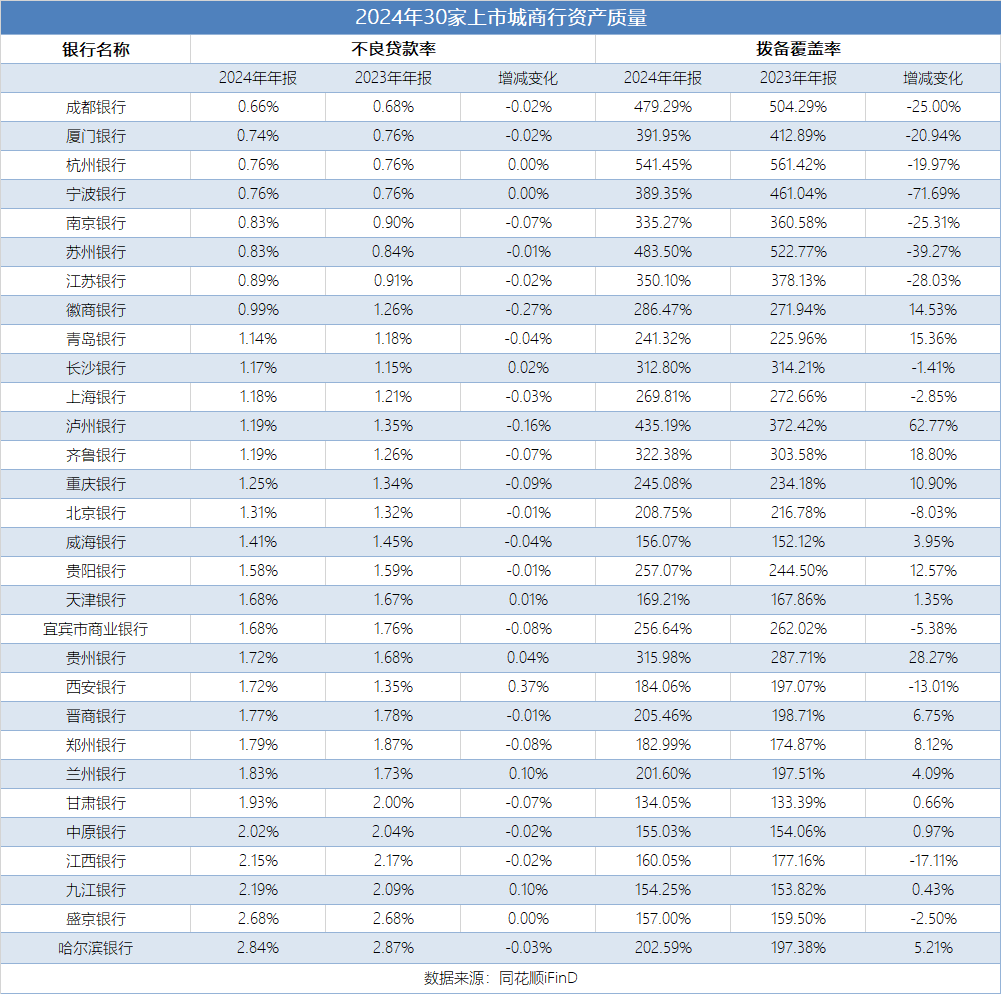
Core Insights - The report highlights the performance of 30 A-share and H-share listed city commercial banks in terms of non-performing loan (NPL) ratios for the year 2024, with Harbin Bank having the highest NPL ratio at 2.84% [1][2] - Chengdu Bank recorded the lowest NPL ratio at 0.66%, showing a slight decrease from the previous year [1][2] - Overall, 20 city commercial banks saw a decrease in their NPL ratios, while 5 banks experienced an increase, and 5 banks maintained the same ratio compared to the previous year [1] NPL Ratio Summary - Harbin Bank: NPL ratio of 2.84%, down from 2.87% in 2023 [2] - Chengdu Bank: NPL ratio of 0.66%, down by 0.02 percentage points from 0.68% in 2023 [2] - Other banks with NPL ratios below 1% include Xiamen Bank, Ningbo Bank, Hangzhou Bank, Nanjing Bank, Suzhou Bank, Jiangsu Bank, and Huishang Bank [1][2] - Notable increases in NPL ratios were observed in Jiujiang Bank (up 0.10 percentage points) and West Xi'an Bank (up 0.37 percentage points) [2] - The majority of banks, 20 out of 30, reported a decrease in NPL ratios, indicating an overall improvement in asset quality within the sector [1]
上市城商行排行榜(一):资产质量篇——谁在稳健前行,谁在踩雷边缘?
Sou Hu Cai Jing· 2025-05-08 02:05
Core Viewpoint - The asset quality data of 30 listed city commercial banks in 2024 shows significant divergence, with varying non-performing loan (NPL) ratios and provision coverage ratios reflecting different operational strategies and regional economic impacts [1][3][5]. Non-Performing Loan Ratios - Chengdu Bank has the lowest NPL ratio at 0.66%, continuing a three-year improvement trend, while Harbin Bank has the highest at 2.84% [1][3]. - The first tier of banks, including Chengdu, Xiamen, Hangzhou, Ningbo, Nanjing, and Suzhou, all maintain NPL ratios below 1% [3]. - The second tier consists of 17 banks with NPL ratios between 1% and 2%, indicating manageable risk levels despite narrowing net interest margins [3]. - The tail end, including Harbin Bank and Shengjing Bank, shows NPL ratios exceeding 2%, with Harbin Bank slightly decreasing from 2.89% in 2022 to 2.84% in 2024 [3][4]. Provision Coverage Ratios - Hangzhou Bank leads with a provision coverage ratio of 541.45%, significantly above the regulatory requirement of 150%, despite a decline from its peak [4]. - Suzhou Bank and Chengdu Bank follow with coverage ratios of 483.50% and 479.29%, respectively, forming a quality defense line in the Yangtze River Delta and Chengdu-Chongqing regions [4]. - A middle tier of 14 banks has coverage ratios between 200% and 400%, indicating basic coverage of regional economic risks, but some banks show signs of accelerated provision consumption [4]. Regional Economic Impact - The asset quality is closely linked to regional economic vitality, with the Chengdu-Chongqing economic circle providing unique advantages for Chengdu Bank, which saw a 21% year-on-year increase in infrastructure loans [5][6]. - The Yangtze River Delta shows a mixed performance, with Hangzhou and Ningbo maintaining low NPL ratios due to strengths in digital economy and advanced manufacturing [6]. - The Northeast region faces significant pressure, exemplified by Harbin Bank's high NPL ratio, while Qingdao Bank benefits from the marine economy transformation, keeping its NPL ratio at 1.14% [6].


贵阳银行2024年净利润下滑7.16% 拟10派2.9元
Xi Niu Cai Jing· 2025-05-07 07:02
Core Viewpoint - Guiyang Bank reported a decline in both operating income and net profit for the year 2024, indicating challenges in its financial performance compared to previous years [2][3]. Financial Performance - In 2024, Guiyang Bank achieved operating income of 14.93 billion yuan, a decrease of 1.09% year-on-year from 15.10 billion yuan in 2023 [3]. - The net profit attributable to shareholders was 5.16 billion yuan, down 7.16% from 5.56 billion yuan in the previous year [3]. - The bank's operating profit fell to 5.42 billion yuan, reflecting an 8.98% decline compared to 5.96 billion yuan in 2023 [3]. - Total profit for the year was 5.43 billion yuan, a decrease of 9.27% from 5.99 billion yuan in 2023 [3]. - For Q1 2025, the bank reported operating income of 3.03 billion yuan, a significant drop of 16.91% year-on-year, and a net profit of 1.44 billion yuan, down 6.82% [2][3]. Asset and Loan Growth - As of the end of 2024, Guiyang Bank's total assets reached 705.67 billion yuan, an increase of 17.60 billion yuan or 2.56% from the beginning of the year [4]. - The total loan amount was 339.14 billion yuan, up 15.10 billion yuan or 4.66% year-on-year [4]. - Total deposits increased to 419.21 billion yuan, reflecting a growth of 18.99 billion yuan or 4.74% from the start of the year [4]. - The non-performing loan ratio stood at 1.58%, a slight decrease of 0.01 percentage points from the beginning of the year [4]. Investment and Risk Management - Financial investments amounted to 287.71 billion yuan, an increase of 18.21 billion yuan or 6.76% year-on-year [4]. - The bank's debt investment decreased by 7.84 billion yuan to 131.80 billion yuan, a decline of 5.62% compared to the previous year, primarily due to a reduction in non-standard asset scale [4]. - Provisions for debt investment impairment increased by 1.72 billion yuan, indicating a deterioration in the risk quality of existing non-performing assets [4]. Customer Complaints - In 2024, Guiyang Bank received a total of 3,882 customer complaints, a reduction of 915 complaints or 19.07% compared to 2023 [5]. - Complaints related to card services accounted for 2,380 cases, representing 61.28% of total complaints, with a year-on-year decrease of 21.4% [5]. - Complaints regarding intermediary services and loan services also saw significant reductions, with decreases of 35.59% and 14.25% respectively [5].

招商银行(600036):利息、财富收入正增,存款成本改善
Changjiang Securities· 2025-05-07 02:44
Investment Rating - The investment rating for the company is "Buy" and is maintained [9]. Core Views - The company's revenue in Q1 2025 decreased by 3.1% year-on-year, while net profit attributable to shareholders fell by 2.1%. However, net interest income increased by 1.9%, and non-interest income grew by 10.6%, with wealth management fee income being a key highlight, growing by 10.5% [2][6]. - The cost of liabilities is declining, with the deposit interest rate decreasing to 1.29% in Q1, reinforcing the company's core advantage of low funding costs [2][6]. - The non-performing loan (NPL) ratio decreased by 1 basis point to 0.94% at the end of Q1, and the provision coverage ratio fell by 2 percentage points to 410% [2][6]. - The new NPL generation rate for Q1 was 1.00%, down by 5 basis points compared to the full year of 2024, primarily due to a significant decline in corporate NPL generation [2][6]. - The core Tier 1 capital adequacy ratio remains the highest in the industry, indicating solid internal growth advantages and significant investment value [2][6]. Summary by Sections Performance - The company's Q1 net interest income growth turned positive, supported by a low base from the previous year and a smaller-than-expected decline in interest margins. Non-interest income decreased by 10.6%, with a 2.5% drop in middle-income sources [12]. - The profit aspect showed a reduction in credit impairment provisions year-on-year, although the cost-to-income ratio and tax rate increased slightly [12]. Scale - Corporate lending drove growth, with loans increasing by 3.4% compared to the beginning of the period, mainly due to a 6.5% increase in corporate loans and a 9.8% rise in bills. Retail loan growth was slower at 0.4% due to a contraction in credit card loans [12]. - Deposits grew by 2.5%, with the proportion of demand deposits remaining stable at 50.5% of the average daily balance in Q1, up 0.1 percentage points from the full year of 2024 [12]. Interest Margin - The net interest margin stood at 1.91%, with a quarterly decline of 3 basis points, which is better than the expected decline of 7 basis points for the full year of 2024. The absolute level of interest margin remains advantageous compared to other large banks [12]. - The loan yield was 3.53%, down 17 basis points, reflecting the impact of repricing and lower rates on new loans [12]. Non-Interest Income - Non-interest income saw a decline of 10.6%, with middle-income sources down by 2.5%. However, wealth management fee income turned positive, growing by 10.5% in Q1, with significant increases in sales of mutual funds and trusts [12]. Asset Quality - The NPL ratio and new NPL generation rate showed improvement, with the new generation rate at 1.00%, down from the previous year. The corporate NPL generation decreased significantly, while retail NPL generation is still on the rise [12]. - The NPL ratio for real estate corporate loans was 4.79%, showing a slight increase but remaining stable overall [12]. Investment Recommendation - The company has a strong capital position with no dilution pressure from refinancing. The core Tier 1 capital adequacy ratio remains stable at 14.9%, the highest in the industry. The expected dividend payout ratio for 2024 is 35% [12]. - The decline in Q1 performance was mainly due to investment income, while core business revenues from interest and wealth management showed positive growth. The company is expected to maintain positive profit and dividend growth for the year [12].

上市银行2025Q1业绩综述:投资支撑营收,息差降幅收窄
NORTHEAST SECURITIES· 2025-05-06 09:49
Investment Rating - The report rates the banking industry as "Outperforming the Market" [7]. Core Insights - In Q1 2025, the total operating revenue of 42 listed banks was 1.45 trillion yuan, a year-on-year decrease of 1.72%. The net profit attributable to shareholders was 563.98 billion yuan, down 1.20% year-on-year [2][15]. - Investment income saw rapid growth, accounting for a significant portion of revenue. In Q1 2025, interest income, commission income, and investment income were 1.02 trillion yuan (down 1.65% YoY), 230 billion yuan (down 0.72% YoY), and 170 billion yuan (up 26.10% YoY), respectively [2][15]. - The reduction in provision for asset impairment losses helped to release profits, with total asset impairment losses at 347.13 billion yuan, down 2.37% YoY [2][15]. Summary by Sections Revenue and Profitability - The operating revenue of listed banks decreased by 1.72% YoY, while net profit fell by 1.20% YoY, indicating a slight decline in overall profitability [2][15]. - Investment income increased significantly, contributing 11.62% to total revenue, up 2.56 percentage points from the previous year [2][15]. Loan and Deposit Growth - As of the end of Q1 2025, the total loan and advance amount reached 174.13 trillion yuan, growing by 7.92% YoY, with a slight deceleration in growth rate [3]. - The deposit scale also showed improvement, with a total of 212.38 trillion yuan, reflecting a 6.21% YoY increase [4]. Interest Margin and Asset Quality - The average net interest margin for listed banks was 1.55%, with a year-on-year decline of 0.09 percentage points, although the rate of decline has narrowed [5]. - The average non-performing loan ratio remained stable at 1.16%, while the provision coverage ratio decreased by 7.87 percentage points [5]. Capital Adequacy - As of the end of Q1 2025, the average core tier 1 capital adequacy ratio was 10.35%, showing a slight decline from the previous year [5]. Investment Recommendations - The report suggests that the core factors supporting the stable performance of the banking sector in 2024 and Q1 2025 include increased investment income and reduced provision for losses, indicating resilience in sector profits. Recommended stocks include Chongqing Bank, Yunnan Rural Commercial Bank, Shanghai Bank, and Shanghai Rural Commercial Bank [6].
北部湾银行2024年营收净利双增 不良率持续上行压力初步缓解
2 1 Shi Ji Jing Ji Bao Dao· 2025-05-06 03:28
Core Viewpoint - Guangxi Beibu Gulf Bank has reported a resilient performance in its 2024 annual report, overcoming economic challenges and maintaining double-digit growth in key operational metrics [1] Financial Performance - As of the reporting period, the total assets of the bank reached 520.37 billion yuan, an increase of 49.24 billion yuan, or 10.45% year-on-year [1] - The loan balance stood at 296.52 billion yuan, reflecting a year-on-year increase of 12.84% [1] - Total deposits amounted to 384.23 billion yuan, up 11.40% year-on-year [1] - The bank achieved total operating revenue of 22.11 billion yuan, a year-on-year increase of 2.81% [1] - Net profit reached 3.11 billion yuan, marking a 7.02% increase year-on-year [1] Interest and Non-Interest Income - The net interest income for 2024 was 6.88 billion yuan, showing a slight decrease of 0.01% year-on-year [2] - The net interest margin was 1.67%, down 0.17 percentage points year-on-year [1] - Non-interest income grew significantly, with a year-on-year increase of 4.04 billion yuan, or 13.63% [2] - Investment income rose from 2.40 billion yuan in 2023 to 3.06 billion yuan in 2024, a growth of 27.80% [2] Asset Quality and Risk Management - The non-performing loan (NPL) ratio was stable at 1.43% for 2024, unchanged from 2023 [4] - The bank has been actively managing credit risk through various measures, including debt collection and asset disposal [5] - As of mid-2024, the bank's securities investment assets totaled 172.68 billion yuan, accounting for 34.11% of total assets [3] Management and IPO Progress - The bank has seen leadership changes, with new appointments in key positions aimed at driving the bank's IPO efforts [5] - The bank announced plans for an initial public offering (IPO) in 2023, with ongoing preparations despite not yet completing the listing guidance [5]
股份行2024不良率榜:恒丰降幅居首 致2银行排名升1位
Zhong Guo Jing Ji Wang· 2025-05-06 01:02
中国经济网北京5月6日讯目前,我国12家全国性股份制商业银行2024年度业绩报告已全部披露完毕。从 不良贷款率表现来看,截至2024年末,渤海银行不良贷款率1.76%,在股份行中最高。华夏银行 (600015)、广发银行的不良贷款率分别为1.60%、1.53%,排在第二、三名,均较2023年末上升一个 名次。招商银行(600036)的不良贷款率最低,为0.95%。 截至2024年末,渤海银行、华夏银行、广发银行、恒丰银行、民生银行(600016)、浙商银行 (601916)、浦发银行(600000)、中信银行(601998)的不良贷款率均较2023年末有所下降,其中恒 丰银行下降0.23个百分点,降幅居首。光大银行(601818)、兴业银行(601166)、平安银行 (000001)、招商银行的不良贷款率与2023年末持平。 银行名称 2024年末不良贷款率 2023年末不良贷款率 2024年末较2023年末变动 | 渤海银行 | 1.76% | 1.78% | 下降0.02个百分点 | | --- | --- | --- | --- | | 华夏银行 | 1.60% | 1.67% | 下降0.07个百分点 ...





招商银行(600036)2025年一季报点评:归母净利润同比小幅下滑 存款成本继续优化
Xin Lang Cai Jing· 2025-05-06 00:25
Core Viewpoint - In Q1 2025, China Merchants Bank reported a decline in both operating income and net profit, indicating a slowdown in performance compared to the previous year [1][2]. Financial Performance - In Q1 2025, the bank achieved operating income of 83.751 billion yuan, a year-on-year decrease of 3.09%, with the decline rate widening by 2.61 percentage points compared to 2024 [1][2]. - The net profit attributable to shareholders was 37.286 billion yuan, down 2.08% year-on-year, with a decline of 3.3 percentage points compared to 2024 [1][2]. - The average return on total assets and average return on equity were 1.21% and 14.13%, respectively, both showing year-on-year declines of 0.14 percentage points and 1.95 percentage points [2]. Revenue Structure - Net interest income for Q1 2025 was 52.996 billion yuan, reflecting a year-on-year growth of 1.92%, continuing the growth trend from Q4 2024 [2]. - Net fee and commission income was 19.696 billion yuan, down 2.51% year-on-year, with wealth management fees increasing by 10.45% [2]. - The revenue from agency wealth management surged by 39.47% due to growth in agency scale and product structure optimization, while agency insurance income continued to decline due to falling insurance sales [2]. - Other net income was 11.059 billion yuan, down 22.19% year-on-year, primarily impacted by rising market interest rates leading to a decrease in the fair value of bond and fund investments [2]. Cost Management - The net interest margin for Q1 2025 was 1.91%, down 11 basis points year-on-year and 3 basis points quarter-on-quarter, with the decline rate narrowing [3]. - The deposit cost rate decreased by 34 basis points year-on-year to 1.29%, positively affecting the net interest margin due to lower deposit rates and regulatory restrictions on high-interest deposit solicitation [3]. Asset Quality - As of the end of Q1 2025, the non-performing loan ratio was 0.94%, a slight improvement of 0.01 percentage points from the end of the previous year [3]. - The non-performing loan ratio for corporate loans improved to 0.95%, while the retail loan non-performing ratio increased to 1.01%, indicating ongoing pressure on retail loan asset quality [3]. - The provision coverage ratio was 410.03%, down 1.95 percentage points from the end of the previous year [3]. Investment Outlook - The bank maintains a "buy" rating, with a dividend payout ratio exceeding 30% and a projected cash dividend of 2 yuan per share for 2024, resulting in a dividend yield of 4.91% based on the closing price on April 30 [4]. - The estimated net asset value per share for 2025 is 45.25 yuan, with the current stock price corresponding to a price-to-book ratio of 0.90 times [4].
建设银行:资负规模积极扩张,质量稳健-20250502
Tianfeng Securities· 2025-05-02 02:23
公司报告 | 季报点评 建设银行(601939) 证券研究报告 资负规模积极扩张,质量稳健 事件: 建设银行发布 2025 年一季度财报。公司实现营收约 1901 亿元, YoY-5.40%;归母净利润 834 亿元,YoY-3.99%;不良率 1.33%,拨 备覆盖率 237%。 点评: 2025 年一季度,建设银行营收 1901 亿元(YoY-5.40%),其中净利息 收入 1419 亿元(YoY-5.21%),占营收比重 74.7%;非息收入 481 亿 元,同比下降 5.96%。拨备前利润、归母净利润分别同比-5.81%、-3.99%。 非息收入方面。2025 年一季度,公司手续费及佣金收入 375 亿元,同比 -4.63%,较 2024 年末改善 4.72pct。另外,投资净收益依旧亮眼,一季 度营收 43 亿元,同比增长 145.83%。 2025 年一季度,建设银行净息差录得 1.41%,环比下行 10bp,同比 -16bp。结合 2024 年底公司生息资产收益率和计息负债成本率来看,因 2024 年 LPR 多次调整,新年存量贷款重定价可能是公司 2025 第一季度 净息差下行的主要原因。另外 ...

建设银行(601939):资负规模积极扩张,质量稳健
Tianfeng Securities· 2025-05-01 12:50
资产端: 2025 年一季度建设银行生息资产总计 41.93 万亿元,同比增长 7.8%。其中,信贷投放和金融投资依旧是企业规模增长的主要动能,2025 一季度分别同比增长 8.0%、14.4%,环比增长 4.5%、5.8%;另外同业 资产环比高增 17.4%。生息资产结构上,贷款、金融投资、同业及拆放、 存放央行分别较 2024 年末变动-0.58、+0.08、+0.41、+0.09pct。 公司报告 | 季报点评 建设银行(601939) 证券研究报告 资负规模积极扩张,质量稳健 事件: 建设银行发布 2025 年一季度财报。公司实现营收约 1901 亿元, YoY-5.40%;归母净利润 834 亿元,YoY-3.99%;不良率 1.33%,拨 备覆盖率 237%。 点评: 2025 年一季度,建设银行营收 1901 亿元(YoY-5.40%),其中净利息 收入 1419 亿元(YoY-5.21%),占营收比重 74.7%;非息收入 481 亿 元,同比下降 5.96%。拨备前利润、归母净利润分别同比-5.81%、-3.99%。 非息收入方面。2025 年一季度,公司手续费及佣金收入 375 亿元,同比 ...