
全球变暖

Search documents
生菜涨价300%!极端天气冲击全球菜单
Guo Ji Jin Rong Bao· 2025-07-22 07:13
Core Insights - Extreme weather events have significantly impacted global food prices, with notable increases such as a 300% rise in Australian lettuce prices and an 80% increase in U.S. vegetable prices [1][2] - The report warns that unprecedented extreme weather conditions will become more common, surpassing the adaptability of current agricultural and economic systems [1] Food Price Increases - California has experienced its driest three years on record, leading to nearly 1 million acres of farmland left uncultivated, resulting in initial revenue losses of nearly $2 billion for vegetable crops [1] - Arizona faced water shortages due to drought in the Colorado River basin, contributing to significant vegetable price increases in the U.S. [1] - In South Korea, vegetable prices surged nearly 70% due to widespread high temperatures, prompting the government to utilize national reserves [2] - Australia experienced record floods, leading to lettuce prices soaring to approximately 12 AUD (about 7.81 USD) from around 2.80 AUD, marking a rise of over 300% [2] Climate Change and Agricultural Sensitivity - Not all agricultural products are equally sensitive to climate risks; coffee and beef prices have been rising due to specific production conditions, while more adaptable crops like corn have not seen similar price increases [3] - New U.S. tariffs may further squeeze foreign farmers' profit margins, complicating producers' decisions [3] Political and Economic Implications - High inflation rates linked to food price surges can alter election outcomes, as evidenced by studies from 18 countries [4] - Rising staple food prices exert pressure on economies and public health, particularly affecting low-income households [4] - The volatility in food prices poses challenges for macroeconomic management, complicating efforts to control overall inflation rates [4][5] - The rising cost of living has played a significant role in recent elections, with warnings that these impacts will worsen without achieving net-zero emissions [5] - The upcoming United Nations Food Systems Summit will address the threats posed by climate change to global food systems, with food price inflation as a central topic [5]
看不到=没有 掩耳盗铃式应对气候变化 美政府为何“倒行逆施”?
Yang Shi Xin Wen Ke Hu Duan· 2025-07-21 12:16
Core Viewpoint - Extreme weather has become a new norm globally, with the UN Secretary-General warning that climate action is now a matter of survival, highlighting the importance of international response to climate change [1] Group 1: Climate Action and Infrastructure - The Trump administration has decided to withdraw federal funding for California's high-speed rail project, labeling it as a "disastrous" and "severely over-budget" initiative, despite its potential to reduce approximately 1.5 million tons of CO2 emissions annually [1] - Environmental experts argue that high-speed rail represents a climate responsibility investment rather than a short-term financial gain [3] Group 2: Government Stance on Climate Change - President Trump has expressed skepticism about global warming, suggesting that cold weather contradicts the concept of climate change, indicating a lack of acknowledgment of climate issues [5] - The Trump administration's approach includes shutting down the U.S. Global Change Research Program website, which provided information on global warming's impact on the U.S., effectively erasing access to critical climate data [7] Group 3: Fossil Fuel Policies - The U.S. Department of the Interior announced the reopening of 23 million acres in Alaska for oil drilling, allowing for increased fossil fuel extraction [11] - The administration aims to double the flow of oil through pipelines in Alaska, with significant reductions in federal land oil and gas leasing fees and delays in penalties for methane leaks from oil and gas companies [13] - The decision to exploit Alaskan wilderness for fossil fuel extraction raises concerns about the abandonment of international climate obligations and the impact on indigenous communities reliant on these lands [15]


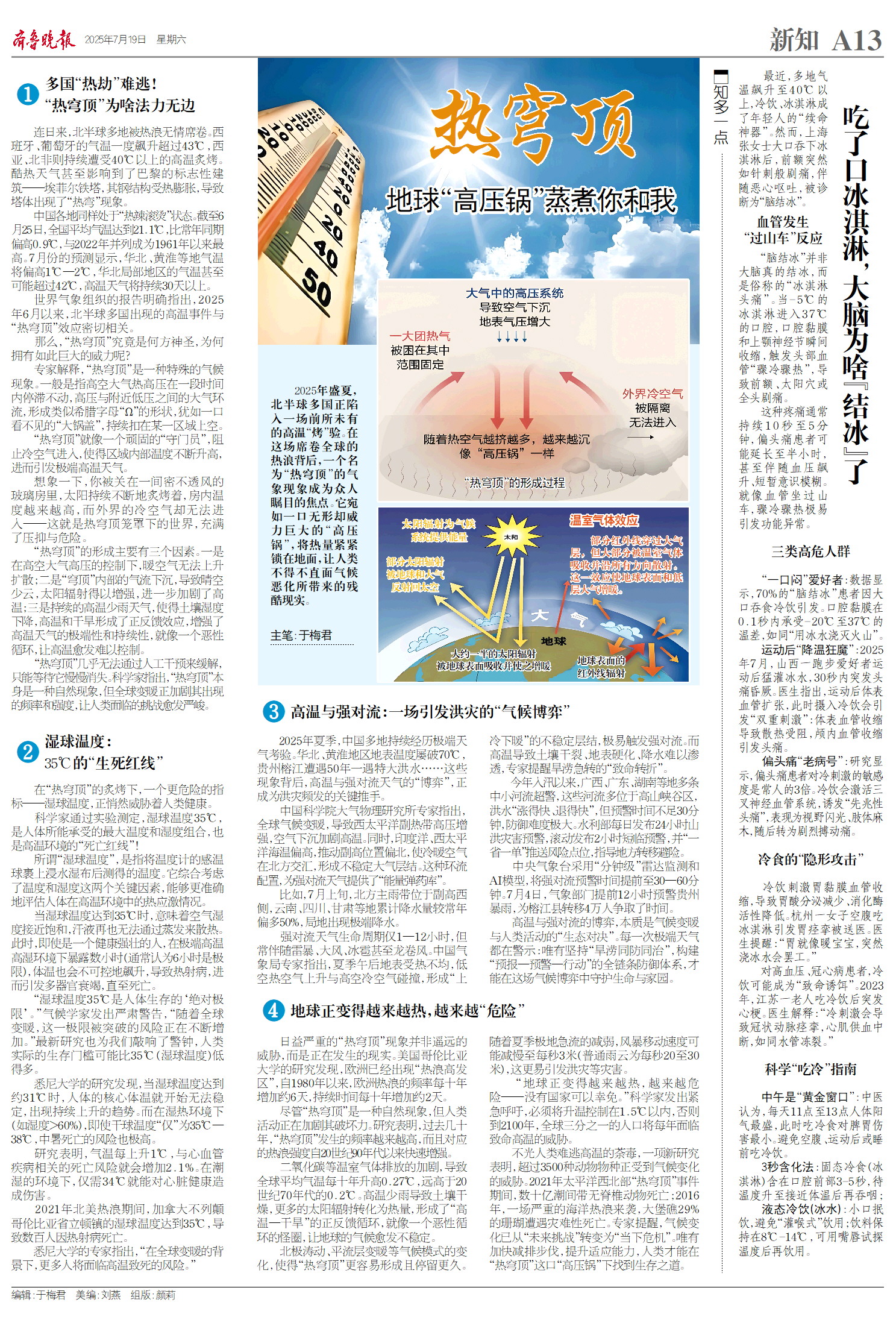
新知|这个夏天热辣滚烫,幕后推手是“热穹顶”这家伙!
Qi Lu Wan Bao· 2025-07-19 09:49
Group 1 - The article discusses the extreme heat wave affecting multiple countries in the Northern Hemisphere, with temperatures exceeding 43°C in Spain and Portugal, and over 40°C in parts of West Asia and North Africa [2][6][10] - In China, the average temperature reached 21.1°C by June 25, 2025, marking the highest level since 1961, with predictions indicating temperatures in North China could exceed 42°C for over 30 days [6][10] - The World Meteorological Organization links these high-temperature events to the "heat dome" phenomenon, which is characterized by a persistent high-pressure system trapping heat in a specific area [10][11] Group 2 - The "heat dome" acts like a stubborn "goalkeeper," preventing cold air from entering, which leads to rising temperatures and extreme heat conditions [3][11] - The formation of the "heat dome" is influenced by three main factors: the inability of warm air to rise, descending air currents that enhance solar radiation, and prolonged dry weather that decreases soil moisture, creating a feedback loop that exacerbates heat [13][29] - The phenomenon is a natural occurrence, but its frequency and intensity are increasing due to global warming, posing significant challenges for humanity [13][26][29] Group 3 - The article highlights the critical threshold of wet bulb temperature at 35°C, which is considered the maximum temperature and humidity combination that the human body can withstand [14][19] - When wet bulb temperature reaches 35°C, it indicates that sweat cannot evaporate effectively, leading to a risk of heat-related illnesses and potentially death [16][19] - Research indicates that for every 1°C increase in temperature, the risk of death related to cardiovascular diseases increases by 2.1% [19][26]
高温来袭,以后夏天会越来越热吗?专家解读
Xin Hua Wang· 2025-07-18 13:40
Core Viewpoint - The article discusses the extreme high temperatures experienced in China this summer, particularly in the central and northern regions, highlighting the early onset and intensity of the heatwave, which is attributed to climate change and specific atmospheric conditions [1][2][3]. Weather Conditions - Since the beginning of summer, many regions in China have experienced persistent high temperatures, with some areas recording temperatures exceeding 40 degrees Celsius [1]. - In Hubei province, the average maximum temperature from July 1 to 15 was 35.8 degrees Celsius, which is 4.2 degrees Celsius higher than the historical average for the same period [1]. - Hubei has recorded 10.51 days of high temperatures as of July 15, marking the highest number for this time of year historically [2]. Climate Trends - Meteorological experts indicate that the summer heat is becoming more intense and prolonged, with a significant increase in the number of high-temperature days and their intensity over the years [3]. - In Henan province, the average summer temperature has risen by 1.5 degrees Celsius compared to the early 2000s, with the number of days with minimum temperatures above 28 degrees Celsius increasing significantly [3]. Future Projections - The climate models predict that the average number of high-temperature days in Henan will increase by approximately 3 days over the next 25 years [3]. - Hubei is expected to continue experiencing high temperatures, with forecasts indicating that July temperatures will be 1 to 1.6 degrees Celsius above the historical average, along with reduced rainfall [2]. Public Awareness - The article emphasizes the difference between measured air temperature and perceived temperature, explaining that the latter can feel significantly higher due to factors like humidity and direct sunlight [4]. - A yellow high-temperature warning was issued, advising vulnerable populations to take precautions against heat exposure [4].
中国气候变化蓝皮书发布,我国增暖速率高于全球平均数
Bei Jing Ri Bao Ke Hu Duan· 2025-07-17 09:07
Group 1 - The core viewpoint of the news is the ongoing trend of global warming and its significant impact on climate change in China, with the release of the "China Climate Change Blue Book (2025)" providing detailed monitoring data and trends [1][3][4] - The average global surface temperature in 2024 is reported to be the highest since 1850, with a notable increase in regional average temperatures in Asia, which are 1.04°C above the normal levels [3][4] - China's average surface temperature has shown a significant upward trend, increasing by 0.31°C every decade from 1961 to 2024, with 2024 marking the first year that the average temperature exceeds 1.0°C above normal [3][4] Group 2 - The concentration of major greenhouse gases continues to rise, with 2023 recording the highest levels of carbon dioxide (420.0±0.1 ppm), methane (1934±2.0 ppb), and nitrous oxide (336.9±0.1 ppb) [3][4] - Extreme weather events in China are increasing in frequency and intensity, with the climate risk index reaching its highest level since 1961 in 2024, particularly highlighting risks from flooding and high temperatures [4][5] - Global ocean warming has accelerated, with the average sea surface temperature in 2024 being 0.39°C above normal, marking the highest level since 1870 [5][6] Group 3 - The overall vegetation coverage in China has shown a stable increase, with the average normalized difference vegetation index (NDVI) rising by 8.2% compared to the average from 2001 to 2020, reaching 0.358 in 2024 [5][6] - The phenological phases of representative plant species in China are occurring earlier, with significant advancements in leafing periods observed at various monitoring stations [6]

更早、更久、更热,欧洲距离50℃的夏季还有多远?
Yang Shi Wang· 2025-07-16 11:09
Group 1: Extreme Heat Events - The summer of 2023 has seen unprecedented heat waves across Europe, with temperatures reaching historical highs, such as 48.8°C in Sicily and 46.6°C in Spain [1][2] - The number of heat-related deaths in Spain surged to 1,180 from May 16 to July 13, 2025, marking a 935% increase compared to the same period last year [1] - The frequency and intensity of extreme heat events in Europe are increasing, with some cities facing heat periods lasting up to five months [5][6] Group 2: Health and Environmental Impact - Extreme heat has resulted in over 60,000 deaths in Europe during the summer of 2022, alongside severe ecological impacts from wildfires and droughts [2][6] - The health risks associated with prolonged high temperatures are particularly acute for vulnerable populations, including the elderly [5][10] - The ongoing heat waves are reshaping urban living conditions, with increased hospitalizations and changes in work schedules due to extreme temperatures [4][11] Group 3: Air Conditioning Debate - The debate over the widespread deployment of air conditioning has intensified, with some experts arguing it is a short-term solution that exacerbates greenhouse gas emissions [3][8] - The low penetration of air conditioning in Europe, with only about 5% in France and 3% in Germany, contrasts sharply with the higher rates in the US and China [8][9] - The European Union is cautious about promoting air conditioning due to its potential to conflict with carbon neutrality goals and the ongoing energy crisis [9][10] Group 4: Infrastructure and Adaptation Strategies - The need for infrastructure upgrades is critical, as extreme heat impacts tourism and public services, leading to closures of popular sites and transportation disruptions [11][12] - Recommendations include enhancing building designs for better heat resistance, implementing green roofs, and establishing climate shelters for vulnerable populations [12] - The call for a multi-faceted approach to climate adaptation emphasizes the importance of energy-efficient technologies and improved public health systems to manage heat-related challenges [10][12]
海冰减少与臭氧空洞恢复加剧两极冰盖融化
Ke Ji Ri Bao· 2025-07-16 09:13
Core Insights - The research led by Sun Yat-sen University provides a long-term assessment of the melting status of polar ice caps, highlighting the accelerating melting of both the Antarctic and Greenland ice sheets due to global warming [1][2] - The study identifies the reduction of Arctic sea ice and the recovery of the Antarctic ozone hole as key drivers of this phenomenon [1][2] Group 1: Research Findings - The Greenland ice sheet is losing approximately 4.5 billion tons of meltwater per year from 1992 to 2022, significantly increasing its contribution to sea level rise [2] - The study utilized satellite data combined with ground observations to quantify the relationship between Arctic sea ice reduction and the accelerated melting of the Greenland ice sheet [2] - The East Antarctic ice sheet has become the largest source of meltwater in Antarctica, surpassing the Antarctic Peninsula, with its meltwater volume significantly correlated with the recovery of the ozone layer [2] Group 2: Implications - The recovery of the Antarctic ozone hole, while beneficial for the environment, may inadvertently lead to extreme melting events in the East Antarctic ice sheet, showcasing the complexity of Earth's system responses [3] - The findings emphasize the need for a deeper understanding of the interconnectedness of climate factors and their impacts on polar ice dynamics [3]
欧洲超2300人热死!这只是10天、12城的数据,全欧洲全年呢?
Sou Hu Cai Jing· 2025-07-15 17:02
Group 1 - The core viewpoint of the article highlights the severe impact of extreme heat on human life, particularly in Europe, where thousands have died due to heat-related factors [3][5][10] - A recent study indicates that at least 2,300 people died from heat-related causes in 12 European cities, with a total population of approximately 30 million, during a heatwave that lasted about 10 days [3][5] - Spain reported 1,180 heat-related deaths between May 16 and July 13, with most victims aged over 65 [3][5] Group 2 - June 2023 was recorded as the third hottest June globally, with Western Europe experiencing its hottest June ever, where perceived temperatures exceeded 38°C [5][7] - Scientists estimate that out of the 2,300 heat-related deaths, at least 1,500 were linked to global warming [5][7] - The phenomenon of heatwaves is referred to as a "silent killer," as many heat-related deaths go unreported, suggesting the actual number of fatalities could be much higher [9][10] Group 3 - The article emphasizes that if global warming continues unchecked, future temperatures will rise, leading to an increase in heat-related deaths [10][12] - There is criticism of European politicians prioritizing climate policies over human lives, particularly in the context of sanctions related to new energy vehicles [10][12]

英国多地陷入干旱 极端天气加剧水资源危机
news flash· 2025-07-15 11:54
英国多地陷入干旱 极端天气加剧水资源危机 跟踪全球极端天气动态 +订阅 金十数据7月15日讯,英国更多地区进入干旱状态,此前英格兰地区迎来了自1976年以来最干旱的年 初,且热浪导致用水需求增加。热浪使英格兰地区的6月成为有记录以来最热的6月。全球变暖正在增加 英国极端天气的频率和强度,威胁着农民的生计和弱势群体的健康。英国许多地区的气温本周晚些时候 将再次升高,这将使情况恶化。英国水务大臣Emma Hardy在一份声明中说:"未来十年,我们面临着日 益严重的水资源短缺问题。"她还补充说,水务公司正在投资超过1000亿英镑(1350亿美元)用于新建 水库和管道,以降低风险。 ...
热浪提前来袭 气候警钟再响——访欧盟气候监测机构科学家尼古拉斯
Xin Hua Wang· 2025-07-15 05:07
Core Insights - The Copernicus Climate Change Service reported that June 2023 was the third hottest June globally since records began in 1940, with Western Europe experiencing the hottest June on record [1] - The report highlights that heatwaves are occurring earlier, more frequently, and with greater intensity in Europe, closely linked to global warming [1] Group 1: Climate Trends - Western and Southern Europe experienced two significant heatwaves in late June, indicating a shift in the timing of such events from July and August to June [1] - A key factor contributing to the intensified heatwaves in June is the record high sea surface temperatures in the Western Mediterranean, which has led to numerous "tropical nights" where temperatures do not drop below 20 degrees Celsius [1] Group 2: Oceanic and Polar Impacts - The Mediterranean region is becoming a climate change hotspot, with its warming rate significantly exceeding the global average [1] - The ocean absorbs about 90% of the heat associated with greenhouse gas emissions, posing severe threats to marine ecosystems, including increased coral bleaching observed globally [1] - Arctic warming is occurring at a rate much faster than the global average, which may alter the jet stream and lead to more frequent extreme weather events [1] Group 3: Ice Coverage - In June, Arctic sea ice extent was 6% below the average, marking the second lowest June extent in 47 years of satellite records, while Antarctic sea ice was 9% below average, the third lowest on record for June [2] - Eastern and Southeastern Europe may face heightened risks of high temperatures and drought in the coming months, with heatwaves becoming a new norm for European summers [2] Group 4: Climate Action Recommendations - The report emphasizes two critical directions for addressing climate change: accelerating mitigation measures to reduce greenhouse gas emissions and enhancing adaptive capacity to improve resilience against extreme weather and long-term warming trends [2]