ESG创新指数

Search documents
对话联合国亚太经社委员会东亚办事处主任:东亚可持续发展需聚焦气候韧性、人口转型与数字包容
Xin Lang Cai Jing· 2026-02-25 01:15
Group 1 - East Asia and Northeast Asia are at a critical crossroads for sustainable development, facing challenges such as climate change, demographic shifts, and technological revolutions [1][33] - The region exhibits unique practical wisdom in pursuing high-quality development while revealing deep governance issues [1][33] Group 2 - A key governance challenge is policy fragmentation across agencies and levels of government, often due to differing mandates and insufficient communication [3][35] - Countries are increasingly adopting a "whole-of-government" approach to address these governance challenges [3][35] Group 3 - Ensuring data reliability for evidence-based decision-making is crucial, requiring the establishment of digital monitoring systems and the closing of data gaps [4][36] - The production of reliable data necessitates significant effort from both local and national authorities and relies heavily on public trust [4][36] Group 4 - Persistent financing constraints hinder the mobilization of sufficient resources for long-term sustainable development goals (SDGs) implementation [5][38] - Addressing financing gaps requires stronger integrated financing frameworks and improved coordination among various governmental sectors [5][38] Group 5 - A robust environmental and social governance (ESG) framework can deliver significant benefits for companies, including improved market access and reduced compliance-related disruptions [6][39] - Companies that proactively plan for ESG obligations are better positioned to maintain their market presence both domestically and internationally [6][39] Group 6 - ESG compliance can enhance a company's reputation and competitiveness within supply chains, making them preferred suppliers for larger companies [7][40] - Financial institutions are increasingly offering preferential financing conditions to companies that comply with recognized ESG standards [7][40] Group 7 - China has made significant progress in sustainable development, including commitments to peak carbon emissions by 2030 and achieve carbon neutrality by 2060 [8][41] - The country has also eradicated extreme poverty and is focused on improving social quality of life while addressing demographic changes [8][41] Group 8 - China actively participates in regional platforms to support sustainable development efforts in Asia-Pacific countries, particularly for the least developed nations [8][56] - There is considerable scope for China to accelerate its energy transition by expanding renewable energy and addressing critical infrastructure needs [8][57]


生态环境部等联合印发《生态文明建设示范区(生态工业园区)管理办法》
Xin Lang Cai Jing· 2026-02-13 04:13
Core Viewpoint - The newly revised "Management Measures for Ecological Civilization Construction Demonstration Zones (Ecological Industrial Parks)" aims to enhance the ecological development of industrial parks, promoting green production and low-carbon, circular development in the industrial sector [3][4]. Group 1: Overview of Ecological Industrial Parks - Since 2001, 73 industrial parks across 19 provinces have been designated as ecological industrial parks, contributing 8.5% of the national industrial added value while maintaining 84% lower pollutant emission intensity compared to the national average and achieving over 89% in solid waste comprehensive utilization [3][8]. - The existing management system for ecological industrial parks is based on "one method and two standards," which includes the "National Ecological Industrial Demonstration Park Management Measures," "National Ecological Industrial Demonstration Park Standards," and "Guidelines for the Preparation of Ecological Industrial Park Construction Plans" [4][8]. Group 2: Key Changes in the Revised Management Measures - The revised management measures emphasize the coordination of pollution reduction and carbon reduction, optimizing management processes, and establishing a framework where provincial authorities organize the creation and national authorities handle acceptance and naming [4][9]. - The new measures enhance supervision during and after the process, detailing performance evaluation and exit mechanisms to ensure the quality of park creation. For instance, the previous three-year review after naming has been changed to a performance evaluation, with warnings for parks that do not meet standards [4][9]. - Specific conditions for revoking naming have been clarified, including severe environmental pollution incidents and data falsification, with a prohibition on reapplying for a period after revocation [4][9]. - An "incentive measures" chapter has been added, focusing on financial support, technological innovation assistance, and funding for ecological industrial parks to promote high-quality development [4][9].
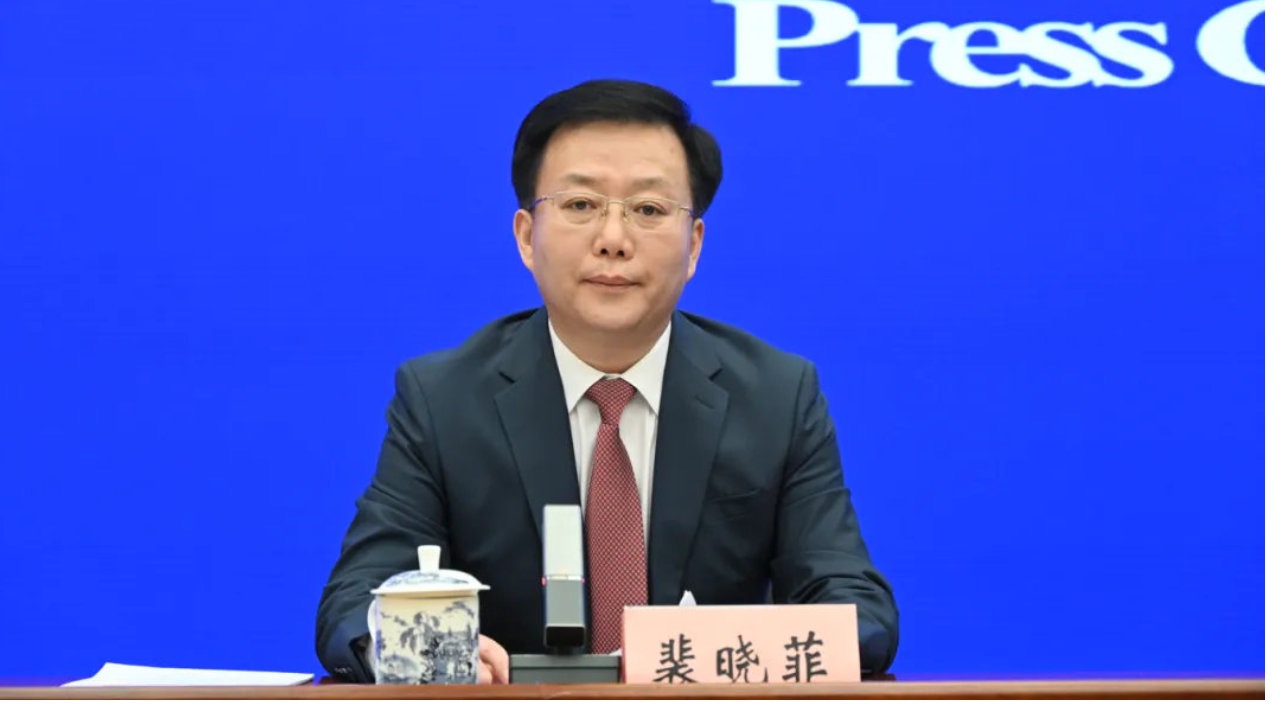
对话OECD驻华代表:从合规到增值——负责任行为如何驱动商业成功
Xin Lang Cai Jing· 2026-01-21 09:09
Group 1 - The world is facing a "triple planetary crisis" consisting of climate change, biodiversity loss, and pollution, which requires a comprehensive response [5][45][57] - Current climate finance is primarily sourced from public funds, but the OECD indicates that private capital mobilization is crucial, as private financing accounts for only about one-fifth of total climate investment [16][58][59] - The OECD suggests several pathways to enhance climate financing, including blended finance, leveraging public policy banks, and utilizing multilateral development banks [17][59] Group 2 - Businesses have a responsibility to address the triple crisis, and government expectations are reflected in ESG principles, which currently face challenges such as a lack of unified standards [18][47][60] - The OECD promotes "Responsible Business Conduct" (RBC) as a framework for companies to manage their environmental and social impacts, which has been integrated into various national laws [19][48][62] - The Inclusive Forum on Carbon Mitigation Approaches (IFCMA) is an OECD initiative aimed at facilitating equal participation among countries to share policies and practices for achieving climate goals [22][63] Group 3 - International cooperation is essential for addressing pressing global challenges, particularly the triple planetary crisis, which cannot be solved by any single nation [30][52][31] - Taxation is identified as a critical area for international collaboration, especially in the context of the digital economy and the OECD's BEPS project [31][53] - The aging population and AI are significant trends that will reshape labor and skill needs, presenting both challenges and opportunities for businesses [32][54][34] Group 4 - The importance of knowledge sharing among governments, local authorities, and industry associations is emphasized to help businesses navigate the complexities of aging and AI [39][56] - Companies need supportive policy environments, including education and training initiatives, to adapt to changes brought by aging and AI [37][55] - The OECD is working on improving vocational education systems to better meet the demands of the labor market influenced by these megatrends [38][55]

英国知名学者马丁·雅克:从“文明型国家”视角理解全球治理倡议
Xin Lang Cai Jing· 2026-01-19 01:53
Group 1 - The core idea of the article revolves around China's global governance initiative, which emphasizes five key principles: adherence to sovereign equality, compliance with international law, promotion of multilateralism, a people-centered approach, and action-oriented focus [1][9] - The initiative is seen as a means to repair and improve the existing international system rather than creating a new one, aiming to restore a rules-based order [2][10] - The concept of China as a "civilizational state" is highlighted as a perspective that can help understand its unique logic in global governance practices [1][10] Group 2 - The article discusses the challenges posed by the current "disorder" in the international system, particularly due to the United States' unilateral actions that undermine international law and multilateralism [4][12] - The need for a new international system that accurately reflects the realities of today's world, particularly the concerns of developing countries, is emphasized [7][13] - The proposed reforms aim to create a more just and inclusive international system that can adapt to the changing global development landscape [7][13]
2025中国企业ESG“金责奖”最佳责任进取奖揭晓
Xin Lang Cai Jing· 2026-01-15 07:31
Core Viewpoint - The 2025 China Enterprise ESG "Golden Responsibility Award" aims to recognize companies that have made significant contributions to ESG (Environmental, Social, and Governance) practices, with over 5,000 enterprises participating in the evaluation process [1][4]. Group 1: ESG Award Overview - The award was launched in November 2025 by Sina Finance ESG Rating Center, focusing on promoting sustainable development and responsible investment [1][4]. - The award emphasizes the importance of responsibility in ESG practices, symbolizing that responsibility is as valuable as gold [1][4]. - The evaluation process included comprehensive performance assessments, professional scoring, and online voting, culminating in the announcement of the award winners after three months of competition [1][4]. Group 2: Award Winners - The "Best Responsibility Initiative Award" was awarded to ten companies, including: - Fenghuo Communication - Wens Foodstuff Group - Haitian Flavoring and Food - Aier Eye Hospital - Yunnan Baiyao - Anker Innovation - Jinfa Technology - Huatai Securities - Seres - Hainengda [2][5]. - The award committee congratulated the winners and expressed hope that these companies will lead by example in enhancing their ESG capabilities and contribute to China's high-quality development [2][5]. Group 3: ESG Rating Center Introduction - The Sina Finance ESG Rating Center is the first Chinese platform dedicated to ESG information and ratings, promoting sustainable development and responsible investment [3][6]. - The center aims to establish ESG evaluation standards suitable for China's characteristics and enhance corporate ratings [3][6]. - It also publishes multiple ESG innovation indices to provide investors with more options regarding corporate ESG performance [3][6].






2025中国企业ESG“金责奖”最佳社会S责任奖揭晓
Xin Lang Cai Jing· 2026-01-15 07:31
Core Viewpoint - The 2025 China Enterprise ESG "Golden Responsibility Award" aims to recognize companies that have made significant contributions to ESG (Environmental, Social, and Governance) practices, with over 5,000 enterprises participating in the evaluation process [1][4]. Group 1: ESG Services and Initiatives - Sina Finance ESG Rating Center offers 14 ESG services, including information, reports, training, and consulting, to help listed companies promote ESG concepts and enhance their sustainable development performance [1][4]. - In 2025, many quality enterprises in China are actively practicing their responsibilities in environmental, social, and governance aspects, while domestic financial institutions are steadily integrating ESG investment concepts into their entire business processes [1][4]. Group 2: Award Selection and Winners - The award selection process involved over three months of competition, combining ESG performance, professional evaluation scores, and online voting results [1][4]. - The winners of the 2025 China Enterprise ESG "Golden Responsibility Award" for Best Social Responsibility include China Shenhua, China General Nuclear Power, China Resources Sanjiu, Sinopec, Shougang, Wuliangye, Yangtze Power, China Telecom, CNOOC Services, and LONGi Green Energy [2][5]. Group 3: ESG Rating Center Overview - The Sina Finance ESG Rating Center is the first Chinese ESG professional information and rating aggregation platform, dedicated to promoting sustainable development and responsible investment [3][6]. - The center aims to establish ESG evaluation standards suitable for China's characteristics and enhance corporate ratings, while also launching multiple ESG innovation indices for investors [3][6].




上海高金执行院长程仕军:我们正站在一个由科技重构未来的关键节点
Xin Lang Cai Jing· 2025-12-15 02:51
Group 1 - The core viewpoint of the news is the emphasis on the integration of technology and finance to create a more resilient and efficient sustainable development paradigm, moving away from traditional pollution-first approaches [2][5] - The "2025 China Sustainable Investment Development Forum" was held on December 12, organized by Shanghai Jiao Tong University and aimed at promoting sustainable investment practices [1][4] - The forum is part of a continuous effort by the Shanghai Advanced Institute of Finance to explore sustainable investment, having been held for three consecutive years [1][4] Group 2 - The Sina Finance ESG Rating Center is the first Chinese platform dedicated to ESG information and ratings, promoting sustainable development and responsible investment [3][7] - The center aims to establish ESG evaluation standards suitable for China's characteristics and enhance corporate ratings, thereby advancing the ESG investment landscape in China [3][7] - Sina Finance has launched multiple ESG innovation indices to provide investors with more options regarding corporate ESG performance [3][7]
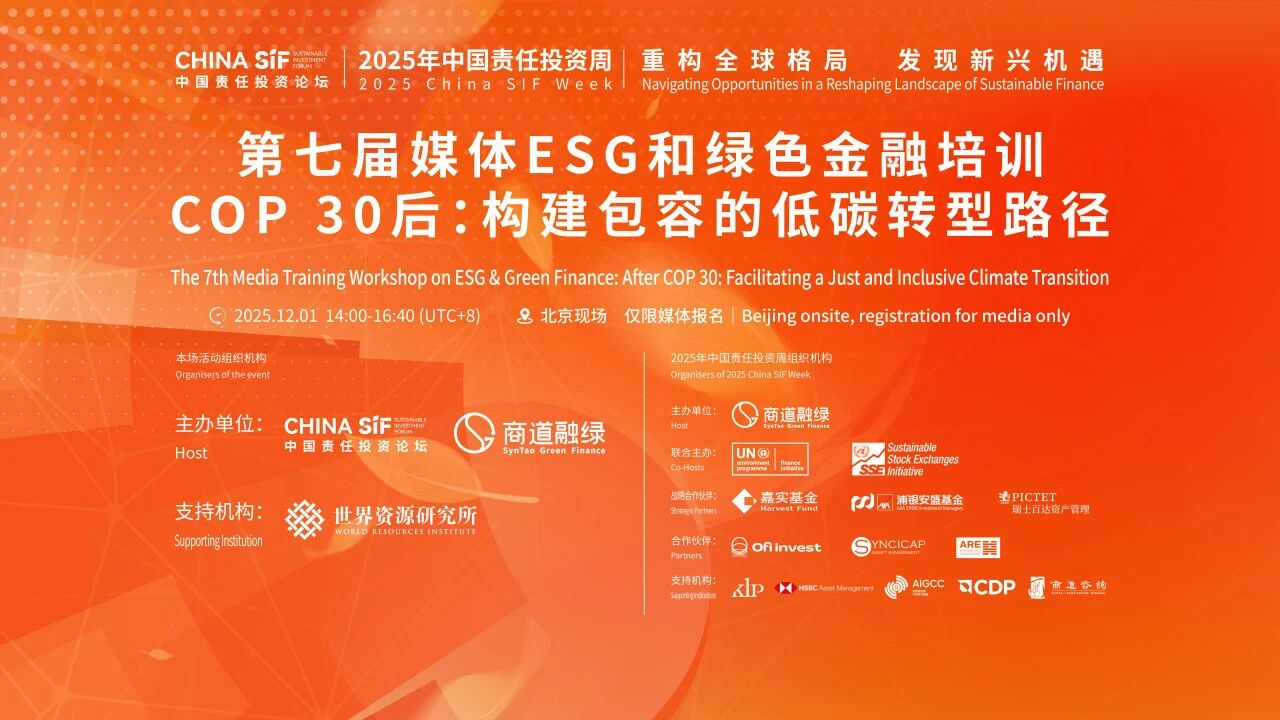
China SIF|第七届媒体ESG和绿色金融培训成功举行,信息披露促进公正转型报告正式发布
培训分享
报告发布
Xin Lang Cai Jing· 2025-12-12 09:24
Group 1 - The training event focused on "Post-COP 30: Building Inclusive Low-Carbon Transition Pathways" to enhance understanding of climate action and promote equitable transformation in green development [3][22] - The China Responsible Investment Forum released a report titled "Information Disclosure Promotes Just Transition: Assessment Analysis and Action Recommendations for Key Domestic Listed Companies" [3][32] - The report highlighted that only two listed companies explicitly support just transition principles in their sustainability reports, indicating limited awareness among domestic companies [15][34] Group 2 - The training was supported by the World Resources Institute (WRI) Beijing Office and aimed to explore how social organizations and market institutions can contribute to climate governance [3][22] - The report proposed an evaluation framework for assessing domestic companies' just transition practices and identified 313 listed companies across 11 key industries with significant low-carbon transition needs [13][32] - The financial sector's role in supporting China's new Nationally Determined Contributions (NDC) targets was emphasized, with a focus on increasing climate financing and mobilizing private capital [11][30] Group 3 - The concept of just transition is widely recognized, but there are significant differences in understanding its implications among various stakeholders [7][26] - The report suggested that promoting just transition practices requires enhanced awareness and capabilities from companies, alongside support from policies and financial resources [15][34] - The event featured over 300 participants, including experts from regulatory, market, and academic sectors, highlighting the growing interest in responsible investment and ESG practices [18][37]
China SIF|钱谷美幸:从气候风险到韧性增长的战略转型
Xin Lang Cai Jing· 2025-12-11 09:42
Core Insights - The 13th China Responsible Investment Forum highlighted the shift of sustainable development from merely an environmental issue to a core financial, economic, and investment topic [1][21] - Climate and nature-related impacts are increasingly recognized as financial risks, necessitating a focus on adaptation and resilience as key investment themes [5][25] Group 1: Emerging Investment Frontiers - New markets are emerging in digitalization and AI monitoring, with companies like Pachama and OroraTech utilizing satellite data and AI to quantify forest carbon storage and land degradation in real-time [6][27] - Digital monitoring has become an investment theme itself, providing credible measurements and enhancing market confidence as data accumulates [7][27] Group 2: Natural and Ecosystem Markets - Financing for nature and biodiversity is becoming a new asset class, with growing investor interest in biodiversity-linked tools, ecological restoration projects, and natural capital valuation [8][29] - COP30 emphasized the rising global focus on ecosystem restoration and natural financing, particularly in Asia, where China is positioned to develop these markets more rapidly than other regions [9][29] Group 3: Infrastructure and Resilience Financing - Adaptive and resilient infrastructure represents a significant future capital demand, including water systems, resilient urban infrastructure, and disaster-resistant supply chains [10][30] - Early examples of resilience financing at the sovereign and industry levels, such as the Caribbean Disaster Risk Insurance Facility, demonstrate how parametric insurance can provide liquidity post-climate disasters [10][28] Group 4: Health Resilience as a New Financial Market - The integration of climate, nature, and health is emerging as a significant trend, with capital flowing into health security and resilience [11][29] - Initiatives like pandemic funds are financing early warning systems and health monitoring infrastructure in emerging economies, marking the emergence of a new asset class in health resilience [11][29] Group 5: Implications for Finance and Business - The financial industry must support capital allocation for adaptation, resilience building, natural financing, and health security solutions [12][30] - Asia's unique advantages, including policy frameworks and financial platforms, position it to scale investments more rapidly than other regions, with China's progress in transforming financial and market infrastructure drawing attention at COP30 [12][30] Group 6: New Strategic Directions - The shift in investment logic is moving from managing climate risks to designing for resilient growth, integrating climate, nature, health, and digital innovation to create value [13][31] - The current challenge lies in fostering collaboration across public and private sectors, financial and corporate realms, and international borders to build the next phase of sustainable and resilient growth [14][32]

气候大会风向变化:谈判进展缓慢,绿色产业影响凸显
Xin Lang Cai Jing· 2025-12-10 03:52
Core Insights - COP30, held in Belém, Brazil, marked the tenth anniversary of the Paris Agreement, but achieved only symbolic progress on key issues, failing to meet the expectations of climate-vulnerable countries for stronger climate action [3][23] - The focus of global climate governance is shifting from multilateral political consultations to economic and industrial decision-making, highlighting the importance of translating international consensus into domestic policies and investment actions [3][23] - Despite the absence of the United States, China and the European Union reached a high-level joint statement, demonstrating their commitment to advancing the Paris Agreement through dialogue and cooperation [3][23] Multilateral Dialogue in Climate and Trade - Trade issues were formally included in the climate conference discussions, with a consensus reached to establish the "Climate-Trade Comprehensive Forum" (IFCCT) to address carbon border measures and low-carbon product standards [4][24] - The forum aims to provide a communication channel rather than establish unified rules, potentially easing policy friction amid increasing fragmentation of global standards [4][24] - The inclusion of trade in climate negotiations is seen as a significant breakthrough, reflecting the integration of climate and economic issues [5][25] China's Growing Influence - China's presence at COP30 was prominent, with a central exhibition area attracting significant attention and participation from various countries, showcasing its climate actions and low-carbon technologies [7][27] - The country is increasingly taking on a coordinating role among developing nations, moving beyond a unified stance with the G77 group to facilitate consensus on key issues [11][31] - China's new Nationally Determined Contributions (NDC) target aims for significant reductions in greenhouse gas emissions and an increase in the share of non-fossil energy by 2035 [9][29] Climate Financing - COP30 emphasized the need for a financing roadmap of $1.3 trillion and a minimum of $300 billion from developed countries to support climate action in developing nations [16][36] - The conference highlighted the challenges posed by the absence of U.S. funding commitments, which has created a significant gap in climate financing that cannot be filled by other countries alone [17][37] - The decision to establish a two-year work program on climate financing reflects ongoing difficulties in advancing funding mechanisms, particularly for adaptation efforts, which are currently underfunded [18][39]