AGI

Search documents
从单打到团战,杨植麟又交新作业
3 6 Ke· 2026-01-27 23:51
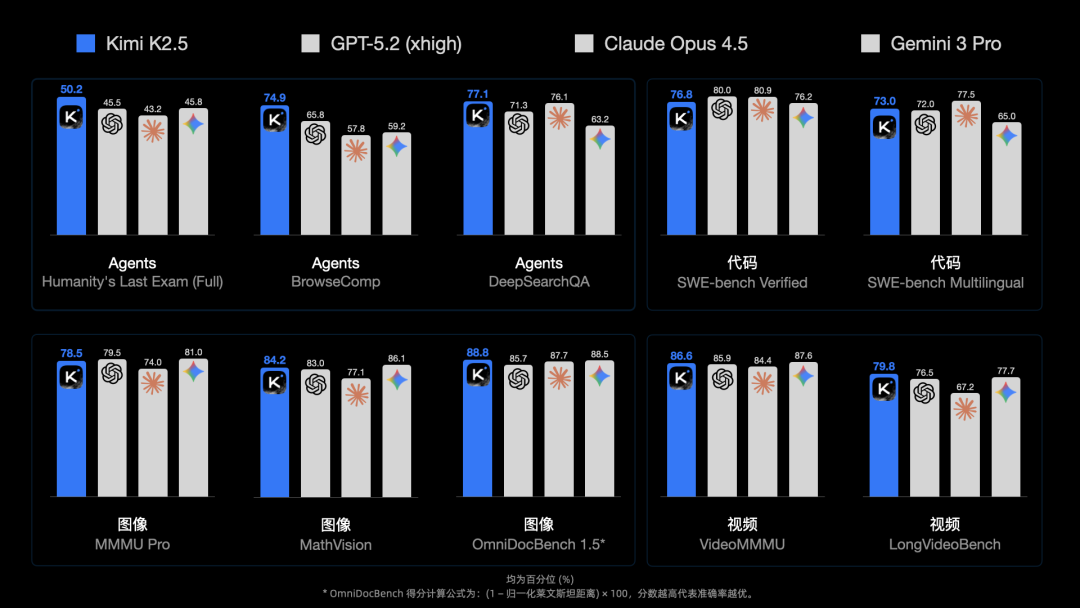
Core Insights - Chinese AI companies are demonstrating their capabilities with significant model updates just weeks before the Chinese New Year, with DeepSeek, Qianwen, and Kimi leading the trends on social media [1] - Kimi's new model K2.5 has been released, showcasing advancements in visual understanding, coding aesthetics, and the introduction of an "Agent cluster" feature, marking a strategic shift towards deliverable outcomes [3][5] Group 1: Kimi's Model Release - Kimi's K2.5 model integrates visual understanding, text reasoning, deep thinking, and instant response into a unified architecture, addressing the fragmentation seen in existing AI systems [6] - The K2.5 model achieved a score of 76.8 in the SWE-bench Verified benchmark, indicating its competitive programming capabilities [6] - Kimi's focus on "Coding aesthetics" aims to simplify the coding process for users, allowing them to create sophisticated applications without extensive coding knowledge [8][10] Group 2: Agent Cluster Feature - The introduction of the "Agent cluster" capability allows K2.5 to manage complex tasks by dynamically creating and coordinating multiple AI agents, potentially reducing project completion times from days to minutes [12][13] - This feature is currently in Beta testing, with its success dependent on the stability and quality of task execution in real-world scenarios [13] Group 3: Strategic Goals and Market Positioning - Kimi aims to position K2.5 as the best "Agentic model" in the open-source landscape, emphasizing research and development while competing in the commercial market [14] - The long-term vision includes embedding K2.5 into everyday workplace software, enabling users to generate professional-level outputs through natural language requests [17][20] - The focus on enhancing agent capabilities is seen as crucial for deepening AI applications across various industries, shifting the evaluation of AI products from mere performance scores to their practical value in real-world workflows [21]

Demis Hassabis: Reaching AGI Requires This...
Alex Kantrowitz· 2026-01-27 16:00
Google DeepMind's CEO says AI systems must master continual learning, memory, more efficient context windows, and better long-term reasoning and planning to get to AGI. ...
X @Decrypt.co
Decrypt· 2026-01-27 15:04
Morning Minute: Anthropic’s CEO Warns AGI May Be 1-2 Years Awayhttps://t.co/CblfsRR23o ...
老牌百亿私募最新发声,信息量大
Zhong Guo Ji Jin Bao· 2026-01-27 12:51
【导读】源乐晟举办2026年度策略会,曾晓洁、杨建海最新发声 近日,老牌私募源乐晟举办2026年度策略会,源乐晟资产创始人曾晓洁与源乐晟合伙人杨建海分享了对 2026年市场的展望及行业观察。 曾晓洁与杨建海均认为,目前无需担忧"AI泡沫",2026年或成为AI行业标志性的一年。当前消费板块较 难出现大贝塔行情,但新消费领域结构性机会持续存在。化工行业当前估值处于低位,产品价格具备反 弹基础,化工板块具备较强的性价比。 整体而言,2026年有望走出"慢牛"行情,但"慢牛"不代表没有波动。在风险方面,地缘政治风险、美联 储降息滞后等因素仍需警惕。 消费行业仍有结构性机会 化工板块具有较强的性价比 "在新消费领域,每年都会有结构性的机会。"杨建海表示,如餐饮中的一些细分赛道,在新兴业态下的 翻台率大幅突破过往。新消费领域不乏这类结构性机会,但这类机会的天花板相较以往更低,相关标的 市值达到一定程度后,其发展的持续性会引发担忧。 他认为,白酒行业那种长期持有"躺平"的逻辑已不再适用于新消费投资,而是需要每年在不同SKU中筛 选出当期锐度最强的方向,同时紧密跟踪标的变化、动态评估。 在杨建海看来,当前消费板块较难出现大 ...
Kimi发布新模型,月之暗面完成C轮融资现金储备破100亿
21世纪经济报道· 2026-01-27 10:41
Core Viewpoint - Kimi has launched its new multimodal model K2.5, which demonstrates state-of-the-art performance in various core areas, including agent collaboration and code generation, marking a significant advancement in AI capabilities [1][3]. Group 1: Model Features and Capabilities - K2.5 is designed with a native multimodal architecture, supporting both visual and textual inputs, and can perform tasks in thinking and non-thinking modes, excelling in agent, code, image, video, and general intelligence tasks [1][3]. - The model significantly lowers the AI interaction threshold by allowing users to submit requests via photos, screenshots, or screen recordings, thus overcoming the limitations of text-based communication [5]. - K2.5 introduces a new "Agent Cluster" capability, enabling the creation of multiple intelligent agents that can work in parallel, improving task efficiency by reducing key steps by 3 to 4.5 times and cutting actual runtime by up to 4.5 times [5][6]. Group 2: Financial and Strategic Developments - Kimi's valuation has risen to $4.3 billion (approximately 29.9 billion RMB) following a $500 million Series C funding round completed on December 31, 2023, which was significantly oversubscribed [1][10]. - The company is currently finalizing a new round of financing with a pre-money valuation of $4.8 billion [1]. - Kimi's strategic shift from a user acquisition strategy to focusing on foundational algorithms and model development has been influenced by the competitive landscape, particularly the rise of DeepSeek [7][8]. Group 3: Future Plans and Goals - Kimi aims to surpass leading companies like Anthropic and become a world leader in AGI by enhancing its K3 model and focusing on unique capabilities that have not been defined by other models [12]. - The company plans to integrate model training and agent product development, aiming for significant revenue growth while not prioritizing absolute user numbers [12].

C轮融资27天后,Kimi推出“最智能”模型
2 1 Shi Ji Jing Ji Bao Dao· 2026-01-27 10:19
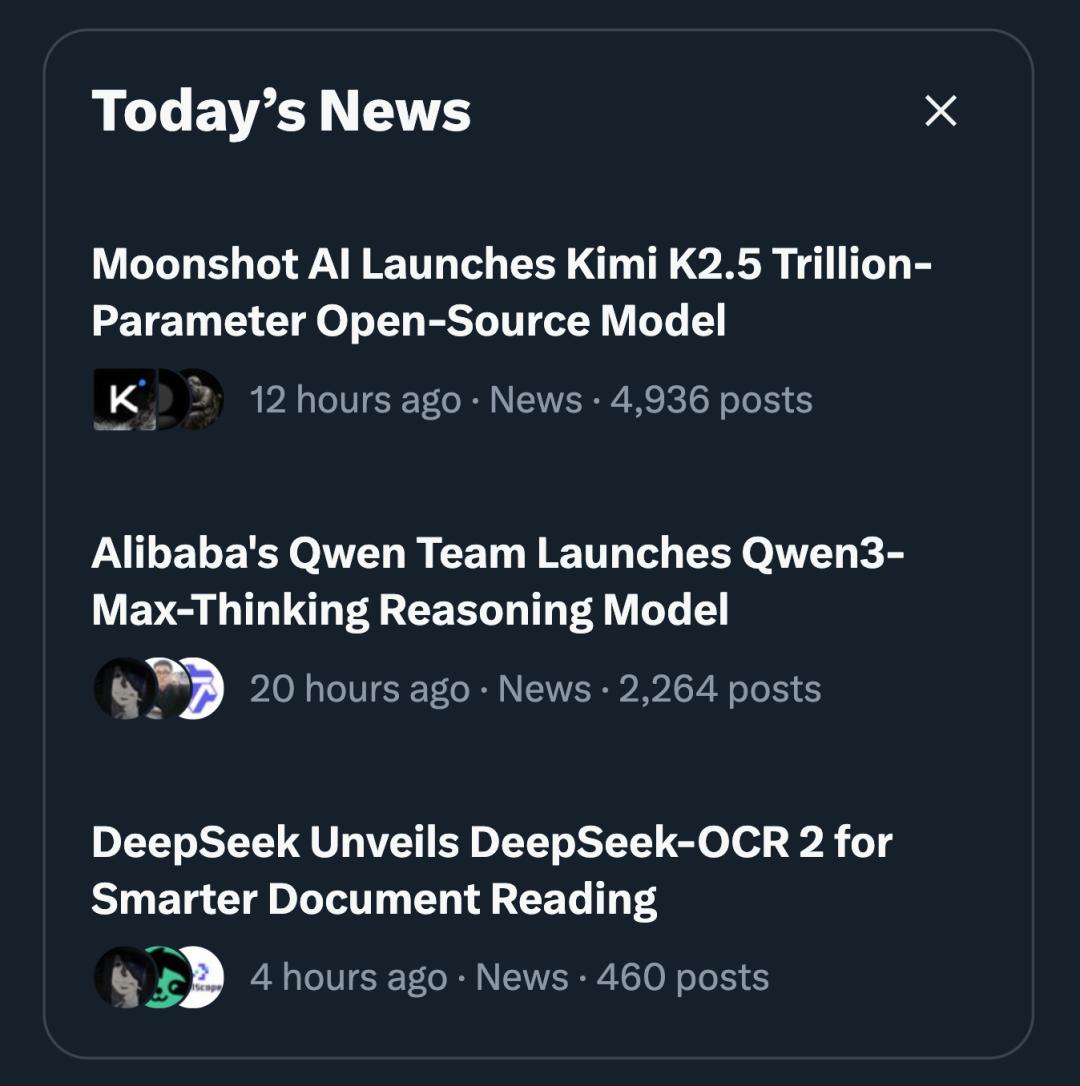
月之暗面发布开源多模态大模型K2.5,支持视觉/文本输入、Agent集群协作与代码生成。去年底,公司完成5亿美元C轮融资。 关联内容 Kimi张予彤亮相达沃斯:用1%的算力,撕开AI的另一种赢法 1月27日,月之暗面Kimi正式发布并开源新一代多模态大模型K2.5。该模型在原生多模态架构、Agent集群协作、代码生成等核心领域实现开源state-of-the- art表现,相关能力已全面登陆kimi.com、KimiApp及开放平台。 据Kimi介绍,作为其迄今最智能、最全能的模型,K2.5采用原生多模态架构设计,同时支持视觉与文本输入、思考与非思考模式、对话与Agent任务,在 Agent、代码、图像、视频及一系列通用智能任务上表现领先。 值得关注的是,此次发布距Kimi 创始人杨植麟去年12月31日宣布完成5亿美元C轮超募融资仅27天,资本与技术形成高效联动,公司估值攀升至43亿美元 (约合人民币299亿元),较B轮融资后的33亿美元实现快速增长。另据智通财经1月19日报道,月之暗面正在敲定新一轮融资,此轮融资投前估值达到48 亿美元。 不卷流量卷技术 目前,KimiK2.5已登陆kimi.com、最新版 ...
赶在农历新年前后,DeepSeek又发大模型,DeepSeek-OCR 2来了!更接近人类视觉编码逻辑
Jin Rong Jie· 2026-01-27 07:56
Core Insights - DeepSeek has launched its new model, DeepSeek-OCR 2, which utilizes the innovative DeepEncoder V2 method to dynamically rearrange image components based on their meaning, enhancing visual encoding logic similar to human perception [1] - The release of DeepSeek-OCR 2 comes approximately four months after the first version, indicating a rapid development cycle [1] - DeepSeek's approach contrasts traditional OCR by converting text information into visual images for efficient understanding, addressing challenges in processing long texts [1] Model Developments - The core component of DeepSeek's technology, the visual encoder, is believed to simulate the human brain's forgetting mechanism, providing a clear technical path for integrating optical and quantum computing in large language models (LLMs) [2] - Following the release of the V3 model in late 2024, DeepSeek is expected to unveil its next flagship model, DeepSeek V4, in February 2025, although the company has not confirmed this [2] - The DeepSeek-V3.1 upgrade features a hybrid reasoning architecture that supports both thinking and non-thinking modes, improving response efficiency and agent capabilities through post-training optimization [2] Performance Metrics - DeepSeek-V3.2 and its enhanced version, DeepSeek-V3.2-Speciale, reportedly achieve reasoning capabilities comparable to GPT-5, significantly reducing output length and computational costs compared to competitors [3] - DeepSeek-R1, launched on January 20, 2025, claims performance on par with OpenAI's models while maintaining a remarkably low inference cost of $294,000, with total training costs still below those of major international competitors [3] Market Impact - On January 27, 2025, DeepSeek topped the free app download charts in both the U.S. and China, surpassing ChatGPT, which has led to a significant revaluation of Chinese assets in the stock market [4] - Following DeepSeek's rise, indices related to computing power and cloud computing in the A-share market surged over 40%, with several stocks experiencing substantial gains [4] - The potential for DeepSeek to replicate its previous success in the market remains a point of interest for investors and analysts [4]

X @BSCN
BSCN· 2026-01-27 04:43
🚨JUST IN: SENTIENT NAMES FRANKLIN TEMPLETON AS STRATEGIC INVESTOR@SentientAGI and @FTI_US will collaborate on open-source, community-driven AGI initiatives.The partnership also targets institutional-grade AI applications for financial services. https://t.co/hE9fY7KWvI ...
年收入飙涨10倍,一家医疗公司接住了AGI
3 6 Ke· 2026-01-27 00:37
文 | 海若镜 2022年,创业第七年,薛翀开始跑步,用汗水来对抗郁闷和失意。 资本寒冬、市场骤冷,谈好的5000万融资无法到账,他创立的医疗SaaS公司全诊医学只好收缩战线,退 守浙江。彼时,医疗行业普遍面临大裁员的苦楚,薛翀也是。濒死挣扎后,他决定还是挤出资源,保留 一支10人小队,探索并不清晰的AI创新业务。 没想到,正是这个反常识的决策,让全诊医学翻了盘,接住了大模型时代的"馈赠": 2025年连获创新医疗等投资的3轮融资;医疗SaaS外的AI新业务,签约ARR(年度经常性收入)增长12 倍,达到六七千万元,2026年签约合同额有望达1.5亿元。 一位医疗AI从业者讲道,以前他并不知道这家公司,直到2025年全诊拿下了广安门医院、常州市第一 人民医院的标。广安门医院很重视数字化;且这两个医院大模型的标,单价不低,说明他家基础不错, 有现成的东西。 在薛翀看来,"有现成产品可以演示,而不是存在于PPT里",是全诊的竞争力之一。访谈时,他顺手打 开手机里"全诊通"APP,说了一段患者自述,软件即时识别语音后,形成了结构化病历。 美国做AI智能病历的公司Abridge,2025年5月实际ARR突破1亿美元, ...
中国最低调的AI公司,悄悄融资50亿,创最高融资记录
Sou Hu Cai Jing· 2026-01-27 00:04
过去一个月,AI圈热闹得像过年。智谱AI、MiniMax先后在港股敲钟,市值千亿;月之暗面拿下5亿美金融资。就在大家以为"大模型六小虎"的座次排定, 可以消停一阵的时候,阶跃星辰突然发布重磅消息,完成超50亿人民币B+轮融资,一举刷新过去12个月中国大模型赛道单笔最高融资纪录。 本轮参与的机构包括,上国投先导基金、国寿股权、浦东创投、徐汇资本、无锡梁溪基金、厦门国贸、华勤技术、腾讯、启明、五源等。要知道,在2025年 这个融资寒冬里,AI公司想拿钱难于上青天,更别提单笔数十亿的大额融资了。 数据显示,2025年AI模型公司总共完成22笔投资,金额94.16亿元,比2024年明显下滑。能拿到大额融资的,也就智谱AI、MiniMax、月之暗面这几家。阶 跃星辰能在这个时候拿下50亿,说明其价值以及资本市场的信任。 一、中国最低调的AI公司,默默深耕"物理AI" 阶跃星辰成立不到三年,但动作迅速。目前已发布30余款模型,构建起国内最全的基模矩阵,形成了围绕AI+终端的独特"1+2"基模体系。 这个"1+2"怎么理解?"1"是Step 3在内的基座模型,负责打地基;"2"是发力多模态(文字、语音、图像)和端云结合两大 ...