鹰派降息

Search documents
【招银研究】海外风险扰动,国内股债震荡——宏观与策略周度前瞻(2025.05.26-05.30)
招商银行研究· 2025-05-26 10:43
Group 1: Overseas Economy - The US economy is maintaining a steady expansion, with the Federal Reserve's interest rate cut expectations converging to two times (approximately 50 basis points) for the year [2][3] - The Atlanta Fed's GDPNOW model predicts a 2.4% annualized growth rate for US real GDP in Q2, driven by personal consumption (PCE) growth of 3.6% and private investment growth of 2.7%, while real estate and construction are contracting due to high interest rates [2] - The job market remains robust, with initial jobless claims falling to 227,000, indicating a low unemployment level [2] - Inflation effects from tariffs are manageable, with a 2% increase in import prices noted, and inflation is expected to stabilize around 3% in the second half of the year [2] - The "Beautiful Act" is progressing well, but the US fiscal deficit is significantly high, reaching $91.9 billion weekly, indicating ongoing fiscal challenges [2] Group 2: Overseas Strategy - Global market concerns have risen due to US debt rating downgrades and trade tensions, leading to increased US bond yields and a weaker dollar [4] - The S&P 500 index saw a 13% year-on-year EPS growth in Q1, exceeding market expectations, indicating resilience in US corporate earnings despite macroeconomic weaknesses [4] - The ongoing easing of inflation pressures provides the Federal Reserve with more policy maneuvering space, suggesting a potential new upward trend for US stocks [4] - Short-term US bond yields may face upward pressure, while a strategy focusing on medium to short-duration bonds is recommended [6] - The Chinese yuan may experience short-term pressure due to seasonal currency purchase demands, but overall stability is expected [6] Group 3: Chinese Economy - Domestic demand shows stability in car purchases, while real estate transactions are cooling, with new home sales in major cities declining by 5.7% year-on-year [7] - Export activities are accelerating as US importers rush to procure goods before tariff exemptions expire, with a 21.5% increase in container throughput at the Port of Los Angeles [7] - Fiscal revenue improved in April, with tax revenue growing by 1.9% year-on-year, marking the first positive growth this year [8] - Land transfer income also saw a year-on-year increase of 4.3%, indicating a recovery in the real estate market, although pressures remain [8] Group 4: Chinese Strategy - The bond market is experiencing slight adjustments, with a recommendation to focus on medium to short-duration bonds due to better risk-return profiles [11] - The A-share market is facing pressure from declining M1 and medium to long-term loan growth, indicating potential volatility [12] - The Hong Kong stock market is showing similar trends to the A-share market, with a focus on high-quality companies and stable dividend-paying stocks [12]


中美贸易休战提振前景 澳洲联储有望年内第二次降息
智通财经网· 2025-05-19 01:30
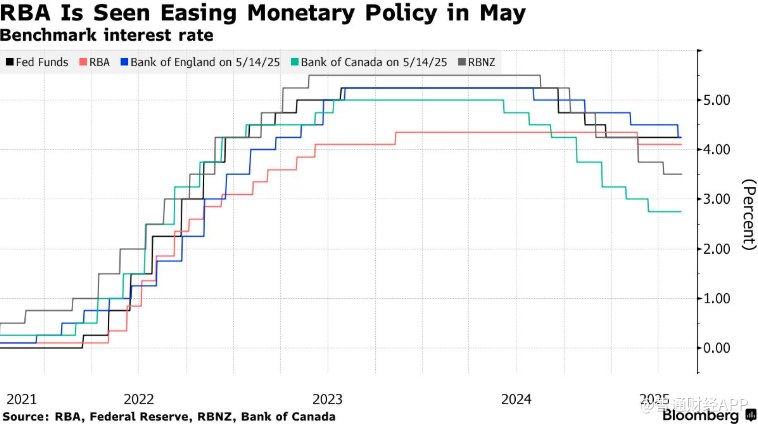
Group 1 - The Reserve Bank of Australia (RBA) is expected to announce a second interest rate cut this year, reducing the cash rate to a two-year low of 3.85% due to easing price pressures and a temporary thaw in US-China trade tensions [1][3] - Economists and the money market anticipate a 25 basis point cut, while RBA Governor Michele Bullock may not indicate further cuts after the decision [1][3] - Recent stronger-than-expected price and labor data, along with a 90-day trade truce between the US and China, have increased the likelihood of a hawkish rate cut in May [1][3] Group 2 - Since the RBA's March meeting, inflation has exceeded expectations, wages have unexpectedly accelerated, and the job market remains tight, leading to a market expectation of two additional rate cuts [3] - The RBA will also release its latest quarterly macroeconomic forecasts, with expectations of downward revisions for inflation, GDP, and employment growth [3] - The RBA's officials are likely to emphasize the tight labor market and the discomfort of wage growth exceeding 3% amid zero productivity growth [3] Group 3 - Analysts describe the RBA's current policy stance as being in a "purgatory" state, with calls for a "hawkish rate cut" [4] - Some economists believe that maintaining the interest rate at 4.1% is a credible scenario for the RBA [4] - The RBA's approach to balancing price growth and labor market sustainability has faced criticism, but it appears to have been effective, with core inflation returning to the target range of 2-3% for the first time in over three years [3]
【招银研究|海外宏观】严阵以待——美联储议息会议点评(2025年5月)
招商银行研究· 2025-05-08 11:33
Core Viewpoint - The Federal Reserve has maintained the benchmark interest rate at 4.25-4.50% and is facing a decision-making dilemma between combating inflation and stabilizing employment, with potential for 1-3 rate cuts within the year totaling 25-75 basis points [1][6]. Group 1: Economic Performance - The U.S. economy is currently in a solid expansion phase, with low unemployment rates and a robust job market [3][5]. - Inflation remains somewhat elevated, and the Federal Reserve is committed to achieving maximum employment and restoring inflation to 2% [3][5]. Group 2: Monetary Policy - The Federal Reserve has decided to keep the federal funds rate target range at 4.25-4.5% and will closely monitor economic indicators, including labor market conditions and inflation pressures, to determine future policy adjustments [3][5]. - The Fed is cautious about the risks associated with its dual mandate of employment and inflation, acknowledging that both unemployment and inflation risks have risen [5][6]. Group 3: Market Strategy - The recommendation is to maintain a strategy of buying long-duration U.S. Treasuries on dips and shorting the dollar on rallies [2][8]. - The market is currently neutral, with expectations for rate cuts being tempered, and the probability of a June rate cut has decreased to around 20% [7][8].

【招银研究】关税形势缓和,地产成交平淡——宏观与策略周度前瞻(2025.05.06-05.09)
招商银行研究· 2025-05-06 10:42
Economic Overview - The latest "hard data" indicates that the US economy remains resilient, with Q1 GDP showing a private sector annualized growth rate of 3.0% after excluding inventory, government purchases, and trade [2] - The job market is stable, with April non-farm payrolls increasing by 177,000, significantly exceeding the market expectation of 138,000, and the unemployment rate holding steady at 4.2% [2] - High-frequency data suggests that the impact of tariffs on the US economy is beginning to manifest, but a recession is still distant. The Atlanta Fed's GDPNOW model predicts a Q2 annualized growth rate for private consumption of 1.9% and a significant drop in private investment growth to 1.3% [2] Market Sentiment and Currency - During the May Day holiday, the risk appetite in overseas markets improved due to better-than-expected non-farm payrolls and signs of easing trade tensions, leading to a rise in US stocks and a rebound in US Treasury yields [4] - The offshore RMB appreciated rapidly, breaking the 7.20 mark, driven by improved market sentiment [4] - The medium-term outlook for the US dollar shows a decline in its fundamental advantages, with short-term fluctuations dependent on trade negotiations [4] Gold Market - The risk of stagflation in the US is rising, coupled with increased central bank gold purchases, suggesting a bullish fundamental outlook for gold. However, short-term overbought conditions may lead to some price correction [5] Domestic Economic Conditions - Domestic demand is under pressure, with retail and catering sales during the May Day holiday increasing by 6.3% year-on-year, surpassing previous holiday performances, while real estate transactions show significant divergence across cities [7] - In April, the transaction volume of new homes in 30 major cities decreased by 12.8% year-on-year, indicating a negative growth trend since November of the previous year [7] - Cross-border tourism has shown strong performance, with international flight numbers increasing by 21.3% year-on-year [8] External Demand and Policy Measures - Overall external demand pressure is evident, but there are signs of recovery in import demand as US importers deplete inventories. Key port throughput has increased since mid-April [8] - The Chinese government is set to implement policies aimed at stabilizing employment, foreign trade, and consumption, with measures expected to roll out in the second quarter [9] - Fiscal measures will accelerate the implementation of the annual budget, focusing on local government bond issuance to support basic livelihood needs [9]