
文化遗产保护

Search documents
新华全媒头条丨中华文明瑰宝 民族交融画卷——布达拉宫保护见证文化传承之路
Xin Hua She· 2025-08-18 10:23
Core Perspective - The article emphasizes the significance of the Potala Palace as a cultural heritage site, showcasing its historical importance and the ongoing efforts for its protection and preservation in the context of Chinese civilization and national unity [1][2][8]. Group 1: Cultural Heritage Protection - The Potala Palace is recognized as the highest and largest palace-style building in the world, symbolizing the historical interactions among various ethnic groups in China [1]. - The management of the Potala Palace has implemented modern technologies such as drones, 3D laser scanning, and multi-angle imaging to create a comprehensive digital model for preservation and research purposes [4][9]. - A monitoring system with over 1,000 sensors has been installed to track structural changes and environmental conditions, ensuring the stability of the palace [4][9]. Group 2: Cultural Exchange and National Unity - The Potala Palace serves as a testament to the historical integration of different ethnic groups, with artifacts and exhibitions highlighting the interactions between Tibet and other regions of China [5][6][7]. - An exhibition titled "Witness and Guardian" features over 100 artifacts that reflect the theme of national unity, showcasing the rich history of cultural exchanges [5][6]. Group 3: Innovative Restoration Efforts - The Potala Palace has initiated a 10-year project with an investment of approximately 300 million yuan for the protection and restoration of ancient texts, including the unique palm-leaf scriptures [9]. - Recent advancements in restoration techniques for palm-leaf scriptures have been achieved, with plans to complete the protection of 46,500 ancient texts by 2028 [9]. - The palace is also exploring ways to transform its cultural resources into high-quality cultural offerings, collaborating with various regions to showcase its artifacts [9].
研究称复活节岛摩艾石像最早将于2080年遭海水侵袭
Zhong Guo Xin Wen Wang· 2025-08-15 08:59
Core Viewpoint - The study published in Cultural Heritage Magazine indicates that rising sea levels may threaten the iconic Moai statues on Easter Island as early as 2080, along with approximately 50 other cultural sites on the island [1] Group 1: Impact of Rising Sea Levels - The research highlights that waves could reach the island's largest ceremonial platform, which houses 15 significant Moai statues, potentially impacting the tourism economy that relies on these sites [1] - The main author of the study emphasizes that rising sea levels are a real and imminent threat, not a distant concern [1] Group 2: Methodology and Broader Implications - Researchers utilized computer simulations to assess the impact of future sea level rise on wave effects and overlaid these results with maps of cultural sites to identify areas at risk of flooding in the coming decades [1] - While the focus is on Easter Island, the findings reflect a broader reality that cultural heritage sites worldwide are increasingly threatened by rising sea levels, as noted in a recent UNESCO report identifying around 50 World Heritage sites at high risk from coastal flooding [1]
2025“永不消失的遗产”全球创客大赛决赛举行
Nan Jing Ri Bao· 2025-08-15 02:37
Core Insights - The "2025 Forever Lost Heritage" Global Maker Competition aims to integrate cultural heritage with modern life, focusing on the theme "One City, One Tower, One River" [1][3] - The "Silk Road Echo" team won the competition with their creative installation "Garden of Sound Bells," inspired by the historical sound bells of the Dabaoen Temple [1][2] - The event saw participation from nearly 700 young creative talents from 19 countries, showcasing innovative proposals for cultural heritage revitalization [1][2] Event Highlights - The competition was organized by the Dabaoen Temple Ruins Museum, with support from UNESCO and various international institutions, enhancing its global perspective [1][2] - 31 young creators presented their digital art installation models, emphasizing interactivity and engagement with cultural heritage [2] - The winning team's design aims to awaken the historical memories of Nanjing, reflecting the city's rich cultural heritage [2] Future Implications - The creative installations developed during the competition will be integrated into public life, forming a growth chain of "creativity—product—industry—economy" [2] - The Dabaoen Temple Ruins Museum plans to officially unveil the "Garden of Sound Bells" installation on its rooftop, inviting global youth to participate in the narrative of Nanjing [2][3] - The competition serves as a model for sustainable development in museums, demonstrating how cultural roots can be preserved amid transformation [3]
世界文化遗产锁阳城遗址享“呵护套餐”焕“新颜”
Zhong Guo Xin Wen Wang· 2025-08-13 09:51
Group 1 - The article highlights the comprehensive preservation efforts for the World Cultural Heritage site of Suoyang City, which includes advanced technologies like remote sensing and new materials to enhance the site's durability [1][2] - Over the past five years, the government has invested more than 10 million RMB in various preservation projects, including the restoration of city walls and archaeological excavations [2] - The archaeological findings at the site, including artifacts from the Tang and Sui dynasties, underscore the historical significance of Suoyang City as a vital hub for Silk Road trade and cultural exchange [3] Group 2 - The site has implemented a monitoring and early warning system to track environmental conditions affecting the heritage site, ensuring ongoing protection and maintenance [2] - Recent enhancements to visitor facilities, such as wooden walkways and viewing platforms, aim to provide an immersive experience of the site's historical and cultural significance [3] - Future plans include the establishment of a digital preservation experience center that will utilize holographic projections and AR technology to engage visitors with the history of Suoyang City [3]
专访吕舟:全民参与正在让北京中轴线“活”起来
Xin Jing Bao· 2025-08-11 12:58
Core Perspective - The successful application for the World Heritage status of Beijing's central axis has initiated a new path for cultural heritage protection that emphasizes public participation [1][2][3] Group 1: Value Transformation and Education - The challenge post-heritage application is to transform heritage protection into a driving force for sustainable urban development, integrating heritage value with social education [2][3] - A significant initiative has been the integration of the central axis's heritage value into basic education, aiming to foster recognition and pride among students regarding their cultural heritage [3][4] - The educational materials developed for different age groups utilize a progressive cognitive design to enhance understanding of the central axis's historical and cultural significance [4] Group 2: Public Participation and Community Engagement - The protection of the central axis requires active public participation, moving beyond the misconception that the successful application is the endpoint [5][6] - Various initiatives, such as the creative competition for the central axis, have engaged hundreds of thousands of participants, demonstrating the potential for cultural heritage to foster community involvement and economic benefits [7][8] - Digital platforms have enabled widespread public engagement in monitoring and protecting the central axis, allowing citizens to contribute actively to heritage conservation [8][9] Group 3: Digital Technology in Heritage Protection - Digital technology has revolutionized cultural heritage protection by enhancing public access and understanding through innovative platforms [9][10] - The use of digital tools allows for immersive experiences that convey the historical evolution of the central axis, making it more relatable to the general public [10][11] - The integration of technology not only broadens the audience's understanding but also maintains the depth of cultural heritage discussions [11][12] Group 4: Long-term Vision and Cultural Significance - The journey of protecting the central axis is viewed as a continuous process, with the goal of making it a living part of the community and a driver for urban development [13][14] - The central axis is seen as a cultural backbone that connects the past, present, and future, emphasizing its role in contemporary society [14][15] - The protection efforts are not merely about preservation but also about cultural innovation and relevance in modern life [15]
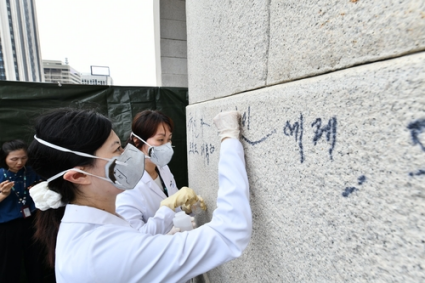
“没写完就被抓”,韩媒:韩国景福宫再遭涂鸦,79岁老人用马克笔写下“特朗普”等内容被捕
Huan Qiu Wang· 2025-08-11 07:48
Core Points - The incident of vandalism at Gyeongbokgung Palace highlights ongoing issues with cultural heritage preservation in South Korea [1][3] - The perpetrator, a 79-year-old man, was arrested after defacing the palace with graffiti, which included references to former President Trump [3] - The South Korean government has committed to responding firmly to any acts of vandalism against national heritage sites [3] Summary by Sections - **Incident Details** - A 79-year-old man named Kim was arrested for vandalizing Gyeongbokgung Palace with a black marker [3] - The graffiti included a message "to the people and the world" and a reference to "President Trump" [3] - The motive behind the act remains unclear [3] - **Government Response** - The Cultural Heritage Administration of South Korea plans to remove the graffiti on the same day and has vowed to take strong action against any damage to national heritage [3] - According to South Korean law, individuals who damage cultural heritage are required to restore the site and cover all repair costs [3] - **Historical Context** - Gyeongbokgung Palace, built in 1395 by King Taejo of the Joseon Dynasty, has faced multiple instances of damage and reconstruction throughout its history [4] - This is not the first instance of vandalism at the palace; a previous incident involved a teenager who was incentivized to graffiti the site, resulting in significant public outrage and repair costs of approximately 130 million KRW [3]

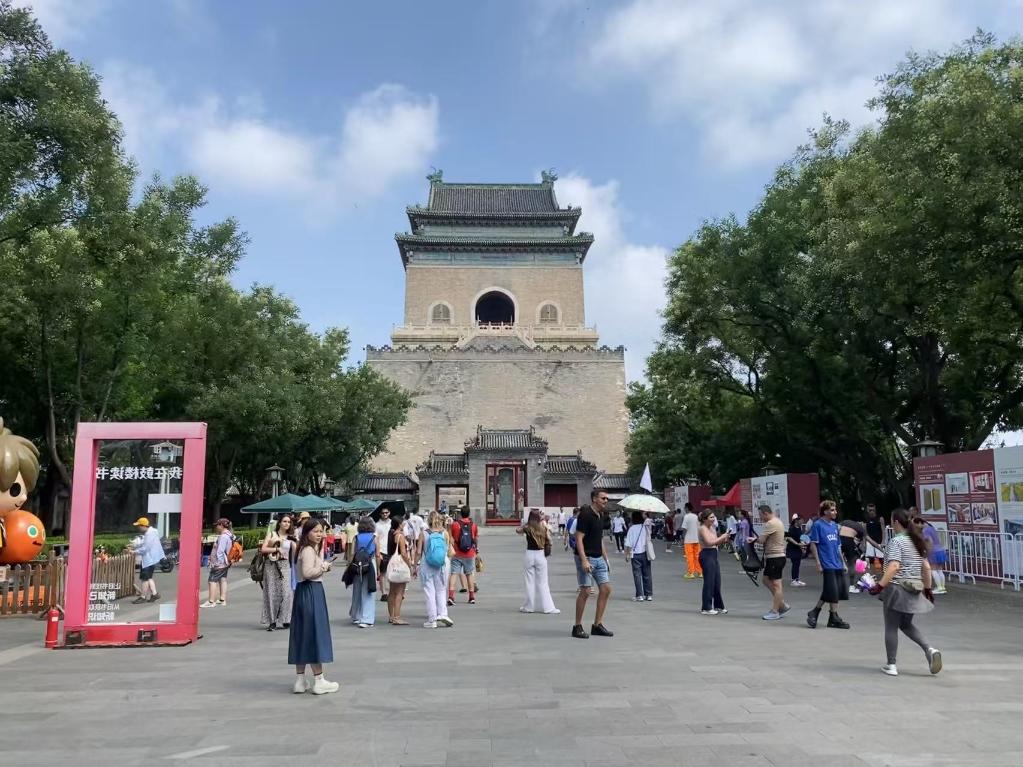
文化中国行|北京:“古都之脊”绽新彩 老城发展添活力
Xin Hua Wang· 2025-08-10 11:49
Core Viewpoint - The revitalization of Beijing's central axis, recognized as a UNESCO World Heritage site, enhances the cultural and tourism landscape, attracting more visitors and enriching local life [4][5][7]. Group 1: Historical Significance - The Beijing central axis, established in the 13th century and completed in the 16th century, spans 7.8 kilometers and is the most complete traditional city axis in China, symbolizing the historical backbone of the ancient capital [4]. - The successful application for World Heritage status on July 27, 2024, has increased interest in lesser-known sites like the Bell and Drum Towers and the Agricultural Ancestors' Altar [4]. Group 2: Tourism Development - Following the World Heritage designation, Beijing has developed new cultural tourism experiences, including themed routes and cultural exploration paths, catering to diverse tourist needs [4][5]. - Visitor numbers have shown a rapid increase, with attractions like the Drum Tower offering interactive experiences that highlight ancient Chinese timekeeping culture [5]. Group 3: Community Engagement - Public participation in the preservation of the central axis is growing, with initiatives like the "Digital Night Watchman" program allowing citizens to contribute to heritage monitoring through mobile applications [5]. - Local residents express pride in the central axis's status as a World Heritage site, noting improvements in cleanliness and the integration of cultural activities into daily life [7].
苏州将建古建工匠数据库
Su Zhou Ri Bao· 2025-08-08 00:29
Core Viewpoint - The establishment of the Suzhou Architectural Industry Association's Garden and Ancient Building Construction Branch aims to protect and inherit the "Xiangshan Gang" traditional building skills, promoting standardization and professionalism in Suzhou's garden and ancient building industry [1][2] Group 1: Establishment and Mission - The "Xiangshan Gang" traditional building skills are recognized as a national and human intangible cultural heritage, representing a historical treasure left by ancient craftsmen in Suzhou [1] - The newly formed branch includes nearly 30 leading enterprises, including Suzhou Garden Group, with the mission of "inheriting thousand-year skills and building a new era chapter" [1] Group 2: Talent Development and Standards - Suzhou has initiated the "Xiangshan Talent Training Program" and issued implementation opinions to protect and inherit the "Xiangshan Gang" traditional building skills, establishing a talent evaluation mechanism and a third-party assessment institution [1] - A three-year action plan for the protection and inheritance of the "Xiangshan Gang" traditional building skills has been formulated to provide institutional support for talent cultivation [1] Group 3: Future Plans and Innovations - The branch will first compile the "Xiangshan Gang Ancient Building Construction and Acceptance Standards," addressing the gap in industry technical standards [2] - Future focus areas include ancient building restoration and cultural tourism integration, utilizing a resource integration and collaborative model to innovate while preserving heritage [2]
知敬畏是价值观也是方法论
Ren Min Ri Bao· 2025-08-07 01:51
Group 1 - The concept of "respect" and "fear" is essential for maintaining discipline and integrity within organizations, emphasizing the need for a balance between internal respect and external constraints [1][2] - The lack of "fear" among individuals in power can lead to corruption and misconduct, as they may disregard the consequences of their actions [1][2] - Historical and cultural preservation is highlighted as an area where respect and fear should guide decision-making, avoiding reckless actions that could harm cultural heritage [2] Group 2 - The importance of adhering to market rules and natural laws is emphasized, suggesting that a lack of respect for these principles can lead to detrimental outcomes for industries [2] - Organizations should cultivate a mindset of caution and awareness, recognizing the significance of their actions and the potential impact on society and the environment [3]
知敬畏是价值观也是方法论(人民论坛)
Ren Min Ri Bao· 2025-08-06 22:49
Group 1 - The concept of "respect" and "fear" is essential for maintaining discipline and integrity within organizations, emphasizing the need for a balance between internal respect and external constraints [1][2] - Historical and cultural heritage protection is highlighted as an area where respect and fear should guide decision-making, advocating for sustainable development over reckless urban expansion [2] - The misuse of administrative power and market interference by some local authorities is criticized, indicating that a lack of respect for market rules can hinder healthy industry development [2] Group 2 - The importance of having a mindset of caution and strategic thinking is emphasized, suggesting that wisdom and capability come from maintaining a sense of respect and fear in decision-making processes [3]