
普惠金融

Search documents
同频共振数十载 中国平安与深圳特区的时代交响
Shen Zhen Shang Bao· 2025-08-25 22:53
Core Insights - The establishment of the Shenzhen Special Economic Zone in August 1980 marked the beginning of a transformative journey for both Shenzhen and China Ping An, which evolved from a small property insurance company to a global financial giant with assets exceeding 13 trillion yuan and nearly 245 million customers [2][4] - China Ping An's growth trajectory is closely intertwined with Shenzhen's development, showcasing a narrative of reform, innovation, and breakthroughs [3][4] Group 1: Historical Development - China Ping An was founded in 1988 in Shekou, becoming China's first joint-stock insurance company and pioneering several industry innovations [4][5] - Shenzhen's GDP grew from 2.7 million yuan in 1980 to 180.4 billion yuan in 1999, reflecting the rapid economic development of the region [4] - In the new millennium, China Ping An transitioned from an insurance company to a comprehensive financial group, aligning with Shenzhen's goal of becoming a regional financial center [4][5] Group 2: Strategic Innovations - China Ping An's comprehensive financial strategy received strong support from Shenzhen's government, contributing to its successful IPO in 2007, which set a record for the largest insurance company IPO globally [5] - The company has invested over 100 billion yuan in technology research and development, applying for more than 55,000 technology patents, positioning itself among the leading financial institutions globally [5][6] Group 3: Financial Services and Initiatives - China Ping An is actively involved in various financial sectors, including technology finance, green finance, inclusive finance, pension finance, and digital finance, responding to national mandates for sustainable development [6][9][13][15] - The company has developed a comprehensive technology finance service system for tech enterprises, supporting Shenzhen's ambition to become a global innovation hub [8][9] Group 4: Future Outlook - As Shenzhen celebrates its 45th anniversary, China Ping An continues to play a significant role in the region's economic development, embodying the spirit of innovation and reform [16][17] - The company aims to leverage its financial capabilities to support national strategies and contribute to the modernization of China [17]



写好普惠金融大文章 绘就民生幸福新图景 中信银行北京分行多措并举推动普惠金融服务高质量发展
Bei Jing Qing Nian Bao· 2025-08-25 18:23
Core Viewpoint - CITIC Bank Beijing Branch is committed to supporting the economic development of the capital by providing innovative financial services to small and micro enterprises, emphasizing a "people-oriented" approach through policy implementation, product iteration, and model innovation [1] Policy Implementation - The bank has established a rapid response mechanism to address the urgent funding needs of small and micro enterprises, exemplified by a case where a company received a 10 million yuan loan within a week without the need for principal repayment [2] - As of the end of Q2 2025, the branch's outstanding balance of loans for small and micro enterprises reached 2.471 billion yuan, with a renewal loan ratio of 17.5%, demonstrating a commitment to continuous support for these businesses [2] Product Innovation - The launch of the "Chuangxin e-loan" product allows small enterprises to obtain loans of up to 3 million yuan online within 30 minutes without collateral, showcasing the bank's focus on technology-driven solutions [3] - This product utilizes big data from the People's Bank of China to create a credit transmission mechanism that extends the credit of large enterprises to upstream small suppliers, overcoming limitations of traditional supply chain finance [3] Service Upgrade - In the first half of 2025, the bank achieved over 10% growth in loans to small and micro enterprises, serving nearly 5,000 clients, indicating significant service upgrades [4] - The bank aims to simplify processes and reduce interest rates for small enterprises, ensuring they can access affordable financing while also building a professional service team to cover both existing and potential clients [4] - Looking ahead, CITIC Bank Beijing Branch plans to continue its strategy of affordable costs and sustainable business, focusing on supporting technological innovation and green development to enhance the impact of inclusive finance on the real economy [4]

一线调研|当“苏超”遇见普惠金融:江南农商行的差异化竞争之路
2 1 Shi Ji Jing Ji Bao Dao· 2025-08-25 12:01
Group 1 - The article highlights the rise of the "Su Chao" league and its impact on local businesses and community engagement, particularly through the story of Jiangnan Rural Commercial Bank employee Wang Haining, who balances his job and passion for football [1][2] - Jiangnan Rural Commercial Bank has successfully supported local small and micro enterprises, with Wang Haining expanding his client base to 32 small micro clients and a credit balance of 26.17 million yuan [1][2] - The bank's strategy focuses on localized service and understanding the unique needs of small businesses, contrasting with larger banks that are increasing their market share in small micro enterprise loans [3][4] Group 2 - Data shows that the share of large commercial banks in providing inclusive loans to small micro enterprises has increased from 31.65% in 2020 to 42.77% by the end of 2024, while rural financial institutions' share has decreased from 33.92% to 26.87% in the same period [3] - Jiangnan Rural Commercial Bank's approach includes grassroots engagement and efficient service, emphasizing the importance of building trust with local small business owners [3][4] - The bank reported a loan balance of 196.55 billion yuan for private enterprises, with an increase of 6.56 billion yuan and a growth rate of 3.45% as of June 2025 [4] Group 3 - The bank has initiated a "thousand-household" outreach program where executives personally engage with small businesses to understand their needs and provide tailored financial solutions [4][5] - Jiangnan Rural Commercial Bank aims to create differentiated products that cater to local industries, such as supply chain finance products for manufacturing businesses [6][10] - The bank's leadership emphasizes the importance of speed, depth, and warmth in service delivery, aiming to be a responsive partner for local enterprises [10][11] Group 4 - The bank has developed its own AI platform, "Xiao Jiang Zhi Nao," to enhance service efficiency and customer experience, although it faces challenges related to data availability and talent shortages [11] - The bank's commitment to serving small micro enterprises and rural areas is seen as essential for local economic stability and growth, positioning itself as a vital player in the financial ecosystem [10][11]
当“苏超”遇见普惠金融:江南农商行的差异化竞争之路
2 1 Shi Ji Jing Ji Bao Dao· 2025-08-25 11:53
Group 1 - Jiangnan Rural Commercial Bank aims to focus on non-standardized products and operational products, leveraging its advantages in differentiation [1][8] - The bank's strategy includes deepening local engagement and understanding the specific needs of small and micro enterprises [5][6] - The bank has successfully increased its loans to private enterprises and agricultural loans, demonstrating effective support for local economic development [6][7] Group 2 - The bank's employees, like Wang Haining, actively engage in community activities, which helps in expanding their client base and building trust [3][4] - Jiangnan Rural Commercial Bank emphasizes the importance of personalized service and quick response times to meet the needs of local businesses [5][13] - The bank has implemented a "run a thousand households" initiative, where executives personally visit small enterprises to understand their needs better [6][7] Group 3 - The bank's digital transformation includes the development of the "Xiao Jiang Smart Brain" model application platform to enhance service efficiency and customer experience [13][14] - Challenges in implementing advanced digital solutions include data scarcity and a lack of qualified personnel with both financial and technical expertise [14] - The bank believes that understanding local economic and cultural contexts is crucial for effectively leveraging digital tools in financial services [14]

金蝶征信:用“数据+场景”破解普惠信贷业务痛点
Zhong Zheng Wang· 2025-08-25 09:21
Group 1 - The core issue facing the banking industry is the "scarcity of quality assets" in the inclusive credit business, which can be addressed through a "data + scenario" collaborative model [1] - Current inclusive credit operations primarily rely on the "bank-tax interaction" mechanism, which reflects the results of business operations rather than real-time dynamics; invoice data is emerging as a crucial supplement [1] - Case studies presented at the conference illustrate that transaction data is more indicative of a company's true creditworthiness compared to traditional tax and financial reports [1] Group 2 - High-quality data is essential for the sustainable development of inclusive finance, emphasizing the need to not only possess data but also to understand it within specific industrial contexts [2] - The newly launched "Tax Invoice Anti-Fraud AI Model 2.0" by the company integrates AI and GraphRAG technology to identify fraudulent activities, enhancing risk management in loan approval and monitoring [2] - The challenge of distinguishing quality small and medium enterprises (SMEs) is prevalent among banks, with the company suggesting that quality SMEs are often embedded within supply chains rather than being concentrated among leading firms [3] Group 3 - The company has developed a service model called "one industry, one solution" in collaboration with major banks, embedding credit services directly into real transaction chains [3] - Utilizing transaction graphs and privacy computing technology, the company can analyze the authenticity and continuity of invoice data, creating a whitelist of quality enterprises within the industry ecosystem [3] - Within three weeks of launching this service model, the credit scale exceeded 60 million yuan, demonstrating the feasibility of this scenario-based service approach [3]
阳光保险公布2025年中期业绩
Zheng Quan Ri Bao· 2025-08-25 09:13
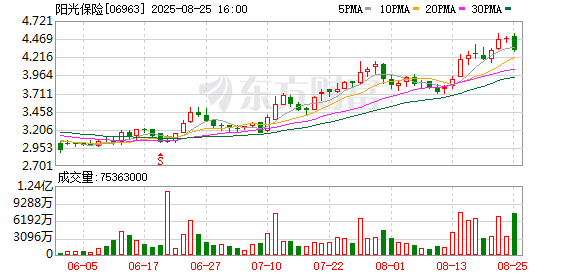
Core Insights - Sunshine Insurance reported a total premium income of 80.81 billion yuan for the first half of 2025, representing a year-on-year growth of 5.7% [2] - The net profit attributable to shareholders reached 3.39 billion yuan, up 7.8% year-on-year [2] - The group's embedded value increased to 128.49 billion yuan, reflecting an 11.0% growth compared to the end of the previous year [2] Life Insurance Segment - Sunshine Life achieved total premium income of 55.44 billion yuan, a year-on-year increase of 7.1% [2] - The new business value for the first half of the year was 4.01 billion yuan, with a comparable year-on-year growth of 47.3% [2] - The contract service margin balance reached 56.08 billion yuan, up 10.3% from the end of the previous year [2] - Individual insurance business saw a total premium income of 15.34 billion yuan, growing 12.1% year-on-year, with new business value at 1.23 billion yuan, up 23.6% [2] - The proportion of floating income products and protection products exceeded 50%, an increase of 26 percentage points year-on-year [2] Health Insurance and Other Channels - The bancassurance business reported total premium income of 35.44 billion yuan, a growth of 4.2% [2] - Other channels, including group insurance, online sales, and agency business, generated a total premium income of 4.66 billion yuan, up 14.9% [2] Property Insurance Segment - Sunshine Property achieved original premium income of 25.27 billion yuan, a year-on-year increase of 2.5% [3] - The combined underwriting cost ratio improved to 98.8%, a 0.3 percentage point optimization [3] - The underwriting profit reached 290 million yuan, up 42.4% year-on-year [3] - In the auto insurance sector, original premium income was 12.5 billion yuan, with a 3 percentage point increase in the proportion of household vehicle premiums [3] - Non-auto insurance premium income grew by 12.5% to 12.78 billion yuan [3] Asset Management - As of June 30, 2025, the total investment assets of the group amounted to 591.86 billion yuan, a 7.9% increase from the end of the previous year [3] - Total investment income reached 10.7 billion yuan, reflecting a year-on-year growth of 28.5% [3] - Comprehensive investment income was 16.33 billion yuan, up 9.2% year-on-year [3] Technological Advancements - The company has enhanced its AI capabilities to improve quality, reduce costs, and increase efficiency [4] - Sunshine Life upgraded its proprietary "Customer Family Protection Needs Recommendation System" for more precise and customized services [4] - Sunshine Property improved its mobile sales management platform "All-in-One Insurance" App, increasing batch quotation efficiency by over three times [4] Support for the Real Economy - In the first half of the year, the company provided risk protection amounting to 35 trillion yuan for the real economy [4] - The investment balance exceeded 480 billion yuan [4] Financial Services Initiatives - The company provided various technology insurance guarantees totaling approximately 37 billion yuan [5] - In the green finance sector, it offered nearly 7.5 trillion yuan in green insurance guarantees [5] - The company provided 830 billion yuan in agricultural and rural insurance, along with 16 trillion yuan in various inclusive financial protections [5] - Innovations in pension financial products were introduced to enrich the pension protection product matrix [5] - The company is deepening its digital transformation and enhancing AI application capabilities across major business areas [5]
昆山农商银行:深耕地方,精准滴灌,开启制造业金融服务新篇章
Jiang Nan Shi Bao· 2025-08-25 08:34
Core Viewpoint - Kunshan Rural Commercial Bank is committed to serving the local economy and supporting the high-quality development of regional manufacturing, particularly focusing on small and micro manufacturing enterprises [1] Group 1: Service Network Development - The bank has established a service system that closely aligns with the needs of manufacturing enterprises, ensuring effective communication and understanding of their financing requirements [2] - Customer managers have conducted regular visits to 2,569 micro and small enterprises, resulting in the issuance of 454 million yuan in new inclusive small loans [2] Group 2: Innovative Product System - To address the financing challenges faced by small and micro manufacturing enterprises, the bank has developed a range of specialized financial products, including "Specialized, Refined, Characteristic, and Innovative" loans and "Order Loans" [3] - The bank has issued 170 million yuan through its "Credit-Backed Loan" product, benefiting 161 small enterprises [3] Group 3: Service Quality Improvement - The bank has enhanced its online banking services, allowing for loan applications and approvals to be processed quickly, with funds potentially available within 24 hours [4] - A comprehensive suite of financial services is offered, including payment settlement, payroll services, and policy consultation, aimed at reducing costs and improving efficiency for manufacturing enterprises [4] Group 4: Commitment to Local Development - The bank remains dedicated to its mission of supporting local manufacturing and will continue to innovate its products and services to foster growth in the sector [5]

金融壹账通数字化“贷”动新型工业 让信贷“活水”精准滴灌实体经济
Zhong Jin Zai Xian· 2025-08-25 07:53
Core Insights - The article emphasizes the importance of financial institutions supporting new industrialization through differentiated credit policies tailored to specific industries and stages of enterprise growth [1] - It highlights the contrasting scenarios in the banking credit market, where traditional loan approvals are stagnating while automated small and micro loans are on the rise, reflecting deeper contradictions in risk control strategies during economic downturns [1] - The integration of digital technologies such as AI and big data is crucial for transforming the entire credit process, making it a key tool for financial institutions to implement policies and serve the real economy [1][2] Group 1: Digital Credit Transformation - The core of digital credit transformation is not merely the accumulation of technologies but the systematic construction of a complete technical loop covering due diligence, approval, risk control, and operation [2] - Financial One Account's digital credit solution exemplifies an end-to-end system that enhances risk management, decision-making, and operational efficiency through AI and big data analysis [2] - The introduction of intelligent due diligence solutions significantly reduces the time and reliance on manual processes, automating up to 80% of credit investigation reports and improving quality by 70% [2] Group 2: Practical Applications and Impact - Financial One Account's AI-driven solutions have demonstrated substantial efficiency improvements, increasing client manager productivity by approximately six times and reducing loan approval times to about one day [4] - The intelligent visual anti-fraud product has achieved over 70% automatic approval rates for retail loan face-to-face assessments, successfully intercepting fraudulent amounts exceeding 700,000 yuan while facilitating over 1 billion yuan in loans [4] - The "Xiangyin Housing Mortgage Loan" product exemplifies effective service to small businesses, with a total of 22,410 clients and a loan amount of 6.11 billion yuan, showcasing both inclusivity and commercial sustainability [4][7] Group 3: International Expansion and Results - Financial One Account has successfully implemented a fully online microcredit system for an international bank, reducing manual processing time by over 70% and achieving over 60% efficiency improvement in loan processing [5] - The digital SME credit system has served over 2 million small and medium enterprises, contributing to a total inclusive loan balance of 32.93 trillion yuan, while also extending its "data credit" model to rural revitalization efforts [6] Group 4: Future Directions and Challenges - The future of digital credit is expected to evolve towards deeper integration with industrial scenarios, enhanced decision-making capabilities through large models, and cross-institutional data collaboration to improve risk control precision [8] - The industry faces challenges such as the need for improved management capabilities in banks as inclusive credit scales up, and the necessity for agile adaptation of credit models and rules in response to data and policy changes [7]
泰兴农商银行:三维服务精准触达小微
Xin Hua Ri Bao· 2025-08-25 07:35
立体网络覆盖,"扫码即贷"惠全民。创新推出"一码贷"专属二维码,广泛覆盖全市公交站台、小区电 梯、村委会等高流量场景,居民扫码即可实时测额、在线申贷,实现金融服务"触手可及"。建立"扫码 申请—实时响应—线下跟进"闭环机制,对需线下核验的客户,专属客户经理在24小时内主动对接,确 保服务无缝衔接。 链式金融赋能,产业生态共繁荣。稳步推进供应链金融,优选核心企业,深挖上下游小微企业需求,配 套多样化金融产品推动信贷业务增量扩面。成功复制"织梦"样本经验至多个农产品行业,先后与分界镇 甜豌豆种植合作社、鹏程禽蛋合作社、姚王街道江缘江沙蟹养殖基地、新街镇鲜时学生餐、澳华饲料等 龙头企业达成深度合作,量身定制金融服务方案,激活农业产业链活力。 科技筑牢底线,普惠服务更安全。升级普惠展业平台,整合工商、税务、征信等10余类数据源构建客户 全景画像体系,前置反中介规则,形成"源头识别—走访核验—签约确认"全流程风控闭环。建立"红黄 绿"五维客户分级模型(政策导向、同业竞争、违约概率、成长趋势、综合贡献),实施"增持—减退— 退出"差异化策略,确保信贷资产质量安全可控。 党建共建为桥,政策落地"零距离"。深化与农业农村局党 ...
【高端访谈】上海农商银行董事长徐力:廿载筑基向百年,以价值创造书写金融为民答卷
Xin Hua Cai Jing· 2025-08-25 07:34
Core Viewpoint - Shanghai Rural Commercial Bank has evolved over 20 years from rural credit cooperatives to a modern commercial bank, focusing on value creation and serving the public as its core mission [1][2][4]. Group 1: Historical Development - Established in 2005, Shanghai Rural Commercial Bank marked the transformation of rural credit cooperatives into a modern commercial bank, maintaining a commitment to value creation and serving the public [2]. - The bank has expanded its services from rural areas to urban centers, with significant milestones including the opening of its first urban branch in 2006 and its listing on the Shanghai Stock Exchange in 2021, achieving a market capitalization exceeding 85 billion yuan [2][3]. Group 2: Core Mission and Values - The bank's mission, "Inclusive finance to support a better life for the public," and its vision of being a service-oriented bank focused on value creation have remained consistent despite changing times [3][4]. - The bank emphasizes a culture of "integrity and kindness," aiming to create a comprehensive financial service system that includes retail, inclusive, and technology-driven finance [3]. Group 3: Strategic Shift - In response to the new normal of low interest rates and economic uncertainty, the bank is shifting its focus from scale expansion to value creation, emphasizing the importance of serving customers and addressing social needs [4][5]. - The bank aims to create three types of value for customers: functional, exclusive, and emotional, adapting to changing customer demands and moving beyond traditional banking services [5][6]. Group 4: Social Responsibility and Community Engagement - The bank's "Heart Home" public service project exemplifies its commitment to providing emotional value by extending services beyond financial offerings to community support, including health care and educational services [7][8]. - The bank aims to enhance the quality of life for the elderly and address their needs, positioning itself as a socially responsible institution that integrates financial services with community welfare [8][9].