中国之治

Search documents
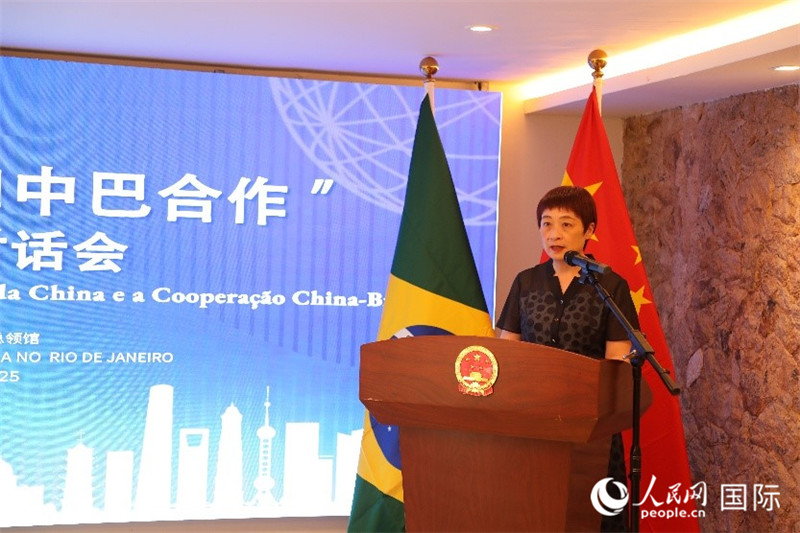
中国驻里约总领馆举办“中国之治与中巴合作”媒体对话会
人民网-国际频道 原创稿· 2025-12-11 07:10
Group 1 - The media dialogue hosted by the Chinese Consulate in Rio de Janeiro focused on the significance of the 20th Central Committee's Fourth Plenary Session and China-Brazil cooperation [1][2] - Chinese diplomats discussed various topics including China's institutional advantages, high-level opening up, technological development, green transformation, poverty alleviation achievements, and the Taiwan issue [2] - Brazilian media representatives expressed appreciation for the event, acknowledging China's development achievements and committing to share positive narratives about China with the Brazilian public [4] Group 2 - The dialogue aimed to enhance mutual understanding and deepen friendly cooperation between China and Brazil [1][4] - The event featured active participation from both Chinese and Brazilian media, fostering discussions on political trust, economic cooperation, cultural exchanges, and educational interactions [2] - The atmosphere of the dialogue was friendly and conducive to open communication, reflecting a positive outlook on China-Brazil relations [4]

从五年规划看“中国之治”
Ren Min Ri Bao· 2025-12-09 22:20
党的二十届四中全会通过的"十五五"规划建议,提供了读懂"中国之治"的一扇窗口。 习近平总书记指出:"科学制定和接续实施五年规划,是我们党治国理政一条重要经验,也是中国特色 社会主义一个重要政治优势。" 世界百年变局加速演进,"中国之治"风景这边独好。 "中国之治"的密码是什么,背后的逻辑是什么,未来的前景是什么?面对"世界怎么了、我们怎么办"这 一时代之问,人们一次次把目光投向中国。 从"一五"到"五五",我国建立起独立的比较完整的工业体系和国民经济体系;"六五""七五",推动基本 解决温饱问题;"八五""九五",实现人民生活总体达到小康水平;"十五"到"十三五",全面建成小康社 会;"十四五"时期,我国经济实力、科技实力、综合国力跃上新台阶,中国式现代化迈出新的坚实步 伐。 一步一个脚印,一程接着一程,在一个又一个五年规划(计划)的接力中,中国式现代化已经展开壮美 画卷并呈现出无比光明灿烂的前景。 "十五五",承前启后的关键时期。回望十四个五年,展望新的五年,眺望伟大复兴的航程,我们更能深 刻理解"中国之制"的巨大优势,更能深刻感受"中国之治"的强大效能。 领导力—— 党的领导是中国特色社会主义制度的最大优 ...
共同富裕彰显“中国之治”优势——广东实施“百千万工程”破解区域协调的发展难题纪实(下)
Xin Hua Wang· 2025-11-30 11:00
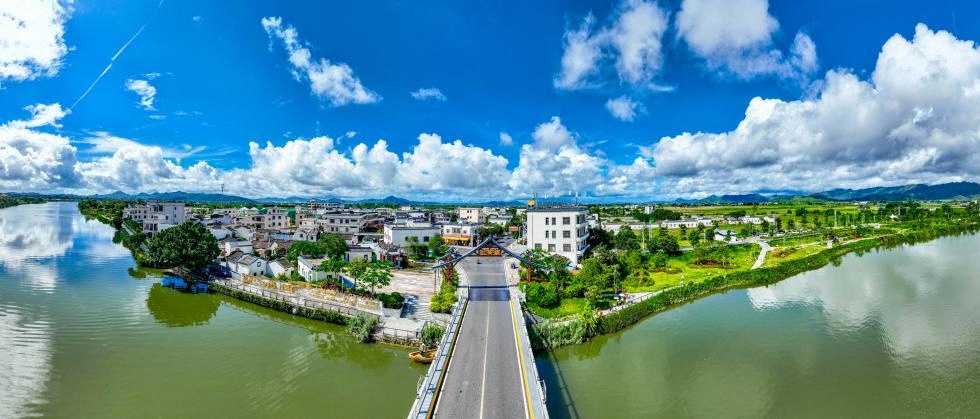
区域协调发展是中国式现代化的内在要求。"十五五"规划建议对促进区域协调发展作出重要部署。 区域协调发展也是世界性、历史性难题。受访专家学者认为,广东"百千万工程"这一写在岭南大地的新实践,以地方的鲜活案例彰显了我国的制 度优势。 "以人民为中心",解答难题的"开锁之匙" 事实证明,只有坚持以人民为中心的崇高追求,并拥有政治魄力和战略定力,才有可能解决协调发展难题。广东践行"千万工程"理念,实施"百千 万工程"3年来,通过政府有形之手来弥补市场缺陷,推动区域协调发展取得初步成效。 在记者的调研中,有的专家和干部一开始对于"百千万工程"也是心存疑虑的:明明把钱投到珠三角效率更高、产出更大,可能增长也更快,干嘛 要放到粤东西北去?放着快钱容易钱不挣,非干苦活找苦吃? 基层的变化提供了答案。汕尾市副市长周小壮介绍,随着环境的提升,最近3年每年到汕尾过夜旅游的人数从七八百万增长到2000多万,不仅珠三 角,来自港澳甚至国外的游客也越来越多。 在汕头采访时,一名汕尾企业家告诉记者,以前有些汕尾人在外工作时,只说"我是潮汕的"而不说我是汕尾的,更别提带朋友回老家了。而现在 到了周末,好多人呼朋唤友、成群结伴回家乡。 一名在 ...
全国婚姻家庭纠纷人民调解工作“大比武”总决赛暨展示活动在长举行
Chang Sha Wan Bao· 2025-11-29 02:23
Group 1 - The national marriage and family dispute mediation competition and exhibition event was held in Changsha, co-hosted by the All-China Women's Federation and the Ministry of Justice [1] - Huang Xiaowei emphasized the importance of marriage mediation work in the context of Xi Jinping's thought, highlighting its role in promoting social stability and family harmony [1] - The event aims to enhance the effectiveness of marriage mediation services and improve the happiness index of families, contributing to national construction and the rejuvenation of the nation [1] Group 2 - Li Mingzheng stressed the need to integrate marriage and family dispute mediation into the broader context of social stability, advocating for a comprehensive mechanism for prevention and resolution of disputes [2] - The Hunan province has actively explored multi-faceted mediation service models, establishing a four-level mediation platform and creating service brands such as "Sunflower Action" and "Xiang Sister Legal Education" [2] - The event serves as an opportunity to promote the "Fengqiao Experience" and enhance the mechanisms for marriage and family dispute mediation, aiming to protect family happiness and promote family civilization [2]
外交部驻澳门特派员公署向葡语国家电视台赠送纪录片
Xin Hua She· 2025-11-27 00:55
Core Viewpoint - The event held in Macau focused on the significance of the documentary "The Path of Chinese Modernization," which aims to explain the successful governance model of China and promote cooperation with Portuguese-speaking countries [1]. Group 1: Event Overview - The documentary was presented by the Ministry of Foreign Affairs in Macau and the Macau SAR government, highlighting China's commitment to high-level opening-up and creating development opportunities for various countries [1]. - Key officials, including the acting commissioner of the Ministry of Foreign Affairs and the Secretary for Social Affairs and Culture of Macau, attended the event and delivered speeches emphasizing the importance of cultural exchange [1]. Group 2: Cooperation and Cultural Exchange - The event marks the fourth consecutive year that the Ministry of Foreign Affairs has donated documentaries to Portuguese-speaking countries, enhancing Macau's role as a cultural exchange hub [1]. - Representatives from Portuguese-speaking countries expressed gratitude for the documentary, noting the popularity of Chinese solutions and wisdom among Portuguese-speaking audiences, and their willingness to further facilitate friendly cooperation [1]. Group 3: Future Engagement - Following the event, representatives from Portuguese-speaking countries will visit the Hengqin Guangdong-Macau Deep Cooperation Zone to experience the integration achievements firsthand [2].
开放发展的中国,世界的机遇和信心 ——从进博会到自贸港
Ren Min Ri Bao· 2025-11-13 22:05
Core Points - The importance of open cooperation and mutual benefit in China's modernization is emphasized, with the recent China International Import Expo (CIIE) showcasing significant achievements in international trade [1][2] - The CIIE recorded an intention transaction amount of $83.49 billion, with participation from 4,108 companies across 138 countries and regions, setting new historical records [1] - The Hainan Free Trade Port is set to officially launch full island closure on December 18, marking a significant step in China's commitment to high-level opening up [1][2] Group 1: Economic Potential - China's large consumer market, with over 1.4 billion people and nearly 50 trillion yuan in annual consumption, is highlighted as a strategic asset for both domestic and global economic growth [4] - The country has become the world's second-largest consumer and import market, continuously opening its market to the world [2][4] - The growth of the middle-income group and the rise of youth consumers are driving demand for high-quality products, enhancing the interaction between supply and demand [4] Group 2: Innovation and Industry - China is focusing on technological innovation and the development of a modern industrial system, which is expected to inject strong momentum into the global economy [5][6] - The country is actively developing future industries and upgrading traditional sectors, with significant advancements in areas such as artificial intelligence, quantum technology, and renewable energy [5] - The integration of innovation and industry is creating a favorable environment for global innovation, positioning China as a strategic market for growth [6] Group 3: Business Environment - China is committed to creating a market-oriented, law-based, and international business environment, promoting fair competition among various ownership enterprises [9][10] - The country has implemented visa-free policies for 76 countries, enhancing its attractiveness as a safe investment destination [9] - The stability of China's political and social environment is seen as a key factor in its ability to attract foreign investment and foster economic growth [8][9]
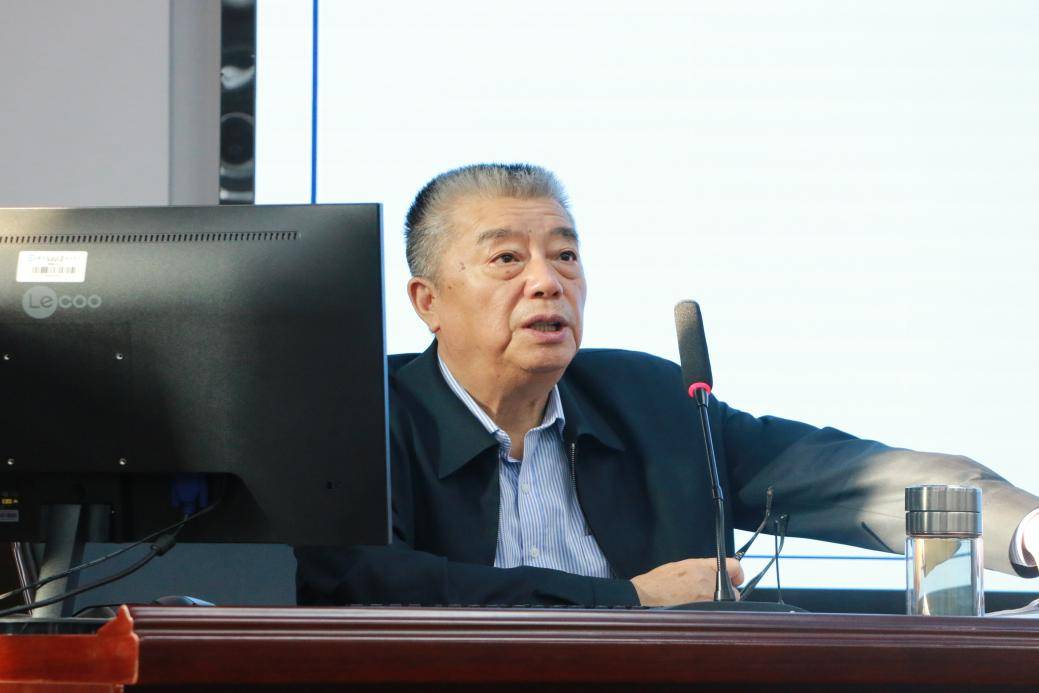
辽宁大学林木西教授来湖南科技大学讲学 经济拔尖班学子参会学习
Sou Hu Cai Jing· 2025-10-25 18:07
Core Viewpoint - The report emphasizes the significance of China's five-year plans as a crucial strategy for governance and economic development, highlighting their role in achieving the "Chinese miracle" and effective governance [3][5]. Group 1: Importance of Five-Year Plans - The five-year plan is identified as a key vehicle for "China's governance," essential for establishing a robust macroeconomic governance system [5]. - Lin Muxi outlines three key terms: "important advantages, important support, and concentrated embodiment," which reflect the critical role of five-year plans in "China's governance" [3]. Group 2: Implementation and Coordination - The rational layout of government macro-control should closely align with the rational behavior of market micro-entities to achieve organic balance between macro and micro [5]. - Lin Muxi calls for adherence to six "persistences" to support the party's leadership and actively participate in the implementation of national five-year planning goals [5]. Group 3: Educational Impact - The lecture serves as a bridge between academic frontiers and business education, helping students understand the internal logic of national planning and economic development [9]. - Students from the elite economics class are encouraged to align their professional growth with the strategic needs of the "14th Five-Year Plan," contributing to high-quality national economic development [9].
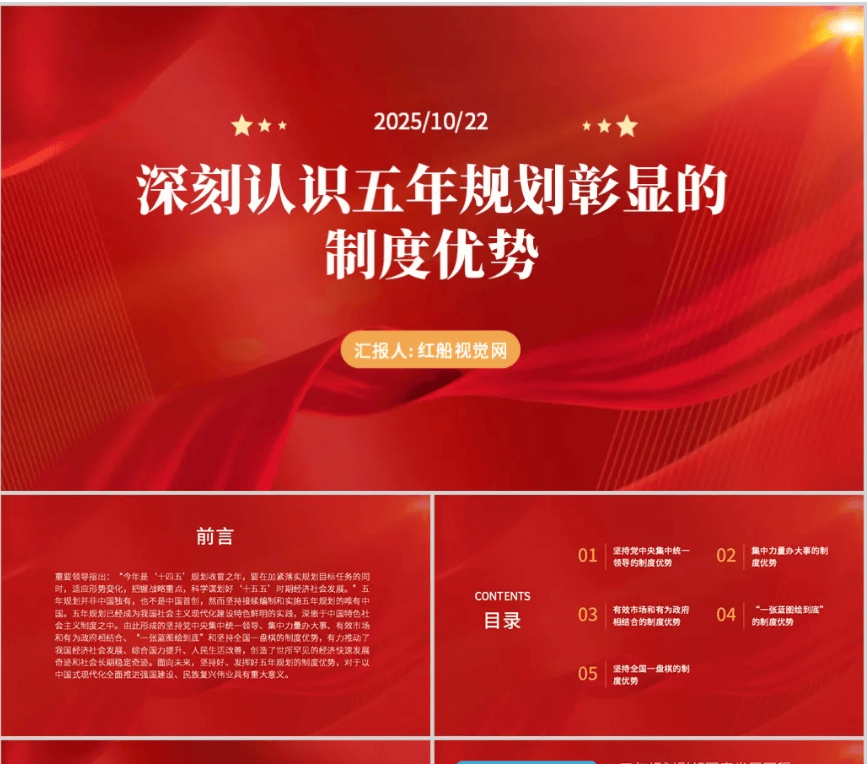
从五年规划看“中国之治”的制度优势PPT
Sou Hu Cai Jing· 2025-10-25 14:46
Core Insights - The Five-Year Plan serves as China's strategic framework for future development, outlining national goals, priorities, and guiding principles for governance [1][3][7] Group 1: Governance and Institutional Advantages - The Five-Year Plan establishes a comprehensive "goal governance" system characterized by scientific goal setting, systematic implementation, and flexible adjustment, which together form China's unique governance advantage [3][5] - It reflects the institutional advantage of concentrating resources to accomplish significant tasks, enabling rapid development and achieving industrialization in a fraction of the time taken by Western countries [3][5] Group 2: Market and Government Interaction - The Five-Year Plan embodies the organic combination of an "effective market" and a "proactive government," allowing for optimal resource allocation while maintaining government guidance to ensure economic stability [5][7] - It plays a crucial role in building a high-level market economy, helping the government maintain market order and stimulate innovation and internal motivation within society [5][7] Group 3: Long-term Strategic Vision - The principle of "drawing a blueprint and sticking to it" demonstrates a long-term strategic determination, allowing China to navigate challenges without being swayed by short-term fluctuations [5][7] - Since the first Five-Year Plan in 1953, China has consistently implemented successive plans, showcasing a commitment to modernization despite changing international circumstances [5][7]
蕴含“中国之治”密码的宏伟蓝图
Yang Shi Xin Wen Ke Hu Duan· 2025-10-25 07:15
Core Insights - The recent Fourth Plenary Session of the 20th Central Committee of the Communist Party of China has approved the "Suggestions on Formulating the 15th Five-Year Plan for National Economic and Social Development," outlining the guiding principles and main objectives for China's economic and social development over the next five years [1][3] - The "15th Five-Year Plan" is positioned as a critical period for achieving basic socialist modernization, linking the achievements of the "14th Five-Year Plan" with the long-term goals set for 2035 [3][4] - The plan emphasizes high-quality development as the primary goal, with a focus on building a modern industrial system and strengthening the foundation of the real economy [4][6] Economic Growth and Development - China's economy is projected to reach approximately 140 trillion RMB by 2025, with an expected increase of over 35 trillion RMB, contributing around 30% to global economic growth [1] - The upcoming five years are expected to create an additional market space of about 10 trillion RMB through the optimization and upgrading of traditional industries, while new and emerging industries are anticipated to generate a scale equivalent to recreating China's high-tech industry over the next decade [6] International Cooperation and Openness - The "15th Five-Year Plan" includes a dedicated section on expanding high-level openness, emphasizing the creation of a win-win cooperation landscape and promoting trade innovation and bilateral investment [6] - China's approach to openness is shifting from "catching up" to "leading," aiming to provide more stable development expectations for the world [6][7] Strategic Vision - The plan reflects a long-term vision with consistent goals, indicating that China will continue to focus on its development despite external uncertainties [7] - The international community is increasingly interested in understanding the "secrets" behind China's governance and its potential as a pillar of global growth and stability [3][4]

国际锐评丨蕴含“中国之治”密码的宏伟蓝图
Yang Shi Xin Wen Ke Hu Duan· 2025-10-25 05:34
Core Insights - The Fourth Plenary Session of the 20th Central Committee of the Communist Party of China has approved the "Suggestions on Formulating the 15th Five-Year Plan for National Economic and Social Development," outlining the guiding principles and main objectives for China's economic and social development in the upcoming five years [1][3] - The "15th Five-Year Plan" is positioned as a critical period for achieving basic socialist modernization, linking the achievements of the "14th Five-Year Plan" with the long-term goals set for 2035 [3][4] - The plan emphasizes high-quality development as the primary goal, with a focus on building a modern industrial system and strengthening the foundation of the real economy [5][7] Economic Growth and Development - China's economy is projected to reach approximately 140 trillion RMB by 2025, with an expected increase of over 35 trillion RMB, contributing around 30% to global economic growth [1] - The upcoming five years are expected to create an additional market space of about 10 trillion RMB through the optimization and upgrading of traditional industries, while emerging industries are anticipated to generate a scale equivalent to recreating China's high-tech industry over the next decade [7] International Cooperation and Openness - The "15th Five-Year Plan" includes a dedicated section on expanding high-level openness, aiming to create a new landscape of win-win cooperation, enhance trade innovation, and expand bilateral investment cooperation [7] - China's approach to openness is shifting from "catching up" to "leading," with multinational companies increasingly viewing investment in China as a necessity rather than an option [7][8] Strategic Vision - The plan reflects a long-term vision with consistent goals, emphasizing that China will continue to pursue its modernization agenda despite external uncertainties [8] - The commitment to high-quality development and international cooperation positions China as a stabilizing force in the global economy, with expectations for significant contributions to world economic growth [6][8]