互联网助贷业务

Search documents
微众银行资产突破7000亿
2 1 Shi Ji Jing Ji Bao Dao· 2025-10-12 13:41
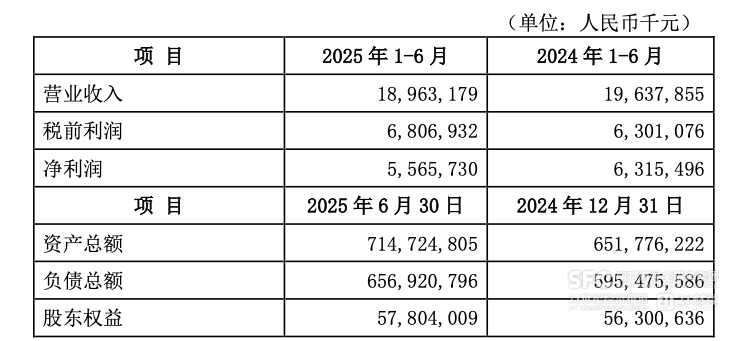
Core Insights - The total assets of WeBank have surpassed 700 billion yuan for the first time, reaching 714.725 billion yuan, a year-on-year increase of 9.66% [1] - The bank reported a decline in operating income to 18.963 billion yuan, down 3.44% year-on-year, and a net profit of 5.566 billion yuan, down 11.87% year-on-year [1] - The non-performing loan ratio increased to 1.57%, up 13 basis points from the end of the previous year, while the provision coverage ratio decreased to 292.86%, down approximately 100 basis points [1] Financial Performance - Total assets reached 714.725 billion yuan, a 9.66% increase from 651.776 billion yuan at the end of the previous year [1] - Operating income decreased to 18.963 billion yuan, a decline of 3.44% year-on-year [1] - Net profit was reported at 5.566 billion yuan, reflecting an 11.87% decrease year-on-year [1] - Tax pre-profit increased by 8.03% to 6.807 billion yuan [1] Asset Quality - The non-performing loan ratio stands at 1.57%, an increase of 13 basis points from the previous year [1] - Provision coverage ratio is at 292.86%, down approximately 100 basis points from the previous year [1] - The core Tier 1 capital adequacy ratio is reported at 11.81% [1] Management Changes - Li Nanqing has taken on the additional role of Chief Compliance Officer, while other senior management positions remain unchanged [2] - The appointment aligns with the new compliance management regulations allowing the bank president to also serve as Chief Compliance Officer [2] Business Developments - WeBank's consumer loan balance is reported at 202.775 billion yuan, a decrease of 5.53% year-on-year [3] - The implementation of a new fiscal subsidy scheme for consumer loans may positively impact WeBank's consumer loan business [3] - WeBank is frequently listed among the internet loan business partners of various banks, indicating its strong market presence [3][4] Partnership and Collaboration - WeBank has established partnerships with several regional banks and foreign banks for internet loan cooperation [4] - The bank's loan platform fee income has decreased by 14.31% year-on-year, indicating challenges in the joint loan business due to regulatory changes [5] - The bank maintains a stable scale of joint loans, with over 60 financial institutions collaborating [5]

微众银行资产破7000亿 行长兼任首席合规官
2 1 Shi Ji Jing Ji Bao Dao· 2025-10-12 00:32
Core Viewpoint - WeBank's total assets have surpassed 700 billion yuan for the first time, indicating growth despite declines in revenue and net profit [1][3]. Financial Performance - Total assets reached 714.73 billion yuan, a 9.66% increase from 651.78 billion yuan at the end of the previous year [1][2]. - Operating income for the first half of 2025 was 18.96 billion yuan, down 3.44% year-on-year [1][2]. - Net profit for the same period was 5.57 billion yuan, a decrease of 11.87% compared to 6.32 billion yuan in the previous year [1][2]. - Pre-tax profit increased by 8.03% to 6.81 billion yuan [1][2]. Asset Quality - The non-performing loan (NPL) ratio stood at 1.57%, an increase of 13 basis points from the end of the previous year [1][3]. - The provision coverage ratio decreased to 292.86%, down approximately 10 percentage points from the previous year [1][3]. - The core Tier 1 capital adequacy ratio was reported at 11.81% [1]. Management Changes - WeBank's president, Li Nanqing, has taken on the additional role of Chief Compliance Officer, reflecting regulatory changes allowing such dual roles [3]. Consumer Loan Business - The balance of consumer loans, particularly the "Weilidai" product, was 202.78 billion yuan, down 5.53% year-on-year [3]. - WeBank is the only private bank included in a new fiscal subsidy scheme for consumer loans, which may positively impact its consumer loan business [3]. Internet Loan Partnerships - WeBank has been actively collaborating with various banks for internet loan services, with a focus on regional banks and some foreign banks [4][5]. - The bank's loan platform fee income decreased by 14.31% year-on-year, indicating challenges in the joint loan business due to regulatory changes [5][6]. - The joint loan model is characterized by shared funding, risk-sharing, and independent approval processes, with over 60 financial institutions involved [6].
新规倒计时!银行“圈定”合作白名单,这类助贷机构入围
Sou Hu Cai Jing· 2025-09-17 19:20
Core Viewpoint - The new regulations for internet lending will take effect on October 1, leading to significant changes in the business models of commercial banks regarding internet loans, with a focus on compliance and risk management [1][4]. Group 1: Regulatory Changes - The Financial Regulatory Bureau issued the "Notice on Strengthening the Management of Commercial Banks' Internet Lending Business" on April 1, which will be implemented on October 1 [2]. - Banks are required to manage their internet lending partnerships through a whitelist system, ensuring that only approved institutions are involved in lending activities [4]. Group 2: Bank Responses - Several banks, including Huishang Bank and East Asia Bank, have released their lists of approved lending partners, indicating a proactive approach to comply with the new regulations [2][3]. - Huishang Bank announced 29 partner institutions for internet lending, covering various collaboration types such as marketing, loan issuance, and risk sharing [2]. Group 3: Market Dynamics - Major internet platforms and leading private banks are becoming the preferred partners for commercial banks, with many institutions from the Ant Group, JD Group, and Tencent Group included in the lists [3]. - The new regulations are expected to elevate the operational standards of lending institutions, pushing them towards more transparent and compliant practices [3][4]. Group 4: Operational Implications - The regulations emphasize the need for banks to adopt a centralized management approach, ensuring that risk management is integrated into all aspects of internet lending [4]. - Banks must enhance their risk assessment capabilities and move away from relying solely on external partners for customer acquisition and loan distribution [5]. Group 5: Future Outlook - Smaller banks may face challenges in adapting to the new regulations due to their limited capabilities in risk management and customer acquisition compared to larger, more established platforms [5]. - Experts suggest that banks should strengthen their compliance frameworks and establish rigorous processes for managing lending partnerships to ensure sustainable growth in the internet lending sector [5].

新规倒计时!银行“圈定”合作白名单 这类助贷机构入围
Guo Ji Jin Rong Bao· 2025-09-17 14:58
Core Viewpoint - The new regulations for internet lending will take effect on October 1, leading to significant changes in the business models of commercial banks regarding internet loans [1][2][4]. Group 1: Regulatory Changes - The Financial Regulatory Bureau issued the "Notice on Strengthening the Management of Commercial Banks' Internet Lending Business" on April 1, which will be implemented on October 1 [2]. - Banks are required to manage their internet lending partnerships through a whitelist system, ensuring compliance and enhancing the quality of lending services [3][4]. Group 2: Bank Responses - Several banks, including Huishang Bank and East Asia Bank, have released their lists of approved lending partners, indicating a shift towards collaboration with major internet platforms and licensed financial institutions [2][3]. - Huishang Bank announced 29 partner institutions for internet lending, including Ant Group and WeBank, covering various collaboration types such as marketing and risk sharing [2]. Group 3: Operational Implications - The new regulations emphasize the need for banks to adopt a centralized management approach, aligning responsibilities and risk pricing with their lending operations [4]. - Banks must conduct thorough evaluations and ongoing supervision of their lending partners, ensuring that these partners do not interfere with the banks' core risk management decisions [4]. Group 4: Market Impact - Smaller banks may face challenges in competing with larger institutions that have established internet platforms, as the new rules demand higher self-competitiveness and management capabilities [5]. - The focus on compliance and risk management may lead to a transformation in the profitability models of banks, moving away from merely pursuing scale to a more data-driven and risk-aware approach [4][5].
公布“豪华”助贷机构名单外资银行寄望消费贷
Zhong Guo Zheng Quan Bao· 2025-09-16 20:20
Core Viewpoint - The recent collaboration between foreign banks and internet loan platforms in China is driven by the need for compliance with new regulations and the desire to enhance local market penetration, particularly in consumer credit [1][3][4] Group 1: Collaboration Details - East Asia Bank (China) and several other foreign banks have disclosed their internet loan cooperation partners, including private banks, consumer finance companies, and major internet platforms [1][2] - Fubon Bank (China) has the most extensive list of partners, totaling 52 institutions, indicating a significant push towards collaboration in the internet loan sector [1][2] - The types of partners include licensed consumer finance companies, small loan companies, and large internet platforms like Alipay and UnionPay, which are crucial for expanding customer reach [2] Group 2: Regulatory Context - The upcoming implementation of the new lending regulations on October 1 is a key factor motivating foreign banks to disclose their cooperation lists, aiming to enhance compliance and consumer protection [3][4] - The new regulations emphasize centralized management, risk pricing, and strict approval processes for external partners, which foreign banks must adhere to [3] Group 3: Strategic Implications - Foreign banks are leveraging partnerships to address their shortcomings in local market knowledge, customer base, and operational experience, thereby facilitating a more effective entry into the consumer credit market [4][5] - The collaboration with local institutions is seen as a strategic move to tap into the growing consumer credit sector in China, which presents new profit opportunities [5][6] Group 4: Challenges and Recommendations - Despite the potential benefits, foreign banks face challenges related to ensuring the compliance and risk management capabilities of their partners, which is critical under the new regulations [5][6] - Industry experts recommend that foreign banks should focus on both external partnerships and internal capabilities to enhance their internet loan offerings and ensure compliance with regulatory standards [6]
新规实施倒计时!多银行披露助贷合作名单,资金“躺赢”模式不再
Bei Jing Shang Bao· 2025-09-15 13:49
Core Viewpoint - The implementation of the new regulations on internet lending by commercial banks is prompting a significant adjustment in the banking sector's approach to internet loan business, focusing on compliance and quality improvement [1][3][5]. Group 1: Regulatory Changes and Bank Responses - The new regulations, referred to as "助贷新规," require banks to manage internet lending through a centralized system, ensuring compliance and risk management [6][7]. - Several banks, including Huishang Bank and East Asia Bank, have disclosed their lists of cooperative institutions for internet lending, primarily focusing on leading private banks and licensed financial institutions [3][4]. Group 2: Characteristics of Cooperative Institutions - The cooperative institutions disclosed by banks are mainly top-tier private banks, licensed consumer finance companies, and major online platforms, indicating a trend towards "head concentration" [3][5]. - For instance, Huishang Bank's partnerships include major players like Ant Group and WeBank, covering various aspects of the lending process from marketing to risk management [4]. Group 3: Implications for Banks - The shift towards compliance-driven operations may lead to a reduction in the autonomy of branch banks, potentially affecting their operational enthusiasm [7]. - The new regulations may disproportionately impact smaller banks that lack the resources and capabilities to compete effectively in the internet lending space [7][8]. Group 4: Strategic Recommendations - Larger banks are encouraged to develop self-operated channels and create ecosystems to maintain customer acquisition and risk control [8]. - Smaller banks should focus on regional markets and leverage local partnerships to enhance their operational efficiency and compliance with the new regulations [8].


外资银行“抢滩”消费贷市场 释放何种信号?
Mei Ri Jing Ji Xin Wen· 2025-09-10 13:37
Core Viewpoint - Foreign banks in China are increasingly disclosing their internet loan cooperation partners to enhance compliance and consumer protection in the consumer loan market [1][4][5]. Group 1: Disclosure of Cooperation Partners - Youli Bank (China) announced its cooperation with Yunhan Information Technology Co., Ltd. for the JD Jingdiao loan product, which includes customer acquisition, marketing, and operational services [2]. - Other foreign banks, such as Hana Bank (China) and Standard Chartered Bank (China), have also disclosed their cooperation partners, indicating a trend among foreign banks to enhance transparency in their internet loan operations [3][4]. Group 2: Regulatory Context - The implementation of the "Personal Consumption Loan Fiscal Subsidy Policy" on September 1 has prompted banks to disclose their cooperation partners, as foreign banks are not included in the list of loan processing institutions [1][5]. - The regulatory environment has shifted, requiring banks to manage their cooperation partners more stringently and disclose this information to ensure clarity in responsibilities and risk management [4][5]. Group 3: Market Implications - The consumer loan subsidy policy is expected to stimulate demand and provide growth opportunities for banks, particularly in the consumer loan sector [5][6]. - Foreign banks are advised to adjust their strategies and deepen cooperation with local platforms to enhance their market presence and competitiveness in the consumer loan market [5][6].
平安消金更新合作机构名单,信用飞入围
Sou Hu Cai Jing· 2025-08-19 11:04
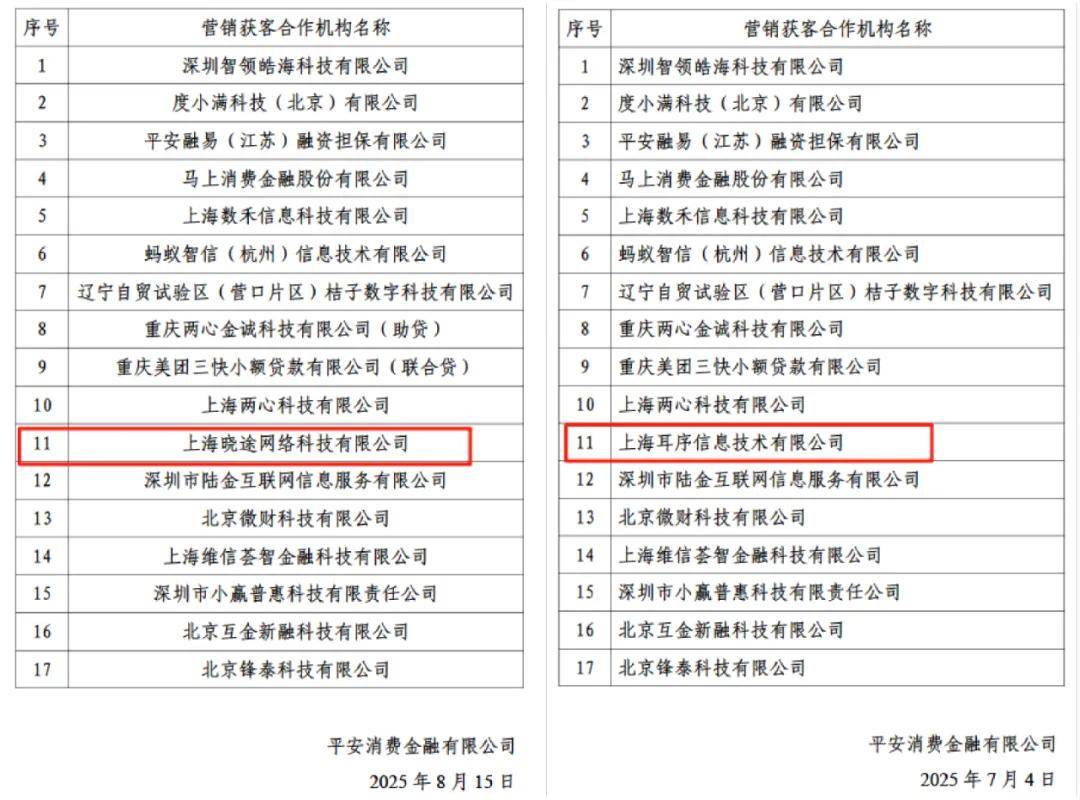
Core Insights - Ping An Consumer Finance has updated its list of partner marketing and credit enhancement service institutions, adding the well-known loan assistance platform, Xinyongfei [1] - Shanghai Xiaotu Network Technology Co., Ltd. has been added to the marketing acquisition list, while Shanghai Ersu Information Technology Co., Ltd. has been removed [1] - The marketing acquisition list highlights partnerships with Chongqing Liangxin Jincheng Technology Co., Ltd. for loan assistance and Chongqing Meituan Sankuai Small Loan Co., Ltd. for joint loans, both of which are affiliated with Meituan [1] - In the credit enhancement service institutions, Tianjin Xinfly Financing Guarantee Co., Ltd. has been added, which is a wholly-owned subsidiary of Shanghai Xiaotu [1] Marketing Acquisition Institutions - The updated list includes various institutions such as Shenzhen Zhiling Haohai Technology Co., Ltd., Du Xiaoman Technology (Beijing) Co., Ltd., and others [2] - Notable additions and removals include Shanghai Xiaotu Network Technology Co., Ltd. being added and Shanghai Ersu Information Technology Co., Ltd. being removed from the list [1][2] Credit Enhancement Service Institutions - The updated list of credit enhancement service institutions includes Tianjin Xinfly Financing Guarantee Co., Ltd. as a new addition [1][3] - Other institutions in the list include Ping An Rongyi (Jiangsu) Financing Guarantee Co., Ltd. and Shenzhen Zhongzhi Credit Financing Guarantee Co., Ltd. [3] Regulatory Context - The update aligns with the guidelines issued by the National Financial Regulatory Administration in April, which mandates that commercial banks manage platform operators and credit enhancement service institutions through a list system [4] - The regulation emphasizes that banks should not engage in cooperation with institutions outside the approved list for internet loan assistance business [4]
“双面”中邮消金,增长背后隐忧待解
Bei Jing Shang Bao· 2025-04-20 15:15
在一众消金机构净利大幅缩水的背景下,中邮消费金融的逆势增长颇受关注。然而,快速扩张的背后,也存隐忧。 曾经,持牌机构依赖助贷"躺赚",但背后也暴露出消费者权益保护的缺位,如今,各大机构纷纷加大自营业务建设,机构在业务扩张 与合规底线的博弈背后,又该如何让消费者诚心买单? 助贷隐患:担保费推高贷款成本,被指贷前未被提醒 "为什么我的还款逾期还不到三天,就被担保公司代偿?这每月多出来的担保费又是怎么回事?"近日,消费者李明(化名)向北京商 报记者谈及了他在中邮消费金融贷款时经历的问题。 李明这一笔贷款是通过中邮消费金融合作的助贷平台处申请,他向北京商报记者介绍,曾于2024年4月借款68500元,年利率4.7%, 分3期还款,放款方为中邮消费金融。 按照合同,李明的还款日为每月25日,问题则出现在第三个月。他称,在前两月已按时还款的情况下,第三个月28日凌晨,在未事先 收到任何提示的情况下,竟发现最后一期还款已由担保公司代偿。 近日,有消费者向北京商报记者反馈,通过中邮消费金融合作的助贷平台处申请,贷后才发现存在相关担保费。两家担保公司收费 后,将消费者实际年化利率由4.7%推高至19.79%,而这一切在贷款签约 ...