人工智能赋能教育

Search documents
对话市政协委员李奕:“教联体”推进将聚焦学生营养膳食及身心健康
Xin Lang Cai Jing· 2026-01-26 16:56
Group 1 - The core viewpoint emphasizes the importance of integrating resources from schools, families, and society in the construction of the "Education Alliance" (教联体) in Beijing, aiming for a collaborative educational ecosystem by 2026 [3][4]. - The "Education Alliance" initiative aims to establish a comprehensive framework for collaborative education that focuses on students' physical and mental health, including aspects like nutrition and exercise [3][4]. - The Beijing Municipal Education Commission has already initiated the "Education Alliance" construction, with a plan to implement a standardized model across all districts by 2026 [3][4]. Group 2 - The initiative will focus on specific areas such as children's nutritional meals and physical health, ensuring that schools, families, and society work together to provide balanced nutrition for students [3][4]. - There is a strong emphasis on integrating physical exercise into students' daily routines, combining school activities with family and weekend sports [4]. - The approach to artificial intelligence in education is characterized by a proactive attitude, with a focus on tailored applications for different age groups and subjects to maximize positive impacts while mitigating risks [4][5]. Group 3 - The introduction of artificial intelligence in education is a key strategic direction for Beijing, with plans to enhance educational quality and promote the development of education technology talent [4][5]. - Schools in Beijing are beginning to implement AI literacy courses, with institutions like Tsinghua University Affiliated Primary School planning to integrate AI education into their curriculum starting in the 2025 academic year [5]. - The Beijing Municipal Education Commission is leveraging AI technology to create virtual intelligent entities that provide data resources related to sports, arts education, nutrition, and health for students and parents [5].

“教联体”推进将聚焦学生营养膳食及身心健康
Bei Jing Shang Bao· 2026-01-26 16:37
Group 1 - The core viewpoint emphasizes the importance of integrating resources from schools, families, and society in the construction of the "Education Alliance" (教联体) in Beijing, aiming for a collaborative educational ecosystem by 2026 [3][4]. - The Beijing Municipal Education Commission has already initiated the "Education Alliance" construction, with a focus on establishing a collaborative educational framework that supports students' physical and mental health [3][4]. - Specific areas of focus for the "Education Alliance" include children's nutritional meals and physical health, with schools, families, and society working together to ensure comprehensive support for students [3][4]. Group 2 - The approach towards artificial intelligence (AI) in education is characterized by a proactive and research-oriented attitude, with a commitment to integrating AI across all educational stages [5][6]. - The implementation of AI in education requires careful consideration of different age groups, subjects, and educational directions, necessitating tailored design plans to maximize positive impacts while mitigating negative factors [6]. - Schools in Beijing are beginning to incorporate AI literacy into their curricula, with institutions like Tsinghua University Affiliated Primary School and Luhua Middle School introducing AI courses to provide students with exposure to AI knowledge [6].

北京正探索AI赋能教育,不同学段精细化考虑!市教委详解
Bei Jing Shang Bao· 2026-01-26 14:29
Core Viewpoint - The integration of artificial intelligence in education is a key focus for Beijing, with an emphasis on the "education alliance" model that combines resources from schools, families, and society to enhance student well-being and learning outcomes [3][4][7]. Group 1: Education Alliance ("教联体") Development - Beijing is prioritizing the coordination of resources from schools, families, and society to build a comprehensive "education alliance" by 2026, aiming to create a new educational ecosystem that supports students' holistic growth [4][6]. - The recent implementation plan for the "education alliance" aims to establish a collaborative framework across all districts in Beijing, focusing on specific areas such as children's nutrition and physical health [4][6]. - The initiative includes integrating daily physical activities and promoting arts and technology skills through collaboration between schools, families, and society [6]. Group 2: Embracing Artificial Intelligence - The Beijing government is actively promoting the integration of artificial intelligence in education, with a focus on enhancing educational quality while managing the dual pressures of reducing student workload and improving teaching standards [7][9]. - A cautious approach is being adopted regarding the application of artificial intelligence across different age groups and subjects, ensuring that its implementation is tailored and beneficial [9]. - Schools in Beijing are beginning to incorporate AI literacy into their curricula, with institutions like Tsinghua University Affiliated Primary School and Luhua Middle School introducing AI courses to provide students with foundational knowledge in this area [9].
2026北京两会丨对话市政协委员李奕:“教联体”推进将聚焦学生营养膳食及身心健康
Bei Jing Shang Bao· 2026-01-26 06:49
Group 1 - The core viewpoint emphasizes the importance of integrating resources from schools, families, and society in the construction of the "Education Alliance" (教联体) in Beijing, aiming for a collaborative educational ecosystem by 2026 [1][4] - The Beijing Municipal Education Commission has already initiated the "Education Alliance" construction, with a plan to establish a collaborative education model that meets the capital's standards and characteristics across all districts by 2026 [4][5] - Specific focus areas for the "Education Alliance" include children's nutritional meals and overall health, with schools, families, and society working together to ensure students receive balanced meals and adequate physical activity [4][5] Group 2 - The Beijing government is actively promoting the integration of artificial intelligence (AI) in education, with a focus on enhancing educational quality and supporting the digital transformation of education [7] - The overall attitude towards AI in education is one of proactive engagement and research, with a need for tailored approaches based on different educational stages and subjects [7] - Initiatives include the introduction of AI literacy courses in primary and secondary schools, with institutions like Tsinghua University Affiliated Primary School and Luhua Middle School already implementing such programs [7][8]
北京优化公共服务供给 将实施稳岗扩容提质行动
Zhong Guo Xin Wen Wang· 2026-01-25 05:28
Group 1: Public Service Optimization - Beijing will optimize public service supply to address community needs, focusing on elderly and child services, including the establishment of 20 regional elderly service centers and the addition of 5,000 family elderly care beds [1][5] - The city aims to enhance the quality of education by integrating ideological education across all school levels, adding 10,000 new middle school places, and promoting the development of vocational education [1][2] Group 2: Employment and Labor Market - Beijing plans to implement actions to stabilize and expand employment, targeting the creation of at least 280,000 new urban jobs, with a focus on providing 100,000 job opportunities for college graduates [2][4] - The city will strengthen local employment services and promote the standardization of the gig economy, ensuring the rights of flexible and new employment forms [2] Group 3: Health Care Improvement - The city will optimize the layout of medical and health resources, with the completion of the Tongzhou branch of the Children's Hospital and the new site of the Municipal Center for Disease Control [4] - Initiatives will include the establishment of over five tightly-knit urban medical groups and a 90% integration rate for village clinics and township hospitals [4] Group 4: Social Security Enhancement - Beijing will enhance social security measures, including the implementation of long-term care insurance and the establishment of new elderly service centers [5] - The city aims to improve child-friendly environments and support policies for childcare, with a target of increasing the proportion of inclusive childcare services to 68% [5]
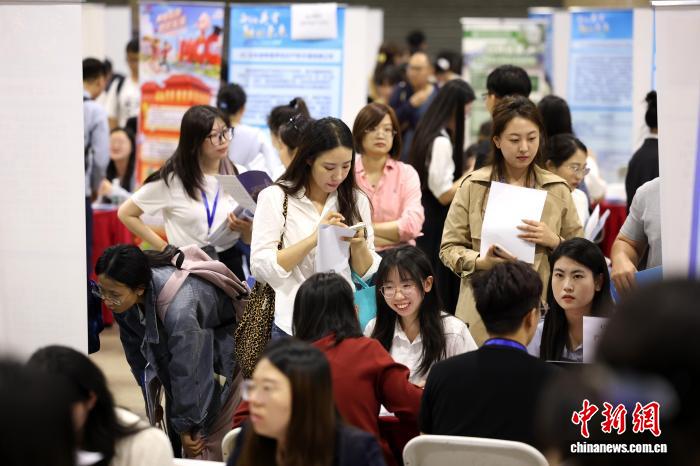
北京今年将新增中学学位1万个 促进义务教育均衡发展
Jin Rong Jie· 2026-01-25 02:45
Core Viewpoint - The Beijing Municipal Government's work report emphasizes the need to adapt to changes in school-age population and improve the dynamic guarantee mechanism for basic education enrollment, with plans to add 10,000 middle school seats by 2026 to promote quality and balanced development in compulsory education [1] Group 1: Education Policy Initiatives - The report highlights the integration of artificial intelligence across all educational stages to enhance teaching quality and efficiency [1] - There will be an expansion in the enrollment scale of vocational undergraduate institutions this year, aimed at creating pathways for students transitioning from vocational to academic education [1] - Support will be provided for the construction of "Double First-Class" universities in Beijing, promoting high-quality development in educational clusters such as Liangxiang University Town and Shahe Higher Education Park [1] Group 2: Quality Improvement Measures - The government aims to promote the balanced development of compulsory education through the implementation of the "Double Reduction" policy alongside improvements in educational quality [1] - Each institution will adopt tailored strategies to facilitate the transformation of scientific and technological achievements into practical applications [1]
智改课堂 育见新篇
Ren Min Ri Bao Hai Wai Ban· 2026-01-21 22:45
Core Insights - The articles highlight the advancements in digital education in China, showcasing the integration of technology in teaching and learning processes, particularly through platforms that facilitate resource sharing and personalized education [4][5][6]. Group 1: Digital Education Development - The "14th Five-Year Plan" period has seen China's digital education evolve from isolated applications to a comprehensive "smart education" phase, emphasizing system integration and deepening [5]. - The National Smart Education Public Service Platform has aggregated over 130,000 quality resources for primary and secondary education, 12,500 vocational education courses, and 145,000 higher education courses, serving over 178 million users across more than 200 countries [6][7]. - China's global ranking in digital education has improved from 24th in 2023 to 6th in 2025, indicating a significant leap in its digital education capabilities [6]. Group 2: Technological Integration in Education - The introduction of AI-driven systems, such as the "AI Smart Sports System," allows for precise tracking of student performance in physical education, enhancing the scientific approach to sports teaching [4]. - The platform has expanded to include early childhood and graduate education, achieving comprehensive coverage of educational services [7]. - The integration of AI in classrooms is transforming teaching methodologies, with institutions like Fudan University and Tsinghua University implementing AI across their curricula [13]. Group 3: Personalized Learning and Resource Sharing - The platform offers personalized services to cater to diverse learning needs, including resources for elderly learners and job skills training for graduates [8][9]. - The Guangdong province has established a lifelong education service network, integrating over 8,000 online courses and creating 1.53 million lifelong learning accounts [8]. - The use of data-driven decision-making in educational governance is becoming more prevalent, allowing for tailored educational experiences based on individual student needs [10][11]. Group 4: Impact on Student Outcomes - Schools utilizing digital tools have reported a 33% increase in academic performance and a 24% improvement in physical health metrics among students [12][13]. - The shift towards AI-enhanced education is expected to continue, with a focus on creating a new educational framework that meets the demands of the digital age [13].
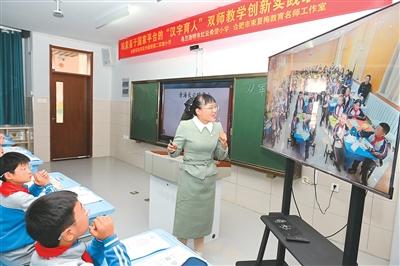
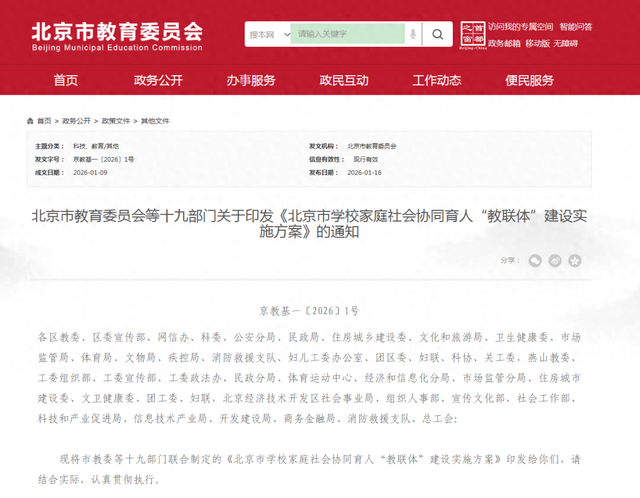
今年本市各区全面建立家校社协同育人“教联体”
Xin Lang Cai Jing· 2026-01-21 17:30
《方案》提出,将以学校为圆心、以区域为主体、以资源为纽带,整合与学生身心健康、安全管护等育 人责任有关的各类主体、各类资源,通过联责任、联资源、联空间与人工智能赋能,推动解决学生成长 中的突出问题,为其在品格涵养、文化学习、体育锻炼、艺术活动、劳动教育等方面的多元化发展需求 提供坚实支撑。 《方案》明确了三大方面14项主要任务。在汇聚社会资源,拓展育人新场域方面,《方案》提出深度依 托北京古都文化、红色文化、京味文化、创新文化特色资源,通过"双向教研""双师课堂"等方式支持博 物馆、科技馆等公共服务机构开发浸润式、体验式教育课程。推动高校博物馆、校史馆、重点实验室向 中小学生开放。 在凝聚家校共识,培育育人新生态方面,《方案》提出完善学校、年级、班级三级家长委员会体系,通 过建立学校开放日、家长接待日等常态化渠道和家长志愿者、家长讲师团等方式,引导家长参与学校管 理、支持学校建设、助力学校教育教学活动。全面落实新型"家长会、家长课、家访行"机制,帮助家长 及时了解学生在校表现。推动干部教师开展针对性家访,重点对特殊家庭、行为异常、情绪突变、学业 困难、社交障碍、生活变故六类情况做到"六必访"。每学期至少组织2 ...
北京将推动高校博物馆向中小学生开放
Bei Jing Shang Bao· 2026-01-20 04:28
Core Viewpoint - The Beijing Municipal Education Commission, along with nineteen other departments, has developed an implementation plan aimed at establishing a collaborative education framework by 2026, focusing on the holistic development of students' physical and mental health [1] Group 1: Implementation Plan - The plan aims to create a "Teaching Alliance" in all districts of Beijing that meets high standards and reflects the characteristics of the capital [1] - It emphasizes the integration of various stakeholders and resources related to student health and safety, utilizing joint responsibilities, resources, and spaces, along with artificial intelligence to address key issues in student development [1] Group 2: Educational Resources and Curriculum - The plan will leverage Beijing's cultural resources, including ancient, revolutionary, local, and innovative cultures, to support the development of immersive and experiential educational courses through public service institutions like museums and libraries [1] - It encourages the opening of university museums and key laboratories to middle and primary school students, aiming to establish a high-quality social classroom and research curriculum system [1]
新方案发布!推动高校博物馆向中小学生开放
Bei Jing Ri Bao Ke Hu Duan· 2026-01-20 00:40
Core Viewpoint - The Beijing Municipal Education Commission and nineteen other departments have jointly developed the "Implementation Plan for the Construction of School-Family-Society Collaborative Education 'Teaching Alliance'" aiming to establish a collaborative education system by 2026 that serves the comprehensive growth of students' physical and mental health [1][15]. Group 1: Objectives and Framework - By 2026, a collaborative education system will be established across all districts in Beijing, focusing on the healthy and happy growth of primary and secondary school students, integrating various resources and responsibilities related to student health and safety [16]. - The plan emphasizes the integration of responsibilities, resources, and spaces, leveraging artificial intelligence to address prominent issues in student development [16]. Group 2: Major Tasks Gathering Social Resources - The plan aims to utilize Beijing's cultural resources to support the development of immersive and experiential educational courses in public service institutions like museums and libraries [4][17]. - It promotes the opening of university museums and laboratories to primary and secondary school students, creating a high-quality social classroom and research curriculum system [5][17]. - The initiative seeks to enhance physical education by integrating sports venues and professional coaches into school activities, promoting innovative sports events that combine cultural transmission and family interaction [18]. Building Consensus Between Home and School - The plan includes optimizing the operation of parent committees and establishing regular communication channels between schools and families to enhance parental involvement in school management [19]. - It introduces a new mechanism for parent meetings and home visits, focusing on key periods such as the start of the school year and exam weeks to provide targeted support for families [20]. Advancing Intelligent Empowerment - The initiative will create a comprehensive intelligent support system for family education, providing 24/7 personalized professional assistance focused on students' health [10][22]. - It aims to develop a digital resource mapping system to connect families with nearby educational resources, facilitating easy access to educational services [10][22]. Group 3: Implementation and Support - The plan calls for strengthening organizational support by including the "Teaching Alliance" construction in the agenda of local education committees, ensuring resource allocation and policy support [23]. - It emphasizes the need for professional support through research and training in collaborative education practices, integrating these capabilities into teacher training programs [23].