
住房危机

Search documents
土地价格飙涨75%!开发商买不起地,澳洲普通人更买不起房了
Sou Hu Cai Jing· 2025-06-04 15:21
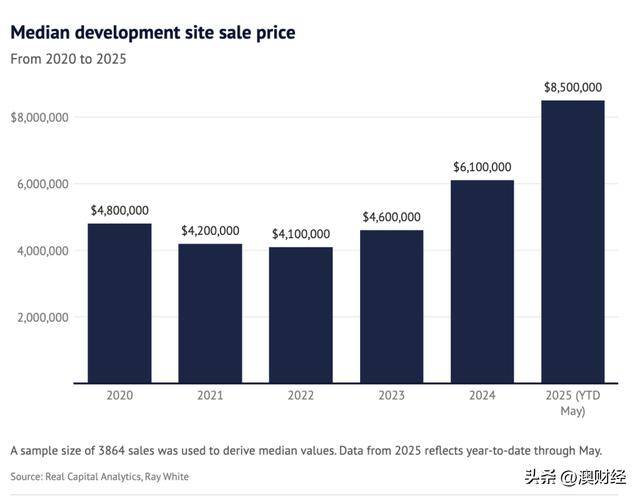
Core Insights - The price of residential development land in Australia has surged by 75% over the past five years, making homeownership increasingly unattainable for the average person [1] - Building costs remain significantly higher than pre-COVID-19 levels, exacerbating the housing affordability crisis [4] - The Australian government aims to build 1.2 million new homes in five years, but rising land and construction costs pose significant challenges [4] Land Prices and Market Dynamics - The median price of residential development land has increased from AUD 4.8 million in 2020 to AUD 8.5 million in 2023 [1] - Developers are reluctant to sell land, and banks are not aggressively pushing for asset liquidation, unlike previous economic downturns [4] - The national average land sale price reached AUD 369,500 by the end of 2023, marking an 8% year-on-year increase [10] Construction Costs and Labor Shortages - Building costs are driven up by historically high land prices and a shortage of skilled labor, with construction workers' salaries rising by 5% to 6% compared to pre-pandemic levels [9][12] - The construction industry is facing challenges due to labor being diverted to government infrastructure projects and high-profit residential renovations [9] Urban Development Challenges - Major cities like Sydney and Melbourne are experiencing severe shortages in apartment and townhouse supply, with infill development facing significant obstacles [7] - The density of cities like Melbourne is insufficient, and there is a need for reform in planning regulations to facilitate housing development in desirable areas [8] Policy Recommendations - The current stamp duty is seen as a major barrier to homeownership, with suggestions to gradually replace it with an annual land tax [12] - Potential solutions include introducing overseas skilled migrants to alleviate labor shortages, promoting modular construction to enhance efficiency, and shifting consumer preferences towards more affordable housing options [12]

澳洲住房短缺再恶化!公寓审批量暴跌,年轻人买房更难了
Sou Hu Cai Jing· 2025-05-31 06:09
Core Insights - The decline in apartment construction has exacerbated housing challenges for young Australians, who are already struggling to enter the housing market [1][3] - The "Australian Dream" of owning a home has become increasingly unattainable for those born after 1990 without financial support [3] - Residential approvals fell by 5.7% in April to 14,633 units, primarily due to a 19% drop in approvals for non-detached housing [3][6] Housing Market Dynamics - The approval rate for private sector detached homes increased by 3.1%, but this was insufficient to offset the decline in apartment approvals [3][6] - The median house price has risen over 30% since the pandemic, while rental vacancy rates remain near historical lows [6] - The construction of affordable housing suitable for first-time buyers has not kept pace with market demand, leading to a challenging situation for young Australians [6] Government and Policy Response - There are calls for federal and state governments to intervene decisively to accelerate housing construction and reduce regulatory burdens on medium-density developments [8] - The Institute of Public Affairs highlighted that new housing approvals have consistently fallen short of the targets set by the National Housing Agreement, lagging by 27% [8] - The time from approval to completion of a house has increased by 50% over the past decade, indicating inefficiencies in the housing market [11] Future Outlook - The expected net immigration of 1.3 million over the next three years will further widen the supply-demand gap in the housing market [8][9] - Critics argue that the federal government has misjudged the housing market's capacity and underestimated immigration growth, contributing to rising prices and rents [11]
温哥华楼市熄火!开发商停工,房市寒冬要来两年?
Sou Hu Cai Jing· 2025-05-13 01:30
Core Insights - The Vancouver real estate market is expected to face significant challenges over the next two years due to the disappearance of foreign capital and historically low interest rates, along with severe inventory backlogs and stalled projects [1][2][3] - The Liberal Party has announced a housing plan aiming to add 500,000 new housing units annually, with a funding commitment of CAD 25 billion and CAD 1 billion for prefabricated housing [2][3] - Experts emphasize the need for tailored housing solutions that address the unique challenges of the Greater Vancouver area, rather than broad, generalized policies [3][5] Group 1: Market Conditions - The current market downturn in Greater Vancouver is characterized by a significant increase in completed unit inventory, with many developers halting sales and marketing efforts [5][6] - The pre-sale market is projected to see a 47% decline in the first quarter of 2024, marking one of the worst quarters in market history [5][6] - Despite the inventory of approximately 4,700 new apartment units for sale, prices have not drastically dropped, as developers are willing to sell at reasonable prices [6] Group 2: Expert Opinions - Industry experts argue that the housing crisis in Vancouver has been exacerbated by decades of low interest rates and easy credit combined with foreign capital influx [3][5] - There is skepticism regarding the federal government's ability to provide affordable housing solutions, with only 35% of respondents in a recent poll expressing trust in the Liberal Party's plans [3] - The need for leadership that considers long-term economic rebuilding and attracting talent to Canada is emphasized by industry leaders [2][3]
“留学签”涨价成澳大选政治砝码,引教育界人士不满
Huan Qiu Shi Bao· 2025-04-28 22:50
Core Points - The Australian government plans to increase the visa fees for international students from AUD 1,600 to AUD 2,000, which is expected to generate AUD 760 million in revenue over the next four years [2] - The opposition party, led by Dutton, proposes a more aggressive increase, suggesting a fee of at least AUD 2,500, and AUD 5,000 for students from the Group of Eight universities [2] - The rising visa fees have sparked criticism from educational leaders, who argue that Australia already has the highest fees globally, and further increases could harm the country's reputation in international education [2] Industry Context - Australia's higher education system is highly regarded globally, with international education being a significant export for the country [1] - The housing crisis in Australia has led to public backlash against international students, with some blaming them for rising housing costs [1] - Political parties are using the issue of international student visas as a means to address domestic concerns about housing supply and affordability [1]