军事施压

Search documents
国际观察|美国航母“就位” 伊朗如何“破局”
Xin Hua She· 2026-01-27 05:01
Core Viewpoint - The situation between the United States and Iran is escalating, with the U.S. military increasing its presence in the Middle East, particularly with the deployment of the USS Abraham Lincoln aircraft carrier strike group, while Iran prepares to respond to any potential aggression [1][2]. Military Mobilization - The USS Abraham Lincoln strike group has entered the Central Command area, with expectations to be deployed to the Gulf region soon, capable of launching military operations within one to two days if ordered by the White House [1][2]. - The U.S. has additional naval assets in the Gulf, including two destroyers and three littoral combat ships, along with F-15E fighter jets deployed to enhance combat readiness [2]. - Military analysts suggest that the U.S. has various options for attacking Iran, including cruise missiles launched from surface ships and submarines, as well as air-to-ground missiles from aircraft and drones [2]. Iran's Response Strategies - Iran has declared a state of "maximum readiness" and warned that any U.S. attack would result in retaliation against U.S. military bases in the region [3]. - Iran's ballistic missile capabilities are considered advanced, with the ability to target U.S. bases across the Middle East, and it has successfully tested several missile types in recent conflicts [3][4]. Diplomatic Efforts - Iran is actively seeking international support and has engaged in discussions with various countries to emphasize the importance of regional peace and stability [5]. - The Iranian government is also focused on stabilizing domestic conditions and maintaining unity among its populace while addressing economic concerns [5]. Future Developments - Despite military escalations, the U.S. administration has indicated that diplomatic options remain on the table, with strategic concerns about potential repercussions on global energy supplies and regional stability [6]. - Experts suggest that any U.S. military action may be limited in scope, aimed at pressuring Iran to return to negotiations rather than initiating a full-scale war [6]. - Ongoing diplomatic efforts are being made to facilitate communication between the U.S. and Iran, although there are concerns about the possibility of sudden military actions during periods of apparent calm [6]. Regional and International Reactions - Regional countries and the international community have expressed opposition to foreign interference in Iran's internal affairs, advocating for dialogue to resolve tensions [7].
美国“大型舰队”正驶向伊朗周边
Huan Qiu Shi Bao· 2026-01-23 06:21
Core Viewpoint - The article discusses the U.S. military's increased presence in the Gulf region as a means to exert pressure on Iran, with President Trump confirming the deployment of a naval task force and ongoing military preparations [1]. Group 1: Military Deployment - A U.S. Navy "task force" is heading towards the Gulf region to maintain pressure on Iran [1] - The USS Abraham Lincoln aircraft carrier strike group has been ordered to move from exercises in the South China Sea to the Middle East [1] - Trump emphasized the readiness of U.S. military forces, stating, "We have a strong military presence heading towards Iran" [1] Group 2: Diplomatic Stance - Trump reiterated the U.S. willingness to engage in dialogue with Iran despite the military buildup [1] - He claimed that threats of military action have prevented the execution of 837 protesters in Iran [1] Group 3: Historical Context - The article mentions a 12-day military operation supported by the U.S. and Israel against Iran last June, aimed at weakening Iran's nuclear and ballistic missile programs [1] - Trump has indicated that the U.S. does not rule out new military actions against Iran [1]
敏感时期,美军“死神”无人机现身
Huan Qiu Wang· 2025-12-28 10:11
Group 1 - The core viewpoint of the article highlights the increasing military presence of the U.S. in the Caribbean region under the pretext of drug enforcement, with significant assets including aircraft carriers, fighter jets, transport planes, and drones being deployed near Venezuela [1] - The U.S. has conducted three interception operations against oil tankers related to Venezuela since December 10, claiming to seize the crude oil on board [1] - Venezuela has repeatedly stated that it will not yield to U.S. pressure, asserting that the U.S. actions are aimed at seizing its oil resources [1]

美军MQ-9“死神”无人机现身波多黎各
Yang Shi Xin Wen· 2025-12-28 09:57
Core Viewpoint - The U.S. military is increasing its presence in the Caribbean region under the pretext of drug enforcement, which has raised tensions with Venezuela, as the latter accuses the U.S. of attempting to seize its oil resources [1] Military Presence - The U.S. has deployed a significant military force near Venezuela, including aircraft carriers, fighter jets, transport planes, and MQ-9 "Reaper" drones, indicating a strategic buildup in the region [1] Venezuelan Response - Venezuela has repeatedly stated that it will not yield to U.S. pressure, asserting that the U.S. actions are aimed at appropriating its oil and other resources [1] Interception Actions - Since December 10, the U.S. has conducted three interception operations against oil tankers associated with Venezuela in nearby waters, claiming to have confiscated the crude oil onboard [1]
扣押油轮实施“全面彻底的封锁” 美国对委内瑞拉再施新压
Xin Lang Cai Jing· 2025-12-27 00:11
Core Viewpoint - The recent actions by the U.S. government, including the seizure of oil tankers near Venezuela, represent a new strategy to exert pressure on the Maduro regime and showcase U.S. military strength [2][5]. Group 1: U.S. Actions - The U.S. has seized oil tankers in international waters near Venezuela, with the latest seizure occurring on December 10, where the "Captain" tanker was taken and its oil cargo announced for confiscation [3]. - On December 16, President Trump ordered a comprehensive blockade of all oil tankers entering or leaving Venezuela that are under U.S. sanctions, indicating a shift to more aggressive economic measures [4]. - The U.S. Coast Guard intercepted the "Century" tanker on December 20, which was not on the sanctions list but was carrying oil from a sanctioned Venezuelan oil company [4]. - The "Bella 1" tanker was also intercepted, but it refused to cooperate with U.S. authorities, leading to ongoing pursuit efforts by the Coast Guard [4]. Group 2: Military and Economic Pressure - The Trump administration has employed multiple strategies over the past six months to undermine the Maduro regime, including military buildup in the Caribbean and accusations against vessels in the region [5][6]. - Despite the lack of significant results from previous military and economic pressures, the U.S. has escalated its efforts by implementing a full blockade of Venezuelan oil exports [6]. - The nomination of General Francis Donovan, with a special operations background, to lead the Southern Command suggests an increased focus on special operations in Latin America [7][8]. Group 3: International Response - Venezuela's National Assembly passed a law on December 23 to protect navigation and trade from what it termed "piracy" and illegal actions, with severe penalties for those involved [10]. - The United Nations Security Council held an emergency meeting at Venezuela's request, where most members called for adherence to the principles of the UN Charter and urged de-escalation of tensions [11]. - Russia condemned the U.S. actions as acts of aggression and warned that such behavior could set a precedent for U.S. actions in other Latin American countries [11]. Group 4: U.S. Rhetoric - U.S. officials have refrained from using the term "blockade," opting for "quarantine" to describe their actions against Venezuelan oil, which reflects a strategic choice in language [12]. - A U.S. official warned that unless Venezuela makes significant concessions, it could face an "economic disaster" by the end of January [13].

美国向加勒比增派特战飞机和部队
Yang Shi Xin Wen· 2025-12-23 21:07
Core Viewpoint - The United States has deployed additional special operations aircraft and troops to the Caribbean region, including at least 10 CV-22 Osprey tiltrotor aircraft, to further pressure the Venezuelan government [1] Group 1 - The deployment includes multiple special operations aircraft aimed at increasing military presence in the Caribbean [1] - The specific aircraft mentioned are CV-22 Ospreys, which are known for their versatility in various operational environments [1] - This military action is part of a broader strategy to exert pressure on the Venezuelan government [1]
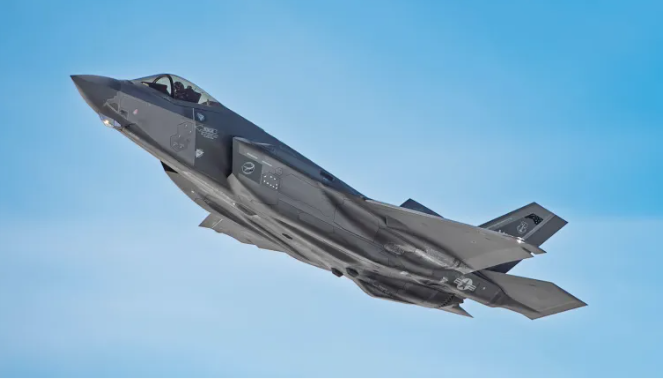
美媒:美国对委内瑞拉加紧施压之际,美军向加勒比海地区派出F-35战机
Xin Lang Cai Jing· 2025-12-21 15:31
Core Viewpoint - The article discusses the recent deployment of F-35A fighter jets by the U.S. military to the Caribbean region as part of the "Southern Sword" operation, aimed at increasing pressure on Venezuela amid accusations of U.S. military threats and expansion in Latin America [1][3]. Group 1: Military Deployment - F-35A fighter jets from the Vermont Air National Guard's 158th Fighter Wing have arrived at a base in Puerto Rico to participate in the "Southern Sword" operation [3]. - This marks the first involvement of F-35A jets in the "Southern Sword" operation, enhancing the aerial capabilities of the U.S. military in the region [3]. - The U.S. has also deployed various aircraft, including combat search and rescue planes, electronic warfare aircraft, MQ-9 Reaper drones, AC-130 gunships, and helicopters [3]. Group 2: Strategic Context - The U.S. has recently deployed multiple warships in the Caribbean Sea near Venezuela under the pretext of anti-drug operations [3]. - Venezuela has accused the U.S. of attempting to instigate regime change through military threats and expanding its military presence in Latin America [3].
美媒:特朗普批准中情局在委内瑞拉实施秘密行动
Xin Hua She· 2025-11-19 11:46
Core Viewpoint - The U.S. government, under President Trump, has approved covert CIA operations in Venezuela as part of escalating pressure on the Venezuelan government, potentially preparing for military action [1] Group 1: Covert Operations and Military Strategy - The specific nature and timing of the CIA's covert operations in Venezuela remain unclear, but they are expected to precede any military strikes [1] - The U.S. military has prepared a list of Venezuelan "drug facilities" as potential targets for strikes, indicating a strategic focus on drug-related operations [1] - Trump has expressed the possibility of direct negotiations with Venezuelan President Maduro, suggesting a dual approach of pressure and diplomacy [1] Group 2: U.S. Military Presence and Drug Enforcement - The U.S. has deployed multiple naval vessels in the Caribbean under the pretext of drug enforcement, sinking over 20 alleged drug trafficking boats since early September, resulting in over 80 deaths [2] - Reports from the U.S. Drug Enforcement Administration indicate that Venezuela is not a primary source of drugs entering the U.S., raising questions about the justification for military actions [2] - The Venezuelan government has accused the U.S. of using military threats to instigate regime change and expand its military presence in Latin America [2]
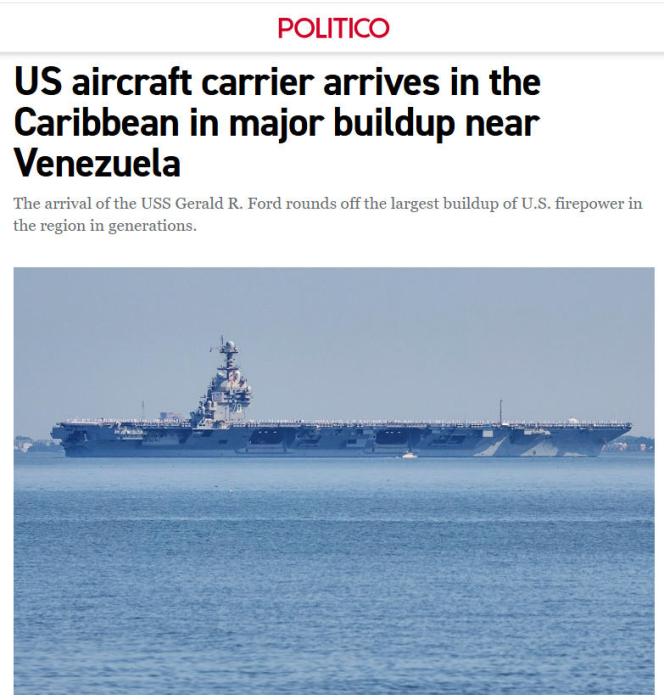
美国“福特”号航母、近12艘海军舰艇及约1.2万名水兵和海军陆战队员,在委内瑞拉附近集结
Xin Jing Bao· 2025-11-17 02:55
Group 1 - The core point of the articles highlights the significant military buildup by the United States in the Caribbean Sea, particularly with the arrival of the USS Ford aircraft carrier, which is part of a broader "anti-drug operation" aimed at increasing pressure on Venezuela [1][2] - Since early September, the U.S. has conducted 20 attacks on small drug trafficking vessels in the Caribbean and Eastern Pacific, resulting in at least 80 deaths, indicating a heightened level of military engagement in the region [1] - The U.S. Navy has assembled nearly 12 naval vessels and approximately 12,000 sailors and Marines in the area, marking a peak in military presence [1] Group 2 - The U.S. military's actions are perceived as a strategy to exert pressure on the Venezuelan government, with experts noting that the USS Ford may not be suitable for targeting drug trafficking organizations [1] - The U.S. Army Secretary has indicated readiness for potential military action against Venezuela, emphasizing ongoing training efforts in the region, including the reopening of a jungle school in Panama [1] - Despite the U.S. military's claims, reports from the Drug Enforcement Administration suggest that Venezuela is not a primary source of drugs entering the U.S., raising questions about the motivations behind the military presence [2]
美“福特”号航母抵达加勒比海 在委内瑞拉附近大规模军事集结
Zhong Guo Xin Wen Wang· 2025-11-16 23:32
Core Points - The USS Ford aircraft carrier has arrived in the Caribbean and is conducting a large-scale military buildup near Venezuela [1][5] - The U.S. Navy announced that the presence of the USS Ford and other warships marks a critical phase in what they describe as "anti-drug operations" [5] - Since early September, the U.S. has launched 20 attacks on small drug trafficking vessels in the Caribbean and Eastern Pacific, resulting in at least 80 deaths [5] - The deployment of the USS Ford has brought the total naval force in the region to nearly 12 ships and approximately 12,000 sailors and Marines [5] - This military action is also seen as a means to increase pressure on Venezuela, with the aircraft carrier serving as a deterrent against other nations [5] - Experts have noted that the USS Ford may not be suitable for targeting drug trafficking organizations [5]