
动力煤价格走势

Search documents
宝城期货动力煤早报(2026年2月5日)-20260205
Bao Cheng Qi Huo· 2026-02-05 01:07
Group 1: Report Industry Investment Rating - Not provided Group 2: Core Viewpoints of the Report - The short - term demand for thermal coal is strong, and factors such as continuous inventory reduction at northern ports and the replenishment demand of downstream terminal enterprises support a small rebound in coal prices. However, the medium - and long - term fundamentals of thermal coal still face pressure. It is expected that coal prices will operate in a narrow range at a low level before the Spring Festival, and may maintain a slightly stronger short - term trend [4] Group 3: Summary According to Relevant Catalogs Main Varieties Price Market Driving Logic - Commodity Futures Black Sector - **Variety**: Thermal coal spot - **Intraday and Medium - term View**: The reference view is "oscillation" - **Core Logic**: In the critical period of peak winter, residential electricity consumption has improved significantly. With two weeks until the Spring Festival, industrial electricity consumption has not declined. In the short term, the daily coal consumption of power plants has reached the peak of the year, and the replenishment demand of downstream power plants and other terminal enterprises still exists, supporting a small rebound in coal prices. However, in the context of the peak season in January, the price of 5500K coal at ports only increased by 11 yuan/ton throughout the month, reflecting the weakness of the current coal fundamentals and the market's bearish expectation of the subsequent coal supply - demand pattern [4]
宝城期货动力煤早报(2026年2月4日)-20260204
Bao Cheng Qi Huo· 2026-02-04 01:41
1. Industry Investment Rating - No information provided 2. Core Viewpoints of the Report - The short - term demand for thermal coal is strong, the inventory at northern ports is continuously decreasing, and downstream terminal enterprises still have restocking needs, which support the coal price to rebound slightly. However, the medium - and long - term fundamentals of thermal coal still face pressure. It is expected that the coal price will run in a narrow range at a low level before the Spring Festival, and may maintain a slightly stronger trend in the short term [4] 3. Summary by Relevant Catalogs 3.1 Time Cycle Explanation - Short - term refers to within one week, and medium - term refers to two weeks to one month [1] 3.2 Calculation of Price Fluctuation - For varieties with night trading, the starting price is the night - trading closing price; for those without night trading, it is the previous day's closing price. The daily - trading closing price is the end price to calculate the price change. A decline of more than 1% is considered weak, a decline between 0 - 1% is oscillating weakly, an increase between 0 - 1% is oscillating strongly, and an increase of more than 1% is strong. Oscillating strongly/weakly only applies to intraday views, and there is no distinction for short - term and medium - term views [2][3] 3.3 Price and Market Logic of Thermal Coal - The intraday and medium - term view of thermal coal is oscillating. The core logic is that during the critical period of peak winter power consumption, residential electricity consumption has improved significantly, and with two weeks to go before the Spring Festival, industrial electricity consumption has not declined. In the short term, the daily coal consumption of power plants has reached the peak of the year, and the restocking demand of downstream power plants and other terminal enterprises still exists, supporting the coal price to stabilize and rebound slightly. However, in the context of the peak season in January, the price of 5500K coal at ports only rose slightly by 11 yuan/ton, which also reflects the current weakness of the coal fundamentals and the market's bearish expectation of the subsequent coal supply - demand pattern [4]
基本面支撑不足,动力煤低位震荡:动力煤月报-20260130
Bao Cheng Qi Huo· 2026-01-30 01:42
Group 1: Report Industry Investment Rating - Not provided in the report Group 2: Core Views of the Report - In January, domestic thermal coal prices moved within a narrow range, showing a trend of rising first and then falling. As of January 23, the price of 5500K thermal coal at Qinhuangdao Port decreased by 9 yuan/ton month-on-month to 686 yuan/ton, and has maintained a weak and stable operation since the middle of the month [3][57]. - On the supply side, in December 2025, the national raw coal output was 437 million tons, still down 1.0% year-on-year, but the absolute output reached the highest level of the year. In the new year, some coal mines that had stopped production due to the completion of annual targets resumed production one after another, and the coal mines in the producing areas were producing steadily. In terms of imports, in December, China imported 58.6 million tons of coal and lignite, refreshing the highest monthly import volume last year, a year-on-year increase of 11.9%. The stable production of domestic coal mines and the high level of imports still put some pressure on coal prices [3][57]. - On the demand side, in December, the total social electricity consumption was 908 billion kWh, a year-on-year increase of 2.8%; the power generation of industrial enterprises above the designated size was 858.62 billion kWh, a year-on-year increase of 0.1%. In late January, affected by the cold wave, the temperature in coastal cities dropped sharply, and the daily coal consumption of power plants climbed. This winter, the overall temperature in China was relatively warm, and the heating demand in coastal cities only improved significantly in January. In addition, the profit of the non-power chemical industry was under pressure, and the enthusiasm for replenishing inventory was also limited [3][57]. - In terms of inventory, as of January 26, the total inventory of thermal coal at the nine ports in the Bohai Rim was 25.83 million tons, a month-on-month decrease of 3.944 million tons, and slightly higher than the inventory of the same period last year by 347,000 tons. As of January 22, the coal inventory of power plants in 17 inland provinces was 90.104 million tons, with 20.2 days of available coal; the coal inventory of 8 coastal provinces was 32.994 million tons, with 13.7 days of available coal [4][58]. - Overall, in the context of the lack of production capacity control policies in the coal industry, the market has a long-term loose expectation for thermal coal. Even during the peak winter season, downstream users still purchase cautiously. Considering the support during the peak season and the fact that coal prices are difficult to fall sharply under the tone of the anti-involution policy, it is expected that thermal coal prices will still move within a narrow range in February. However, as the peak winter season approaches the end after the Spring Festival, coal prices may be under pressure to weaken under the expectation of the off-season [4][58]. Group 3: Summary According to the Directory Chapter 1: Market Review 1.1 Price Review - In January, domestic thermal coal prices moved within a narrow range, showing a trend of rising first and then falling. As of January 21, the price of 5500K thermal coal at Qinhuangdao Port decreased by 14 yuan/ton month-on-month to 689 yuan/ton, and has maintained a weak and stable operation since the middle of the month. At present, the supply and demand of domestic thermal coal are both strong, but downstream users have a weak expectation of the sustainability of winter demand. Coupled with the acceptable inventory levels in the middle and lower reaches, most enterprises replenish inventory on demand based on long-term agreement coal, with a strong wait-and-see sentiment and weak speculative demand, reflecting the market's cautious expectation of the subsequent price trend. Considering the support of the peak season and the downstream's need to replenish inventory, it is expected that thermal coal prices will still move within a narrow range in February, but as the peak winter season approaches the end after the Spring Festival, coal prices may be under pressure to weaken under the expectation of the off-season [8]. - In the international market, the international mainstream thermal coal price index also moved steadily in January. As of the week of January 23, the European ARA port coal price index reported 95.88 US dollars/ton, flat month-on-month, and 23.37 US dollars lower than the price of the same period last year; the Newcastle NEWC6000 index reported 111.26 US dollars/ton, a month-on-month increase of 4.31 US dollars/ton, and 4.28 US dollars lower than the price of the same period last year; the South African Richards Bay RB index reported 85.25 US dollars/ton, flat month-on-month, and 17.25 US dollars lower than the price of the same period last year [8]. 1.2 Futures-Spot Price Difference - As of January 23, the price of the main thermal coal contract was 115.4 yuan/ton higher than the price of 5500 kcal thermal coal produced in Shanxi at Qinhuangdao Port [13]. Chapter 2: Analysis of Factors Affecting Prices 2.1 Supply Side 2.1.1 Origin Situation - In December 2025, the national raw coal output was 437 million tons, still down 1.0% year-on-year, but the absolute output reached the highest level of the year. In 2025, the cumulative national raw coal output was 4.832 billion tons, a cumulative year-on-year increase of 1.2%. High-frequency data showed that in the week of January 23, the capacity utilization rate of 462 thermal coal mines nationwide was 89.6%, and the average daily raw coal output was 5.41 million tons, a week-on-week decrease of 57,000 tons/day. In the new year, some coal mines that had stopped production due to the completion of annual targets resumed production one after another, and the coal mines in the producing areas were producing steadily. However, in February, with the arrival of the Spring Festival, some private coal mines may enter the shutdown and vacation state in advance, driving the contraction of raw coal output [16]. - In terms of provinces, in December 2025, the raw coal output in Shanxi was 113 million tons, slightly 0.7% lower than the same period last year, and the decline was 2.6 percentage points narrower than that in November; from January to December, the cumulative raw coal output in Shanxi was 1.305 billion tons, a cumulative year-on-year increase of 2.1%. In Inner Mongolia, in December 2025, the raw coal output was 121 million tons, the same as the same period last year; from January to December, the cumulative raw coal output in Inner Mongolia was 1.29 billion tons, a cumulative year-on-year decrease of 1.0%. In Shaanxi, in December 2025, the raw coal output was 74 million tons, a year-on-year increase of 5.9%, and it was the only province in the main producing areas that maintained positive growth; from January to December, the cumulative raw coal output in Shaanxi was 805 million tons, a cumulative year-on-year increase of 2.9%. In Xinjiang, in December 2025, the raw coal output was 54 million tons, a year-on-year decrease of 8.0%; from January to December, the cumulative output in Xinjiang was 553 million tons, a year-on-year increase of 1.9% [17]. - Overall, the impact of the "anti-involution" policy in the coal industry has gradually materialized, and the year-on-year decline in coal production in Shanxi and Inner Mongolia has significantly narrowed. In January, the coal mines in the main producing areas of China were producing steadily, but it is expected that in February, affected by the Spring Festival holiday, coal production will decline seasonally. At the same time, attention should be paid to whether there are new positive signals from the "anti-involution" policy [18]. 2.1.2 Import Volume - In December 2025, China imported 58.6 million tons of coal and lignite, refreshing the highest monthly import volume last year, a month-on-month increase of 33.0% and a year-on-year increase of 11.9%; from January to December, the cumulative import volume was 490.27 million tons, a year-on-year decrease of 9.6%. - High-frequency data showed that in the first two weeks of January, the arrival volume of seaborne coal in China was 13.252 million tons, equivalent to an average daily arrival volume of 1.104 million tons, a month-on-month decline compared with the average daily arrival volume of 1.317 million tons in December, but a year-on-year increase of 13.8%. The Mongolian coal imported by railway increased significantly in December last year. Only at the Ganqimaodu Port, there were 37,291 vehicle passages, a further increase of 27.5% compared with the high import volume in November. In January, the daily vehicle passage number at this port briefly dropped from about 1,500 vehicles to 1,200 vehicles, and gradually recovered in the middle of the month. Data showed that as of January 20, the total customs clearance of Mongolian coal at the Ganqimaodu Port was 19,890 vehicles, a month-on-month decrease of 24.9% and a year-on-year increase of 25.4%. According to reports from information agencies, Mongolia plans to increase its coal exports from 84 million tons in 2026 to 90 million tons, and strive to reach 100 million tons in 2027 [25][26]. 2.2 Intermediate Link Transportation 2.2.1 Datong-Qinhuangdao Railway - In December 2025, the Datong-Qinhuangdao Railway completed a freight volume of 34.43 million tons, a year-on-year decrease of 1.68%, and the average daily freight volume was 1.1106 million tons. From January to December 2025, the Datong-Qinhuangdao Railway cumulatively completed a freight volume of 390.04 million tons, a year-on-year decrease of 0.54%. From a high-frequency data perspective, as of January 22, the Datong-Qinhuangdao Railway completed a freight volume of 22.0872 million tons, a 11.5% decrease compared with December, equivalent to an average daily freight volume of 1.004 million tons [29]. 2.2.2 Ports in the Bohai Rim - iFind data showed that in December 2025, the total railway coal inflow volume of the seven major ports in the Bohai Rim (Qinhuangdao Port, Caofeidian Port, Donggang of Jingtang Port, Jingtang Port Coal Company, Huanghua Port, Huadian Caofeidian Port, and Caofeidian Phase II Port) was 46.556 million tons, a year-on-year decrease of 4.86%, equivalent to an average daily inflow of 1.5018 million tons. As of January 26, 2026, the cumulative inflow of the seven ports in the Bohai Rim was 36.241 million tons, equivalent to an average daily inflow of 1.3939 million tons [30][31]. - In terms of outflow, in December 2025, the total coal outflow of the seven major ports in the Bohai Rim was 46.009 million tons, a year-on-year decrease of 13.48%, equivalent to an average daily outflow of 1.4842 million tons. As of January 26, 2026, the cumulative outflow of the seven ports in the Bohai Rim was 38.248 million tons, equivalent to an average daily outflow of 1.471 million tons. - Since January, the coal outflow efficiency of the port group in the Bohai Rim has basically remained stable, but the inflow volume has decreased month-on-month, showing that the coal inventory in the northern port group has decreased. iFind data showed that as of January 26, the total inventory of thermal coal at the nine ports in the Bohai Rim was 25.83 million tons, a month-on-month decrease of 3.944 million tons, and slightly higher than the inventory of the same period last year by 347,000 tons. Overall, affected by multiple cold snaps, the heating demand of residents in coastal areas has improved, driving the seasonal decrease of coal inventory in northern ports to a level close to that of the same period last year. As of January 22, the coal inventory of 8 coastal provinces was 32.994 million tons, with 13.7 days of available coal. There is still a need to replenish inventory in the short term, but considering the decline in the electricity demand of the secondary industry around the Spring Festival and the gradual warming of the temperature after the festival, the wait-and-see sentiment in the spot market is still getting stronger, downstream users purchase cautiously, and the upward momentum of coal prices is limited [33]. 2.2.3 Shipping Situation - In January, the trends of the domestic and international shipping markets were somewhat differentiated, among which the international dry bulk market fluctuated within a narrow range. iFind data showed that as of January 26, the BDI index closed at 1,780 points, a month-on-month decrease of 5.2% and a year-on-year increase of 133.9%. Looking at the sub-vessel types, the freight rates of Capesize vessels declined during January, the freight rates of Panamax vessels rose significantly, and the freight rates of Supramax vessels were relatively stable. As of January 26, the Capesize (BCI) index closed at 2,626 points, a month-on-month decrease of 20.9% and a year-on-year increase of 174.1%. The Panamax (BPI) index reported 1,612 points, a month-on-month increase of 27.2% and a year-on-year increase of 112.4%. The Supramax (BSI) index reported 1,035 points, a month-on-month decrease of 9.5% and a year-on-year increase of 64.5%. - In the domestic shipping market, as of January 26, the CBCFI index closed at 679.17 points, a month-on-month increase of 12.4% and a year-on-year increase of 42.6%. Affected by the continuous cold air, the daily coal consumption of coastal power plants has entered the peak stage of the year, and the demand for replenishing inventory has been slowly released. At the same time, under extreme weather such as rain and snow, the phenomenon of port closures has increased, the supply of shipping is weak and the demand is strong, and the freight rates have certain support, and may maintain a relatively strong operation in February [36][38]. 2.3 Demand Side 2.3.1 Total Social Electricity Consumption - According to data from the National Energy Administration, the total social electricity consumption in December was 908 billion kWh, a year-on-year increase of 2.8%. In 2025, the cumulative total social electricity consumption was 1.03682 trillion kWh, a year-on-year increase of 5.0%. From the perspective of electricity consumption by industry, the electricity consumption of the primary industry was 14.94 billion kWh, a year-on-year increase of 9.9%; the electricity consumption of the secondary industry was 663.66 billion kWh, a year-on-year increase of 3.7%; the electricity consumption of the tertiary industry was 199.42 billion kWh, a year-on-year increase of 8.2%; the electricity consumption of urban and rural residents' living was 158.8 billion kWh, a year-on-year increase of 6.3%. The electricity consumption of the tertiary industry and urban and rural residents' living contributed 50% to the growth of electricity consumption. The electricity consumption growth rates of the charging and battery swapping service industry and the information transmission, software, and information technology service industry reached 48.8% and 17.0% respectively, which were important reasons for driving the growth of electricity consumption in the tertiary industry [41]. - In January, China entered a critical period for peak winter power consumption, and the coal consumption of power plants across the country entered the peak stage of the year. Data showed that as of January 22, the daily coal consumption of power plants in 17 inland provinces was 4.459 million tons, a week-on-week increase of 337,000 tons/day, the coal inventory was 90.104 million tons, with 20.2 days of available coal; the daily coal consumption of power plants in 8 coastal provinces was 2.417 million tons, a week-on-week increase of 239,000 tons, the coal inventory was 32.994 million tons, with 13.7 days of available coal. Overall, in January, the supply and demand of thermal coal were both strong, but downstream users had a weak expectation of the sustainability of winter demand. Coupled with the acceptable inventory levels in the middle and lower reaches, most enterprises replenished inventory on demand based on long-term agreement coal, with a strong wait-and-see sentiment and weak speculative demand, reflecting the market's cautious expectation of the subsequent price trend. Considering the support of the peak season and the downstream's need to replenish inventory, it is expected that thermal coal prices will still move within a narrow range in February, but
动力煤:供需趋于双弱,煤价小幅探涨
Guo Tai Jun An Qi Huo· 2026-01-29 02:23
Report Title - The report is titled "Thermal Coal: Supply and Demand Tend to Weaken, Coal Prices Rise Slightly" [1] Industry Investment Rating - Not provided Core View - The supply and demand of thermal coal tend to weaken, and coal prices rise slightly. The short - term price is expected to remain strong, and subsequent market supply - demand changes need to be closely monitored [1][3] Summary by Directory 1. Thermal Coal Fundamental Data - **产地价格**:大同南郊动力煤Q5500为568元/吨,环比涨2元/吨,同比降56元/吨;鄂尔多斯伊金霍勒旗电煤Q5500为531元/吨,环比涨2元/吨,同比降39元/吨;榆林烟煤末Q6000为595元/吨,环比涨3元/吨,同比降58元/吨 [2] - **港口价格**:秦港山西产Q5500为607元/吨,环比涨5元/吨,同比降63元/吨;秦港山西产Q5000为525元/吨,环比涨2元/吨,同比降56元/吨;秦港山西产Q4500为750元/吨,环比涨1元/吨,同比降60元/吨 [2] - **海外价格**:印尼FOB Q3800为49.5美元/吨,环比持平,同比降0.5美元/吨;澳大利亚FOB Q5500为74.6美元/吨,环比持平,同比降4.4美元/吨 [2] - **1月长协价格**:港口Q5500为684元/吨,环比降10元/吨,同比降9元/吨;山西Q5500为540元/吨,环比降8元/吨;陕西Q5500为483元/吨,环比降13元/吨;蒙西Q5500为453元/吨,环比降7元/吨 [2] 2. Macro and Industry News - **期货研究** - 1月28日港口市场价格坚挺,上游报价小幅探涨,下游询盘少、接受度不高,成交价格重心提升慢。煤矿价格上涨、港口发运倒挂、电厂日耗高位支撑上游挺价,但下游需求未明显改善,预计价格上涨空间有限。产地动力煤市场稳中偏强,部分煤矿停产致供应收紧,终端及站台刚需补库,大集团和港口价格上扬带动贸易商拉运情绪,推动价格上行 [3] - 2025年12月全国原煤产量环比增2.40%,同比降1.0%,是2025年7月以来连续第六个月同比下降,但环比连续第二个月增长。12月日均产量1410万吨,较11月减13万吨,较去年同期减5.6万吨。2025年全年累计原煤产量483178万吨,同比增1.2% [3] - 2025年12月全国进口煤炭5859.7万吨,同比增11.94%,环比增33.01%。进口煤超预期是因印尼出口关税政策调整致海外供应商“抢出口”,以及年末国内供应收紧、内贸煤价格下跌使海外煤有进口优势 [3][4] 3. Trend Intensity - The trend intensity of thermal coal (based on the spot price of thermal coal at Beigang) is 1 [5]
宝城期货动力煤早报(2026年1月27日)-20260127
Bao Cheng Qi Huo· 2026-01-27 01:32
Group 1: Report Industry Investment Rating - No relevant content Group 2: Core Viewpoints of the Report - The coal industry has a long - term expectation of a loose supply of thermal coal without capacity control policies. Even during the peak winter season, downstream users are cautious in purchasing. Considering the support during the peak season and the anti - involution policy, the thermal coal price is expected to remain in a narrow range in February [4] Group 3: Summary According to Relevant Catalogs Supply Side - In the week of January 16th, the capacity utilization rate of 462 thermal coal mines nationwide was 90.6%, with a daily average raw coal output of 5.467 million tons, returning to the level of mid - December. After entering the new year, some coal mines that had stopped production due to achieving annual targets resumed production, and the coal mines in the production areas were operating stably as the Spring Festival holiday had not yet arrived [4] - In the first two weeks of January, the seaborne coal arrival volume in China was 13.252 million tons, with a daily average arrival volume of 1.104 million tons. This was a month - on - month decrease compared to the daily average arrival volume of 1.317 million tons in December but a 13.8% year - on - year increase [4] Demand Side - In late January, affected by the cold wave, the temperature in coastal cities dropped sharply, and the daily coal consumption of power plants increased [4]
宝城期货动力煤早报(2026年1月23日)-20260123
Bao Cheng Qi Huo· 2026-01-23 02:17
Report Summary 1. Report's Investment Rating for the Industry - No relevant information provided. 2. Core View of the Report - The report suggests an overall "oscillating" stance for the medium - term view of the thermal coal spot market. The price increase of domestic thermal coal has narrowed this week and stabilized again. Due to warmer temperatures in coastal cities in mid - January, the demand for residential heating has declined. Although the temperature will drop significantly in late January, as of now, coal stocks at ports and downstream power plants are sufficient, resulting in a weak market atmosphere and low - level price operation [4]. 3. Summary by Relevant Catalog 3.1 Price and Inventory Data - As of January 15, the FOB price of 5500K thermal coal at Qinhuangdao Port was 699 yuan/ton, a week - on - week increase of 6 yuan/ton [4]. - As of January 15, the total coal inventory at 9 ports in the Bohai Rim region was 2705.1 million tons, a week - on - week increase of 33.8 million tons, and 171.2 million tons higher than the same period in 2025 [4]. 3.2 Market Analysis - In mid - January, the temperature in coastal cities in China warmed up, with the maximum temperature in some areas of Jiangsu and Zhejiang returning above 20°C, leading to a decline in residential heating demand [4]. - As of now, coal stocks at ports and downstream power plants are sufficient, and the coal market atmosphere is weak, with prices remaining low [4]. - This week, coal mines in the main production areas maintained normal production, and non - power terminal procurement was relatively stable. However, due to the decline in power coal demand, the shipping pressure of some coal mines increased, and the atmosphere at the mine end began to weaken [4].
动力煤先强后弱震荡运行,降温能否救场?
Zhong Guo Neng Yuan Wang· 2026-01-21 11:35
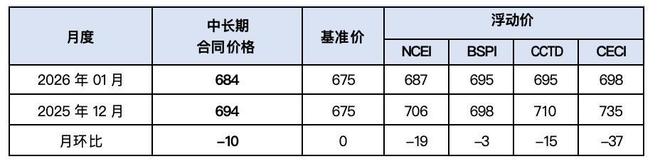
Group 1 - The core viewpoint of the article indicates that the thermal coal market is characterized by a mix of bullish and bearish factors, with overall supply stability, slow logistics, ongoing inventory reduction in intermediate links, and weak demand suppressing prices [1] - The price trend for thermal coal shows a clear divergence, with long-term contract prices declining month-on-month while spot prices have slightly increased but with narrowing gains [2][3] - The long-term contract price for 5500 kcal thermal coal is reported at 684 RMB/ton, a decrease of 10 RMB/ton from the previous month, with various floating price indicators also showing declines [2][3] Group 2 - Domestic coal supply remains stable, with major production areas continuing to resume operations, leading to a steady increase in output, while imports have become a significant supplement to supply [6][7] - In December 2025, coal imports reached 58.597 million tons, a year-on-year increase of 11.9%, marking a significant recovery and contributing to market supply during the peak winter demand season [7] - The logistics segment is under pressure, with port operation efficiency limited by adverse weather conditions, resulting in a decrease in coal outflow [10] Group 3 - Weak demand is identified as the primary factor suppressing coal prices, with reduced operating rates in downstream industries and lower demand for residential heating due to warmer temperatures [11] - The outlook for the market suggests that upcoming cold weather and increased heating demand may provide temporary support for thermal coal prices [11]

宝城期货动力煤早报-20260120
Bao Cheng Qi Huo· 2026-01-20 03:15
Report Summary 1. Report Industry Investment Rating No relevant content provided. 2. Core View The report suggests that the domestic thermal coal price rally has narrowed and stabilized again. The price of thermal coal will maintain a low - level operation due to warm winter temperatures, sufficient overall supply, weak demand, and insufficient fundamental support [5]. 3. Summary by Related Catalogs - **Price and Inventory Data** - As of January 15, the FOB price of 5500K thermal coal at Qinhuangdao Port was 699 yuan/ton, a slight weekly increase of 6 yuan/ton [5]. - As of January 15, the total coal inventory of 9 ports around the Bohai Sea was 2705.1 million tons, a weekly increase of 33.8 million tons, and 171.2 million tons higher than the same period in 2025 [5]. - **Market Driving Factors** - In mid - January, the temperature in coastal cities in China warmed up, the demand for residential heating declined, and although the temperature will drop significantly again by late January, the coal inventory at ports and downstream power plants is sufficient as of now, leading to a weak market atmosphere and low - level price operation [5]. - This week, coal mines in the main production areas maintained normal production, non - power terminal procurement was relatively stable, but due to the decline in power coal demand, the shipping pressure of some coal mines increased, and the atmosphere at the mine end began to weaken [5].
宝城期货动力煤早报-20260119
Bao Cheng Qi Huo· 2026-01-19 02:04
Report Summary 1. Report Industry Investment Rating - No information provided in the report about the industry investment rating. 2. Core View of the Report - The domestic thermal coal price rally narrowed and stabilized this week. The price is expected to remain low due to warm winter temperatures, sufficient overall supply, weak demand, and insufficient fundamental support [5]. 3. Summary by Relevant Catalog Main Variety Price Market Driving Logic - Commodity Futures Black Sector - **Reference View**: The intraday and medium - term view for thermal coal spot is "oscillation" [5]. - **Core Logic**: As of January 15, the FOB price of 5500K thermal coal at Qinhuangdao Port was 699 yuan/ton, a weekly increase of 6 yuan/ton. In mid - January, the temperature in coastal cities in China warmed up, reducing residents' heating demand. Although the temperature will drop significantly in late January, port and downstream power plant coal stocks are sufficient as of now. The coal market atmosphere is weak, and prices remain low. This week, main - producing area coal mines maintained normal production. Non - power terminal procurement was relatively stable, but due to the decline in power coal demand, some coal mines faced increased shipping pressure, and the mine - end atmosphere began to weaken. As of January 15, the total coal inventory of 9 ports in the Bohai Rim was 2705.1 million tons, a weekly increase of 33.8 million tons, and 171.2 million tons higher than the same period in 2025 [5].
宝城期货动力煤早报(2026年1月7日)-20260107
Bao Cheng Qi Huo· 2026-01-07 01:33
Report Summary 1. Report's Industry Investment Rating - Not provided 2. Core Viewpoints of the Report - The short - term, medium - term, and intraday views on thermal coal spot are all "oscillating". The short - term and medium - term core logic is that downstream demand provides support, leading to a slight increase in port coal prices. The intraday view's core logic is that the domestic thermal coal fundamentals may recover in January, driving coal prices to stabilize and rebound [1][4]. 3. Summary by Relevant Contents Price and Market Conditions - As of December 31, the FOB price of 5500K thermal coal at Qinhuangdao Port was 676 yuan/ton, a week - on - week decrease of 12 yuan, continuing to weaken after falling below 700 yuan/ton and gradually stabilizing this week [4]. Driving Factors for Price Changes - Before the New Year's Day holiday, thermal coal prices were weakening. The decline was due to high supply and unexpectedly weak demand. With the arrival of the New Year, although some suspended coal mines on the supply side will resume production, coal mines will have concentrated holidays during the Spring Festival, and downstream replenishment demand will be realized. On the demand side, the heating demand of residents in southern coastal cities will further increase in January, driving the coal consumption of power plants to reach the peak of the year [4].