
嵌入式金融

Search documents
Inbank unaudited financial results for Q3 and 9 months of 2025
Globenewswire· 2025-11-05 06:00
Core Insights - Inbank achieved a record originated volume of 204 million euros in Q3 2025, marking a 14% year-on-year increase and a consolidated net profit of 5 million euros, up 62% from the previous year [1][6] - The total net income for the first nine months of 2025 reached 63.3 million euros, reflecting a 15% increase year-on-year [6] - The company successfully completed a Tier 2 bond issue on Nasdaq Tallinn, raising 8 million euros to support future growth [3] Financial Performance - Total assets as of September 30, 2025, were 1.59 billion euros, with a loan and rental portfolio of 1.24 billion euros and customer deposits of 1.32 billion euros [5][9] - Return on equity improved to 12.5% in Q3 2025, with an average of 11.4% for the first nine months [1][5] - The cost/income ratio declined to 52.3%, indicating improved efficiency [6] Growth Drivers - The growth in originated volume was driven by high demand for green financing products in Poland, expansion of buy-now-pay-later (BNPL) sales in the Baltics, and steady growth in direct lending across all markets [6] - Green financing sales reached a record 39.3 million euros, growing 57% year-on-year, while direct lending sales increased by 48% to 35.1 million euros [6] Customer and Market Engagement - Inbank serves over 5,900 partners and has 625,000 active customers, with a total of 915,000 active customer contracts by the end of Q3 2025 [4][6] - The company is focused on expanding its embedded finance solutions to more merchants and customers across existing and new European markets [4]


Festi hf.: Financial results for Q3 2025
Globenewswire· 2025-10-30 16:24
Core Insights - Festi's Q3 2025 performance exceeded expectations, confirming operational strength and momentum across subsidiaries [2][3][7] Financial Performance - Sales of goods and services reached ISK 47,093 million, a 6.4% year-over-year increase, and a 9.1% increase when excluding currency and fuel price effects [3] - Margin from sales amounted to ISK 12,057 million, reflecting an 11.3% increase from the previous year [3] - Profit margin improved to 25.6%, up by 1.1 percentage points from Q3 2024, with a 0.5 percentage point increase when excluding currency and fuel price effects [3] - EBITDA for the quarter was ISK 5,319 million, a 12.2% increase year-over-year [3] - Profit for the quarter was ISK 2,651 million, an 18.8% increase compared to the previous year [3] - Net cash from operating activities increased by 43.5% to ISK 6,664 million [3] - Equity at the end of Q3 2025 was ISK 46,097 million, with an equity ratio of 39.2% [3] Strategic Developments - Festi raised its EBITDA guidance for 2025 by ISK 400 million, now projected between ISK 15,600 million and ISK 16,000 million [3] - ELKO launched ELKO Smart Payments, allowing customers to spread payments flexibly, and plans to introduce a digital advisor powered by AI [4][5] - Krónan opened a new flagship store and plans to expand its store network further [4] - N1 introduced fast-charging for electric vehicles, receiving positive customer feedback [4] - A new refrigerated warehouse is set to open in Q1 2026 to enhance internal efficiency [4] Market Outlook - Despite macroeconomic uncertainties, Festi's outlook remains strong, with a focus on customer service and sustainable products [6][7] - Potential challenges include the impact of recent Supreme Court rulings on interest rates and reduced fishing quotas affecting key export industries [6]

Fiserv(FI) - 2025 Q3 - Earnings Call Transcript
2025-10-29 13:02
Financial Data and Key Metrics Changes - Total adjusted revenue for Q3 grew 1% to $4.9 billion, while adjusted operating income decreased 7% to $1.8 billion, resulting in an adjusted operating margin of 37%, a decrease of 320 basis points [36] - Year-to-date adjusted revenue grew 5% to $14.9 billion, and adjusted operating income grew 5% to $5.7 billion, maintaining an adjusted operating margin of 38.2% [36] - Adjusted EPS for Q3 was $2.04, down 11% from $2.30 in the prior year [36] Business Line Data and Key Metrics Changes - Merchant Solutions segment organic revenue growth was 5% for the quarter and 7% year-to-date, with adjusted revenue growth also at 5% [38] - Financial Solutions segment organic revenue declined 3% in Q3 but grew 3% year-to-date, impacted by lower periodic license revenue [42][44] - Clover revenue grew 26% in Q3, with GPV growth of 8% reported, and 11% excluding the 2023-2024 gateway conversion [39][17] Market Data and Key Metrics Changes - Argentina contributed over 5 percentage points to the company's 12% organic growth rate in 2023 and roughly 10 percentage points to the 16% organic growth in 2024 [9] - The organic growth rate in Argentina was 56% year-to-date, adding approximately 2 percentage points to the overall organic growth rate of just over 5% [9] Company Strategy and Development Direction - The company is shifting its strategic focus to prioritize sustainable, client-focused opportunities, which may negatively impact near-term results but is expected to position the company for predictable growth [4][6] - The "One Fiserv" action plan includes investments in client-first operations, enhancing Clover as a small business operating platform, and leveraging AI for operational excellence [22][24] - The company aims to return to consistent mid-single-digit revenue growth with potential for acceleration over time, targeting double-digit adjusted EPS growth starting in 2027 [33] Management's Comments on Operating Environment and Future Outlook - Management acknowledged that recent performance issues were largely self-inflicted and are being addressed through investment and operational improvements [14][53] - The company is confident in its ability to generate free cash flow and maintain a disciplined capital allocation strategy, which supports long-term growth [54] - Management emphasized the importance of aligning structural growth with sustainable revenues and expenses, moving away from short-term initiatives [14][13] Other Important Information - The company announced several leadership changes, including new Co-Presidents and a new CFO, to drive the strategic initiatives forward [27][28] - Three acquisitions were made during the quarter to enhance client service and expand into new markets, including the acquisition of Smith Consulting Group [46] Q&A Session Summary Question: How long was Fiserv over earning with deferred investments and short-term initiatives? - Management indicated that the analysis revealed a need for recalibration and that the company is focused on addressing self-inflicted issues to return to double-digit EPS growth [50][52] Question: What changed specifically in the Financial Solutions segment? - Management noted that the segment experienced a decline due to lower periodic license revenue and emphasized the strength of the issuing business and ongoing investments to improve performance [57][68] Question: Is Clover's 10% revenue growth a decent proxy for next year? - Management expressed confidence in Clover's growth trajectory and highlighted ongoing investments to enhance competitive positioning across Merchant Solutions [73]

2025年上半年金融科技动向报告:全球金融科技融资分析(英文版)-毕马威
Sou Hu Cai Jing· 2025-08-27 09:56
Global Insights - The global fintech market attracted $44.7 billion in investment during H1 2025, marking the lowest six-month period since H1 2020, with a significant decline from $54.2 billion in H2 2024 [21][8] - Q2 2025 saw particularly low investment levels, with only $18.7 billion across 972 deals, the lowest deal volume since Q3 2017 [21][8] - The decline in investment is attributed to geopolitical tensions and changing trade policies, leading to a more cautious approach from investors [7][21] Regional Insights - The Americas accounted for over half of the global fintech investment in H1 2025, totaling $26.7 billion, driven by significant deals such as the $2.6 billion acquisition of Next Insurance and a $2 billion raise by Binance [22][9] - EMEA followed with $13.7 billion, including the largest deal of the year, a $3.2 billion acquisition of Preqin by BlackRock [22][9] - The ASPAC region lagged with only $4.3 billion, highlighted by the $571.3 million acquisition of WealthNavi [22][9] Sector Insights - Digital assets and currencies led the investment with $8.4 billion, positioning the sector for a potential three-year high, while AI-focused fintech attracted $7.2 billion [10][23] - The payments sector experienced a significant drop, with only $4.6 billion in investment compared to $30.8 billion in 2024, indicating a lack of large megadeals [26][10] - Insurtech saw a surge in investment, totaling $4.8 billion, surpassing the entire investment for 2024 [66][68] Future Trends - Investors are expected to remain cautious in H2 2025, focusing on sectors like digital assets, AI, and embedded finance as potential hotspots [2][34] - The regulatory landscape, particularly around stablecoins and digital assets, is anticipated to evolve, potentially driving further investment [35][34] - Continued interest in AI solutions for cost reduction and efficiency improvements is expected to shape investment strategies moving forward [27][34]

拆解助贷“六小强”二季报
Bei Jing Shang Bao· 2025-08-25 16:19
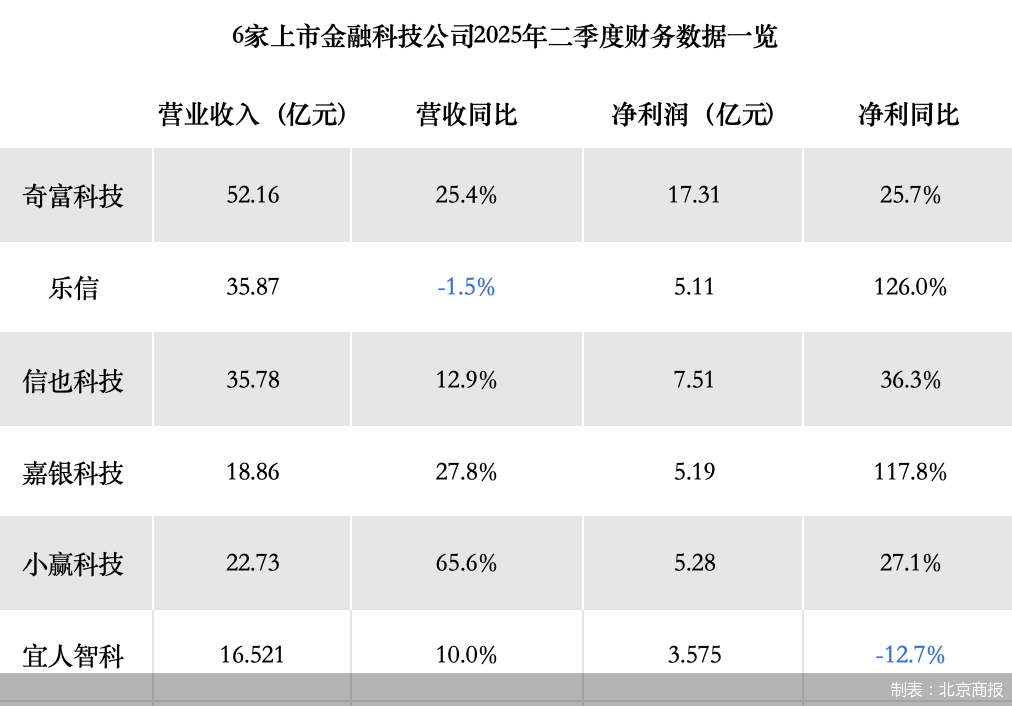
Core Insights - The financial technology companies have reported strong performance in Q2 2025, with a total profit of 4.4 billion yuan among six listed firms, indicating overall growth despite industry differentiation [1][4] - Most companies experienced year-on-year increases in both revenue and net profit, with notable performances from Qifu Technology and Xinye Technology [4][5] Revenue and Profit Growth - Qifu Technology led with revenues of 5.216 billion yuan and a net profit of 1.731 billion yuan, both showing significant year-on-year growth of 25.4% and 25.7% respectively [4] - Xinye Technology reported revenues of 3.578 billion yuan, up 12.9%, and a net profit of 751 million yuan, up 36.3% [4] - Xiaoying Technology saw a revenue increase of 65.6% to 2.273 billion yuan and a net profit rise of 27.1% to 528 million yuan [4] - Le Xin and Jia Yin Technology both exceeded 500 million yuan in net profit, with Jia Yin's revenue at 1.886 billion yuan, up 27.76%, and Le Xin's total revenue at 3.587 billion yuan, despite a slight decline of 1.5% [4] - Yiren Zhike's total net income was 1.6521 billion yuan, a 10% increase, but net profit saw a year-on-year decline [4] Loan Scale Expansion - The growth in revenue for many companies is attributed to the expansion of loan scales, driven by strong borrower demand and increased marketing efforts [7] - Yiren Zhike's financial services revenue grew by 75% to 1.4896 billion yuan, primarily due to sustained demand for small revolving loan products [7] - Le Xin's revenue from loan facilitation and services decreased due to changes in the credit sector, with a reported income of 1.131 billion yuan, down from 1.433 billion yuan in the previous year [7] AI and Risk Control - The financial technology sector is increasingly investing in AI for enhanced risk control and operational efficiency, with companies like Xinye Technology and Le Xin making significant advancements [9][10] - Xinye Technology's R&D expenditure reached 130 million yuan, focusing on improving fraud detection systems with a 98.8% accuracy rate [9] - Companies are utilizing AI to optimize the entire loan service chain, from user profiling to post-loan management, significantly improving repayment efficiency [10] Regulatory Environment - New regulations for internet lending are set to be implemented in October, aiming to standardize practices across the industry and potentially favoring larger, compliant platforms [11] - The regulations are expected to accelerate industry consolidation and enhance the competitive edge of platforms with strong compliance and technological capabilities [11]
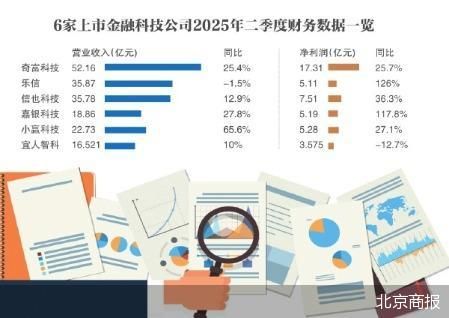
拆解助贷“六小强”二季报:多数营收净利双增!合赚44亿元
Bei Jing Shang Bao· 2025-08-25 14:16
Core Viewpoint - The financial technology companies have reported strong performance in Q2 2025, with most showing growth in both revenue and net profit, although the industry remains divided in terms of performance [1][3]. Group 1: Financial Performance - Six listed financial technology companies collectively earned 4.4 billion yuan in Q2 2025, with most reporting year-on-year growth in revenue and net profit [1][3]. - Q2 revenue and net profit figures for key companies include: - Qifu Technology: Revenue of 5.216 billion yuan (up 25.4%), Net profit of 1.731 billion yuan (up 25.7%) [2][3]. - Lexin: Revenue of 3.587 billion yuan (down 1.5%), Net profit of 511 million yuan (up 126%) [2][3]. - Xinye Technology: Revenue of 3.578 billion yuan (up 12.9%), Net profit of 751 million yuan (up 36.3%) [2][3]. - Jiayin Technology: Revenue of 1.886 billion yuan (up 27.8%), Net profit of 519 million yuan (up 117.8%) [2][3]. - Xiaoying Technology: Revenue of 2.273 billion yuan (up 65.6%), Net profit of 528 million yuan (up 27.1%) [2][3]. - Yiren Technology: Revenue of 1.6521 billion yuan (up 10%), Net profit of 357.5 million yuan (down 12.7%) [2][3]. Group 2: Growth Drivers - The growth in revenue and profit is attributed to increased loan demand, improved risk control models, and deeper cooperation with funding sources [4][8]. - Qifu Technology's growth is driven by a diversified customer acquisition strategy and enhanced embedded financial channels [4][8]. - Xinye Technology's international business saw significant growth, with a transaction volume exceeding 3.2 billion yuan, up 39% year-on-year [4][8]. Group 3: Marketing and Customer Acquisition - Many companies have increased marketing expenditures to maintain growth in their core lending business, with Jiayin Technology's marketing expenses rising by 46% year-on-year [6][7]. - Lexin's e-commerce segment saw a significant increase in GMV, reaching 2.029 billion yuan, up 117% from the previous year [3][6]. Group 4: Risk Management and AI Integration - Companies are increasingly leveraging AI for risk management, with significant investments in AI technologies to enhance operational efficiency and user experience [8][9]. - Xinye Technology reported a 98.8% detection accuracy for complex AI fraud, showcasing advancements in their risk control systems [8][9]. Group 5: Regulatory Environment and Future Outlook - The upcoming "assisted lending regulations" are expected to impact the industry significantly, potentially leading to a consolidation of smaller players and benefiting larger, compliant firms [10][12]. - Analysts predict that the new regulations will accelerate industry clearing and enhance collaboration between licensed institutions and funding sources [10][12].
奇富科技(03660)2025年二季度财报:营收52亿元,环比增长11.2%
智通财经网· 2025-08-14 22:56
Core Viewpoint - Qifu Technology demonstrates strong resilience and risk management capabilities in a complex macroeconomic environment, achieving significant growth in user base and financial performance [1][2][3] Financial Performance - In Q2 2025, Qifu Technology reported revenue of RMB 52 billion, a quarter-on-quarter increase of 11.2% and a year-on-year increase of 25.4% [2][3] - The non-GAAP net profit for the same quarter was RMB 18.5 billion, with operating cash flow reaching approximately RMB 26.2 billion [2][3] - The company achieved a record high in ABS issuance, with a further decrease in comprehensive funding costs quarter-on-quarter [2] User Growth and Engagement - As of June 30, 2025, Qifu Technology served 165 financial institutions, with a registered user base of 276 million, reflecting a year-on-year growth of 11.4% [1] - The number of cumulative credit users increased to 60.2 million, up 12.3% year-on-year, while borrowing users reached 36.8 million, a 14.9% increase [1] - In Q2, the platform facilitated loans totaling RMB 84.6 billion, a year-on-year growth of 16%, with a loan balance of RMB 140.1 billion at the end of the quarter [1] Strategic Initiatives - The company has expanded its customer acquisition channels through embedded finance, linking with various internet scenarios such as short videos, e-commerce, travel, and food delivery [1] - Over half of the new credit users in the quarter came from embedded finance partners, with new credit user numbers increasing by 40% year-on-year [1] - The company plans to continue investing in AI applications within its credit service chain to enhance service quality and efficiency [2]
Priority (PRTH) FY Conference Transcript
2025-08-13 14:05
Summary of Priority Technology (PRTH) FY Conference Call Company Overview - **Company Name**: Priority Technology - **Industry**: Fintech, Payments, and Banking - **Established**: 20 years ago, celebrating its anniversary in August 2025 - **Business Segments**: - Merchant acquiring - B2B payables - Enterprise payments - **Core Services**: A comprehensive commerce engine for collecting, storing, lending, and sending money, including traditional payment methods and virtual/physical card issuance [4][5][6] Financial Performance - **Annual Payments Volume**: Approximately $140 billion [7] - **Customer Accounts**: About 1.4 million accounts with $1.6 billion in customer funds under administration [8] - **Revenue Model**: - Transaction-based revenue - 62% of adjusted gross profit from recurring revenue [10][11] - **Recent Financial Highlights**: - Q2 net revenue increased by 9% - Adjusted gross profit rose by 13% - Adjusted EBITDA grew by 9% - EPS of $0.26, up 15% year-over-year [25][26] Market Position and Growth Potential - **Total Addressable Market (TAM)**: - B2C market in the US: $6 trillion - B2B market in the US: Nearly $20 trillion, largely underpenetrated [13][15] - **Market Share**: Fifth largest non-bank merchant acquirer in the US [18][19] - **Growth Strategy**: - Focus on B2B segment and enterprise solutions - High customer growth rate of 2,500 to 3,000 new customers per month [29] - Emphasis on integrated solutions for cash flow optimization and working capital [21][22] Competitive Landscape - **Competitors**: Traditional acquirers like Fiserv, TSYS, and newer entrants like Stripe [7] - **Market Trends**: Increasing demand for integrated payment solutions across various sectors, including healthcare and construction [30][34] Risks and Challenges - **Execution Risks**: Importance of maintaining delivery and operational precision to sustain growth [35][36] - **Economic Sensitivity**: Potential impacts from economic cycles and tariff policies, though currently positioned to benefit from such conditions [47][48] Capital Allocation and M&A Strategy - **Debt Management**: Recently refinanced debt to reduce capital costs and improve liquidity [39][40] - **M&A Focus**: Targeting countercyclical segments and early-stage conversion opportunities within fintech [41][42] - **Investment Areas**: Payroll, benefits, construction technology, and property technology [45][46] Investor Insights - **Valuation Perspective**: Analysts suggest that certain business lines are undervalued, indicating potential for higher market valuation [50][51] - **Shareholder Commitment**: CEO holds over 60% of shares, indicating strong alignment with shareholder interests [52] Conclusion Priority Technology is positioned for growth within the fintech space, leveraging its diversified service offerings and strong market presence. The company is focused on executing its growth strategy while managing risks associated with economic fluctuations and operational execution.

Green Dot(GDOT) - 2025 Q2 - Earnings Call Transcript
2025-08-11 22:00
Financial Data and Key Metrics Changes - Adjusted revenue increased by 24% year-over-year, while adjusted EBITDA rose by 34%, both exceeding expectations [7][18] - Non-GAAP EPS reached $0.40 per share, representing a 60% year-over-year increase [18] Business Line Data and Key Metrics Changes - The B2B segment, which includes the BaaS channel, saw revenue growth of nearly 40%, driven by a significant BaaS partner and overall growth in the BaaS portfolio [19][20] - The Rapid Employer Services division experienced revenue declines due to decreased active accounts and volumes, particularly in the staffing industry [21] - The Money Movement segment's tax processing business outperformed expectations, while the money processing business saw a modest decline in revenue due to an 8% decrease in transactions [25][26] Market Data and Key Metrics Changes - The retail channel remains under pressure, but revenue and active account declines are moderating, largely due to the partnership with PLS [28][29] - Active accounts in the consumer segment have stabilized, but the overall revenue in the consumer segment is projected to decline in the low double digits [36] Company Strategy and Development Direction - The company is focused on optimizing the profitability of its balance sheet while maintaining a conservative risk profile, with an emphasis on generating deposit growth [10][11] - New partnerships, such as with Samsung and Credit Sesame, are expected to drive future growth and enhance the embedded finance platform [12][18] - The company is realigning resources to support scalable long-term success, particularly in the Rapid division and earned wage access (EWA) market [17][37] Management's Comments on Operating Environment and Future Outlook - Management expressed confidence in the company's ability to capitalize on opportunities in the embedded finance market, despite challenges in certain segments [39][41] - The company anticipates continued growth in the B2B segment, with a backlog of partners to launch in the BaaS business [36][37] - Adjusted guidance for 2025 includes non-GAAP revenue expectations of $2 billion to $2.1 billion and adjusted EBITDA of $160 million to $170 million [32][33] Other Important Information - The company has made significant investments in technology infrastructure and compliance to support growth and operational stability [40][41] - A $70 million non-cash charge was recorded due to an incentive payment related to the Walmart partnership, which continues to provide strong economic returns [31] Q&A Session Summary Question: Can you talk about the journey of leveraging the bank and balance sheet to improve profitability? - Management indicated they are in the early stages of repositioning the portfolio and will continue to make adjustments throughout the year [43][44] Question: Any update on the strategic review of alternatives? - The strategic review is ongoing, with no significant updates available at this time [48][49] Question: Can you provide more detail on the shift towards earned wage access? - The company is focusing its sales resources on EWA, targeting a different buyer and leveraging existing sales expertise [52][54] Question: Can you elaborate on the competitive takeaway with Credit Sesame? - The sales cycle for the Credit Sesame partnership was typical, around six months to a year, with the ARC platform's capabilities being a key factor in winning the deal [58][60]

Inbank unaudited financial results for Q2 and 6 months of 2025
Globenewswire· 2025-08-05 05:00
Core Insights - Inbank achieved record sales in Q2 2025 with an originated volume of 196 million euros, a 15% increase year-on-year, while net profit for the quarter was 3.6 million euros, down 6% year-on-year [1][6] - The company reported a consolidated net profit of 8.1 million euros for the first half of 2025, representing a 5% increase compared to the same period last year [1] - Inbank's return on equity was 9.3% in Q2 and 10.8% for the first half of 2025 [1] Financial Performance - Total net income for Q2 2025 reached 20.7 million euros, an 8.4% increase year-on-year, with core activities income growing by 15.3% to 21.1 million euros [6] - Total operating expenses for Q2 amounted to 11.6 million euros, a 7.1% increase year-on-year, leading to an improved cost/income ratio of 55.9% [6] - Impairments on loans and receivables increased by 18.1% to 4.9 million euros, accounting for 1.64% of the average loan and rental portfolio [6] Market Position and Strategy - Inbank's market share in consumer lending in Estonia reached 20.3% by the end of 2024, with plans to explore new niches in the €50 billion Polish consumer finance market [2] - The company launched payment protection insurance in Latvia and Lithuania, completing its product offerings across all Baltic countries [3] - Inbank's sales in the Central and Eastern Europe (CEE) region reached a record 78 million euros in the last quarter, driven by high demand for green financing products [2][6] Key Financial Indicators - As of June 30, 2025, Inbank's total assets were 1.50 billion euros, with a loan and rental portfolio of 1.21 billion euros and customer deposits of 1.23 billion euros [4][8] - Total equity stood at 156 million euros, with a return on equity of 9.3% [4] - The number of active customer contracts reached 931,000, supported by partnerships with over 5,700 merchants [8]