工业经济

Search documents
今年上半年,章丘区规上工业完成总产值658.5亿元
Qi Lu Wan Bao Wang· 2025-07-29 05:22
Core Viewpoint - The industrial economy in Zhangqiao District is showing positive growth, with significant increases in industrial production, investment, and key industry performance, indicating a robust economic outlook for the region [3][4]. Industrial Performance - Zhangqiao District has a diverse industrial base, with 31 major categories and a total of 666 subcategories, making it a traditional industrial hub in Jinan [3]. - The industrial added value in the district increased by 5.1% in the first half of the year, contributing 1.9 percentage points to the GDP growth [3]. - The total output value of the industrial enterprises above designated size reached 65.85 billion yuan, ranking second in the city [3]. Investment Trends - Industrial investment in Zhangqiao District reached 6.46 billion yuan in the first half of the year, accounting for one-seventh of the city's total and showing a year-on-year growth of 11.8% [3]. - Manufacturing investment was particularly strong, totaling 4.23 billion yuan, with a year-on-year increase of 28.6%, representing 65.5% of the total industrial investment [3]. - Technological transformation investment amounted to 4.22 billion yuan, making up about 20% of the city's total and ranking first in the city [3]. Key Industries and Growth - Fourteen industries in the district achieved positive growth in the first half of the year, with notable performances in automotive manufacturing (23.704 billion yuan, up 3.44%), metal products (7.538 billion yuan, up 8.59%), and beverage and refined tea manufacturing (1.877 billion yuan, up 21.23%) [4]. - There were 39 enterprises with output growth exceeding 10%, and 12 enterprises with growth over 50%, solidifying the foundation for stable industrial growth [4]. Future Outlook - The district plans to continue exploring new growth points in the industrial economy, focusing on operational stability and expansion [4]. - Efforts will be made to support and cultivate over 40 small and micro enterprises, aiming to grow the number of billion-yuan enterprises and establish a sustainable enterprise structure [4]. - The strategy includes strengthening leading industries and optimizing industrial chains through both internal development and external attraction, fostering a collaborative industrial development model [4].

沂河新区“工业过千亿、城市更美丽”集中攻坚行动总结会议召开
Qi Lu Wan Bao Wang· 2025-07-28 05:48
Core Points - The meeting summarized the "Industrial Over 100 Billion, More Beautiful City" concentrated attack action and outlined the work for the second half of the year, aiming for high-quality development in the Yihe New District [1][2] Group 1: Economic Development - The Yihe New District has taken the lead in Linyi City this year, proposing the overall requirement of "pragmatic innovation, leading the way" to drive high-quality development [1] - Key economic indicators have shown significant improvement, achieving the set targets through collaborative efforts from various levels and departments [1] - The focus for the second half of the year includes enhancing industrial economic operations, accelerating project construction, and strengthening the entrepreneur team to boost industrial economy [2] Group 2: Urban Quality Improvement - The goal is to enhance urban quality by creating a modern new city characterized by "vitality, livability, and ecology" [1][2] - Plans include building a cross-border e-commerce gathering area and expanding foreign investment channels to strengthen the open economy [2] Group 3: Innovation and Reform - Emphasis on practical innovation and collaboration among departments to enhance service and governance, fostering a competitive atmosphere [3] - The approach includes reform thinking, forward-looking strategies, and a focus on problem-solving within professional fields [3] Group 4: Recognition and Awards - The meeting recognized 10 projects with the "Ten Good Projects" honor and awarded several units and individuals for their contributions to project services and advancements [5]
山东工行:向新而行 统筹抓好传统产业转型升级和新质生产力金融服务
Qi Lu Wan Bao· 2025-06-27 11:09
Core Viewpoint - The Shandong branch of the Industrial and Commercial Bank of China (ICBC) emphasizes its commitment to supporting high-quality economic development through financial services, particularly in technology innovation and industrial economy [1][2][3][4] Group 1: Financial Performance - As of the end of May, ICBC Shandong achieved a record loan increment exceeding 100 billion yuan, marking a historical high and leading among comparable peers in the province [1] - The bank's total loan balance surpassed 1.4 trillion yuan, making it the first large state-owned commercial bank in the province to reach this milestone [1] Group 2: Support for Technology Innovation - ICBC Shandong has actively promoted technology finance, with loans to technology enterprises and strategic emerging industries exceeding 200 billion yuan, with an increment of over 40 billion yuan [2] - The growth rates for medium to long-term loans to technology enterprises and small to medium-sized technology companies reached 22.6% and 29%, respectively, both surpassing the provincial average [2] - The bank established a comprehensive "1+2+N" specialized technology finance structure, including a provincial technology finance center and 43 technology branches [2] Group 3: Service to Industrial Economy - The bank focuses on transforming and upgrading traditional industries, with manufacturing loans exceeding 300 billion yuan and medium to long-term loans surpassing 100 billion yuan, both leading among peers [3] - ICBC Shandong has introduced specialized financial products to support emerging industries, including green loans for specialized equipment purchases and manufacturing loans [3] - The bank collaborates with provincial authorities to create tailored financing solutions for advanced manufacturing and strategic emerging industry clusters [3] Group 4: Strategic Goals - ICBC Shandong aims to integrate traditional industry transformation with new quality productivity financial services, enhancing the synergy between supply and demand in financial services [4]

一季度工业企稳,但应重视私营工业企业的盈利压力、效益下滑
Sou Hu Cai Jing· 2025-05-09 11:25
Group 1 - The industrial economy in China showed a stable and positive trend in Q1 2025, with industrial enterprise profits turning from decline to growth, indicating a good start to the year [2][3] - The overall revenue of industrial enterprises above designated size reached 321,395.9 billion yuan, a year-on-year increase of 3.4%, accelerating from the previous year's growth rate of 2.1% [4][5] - Private industrial enterprises achieved the highest revenue growth at 3.5%, while state-owned enterprises experienced a decline of 0.2%, marking the lowest growth among the three types of enterprises [4][5] Group 2 - The total profit of industrial enterprises above designated size reached 15,093.6 billion yuan, a year-on-year increase of 0.8%, reversing the continuous decline since Q3 of the previous year [6][7] - Private industrial enterprises reported a profit of 3,709.7 billion yuan, down 0.3%, but the decline was significantly reduced compared to the previous months [6][7] - Foreign-invested enterprises showed the best performance with a profit of 3,883.5 billion yuan, reflecting a year-on-year increase of 2.8% [6][7] Group 3 - The debt burden of private industrial enterprises is relatively heavy, with an asset-liability ratio higher than the national average and the highest among the three types of enterprises [7][9] - Profitability indicators such as revenue profit margin and asset profit margin are the lowest for private industrial enterprises, indicating significant pressure on their profitability [9] - The asset profit margin for private industrial enterprises has been on a continuous decline, dropping from 14.2% in 2011 to 2.9% in March 2025, the lowest among the three types of enterprises [9][11]
2025年一季度万亿城市经济竞速:谁在领跑?
Sou Hu Cai Jing· 2025-04-30 15:10
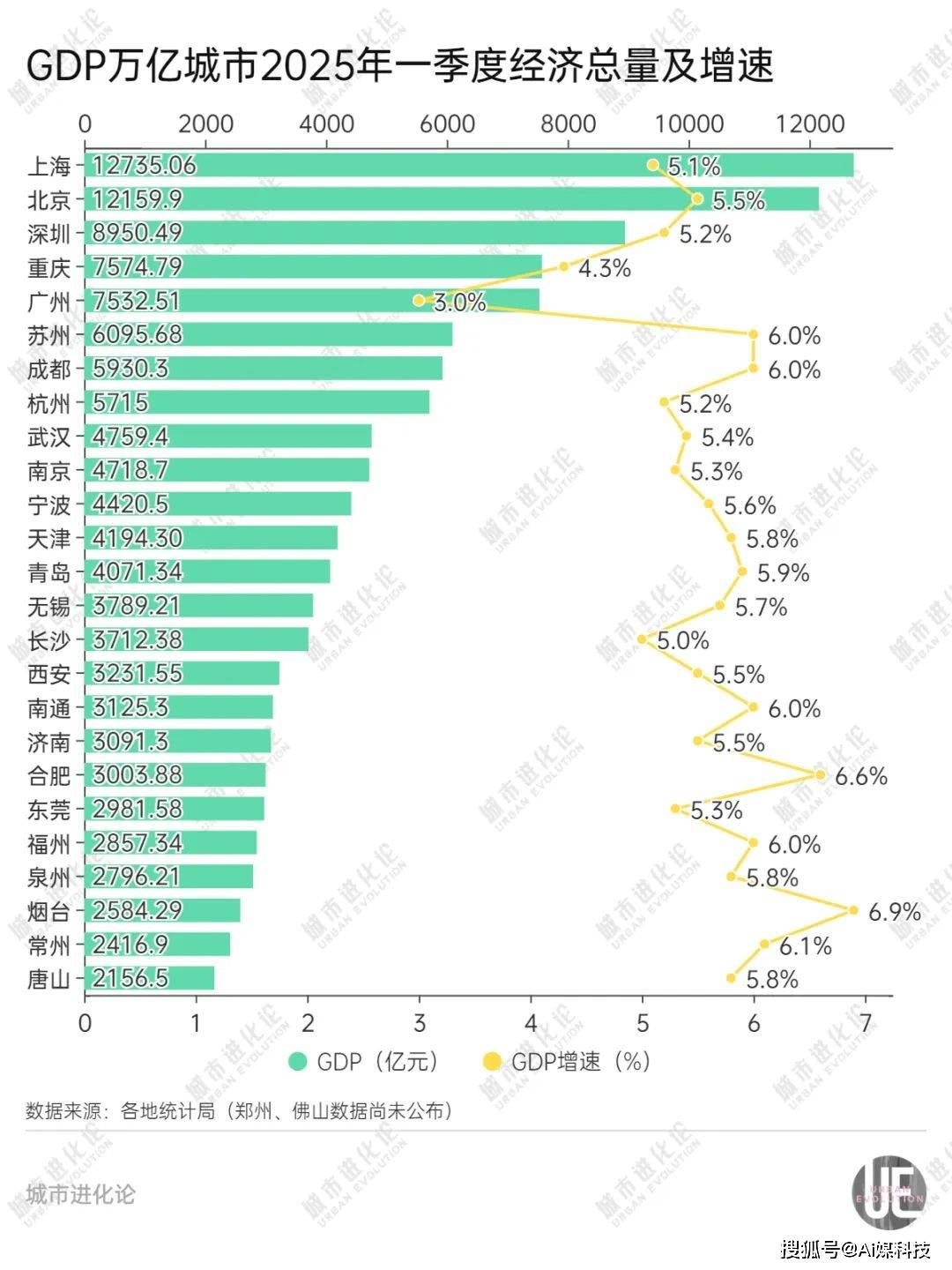
Core Insights - The competition among China's trillion-yuan cities is intensifying, with 25 out of 27 cities reporting their GDP for Q1 2025, showcasing a differentiated development pattern of "leading head, competitive waist, and sprinting tail" [1] Group 1: Economic Performance of Major Cities - Shanghai and Beijing maintain their positions in the "first tier," each surpassing 1.2 trillion yuan in GDP with growth rates of 5.8% and 5.7%, respectively, exceeding the national average of 5.4% [2] - Shenzhen is approaching the 900 billion yuan mark with a GDP of 899.2 billion yuan, driven by industrial and foreign trade, achieving an industrial growth rate of 8.2% [4] - Yantai leads the trillion-yuan cities with an impressive growth rate of 6.9%, followed by Changzhou (6.1%), Suzhou, and Chengdu (both at 6%) [4] Group 2: Industrial and Economic Drivers - The industrial sector remains a core variable in urban competition, with Hefei and Xi'an achieving industrial growth rates of 14% and 13.3%, respectively, pushing their GDPs beyond 300 billion yuan [7] - The digital economy is a key growth driver, with Hangzhou's information service industry growing by 26% and Suzhou's industrial internet platform covering over 10,000 enterprises [7] Group 3: Regional Competition and Challenges - The competition between the Yangtze River Delta and the Pearl River Delta continues to escalate, with Ningbo (5.6%) and Nanjing (5.3%) vying for positions among the top ten cities [5] - Cities with high foreign trade dependence, such as Wenzhou, face potential risks from geopolitical tensions, while cities with sluggish consumption recovery need to be cautious of "investment dependency" [8] Group 4: Future Outlook - The Q1 performance of trillion-yuan cities reflects the resilience and vitality of China's economy, indicating a shift in urban competition from "scale expansion" to "quality breakthrough" [10] - As policies to stabilize growth are intensified in Q2, the competition among cities regarding their economic capabilities is expected to become more intense [10]