
市场情绪修复

Search documents
量化择时周报:模型提示行业交易拥挤度上升,市场情绪逐渐修复-20250714
Shenwan Hongyuan Securities· 2025-07-14 08:42
Group 1 - Market sentiment indicators have improved, with the sentiment score rising from -0.9 to -0.25, indicating a shift towards a more bullish outlook [9][13][18] - The increase in industry trading congestion and the positive shift in the PCR combined with the VIX index reflect a recovery in market sentiment [13][18] - The total trading volume in the A-share market has shown a significant increase, with the highest daily trading volume reaching 1,736.61 billion RMB [18][19] Group 2 - The construction materials sector has shown a significant upward trend, with a short-term trend score increase of 21.05% [32][33] - The model indicates that small-cap growth stocks are currently favored, with a strong signal for small-cap stocks and a rapid increase in the 5-day RSI relative to the 20-day RSI [32][37] - The sectors with the strongest short-term trends include defense, media, communication, and computer industries [32][33]
量化择时周报:模型提示资金风险偏好降低,情绪进一步修复缺乏哪些关键因素?-20250518
Shenwan Hongyuan Securities· 2025-05-18 11:13
Group 1 - The market sentiment indicator has risen to 2 as of May 16, indicating a continued upward repair of market sentiment over 17 consecutive trading days since the low on April 18, with a bullish model perspective [9][3][7] - Future improvements in market sentiment require dual support from trading volume and investment themes, as the A-share market shows signs of sentiment recovery, but risk appetite has declined and industry trend scores have turned negative [12][3] - The overall trading volume in the A-share market has shown a downward trend, with total trading volume on Friday reaching 1.12 trillion RMB and daily trading volume dropping to 95.291 billion shares [14][3][12] Group 2 - The trend scores for various industries have turned negative, indicating a lack of investment themes in the current market [20][3] - The short-term trend scores for industries such as comprehensive services and transportation have significantly increased, with scores rising nearly 60% [24][3][25] - The overall market style is shifting towards large-cap stocks, although the growth style remains dominant [27][3][28]
量化择时周报:风格切换到成长后模型对红利指数的观点如何?-20250511
Shenwan Hongyuan Securities· 2025-05-11 10:15
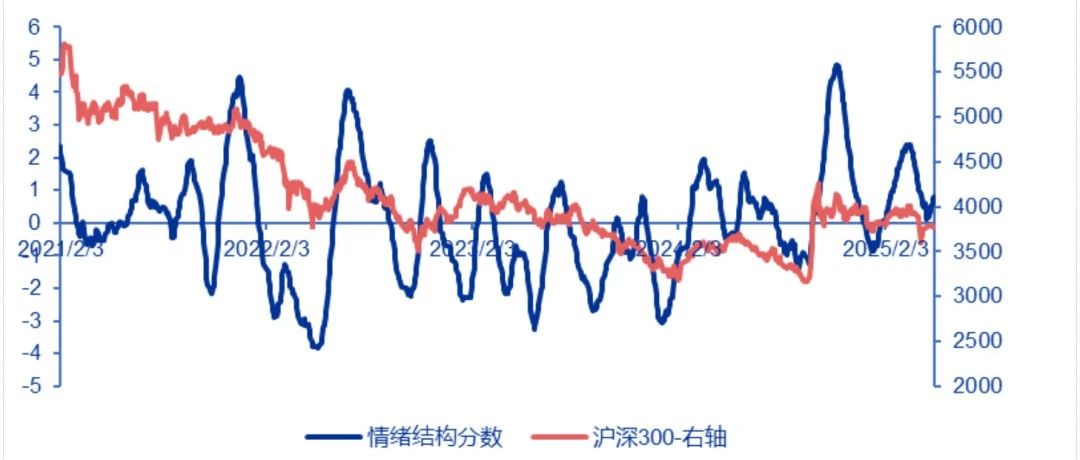
Quantitative Models and Construction Methods 1. Model Name: Market Sentiment Timing Model - **Model Construction Idea**: This model is designed to quantify market sentiment using a structured approach, incorporating multiple sub-indicators to assess the overall sentiment direction [7][8] - **Model Construction Process**: 1. Sub-indicators used include: industry trading volatility, industry trading congestion, price-volume consistency, Sci-Tech 50 trading proportion, industry trend, RSI, main buying force, PCR combined with VIX, and financing balance proportion [8] 2. Each sub-indicator is scored based on its sentiment direction and position within Bollinger Bands, with scores categorized as (-1, 0, 1) [8] 3. The final sentiment structure indicator is calculated as the 20-day moving average of the summed scores, oscillating around the zero axis within the range of [-6, 6] [8] - Formula: $ \text{Sentiment Indicator} = \text{20-day MA of (Sum of Sub-indicator Scores)} $ - **Model Evaluation**: The model effectively captures market sentiment fluctuations, with significant sentiment recovery observed since April 2024 [8][9] 2. Model Name: Moving Average Sequence Scoring (MASS) Model - **Model Construction Idea**: This model evaluates the long-term and short-term trends of indices by analyzing the relative positions of moving averages over different time horizons [20] - **Model Construction Process**: 1. For a given period \( N \) (e.g., \( N=360 \) for long-term, \( N=60 \) for short-term), calculate scores for \( N \) moving averages [20] 2. If a shorter moving average \( k \) is above the longer moving average \( k+1 \), assign a score of 1; otherwise, assign 0 [20] 3. Normalize the scores to a range of 0-100 and compute the average score for the index at a specific time point [20] 4. Calculate the 100-day and 20-day moving averages of the trend scores to generate buy/sell signals [20] - Formula: $ \text{Trend Score} = \frac{\text{Sum of Scores}}{N} \times 100 $ - **Model Evaluation**: The model provides clear signals for trend reversals, with recent results indicating a shift towards growth-oriented sectors [20][21] 3. Model Name: RSI Style Timing Model - **Model Construction Idea**: This model uses the Relative Strength Index (RSI) to evaluate the relative strength of different market styles (e.g., growth vs. value, small-cap vs. large-cap) [24] - **Model Construction Process**: 1. Calculate the net value ratio of two style indices (e.g., growth/value) over a fixed period [24] 2. Compute the RSI using the formula: $ \text{RSI} = 100 - \frac{100}{1 + \frac{\text{Average Gain}}{\text{Average Loss}}} $ - Where "Gain" represents average positive changes, and "Loss" represents average negative changes over \( N \) days [24] 3. Compare the 20-day RSI with the 60-day RSI to determine the dominant style [24] - **Model Evaluation**: The model indicates a clear shift from large-cap value to small-cap growth styles, with strong confirmation from recent RSI trends [24][27] --- Model Backtesting Results 1. Market Sentiment Timing Model - Sentiment Indicator Value: 1.5 as of May 9, 2025, indicating a positive sentiment recovery [9] 2. Moving Average Sequence Scoring (MASS) Model - Short-term signals: Positive for indices such as CSI 300, CSI A500, and ChiNext, with short-term scores ranging from 33.90 to 40.68 [36] - Long-term signals: Positive for most indices, with long-term scores exceeding 66.57 for indices like ChiNext [36] 3. RSI Style Timing Model - Growth/Value RSI: Growth-dominant with RSI values of 57.91 (short-term) and 55.24 (long-term) for the CSI Growth/Value index [27] - Small/Large Cap RSI: Small-cap dominant with RSI values of 59.84 (short-term) and 60.16 (long-term) for the Small/Large Cap index [27] --- Quantitative Factors and Construction Methods 1. Factor Name: Price-Volume Consistency - **Factor Construction Idea**: Measures the stability of market sentiment based on the alignment of price and volume movements [8] - **Factor Construction Process**: 1. Calculate the correlation between price changes and trading volume over a fixed period [8] 2. Assign scores based on the strength of the correlation, with higher scores indicating stronger consistency [8] - **Factor Evaluation**: The factor showed significant improvement in recent weeks, contributing to the overall sentiment recovery [11][16] 2. Factor Name: RSI - **Factor Construction Idea**: Reflects the relative strength of buying vs. selling pressure over a specific period [24] - **Factor Construction Process**: 1. Compute average gains and losses over \( N \) days [24] 2. Use the RSI formula to calculate the index value [24] - **Factor Evaluation**: RSI values above 50 indicate strong buying pressure, with recent results favoring growth and small-cap styles [24][27] --- Factor Backtesting Results 1. Price-Volume Consistency - Recent Score: Increased to 1 as of May 9, 2025, indicating improved alignment between price and volume [12] 2. RSI - Growth/Value RSI: Growth-dominant with short-term RSI of 57.91 [27] - Small/Large Cap RSI: Small-cap dominant with short-term RSI of 59.84 [27]

模型提示市场情绪指标进一步回升,红利板块行业观点偏多——量化择时周报20250430
申万宏源金工· 2025-05-06 04:15
Group 1 - The core viewpoint of the article indicates that market sentiment is recovering, with a model perspective leaning towards bullishness as the sentiment index rose to 0.8 as of April 30, following a continuous upward trend for eight trading days since the low on April 18 [2][3] - The A-share market continues to show signs of sentiment recovery, with notable improvements in the main buying power indicator and price-volume consistency indicator, both of which have increased scores compared to the previous week [3][4] - The model suggests that sectors such as beauty care, public utilities, banking, and oil and petrochemicals have short-term bullish signals, while most other sectors, including real estate, retail, and construction decoration, have seen significant declines in short-term scores [13][14] Group 2 - The model indicates that the overall market continues to favor large-cap and value styles, although there is a short-term strengthening trend in growth and small-cap styles [15][16] - The main funds have seen a net outflow from the Sci-Tech Innovation Board, with a cumulative net outflow exceeding 2.72 billion RMB over three trading days, indicating a shift in investment focus [8][10] - The recent trading volume for the entire A-share market was approximately 1.2 trillion RMB on Wednesday, showing stability compared to the previous week [5]

比直接抄底标普500确定性更强的策略
雪球· 2025-05-04 04:04
Core Viewpoint - The article suggests a strategy of shorting the VIX index as a more certain approach to capitalizing on market downturns, rather than directly buying into the S&P 500, especially when the latter's valuation has not fully bottomed out [2][4]. VIX Index Overview - The VIX index measures the expected volatility of the S&P 500 over the next 30 days and is often referred to as the "fear index," serving as a gauge of market sentiment [3]. - Historically, regardless of significant risk events, the VIX index tends to stabilize at an average level after spikes, indicating a potential strategy of shorting the VIX at high levels and buying back at lower levels [3][4]. Strategy Comparison - Shorting the VIX focuses on "shorting market sentiment," requiring only a return to normal market conditions for profit, which is less complex than predicting stock price movements when directly buying the index [4]. - Directly buying the index requires a low valuation entry point, but markets may not wait for a complete downturn before rebounding, leading to missed opportunities [5]. Backtesting Results - The article presents backtesting results for various shorting strategies based on VIX levels, indicating that shorting above 30 and covering below 12 yields significant returns, albeit with long holding periods that can reduce annualized returns [12][11]. - A more relaxed strategy of shorting above 30 and covering below 20 shows quicker recovery opportunities, with some trades yielding 30%-40% returns in a short time frame [13][14]. Risk and Considerations - The strategy's risks include the potential for infinite losses if the VIX spikes unexpectedly, as it is not tied to a tangible asset like stocks [22]. - Costs associated with shorting the VIX through derivatives can introduce discrepancies in expected outcomes, particularly during volatile market conditions [22]. Summary of Strategy Characteristics - The strategy is characterized by strong certainty, relying on the recovery of market sentiment over time, with the potential for significant short-term gains [23]. - It is advisable to prepare for short-term losses and to exit positions when the VIX stabilizes around 25, as holding beyond this point may not be cost-effective [23].

美股策略周报:短期不确定性下降,市场情绪修复推动估值提升-20250428
Eddid Financial· 2025-04-28 11:04
Economic Data - The US Redbook retail sales increased by 7.4% year-on-year, with a four-week moving average of 6.5%, surpassing the previous value of 6.1%, indicating robust consumer spending [7][9] - March new home sales were annualized at 724,000 units, a month-on-month increase of 7.4%, marking the highest growth rate in 11 months [7][8] - March existing home sales were annualized at 4.02 million units, with a month-on-month decrease of 5.9%, the lowest growth rate in 28 months [7][8] - Initial jobless claims for the third week of April were 222,000, in line with expectations, with a four-week moving average of 220,000, showing a downward trend [8][11] - The New York Fed's weekly economic index was 2.7, with a 13-week moving average of 2.5, indicating an overall upward trend [8] Market Sentiment - The US Economic Policy Uncertainty Index (EPU) reported 398 points, with a seven-day moving average of 418 points, significantly down from a previous high of 703 [12][13] - Retail investor sentiment showed that 55.6% were bearish on the market, while 21.9% were bullish, with a bullish-to-bearish ratio of 0.39, a decrease from the previous value of 0.45 [12][15] - The Fear and Greed Index improved from 'extreme fear' to 'fear', closing at 35 points, with notable improvements in volatility metrics [12][17] Global Market Overview - Global equity markets rose by 3.9% last week, with developed markets up 4.1% and emerging markets up 2.7%, with the US stock market leading globally [16] - Gold's upward momentum has slowed, with a weekly increase of 0.1%, while Bitcoin surged by 11.7%, making it the best-performing asset class for the week [16] Industry Performance - Among 36 secondary industries in the US stock market, 32 saw gains, with significant increases in the automotive, semiconductor, and electrical equipment sectors [19] - The software services sector had the highest estimated daily fund strength at approximately $133.5 billion, indicating strong investor interest [26] S&P 500 Valuation - As of now, 180 companies in the S&P 500 have reported Q1 2025 earnings, with overall EPS exceeding expectations by 10.0%, higher than the five-year average of 8.8% and the ten-year average of 6.9% [10] - The S&P 500 PE (TTM) stands at 24.7 times, at the 34.2 percentile, slightly above the ten-year average of 24.5 times [10] - Forward PE increased from approximately 20.0 times to 20.8 times, a rise of about 4.0%, while Forward EPS slightly decreased from $265 to $264, a decline of about 0.4% [10]


市场情绪修复,主力资金对成长板块不确定性较强——量化择时周报20250425
申万宏源金工· 2025-04-28 02:33
市场情绪自3月20日持续调整,于4月18日下降至低点,数值为0.1。本周市场情绪指标在接近0轴处开始向上反弹,回升至0.5,数值较上周五(4/18)上升0.4,模型转多,市场 情绪有所缓和。 本周A股市场提示市场情绪有一定修复,较上周明显发生变化的指标有科创50成交占比、主力买入力量和期权波动率。主力流出速率减缓和VIX指标体现的恐慌程度减弱是本 周市场情绪回升的主要原因。 科创50成交占比、行业涨跌趋势性、主力买入力量和PCR结合VIX,分别代表了市场风险偏好程度下降,市场情绪不确定性增强,主力流出速度 减缓和期权市场恐慌情绪缓和。其他指标维持和上周一致的判断。 资金当前对成长高估值板块观点不确定性较强。 自上周科创50成交占比指标快速下跌至下轨以下后,本周科创50成交占比指标仍在持续下降。本周主力资金持续从科创板块 流出,累计净流出超过32亿人民币。 投资者信心逐渐恢复,市场的活跃度和投资者参与度都有了明显提升。 除了看到主力资金本周流出科创板,主力资金本周在全A仍然呈现净流出的态势,但流出速度较上周有 所减缓,主力流出主力买入力量指标有所回升。从主力资金净流出绝对量看,主力资金本周累计净流出超过370亿 ...